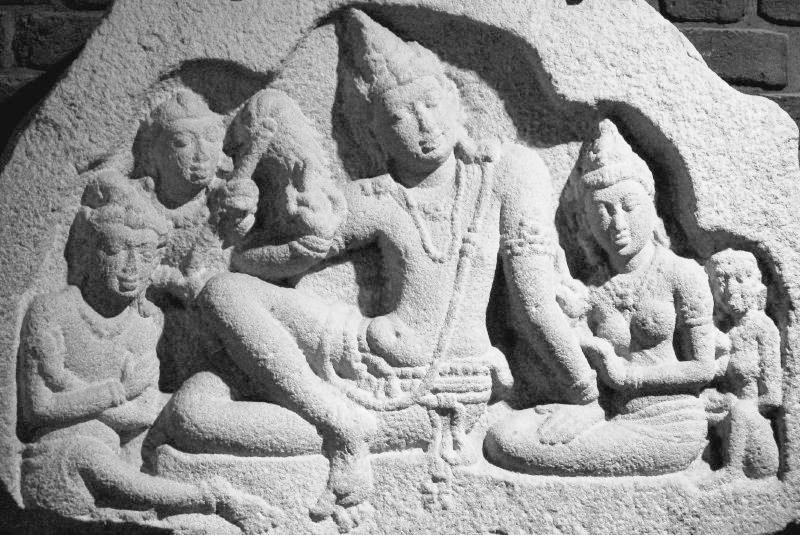
Figure 1.--This sculpture relief comes from Anuradhapura. It shows a Sri Lankan king with his family. The Anuradhapura Kingdom dominated Sri Lanka for a millenium and a half (4th century BC -11th century AD). Archeologists can not yet identify the king, but they date the frieze between (6th and 8th century AD). The Kingdom at the time wa under cont presure from Tamil invaders from southern India. We can see that the king and the queen and three children. All the family is shirtless, but the freeze is not detailed enough to tell much about clothing. Thy are also barefoot which probably reflects how they dressed in palaces.
Sri Lankan recorded history, called the Mahavamsa or “Great History” began with the arrival of the Aryan Prince Vijaya who conquered the indigenous people (543 BC). He established the first Sinhalese kingdom. The next era was the early-Anuradhapura period (about 250 BC). King Devanampiya Tissa was the first ruler in the dynasty. It was during this period that a sapling of the Lord Buddha's sacred Bo Tree reached Sri Lanka. It was under this tree that the Lord Budda attained enlightenment. Anuradhapura became a major Buddhist center. King Kasyapa is associated with the late-Anuradhapura Period (459- ). He oversaw the construction of Sigiriya. The next period was the Polonnaruwa. The capital was moved from Anuradhapura to Polonnaruwa (1073). Three kingdomes became established. The Portugues and the Dutch which followed them defeated the coastal kingdomes, but were unable to successfully penetrate the inland kingdom of Kandy. The spices of the island were a powerful attraction. The British seized the island from the Dutch after the outbreak of the French Revolutuon (1796). It was the British who finally defeated Kandy. The British developed plantations, but Sinhalese resisted wirking on the plantations. The British imported more compliant workers from south India. Many Sinhalese peasants were unable to compete with the plantatioins and lost their land. The indpendence movement grew in strength following World war I. Brirain granted indeoendence as a dominion within the Commonwealth (1948).
Pre-History
We do not yet have much information on Sri Lankan pre-history. The early pre-history has not yet been well worked out. Some researchers believe tha early homonoids (Homo erectus) reached sri Lanka. The chronology is widely debated (300,000 - 500,000 BP). The most ancient people are believed to be the ancestors of the Veddas, a surviving aboriginal people who can still be found in jungle areas near Maduru Oya National Park. They may have been part of the first migration of modern humans out of Africa east along the Asian coast. There are other related residual populations in South Asia, including the Andaman Islands and Australian aborignes. This is possible because of varying ocean levels which mean at several times the island may have been connected with the Indian mainland. And there even connections relatively recetly. Rama's Bridge ( Rama Setu ), also known as Adam's Bridge, was a chain of limestone shoals which connected India and Srilanka until 1480. There is substantial evidence of prehistoric settlements in Sri Lanka (by about 125,000 BP). Substantial archeological evidence shows that human habitation began (about 30,000-35,000 BC). Some sources argue for a somewhat earlier date. There is evidence of agriculture (about 8,500 BC).
Early History
Sri Lankan recorded history, called the Mahavamsa or 'Great History' began with the arrival of the Aryan Prince Vijaya of India who conquered the indigenous people (543 BC). He established the first Sinhalese kingdom. The Sinhalese originated in northern India, The Ramayana, the ancient Hindu epic, appears to describe the conquest. The Sri Lanka chronicle Mahavamsa describes the arrival of Vijaya, The Sinhalese settled in the north and developed an importantagricutural economy based on a sophisticated irrigation system. They founded Anuradhapura which became their capital. Buddhism was introduced from from India (3rd century BC). Anuradhapura became one of the most important Buddhist centers. It was during this period that a sapling of the Lord Buddha's sacred Bo Tree reached Sri Lanka. It was under this tree that the Lord Budda attained enlightenment. Anuradhapura became a major Buddhist center.
The Temple of the Tooth at Kandy as well as the Dalada Maligawa are two of the most sacred Buddhist sites. Buddhism was a major stimulus of the fine arts in Sri Lanka. The classical and most productive period occurred during the early medieval era (4th to the 6th century).
The next era was the early-Anuradhapura period (about 250 BC). King Devanampiya Tissa was the first ruler in the dynasty. King Kasyapa is associated with the late-Anuradhapura Period (459 - AD). He oversaw the construction of Sigiriya. The next period was the Polonnaruwa. The capital was moved from Anuradhapura to Polonnaruwa (1073).
Sri Lanka is separated from southern India dominated by Tamil peopl by a narrow channel. The result was a series of Tamil invasions. The Chola conquered Anuradhapura (early-11th century). The Chola made Pollonarrua their capital. The Sinhalese soon reestablished control. A Tamil kingdom was founded in the north (12th century). The Tamils drove the Sinhalese to the southwest of the island.
The Italian trader/explorer, Marco Polo, is believed to have reaced Sri Lanka some time in the late-13th or early-14th century. Sri Lanka at the time the Portuguese arrived had three principal kingdoms. The Kingdom of Jaffna dominated the north. The Kingdom of Kandy dominated the central highlands. Kotte was the strongest kingdom and dominated the southwest.
Arab Traders (12th-13th centuries)
After the Arab outburst and conqust of the Midde East and North Africa (7th century), Arab traders dominated the western Indian Ocean (Arabian Sea). Trade between India and Euroope had to go through Arab merchants and ports.
While The Arabs traded with western India from an early point, Arab maritime traders reached Sri Lanka much later (12th century). They were attracted by bountiful island's spices. They were the origins of the country's small non-Tamil muslim population.
Kandy Kingdom (late-16th through the early-19th centuries)
The Kingdom of Kandy was one of the most important Sri Lanka monarchies and was notable for maintaining its independence for several centuries in the face of European colonial expansion. Kandy dominated the central and eastern areas of the island. The monarchy was founded just before the arival of the Europeans. Kandy began as a client kingdom of the Kotte Kingdom, but over time exerted its independence over its former masters as the Europeans expanded their presence on the island. Kandy persued a carefully crafted diplomacy, at time negotiang allinces with both local kingdoms and even the Europeans. Allies inclluded the Jaffna Kingdom in the north, the Madurai Nayak Dynasty of South India, and Sitawaka as well as the Portuguese and the Dutch. Kandy was the only Sri Lanka kingdom to maintain its independence from the Europeans (1590s). In addition to diplomacy, Kandy adopted hit-and-run tactics in the rugged interior of the island which proved effective against the British. The Kingdom finally fell after the Napoleonic Wars enabled the Britian to focus on the island. Kandy became a part of the British Empire giving Britain control over the entire island. Kandy was converted into a protectorate as a result of the Kandyan Convention (1815). Kandy lost its autonomy as a result of the Uva Rebellion (1817). The cultural traditions of the Kandy Kingdom can still be seen today in the Kandayan dance.
The Portuguese (1505-1658)
The Portuguesr began the European out reach. Seaking a sea route to Asia, they began sailing south along the African coast (15th century). Bartholomeu Dias reached the Cape of Good Hope on the southern tip of Africa (1486), showing that Ptolemy was wrong about the possibility of a sea route to Asia. Vasco da Gama reached India (1498). Portugal was thus the first European nation to reach India, the Indies, and China. They landed in Sri Lanka (1505). Lorennso de Almeida led the first Portugese expedition to Sri Lanka. He suceeded in established friendly relations with the king of Kotte. One of the principal European interests in trade with the East was obtaining access to spices. And Kotte granted the Portuguese in the cinamon and other spice trade. Kotte supported by the Portuguese which had modern weapons and naval vessels began expanding. This lead to Portugal taking over mich oif the island. This was a sgift in colonial policy as for the most part Portugal primarily set up coastal trading posts and did not venture inland as it moved down the Aftrican coast. In the wars with Kandy, the Portuguese suffered some defeats and were driven back to the coast. The Portuguese wre not just interested in trade, but made a huge effort to conquer the island and spread tChristianity. The Portuguese were, however, unable to penetrate the inaccessible cebtral highlands. Thus Kandy was able to maintain its independence.
The Dutch (1658-1796)
Other Europeans were quick to follow the sea routes opened by the Portuguese. Kandy seeking an ally in its wars with the Portuguese reached out to the Dutch. The result was not exactly what they had hoped. The Dutch did suceed in expelling the Potuguese (1658). The Dutch, however, continuedthe Portuguese effort to conquer the entire island, including Kandy. The Dutch dominated the island for a cebtury and a half. The Dutch, like the Portuguese, attempted, but failed to conquer Kandy. The Dutch were orimarily unterested un trade and made less of an effort to conquer Kandy and to spread Christianity. A Dutch reader writes, " Burghers are an important part of Sri Langka's history. People of mixed Dutch/Portuguese/Singhalese descent are called burghers. Many were prominent on the island. They nearly always have European surnames, often Dutch. At the Wolvendaal cemetery there still are old headstones in Dutch.
When I visited Sri Langka some years ago I noticed the Wolvendaal church, a beautiful example of Dutch colonial architecture in Sri Langka (built 1749). It is located in the 'Petta', the down town area of Colombo. The church is well-taken care of."
The French Revolution had a huge impact on European colonial empires. While French armies dominated Europe, especially, after the Rise of Napoleon Bonaparte, the Royal Navy pressed its advantage at sea. French armies seized the Netherlands. Britain proceeded to seize Dutch possessions around the world. The British seized the Dutch settlements in Ceylon (1795-96). The British made Ceylon a Crown Colony (1802). The British finally defeated Kandy and thus control the entire island (1815). They quickly moved to establish a unified administration for the island (1818). The British unlike the Portuguese and Dutch began a major effort to develop Ceylon. They opened coffee, cinnamon, and coconut plantations. And they launched major road and rail construction projects. The modern infrastrucvture of Sri Lanka was laid by the British. English became used as a language of commerce and educaton and is still widely spoke in Sri Lanka. Coffee became the principal crop. A leaf blight destroyed coffee plants (1870s). Planters turned to tea and rubber. Tea continues to be a major crop. British plantation owners offered extremely low wages. Many Sinhalese refused to acceot the wages and poor working conditions on the British plantations, The British thus imported more compliant workers from south India. During the British colonia era, many Sinhalese peasants in the hill country lost land, finding it diffifult to compete with the plantations which used low-paid labor.
An imprtant factor in the mationlist movement and resulting indenendence movement was the revival of Buddhism and Hinduism in Sri Lanka, especially Buddhism. Buddhism rose first in India and then spread to two countries Gandhara and Ceylon. Gandhara controlled an area includig modern Afghanistan. The Buddhas of Bamiyan were 4th- and 5th-century monumental statues destroyed by the Taliban. Since Buddhism died out in India and Gandhara, the oldest living Buddhist tradition today is Sri Lanka. Today about 70 percent of the citizens of Sri Lanka are Theravada Buddhists, but in the 19th century Buddhism almost died out in Sri Lanka. It was the Indian Emperor Ashoka the Great (304-232 BC) that helped bring Buddhism to Sri Lanka, influencing King Tissa of Ceylon. Beginning with the Court Buddhism spread and flourished. Political instability within Ceylon combined with invasions by the Hindu Tamils of southern India weakened Buddhism in Ceylon (6th century AD). Buddhism unlike the situation in India recovered in Sri Lanka (12th-13th centuries). Then Buddhism faced another challenge--European Chriustianity.
This began with the Portuguese. Lourenco de Almeida landed on Ceylon and established a base port at Colombo (1505).
There were several warring kingdoms in Sri Lana, this helped the Portuguese to gain control of the coast. They were agast with both Buddhism and Hinduism. They began to root out Buddhism, destroying monasteries, libraries, and art. Monks wearing saffron robes were executed. One report possibly exagerated claims that at thend of Portuguese rule, only five fully ordained monks were left (1658). .And without the monks the Buddhist traditions began to die out. The Dutch were interested in trade and not in stamping out Buddhism, but they continued to promote Christinity and under Dyutch rue there continued to be advantages to being Christian. The Britush seized control of Sri Lanka during the wars with Revolutionry France (1796). The Dutch had involuntrily become become French allies. Soon Christian missionaries were pouring into Ceylon. The British government after the Napoleonic Wars aggrssively promoted Christianity seeing it as a 'civilizing' effort. Christian opened schools throughout the island to convert the natives from 'idolatry'. The result was that by the late 19th century, Buddhism was dieing out as it had in India. Buddhist institutions had either disappeared or were moribund. Most of the popultion had little knowlege their spiritual heritage. It is at this time that three individuals reversed the state of affairs. The Sri Lankns were Mohottivatte Gunananda (1823-90) and Mohottivatte Gunananda (1823-1890) and Anagarika Dharmapala (1863-933). And most remarably one was an American-- Henry Steel Olcott (1832-1907), a New York customs lawyer.
World War II (1939-45)
One of these least noted naval campaign was the Indian Ocean engaements during early 1942. Admiral Nagumo with the powedul First Air Fleet entered the Indian Ocean with a force of five carriers and four fast battleships as well as cruisers and destroyers (March 26, 1942). The purpose appears to have been to support Army operations in Burma and escort a convoy to Rangoon and then strike the Btitish naval base in Ceylon (Sri Lanka) where the Royal Navy had been building up a substantial naval force. Incredibly this was a larger carrier force than deployed 2 months later against aginst the U.S. Pacific fleet in the Midway operation, testimony to the growing contempt with which the Imperial Navy was developing toward athe American Navy. Nagumo's carriers ran wild in the Indian Ocean adventure. The force succeeded in sinking the British light carrier HMS Hermes, two cruisers, and smaller ships. The Royal Navy was asonished with the power of the Japanese carrier force. At this stage of the War, the Japanese carrier aircraft were far superior to the British carrier aircraft, still using obsolere biplanes. After the engagement the Royal Navy retired from the eastern Indian Ocean. It is unclear what the value of this campsign was. At the time the only creditable threat to Japan was the badly mauled American Pacific fleet and its four priceless carriers. Any assessment of the military situation would suggest that Japan should have focused on bringing the Pavific fleet to battle to get at those carriers. It is unclear what the purpose of this powerful force was. They could have seized Ceylon or even attacked British facilities in India. While Nagumo had considerable success against the Royal Navy force, the Royal Air Force from bases in Ceylon had downed or damaged a substantial number of Japanese planes. Nagumo had dispersed the British threat, but the American Pacific fleet carriers were still a threat and the British had impaired the combat effectiveness of the First Air FleetI. Surely any basic assessment of would have led the the Japanese to deploy Nagumo's First Air Fleet against the American carriers, the only force that seriously chalenged Japanese naval dominance was the U.S. Pacific Fleet carriers. Diversion of the Japanese carriers to the Indian Ocean bought the inexperinced American flyers and commanders valuable time to develop needed skills and build up available forces for the ineviable showdown wuth Nagumo and his carriers.
Independence (1948- )
The Sinhalese like the Indians to the north began to work for indedendence, especially after World war I. The independence movement was not as confrontational as in India. After World War II, Britain's Labor Party granted indeoendence to India (1947). The resulting partition caused a mnassive migration and terrifying communal violence. Britain granted Sri Kanka independence as a dominion witin the Commonwealth (1948). The country followed the British system of parlimentary democracy. D.W. Senanayake was the first primeminister (1948-52). S.W.R.D. Bandaranaike (1956-59). He was assasinated and replaced by his widow (1960- ).
Sri Lankan Civil War (1983-2009)
The Sri Lankan Civil War was fought intermintely for over 25 years by the Liberation Tigers of Tamil Eelam (LTTE), bettr known as the Tamil Tigers, and the Sri Lankan Government of Sri Lanka. Sri lamka was a majority e Sinhalese Buddhist country. The second largest group are th mostly Hindu Tamils who dominate the north and extrme east of the island as well as much od southern India. The Tamil Tigers launched an independen campaign to create Tamil Eelam (1983). A brutal guerilla insurgency followed which in large numbers of casualties, physical damage, and population dispalcement. Refugees fled the combat regions. Massive damage was done to the economy. Some 0.1 million people may hav beem killed. ["Up to ..."] The Tigers seized araeas in the Tamil poopulatiin region. The Sri Lankan Army ttempted to retake the area. The Tigers empluyed attacks on civilians resukting in 23 countries classifying thm as a terror organization, including both the Unites States and India. The Sri Lankan Army respmded with brutality of their own and were accused of human rights abuses of their own. The Indian Army intervened, but failed to end the fighting. The Sri Lankan military defeated the Tigers in May 2009, bringing the Civil War to an end (2009). [SLMD]
Sources
Sri Lanka Ministry of Defense (SRMD). "LTTE defeated; Sri Lanka liberated from terror," (May 18, 2009).
"Up to 100,000 killed in Sri Lanka's civil war: UN". ABC Australia. (May 20, 2009).