|
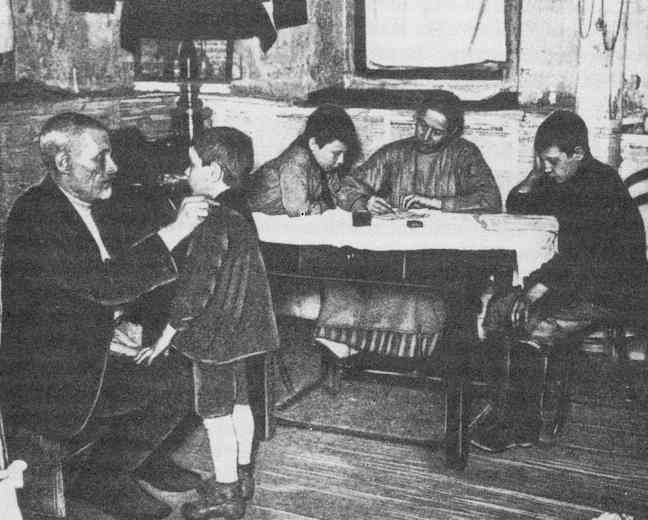
One interesting aspect of fashions is assessing how the entire famuly was dressed. These images not only help to assess what kind of clothes the rest of the family was wearing with the different boys' fashions. These famly images provide views of whjat the other members of the family was wearing. The images also provide some interesting insights on social trends. This is especially interesting given the huge political and social changes furing the 20th century. Here we have just begun to collect Russian family images.
We have not yet found many 9th century Ruddian family images. One lovly imge is the Grand Duchess Maria Nicholiava and her children in 1849. It shows a fanily scene of the Russian airistocracy at mid-century.
Russia underwent major political changes in the 20th century. As a result, family life and clothing underwent fundamental change. Tsarist Russia still governed Russia in the early-20th century (1900-17). The Church played a major role in family life at this time and the population was primarily rural. Both peasant families and workers lived in poverty. Middle class families lived and dressed much like similar famies in the rest of Europe. This changed after the Revolution. But it was not the worker's paradise that many had hoped for. After Stalin seized control, living standards improved in the cities, but never reached levels in Western Europe, let alone America. And this was achieved by starving the countryside. Stalin's Siviet Union was a closed society, but the Germans when they invaded (1941) encountred incredible poverty in rural Russia. This was because that in collectivizing Russian farms and killing many of the best farmers, farm production declined and the collective farmers were only allowed to retain a small part of it. While the regime propaganda went on and on about poverty before the Revolution, the rural population was actually better off. One thing the Communists did do was to expand the education system. After World War II, living standards generally improved, but lagged badly behind standards in Western Europe. And than by the 1970s living standards stopped rising as the inherent inefficencies of Socialist central planning overwealmed the capabilities of an educated wiork force and the country's raw material riches. All of this can be seen in family photographs. The Soviet Union was disolved (1992). Communism was outlawed, but subsequent Russian Governments have not adopted the democratic policies of Western Europe.
Here we have a modern Russian family. This is a successful moddle-class family, presumably in Moscow or other large city. The photograph is undated, but was probanly taken about 2005. Note the popularity of denim. The fact that even the mother wears denim jeans means is an indicator that they are a modern family. Another indicator is that there is only one child. Russia faces very difficulg demographic trends. The Russian population is declining and families having only one child is an important indicator of this. Besides the jeans another inteesting fashion seen here is the popularity of tights for boys. Notably this is not a residual traditional style, but a style popular with modern fmilies.
Gorsuch, Anne E. Youth in Revolutionary Russia (Bloomington: Indiana University Press, 2000).

Navigate the Boys' Historical Clothing Web Site:
[Introduction]
[Activities]
[Biographies]
[Chronology]
[Clothing styles]
[Countries]
[Girls]
[Topics]
[Bibliographies]
[Contributions]
[FAQs]
[Glossaries]
[Images]
[Links]
[Registration]
[Tools]
[Boys' Clothing Home]
Navigate the Historic Boys' Clothing Russian pages:
[Ballet]
[Children's literature]
[Choirs]
[Fashion magazines]
[Movies]
[Royalty]
[School uniform]
[Youth groups]
Navigate the Boys' Historical Clothing Web Site:
[Return to the Main Russian page]
[Return to theMain country page]
[Australia]
[Canada]
[England]
[France]
[Germany]
[Ireland]
[Italy]
[Mexico]
[New Zealand]
[Poland]
[Scotland]
[United States]