|
HBC has only a few individual experiences pages for Russiab boys at this time. . We have collecting a few accounts about the experiences of individual Russian boys, but mostly from literary and newspaper sources. We also have assssed some of the available images. Unfortunately our Russian readers have not yet submitted their own accounts. Her I think language is a major inhibiting factor.
Aleksandr Nikitenko wrore a fascinating personal account in the 19th century, Up From Serfdom: My Childhood and Youth in Russia, 1804-1824, translated by Helen Saltz Jacobson with foreword by Peter Kolchin (New Haven and London: Yale University Press,
2001), 228 pp [ISBN 0-300-08414-5]. Often such personal accounts come from the middle class or wealthier classes. This is one of the rarer accounts of a serf boyhood. The book originally published in Russian in 1888 deals with Aleksandr's life up to the time when he was emancipated from serfdom in 1824, at the 19 or 20 years. The title that the translater gave the book, Up From Serfdom, is designed as an obvious allusion to Booker T. Washington's 1901 autobiography, Up From Slavery.
There is a intereting account of a working class boyhood in the autobiography of Semen
Kanatchikov [A Radical Worker in Tsarist Russia: The Autobiography
of Semen Ivanovich Kanatchikov, translated by Reginald E. Zelnik
(Stanford: Stanford University Press, 1986)]. It is an interesting companion piece to the above account by Aleksandr Nikitenko. Both feel a sense of nostalgia for the lost, innocent rural world of their childhood. Even so, both aspire to imptrove thair social status by adopting the manners, clothing, and attitudes of middle class life. In both cases, any desire that might exist to join the upper classes is offset by a deep suspiciousness toward the elite's values and morals.
We have found a portrait of an unidentified boy, probably a Russian boy. We do not know where in the Russian Empire the portrait was taken. The lettering is in Russian (Cyrilic) and German. The photographer was German which might suggest the Baltics. We do know when it was was taken, although the lettering is difficult to read. We thought bit said 1914, but a reader tells us it was 1916. This of course places it in during World War I, at which time conditions in Russia were beginning to deteriorate. The boy is wearing a uniform. He is very young, about 12-13 years we would guess. Russian secondary students wore military-style uniforms, so he could be a student. The boots, however, have a defenite milirary look. We don't think thast they would have been worn by a middle-class bioy in Moscow or St. Petersburg, biut perhaps in a smaller city or town. A Russian reader twlls us, "It seems to me that the date in the lower right corner can be read as 'June, 1916', although it is faint really. Evidently it is not a uniform. In Tsarist Russia any uniform (military, school, etc) had its own marks, usually with letters or with the Emperor's monogram. There's no insigina on the belt, on the cap or on shoulders. This I think he is a student. The belt looks really strange to me. Except for the belt and this is a typical casual clothes for a boy from a rather wealthy, but not noble family, perhaps a small-shop owner in a small city or town. That's what I think, but I am not at all sure. On the back there're no information about where the portrait was taken." This seem to make sence. The cap is probably his school cap.
Tamar Bergman, the author of The Boy from Over There (1988) bases this novel Along the Tracks about a Polish/Soviet boy during World War II on the actual real experiences of a Polish family that eventually managed to get to Palestine. In the confusion of an air attack, Yankele, now 8 years old, falls off a train and is lost. During the next 4 years--as narrated by Yankele, now prudently known as the more mature Yasha--the boy survives by stealing food, and making fleeting alliances with other orphaned or displaced boys.
The Russian boy here is unidentified. All we know is that he appeared in a Soviet magazine during the 1950s. Unfortunately the background is cropped out which means we do nor quite know the context of the photograph. Even so, quite a bit can be decuced from the photograph about Soviet boys in the 1950s. A HBC reader writes, "As is clear from the context of the montage images, Soviet boys, at least in Moscow, wore mostly military-style uniforms to class in 1956--belted suits of light brown with long trousers and peaked caps.
But at home when they were relaxing, they preferred to dress more casually and comfortably and often looked like this boy. Notice that he wears a white shirt buttoned at the neck, dark short pants, long brown ribbed stockings (apparently worn for warmth on chilly days), and lace-up high-top leather shoes. The stockings, which fit very trimly and form-fittingly, were probably knitted of cotton or a cotton-synthetic mixture
for the added elasticity. Note the close-cropped hair, a style that gives the lad an almost shaved-head appearance. This hair style was typical and seems to have been customary because of hygiene and the quasi-military ideology and discipline of the Soviet school system in the 1950s. The boy is not wearing a red neckerchief, but, otherwise, he is dressed very much like a Young Pioneer. The young Pioneers usually wore short pants and white shirts--sometimes with long stockings and sometimes with knee socks."
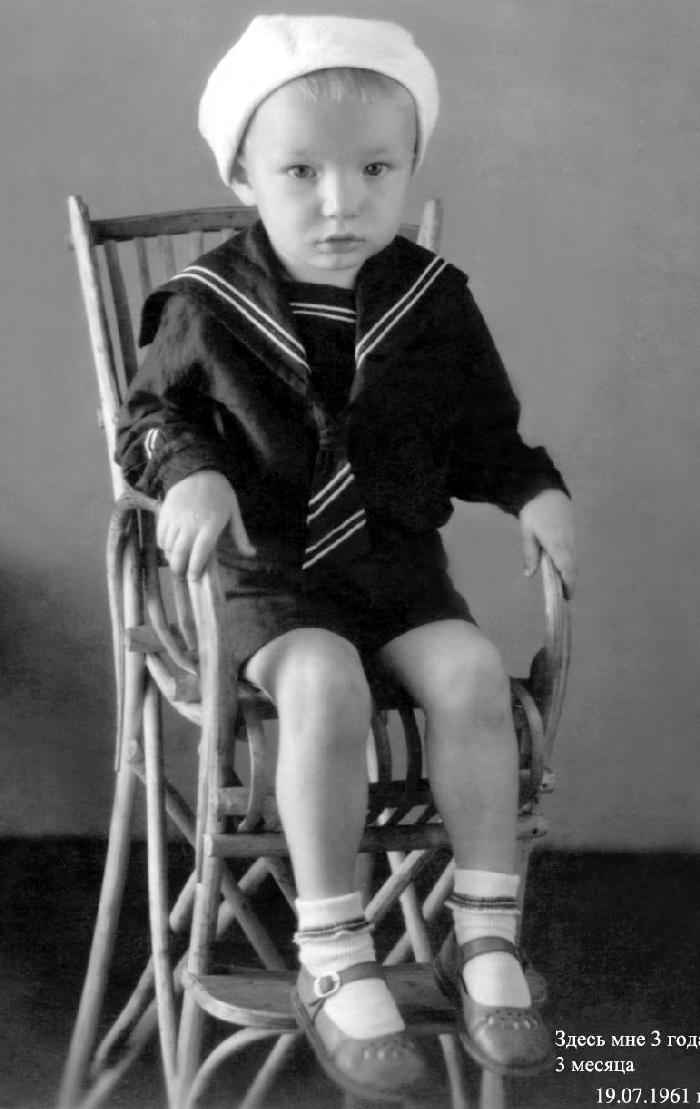
I will tell you about the clothes I wore as a boy to add to your information on Soviet boys' clothing and I have photographs from our family album taken during the 1960s to illustrate the clothes that I wore. As you can see from the photograph here, my mother liked to dress mylittle brother and me in sailor suits. As you see, sailor suits were popular during the summer time both with short and long trousers. It is clearly evident in the photographs that the suits different, but all had sailor styling. This type of clothing was very popular for small boys about 7 yearsof age just beginning school. Boys would wear them up to about 10 years of age, but not as commonly as the younger boys. Sailor suits by the mid-1960s were declining in popularity. They had veen much more popular in the 1940s and 50s when boys 9-11 years of age commonly wore them if parents could afford them. They were relatively expensive in the post-World War II Soviet Union and not all parents could afford them.
A heart rending story about brothers and sisters divided and reunited. The four children of alcoholic Russian parents were taken from them about 1994. Two of the children. Sasha, the oldest brother, remembers being cold and hungry. The orphanage that cared for them was clean, but Sartan. The children there were cared for adequately, but the resources were very limited. Sevetlana and Dimitri were 3 years old and were adopted by a Russian family. Sasha and the youngest sibling Valentina who was only 2 years old were adopted by an American family. The oldest children, however, did not forget about each other and yearned to hear if their were each well and happy.

Navigate the Boys' Historical Clothing Web Site:
[Introduction]
[Activities]
[Biographies]
[Chronology]
[Clothing styles]
[Countries]
[Bibliographies]
[Contributions]
[FAQs]
[Glossaries]
[Images]
[Links]
[Registration]
[Tools]
[Boys' Clothing Home]
Navigate the Historic Boys' Clothing Russian pages:
[Ballet]
[Children's literature]
[Choirs]
[Fashion magazines]
[Movies]
[Royalty]
[School uniform]
[Youth groups]
Navigate the Boys' Historical Clothing Web Site:
[Return to the Main Russian country page]
[Australia]
[Canada]
[England]
[France]
[Germany]
[Ireland]
[Italy]
[Mexico]
[New Zealand]
[Poland]
[Scotland]
[United States]