|
Switzerland is a small mountaneous country, in fact the most mountaneous country in Euroope. It is located in the middle of Europe, wedged between several large countries or formerly large countrues, Austria, Italy, France, and Germany. As a result, the country has to contend with an interesting mix of language (French, German, and Italian) and religious (Catholic and different protestant) groups. First communion thus can be quite varied among these different groups. Switzerland is a confederation of 22 cantons. Switzerland first appears in history as an area targetted by Ceasar in the Galic wars. Over timer it vhas acquired the destinction of being a neutral country. Swiss boys are best known in the popular mind with wearing Lederhosen and hiking in the Alps. While a few boys may have worn Lederhosen, they vwere not very common. Swiss boys more commonly dressed like boys in other European counties. Because of the large German and French speaking populations, clothing styles in those countries have been particularly popular. Italian fashions have also had some influence, but the Italian-speaking population is relatively small. We do not notive many destinctive Swiss styles.
Three of the cantons are divided ibnto half cantons for administrative purposes. The population is largely derived from the Helvetii, a Celtic people and the Rhaetians, a people of debated origins, and the Teutonic tribes (especially the Burgundians and the alemanni) which invaded the Roman Empire. Germans, French, and Itlalians have added to the country's ethnic diversity. Each of the three major languages (French, German, and Italian) are officual languages along with Romansch, the national language. The Swiss have been able to avoid many of the difficulties plaging other multi-lingual countries. Normally questions such of the language of instruction in schools is settled by using the language of the largest group.
Julius Caesar conquered the area of modern Switzerland during the Gallic wars and it was incorporated into the Roman Empire. As a Roman province, the area became highly civilized. Major cities developed (Basel, Geneva and Zurich) whch were linked to each other and Rome by military roads which also served as commercial arteries. As Roman power declined (5th century), the Legions could no longer maintain the borders on the Rhine. Germanic tribes poured into the Empire. The Germanic tribes invaded Switzerland from boh the west and north. Charlemagne added Switzerland to the Frankish Empire (800 AD). After the disolution of the Frankish Empire, Switzerland became ruled by German emperors who eventually became mostly the Austrian Hapsburghs. The three forest cantons of Uri Schwyz and Unterwalden signed the Eternal Alliance (1291). This was a challenge to Hapsburgh rule. The Hapburghs attempted to crush the Swiss revolt, but this proved difficult in the rugged mountaneous territory of Switzerland. The Swiss defeated a Hapsburgh army at the battle of Morgarten (1315). The cost to the Hapsburghs of persuing the war proved not worth the potential prize. The Swiss thus achieved autonomy within the German Empire as the Swiss Confederation. Much of German Switzerland converted to Protestantism during the Reformation. The Thirty Years War destroyed large areas of Germany. Swiss indeopendence from the Holy Roman Empire and its neutrality was recognized by the Treaty of Westphalia which ended the War (1648). Switzerland could not maintain its neutrality as Europe was rocked by the French Revolution. The French Republic conquered Switzerland (1798). Swiss independence was reaffirmed by the Congress of Vienna and the Second Peace of Paris (1815). The Great Powers at the Congress of Vienna agreed to permanently recognize Swiss neutrality. The country was affected by the Revolutions of 1848 which swept Europe. In Switzerland, however, there was not a violent Revolution, but rather a new federal constitution was adopted based on the federal principles of the United States Constitution. The Swiss made major amendedments to the constitution (1874). The changes gave the federal government responsibility for defense, trade, and legal matters. Switzeland since the 19th century has gradually developed a prosperous modern economy. The Swiss remained neutral in World War I (1914-18). The League of Nations was based in Geneva. Axis forces surounded Switzerland in World War II (1939-45). There was for a time a danger of a NAZI invasion. Switzeland proved, however, valuable to the NAZI war effort and was not invaded. Switzerlad after the War continued to prosper. It is one of the few European countries that has npt joined the European Union. Today the issue of integrating Muslim imigrants hs become a major issue.
HBC at this time has only sketcy information on the chronology of boys' clothing trends in Switzerland. Younger boys as in other European countries wore dresses. Suit styles for younger boys followed fashiins in Germany, France, and Italy. Long pants suits were common through the the 1860s. Kneepants became increasingly popular in the 1870s. HBC is uncertain when boys began to wear smocks, but this may have began in the 1870s following the adoption of smocks for schools by the French Third Republic thus promoting this style. Presumaby French-speaking Swiss woul have been influenced by French fashion trends. Short pants and kneesocks became increasing popular by the 1910s an by the 1920s most younger Swiss boys wore shorts. Suring the winter they might wear knickers or continuing wearing shorts, but with long over the knee stickings. Tights appeared in the 1950s. Boys increasingly wore long pants by the 1960s. Today Swiss boys clothes is similar to the pan-European styles now prevalent.
Switzerland is a small, mountenous and land-locked country surronded by large neigbors (France, Germany, and Italy). Despite the country's small size, there are substantial regional differences. This is in large measure due to the country's dramatic mountenous geography. The mountains impeded transportation. And until after World War II mountasin villages throughout the country lived very isolated lives. This of course is the environ,rnt in which regional differences debelop. Thus you have in Switzerland some very sophisticated, cosmppolitan cities as well as isolated mountain villages with destinctive customs and costumes. The country's diversity is an important part of Switzerland's uniue national identity. The country might be divided into four geographic regions, roughly corresponding to the four linguistic-cultural groups. Western Switzerland is Francophone. This region includes Geneva and Lausanne on Lake Geneva. The popular resort towns of Montreaux and Neuchâtel are located in the western region. Southern Switzerland is Italian and often referred to as the Ticino region. This is much smaller than the French and German speaking regions. The culture of this region is very similar to Italy. The northern and central areas of Germany are largely Germnic. This region includes Bern, Lucerne, and Zurich. The majority of the Swiss population is located in this region. The fourth region is located in far eastern Switzerland near Austria and Liechtenstein. It is the province of Graubünden. Inhabitants here speak Romantsch, a basically Germanic language with a lot of Italian and Latin words.
A Swiss reader writes, "I think there was a great difference between the kids whe grew up in the mountains of on farms and the ones who grew up in mor urban areas. I saw
that difference on two occasions. Once, when I went to the boarding-schools and then when I was about 19 years old and fulfilled my military service. Both times I was in very close proximity of many boys or young men. While the urban kids wore more modern underwear and were the first ones to have long pants etc., we country-kids still had the old-fashioned underwear, such as union-suits, waists, stockings etc. This was very much the case at the boarding-school. We from the country got teased about that, which accelerated the change to more modern closing for us. It is however safe to say, that long underwear during cold weather was a standard piece of clothing for just about all boys. It just changed from union-suits or stockings to long underpants and undershirts and then in the early 1960s, tights came into the picture as they started to be manufactured commercially. Tights were not worn in the military, as a piece of footed clothing was not practial, especially for us in the mountain infantery where we covered long distances on foot and therfore had to be able to change our socks very often. I observed there too that those young men who came from urban areas wore more the jockey-type uderpants and a-shirts, where the "farmer-boys wore the long underpants and undershirts. My family lived back in Switzwerland in the early 1990s and I was involved in the Scout troop of my son. Long underwear had clearly become something one would only wear for outdoor activities in cold weather. Long underpants and
tights are widly available in stores but clearly only sold fot that purpose. Boys, other than the the very young ones do not wear long underwear or tights on a daily basis anymore. Just for sports and outdoor-activities. There they are part of the standart equipment.
As to outer-clothing the biggest difference was that the coutry-pleople still wore the heavy woolen clothing, where as the urban kids had changed to the lighter more colorful clothing." [Voute]
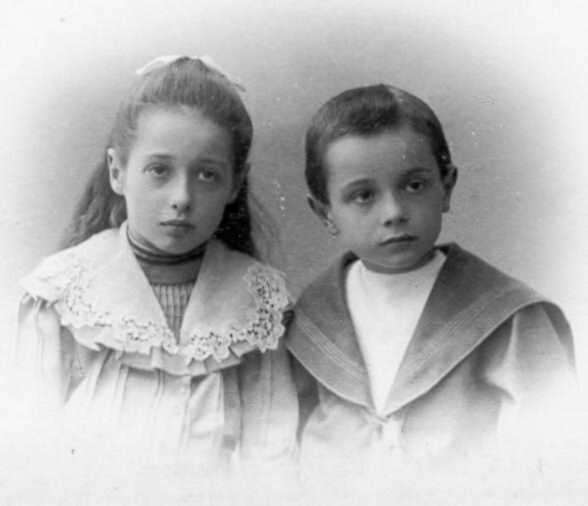
Swiss boys wore many of the same garments as boys in neighboring countries, especially Germany and France. The fact that the two major linguistic groups in Switzerland are French and German is a factor here. Clothing styles seem more dtermined by language than the fact that the boys are Swiss. Boys are best known for wearing leerhosen, but they are now more folk dress than garments commonly worn by moern Swiss boys. Young Swiss boys in the 19th and early 20th century were commonly outfitte in dresses, as was the case of other European countries an America. Sailor suits were a popular style for Swiss boys as was the case in most European countries. They were commonly worn by boys in German, French, and Italian speaking areas of Switzerland. Switzerland is a multi-cultural and linguistic country. Smocks were commonly worn by Swiss-Italian and Swiss-French boys, but less so than the Swiss-German boys. They were mostly worn to school. As far as boys clothing is concerned, the French speaking part of Switzerland was comparable to France. HBC knows of no specific Swiss style for Swiss boys suits. Presumably Swiss boys in the early 19th century wore skeleton suits like boys in other European countries. Swiss boys by the mi-19th century were wearing suits with more modern styling an long pants. Gradually by the 1870s, kneepants suits had become more common for boys. I'm not sure when knicker suits began to be worn. Short pants suits with modern styling appeared in the 1910s and were widely worn by the 1920s. Gradually suits became less commonly worn and were much less common by the 1940s. One European readers tells HBC that lederhosen were not worn in Switzerland. Unlike other Alpine countries, lederhosen were not commonly worn in Switzerland. Some readers, however, tell us that some Swiss boys did wear lederhosen. This appears to have been especially true among Swiss boys of German ancestry. Younger Swiss boys, especially in the French-speaking areas, commonly wore closed toe sandals, both English-style school sandals and single bar sandals. HBC is not sure when Swiss boys began wearing sandals, probably the 1920s. They were commonly worn until the 1960s. Swiss boys like German boys also continued wearing long stockings in the 1920s as they were declining in popularity in other countries. Swiss boys also wore tights.
Folk styles in Switzerlamd as in much of Europe are basically widespread peasant styles during the 18th century. There are very destinctive male and female styles, but there were very little age differentiationn. Boys and girls just wore scaled down versions of their parents styles. People in thw 18th century did not have the mobility of our modern age. Many people did not move beyond 50 miles of where they were born. There were adventurous souls that did travel, but this was not the experience of the vast majority of the population. This was especially the case of Switzerland and other mountaneous Alpine countries. Swiss styles for example are similar to styles in neigboring Germany (especially Bavaria) and Austria. Another factor here is that much if the Swiss population is ethnic Germans who dominate most of Switzerland's 26 Cantons. A much smaller part of the population had French or Italian ethnic ancestry. Mountaneous terraine made travel much more difficult than flat terraine. This the experience of many people was limited to the valley communities where they lived and had always lived. And this dynamic meant that that the isolated communities developed destintive variations, usually on basic garments that were widely worn. Swiss men wear trousers or breeches, a smocked shirt, a long-sleeved jacket or/and a vast, headwear, dark woolen stockings, and shoes. Though, as we said earlier, there are plenty of varieties of attire for men in Switzerland. Men might wear lederhosen of varying length, similar to Bavarian folk clothing. Lederhosen are especially suitable for wear in rough mountain regions because of the leather is so durable. Headwear was seasonal, short-brimmed felt hats in colder months and and wide-brimmed straw hats in warmer months. Swiss female folk styles were bright, colorful smocked dirndl dresses with puffed sleeves and tight ribbon crest tops. They were worn with white aprons. The apron was important and very common is worn over the skirt and tied at the back. It protected the rest of the outfit at a time what we now call folk clothing was ordinary everday clothing. So, a woman could have only one dress, but several aprons. This helps to be always tidy and look a little different ar the same time. A very important device for a woman. The greatest variety was seen in headwear. There were fairl standard lace bonnets as well as variery of very destinctive styles. Long stockings were fairly commpm, especially white, but we see some red stockings. Tights are a modern substitute. At the time tight were not worn, but long stockings were common. Today long stpckings are not available, but tights are. We also note embroidered bags. The dress is odten replaced by a white blouse with puffed sleeves, a tight top corset, and a full skirt worn with an apron on top. The blouse and and apron are normally white, the rest of the outfit could be very colorful with elaboratebl decorations and accessories. The bodice is normally closed with hooks or laceing.
It is also useful to look at family images. They provide a range of interesting fashion and cultural insights. It is interesting to see what other members of the family were wearing over time. Family portraits provide interesting time capsules showing what girls and parents were wearing with the various boy fashions we discuss on HBC. Also we can better assess social class factors when we can view the entire family. Other trends such as family size and interpersonal dynamics can also be observed in these family portraits. We do not have many Swiss family portraits yet, but we have begun to collect them.
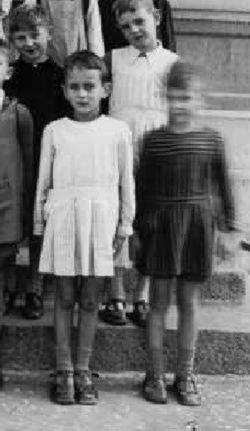
We do not have a lot of information on Swiss girls clothing. Swiss girls mostly wore dresses that look a lot like those worn in neighboring France and Germany. Sailor styles do not seem as popular. We do note quite a number of girls wearing pinafores and not just for school. Boys in French cantons wore smocks and pinafores for school, but not in German Cantons. Girls in both French and German Cantons wore pinafores. Almost all girls wore dresses. We not a few girls wearing pants for casual wear around the home in the 1940s, but this does not seem to be very common and we do not see it at school untill. Braids seemed very popular for Swiss girls hair styles.
|
Switzerland is a multi-ethnic and mult-linguistic country. Until the 1960s, schoolwear was heavily influenced by the different national groups making up the Swiss union. Boys at schools in French catons, for example, commonly wore smocks while boys at schools in German catons generally did not. Swiss boys did not normally wear uniforms. Many French schools required that the younger children wear smocks. State schools did not normally establish a specific style, but some private schools did. Today in Swiss schools there are few differences from caton to caton.
We have few details on uniforms worn by Swiss children. Swiss children have not generally worn school uniforms, although there were a few military schools. There may have also been a cadet program. Perhaps in the 19th century there were also drummer boys. We are not certain who some of the boys wearing uniforms in the 19th century are. In the 20th century there were also uniformed youth groups--primarily the Scouts.
We do not have very much information about Swiss catalogs and advertising at this time. We suspect that Swiss parents may have used German, French,and Italian catalogs. All of those countries had much larger clothing industries than Switzerland. I am not sure yet, however, just when mail order became common in Europe or to the extent import duries were imposed. We are not sure what kind of mailorder ctalogs they had. Given the size of the country, mail order catalogs may have been limited. We have noted a catalog form the "Grand magasins Jelmoli" which was located in Zurich. They were publishing catlogs in the 1900s, but I am not sure just when they began. Information from the various catlogs provides a useful overview for Swiss boys fashions over time. Hopefully we will be able to eventually add other companies to this section.
A Swiss reader suggests that it should be mentioned on this page that quite a few mothers sewed a lot of their kids clothes. This was particularly true for girls, but also included smocks or pants for boys. HBC believes that this was the case at least through the 1950s, but has probably decline in modern Switzerland. Full details on sewing in the Swiss home are not available at this time.
We do not yet have enough information and images of Switzerland in our archives to develop an activities section. A HBC reader has forwarded us some images of a choir in Escharlens. We believe that is in Switzerland hopefully our Swiss readers will provide some more information. We do have some information on Swiss choirs]. We also have some information on Swiss school clothing. We also have some limited information on Swiss youth groups.
A Catholic Swiss contributor reports that First Communion is a large celebration where all is festively dressed. He remembers his First Communion in April 1970. The children wore long cassocks. It was a cold day and under his cassock he wore a shirt, sweater, my long trousers, white tights (strumpfhose) and black shoes. He also remembers an an Italian boy who wore short trousers and strumpfhosen.
Ar provides valuable information on a variety of topics addessed by HBC. We not only see fashions illustrated, but cluses about families and childhood. All of this is particularly important in the era before photography. We do not yet know much about Swiss art. We have found information about a few Swiss artists.
We have virtually no information at this time on Swiss photography. Altough the Daguerreotype was developed in neigboring France, Swiss Dags do not seem very common. The earliest Swiss photography we have found or CDV studio portraits (1860s) Cabinet cards seem less common than CDVs throughout the late-19th century. Amateur photography ws possible in the late-19th century, but taking photographs was complicated. This significantly reduced the number of people interested in buying cameras and taking family snapshots. The Kodak Brownie changed this (1900). Suddenly interested amateurs could easily take snapshots at at a very modest cost. The Brownie was a instant success not only in America, but other countries as well. Presumably Swiss companies quickly came up with competitors or perhaps more likely French and German compsnies. We have little information on this. Hopefully our Swiss readers will be able to provide us some historical information on the development of amateur photography in their country. We do begin to see Swiss snapshots at about the saje time a in America, but not in the same quantities. The size, margin, edging, and other characteristics of the snapshots can help date the images.
The Swiss Foundation for Photography (Fotostiftung Schweiz) has highlighted photobooks that have influenced photography in Switzerland since the late-1920s.
A sad circumstance in Switzerland is the experiences of the Verdingkinder or Discarded Children.
Up unitl the 1950es there was an inhappy situation in Switzerland, where "unwanted" children were "sold" primarly to farmers who were supposed to take care of these children in exchange for free labor. Many of these children were missused or abused. Not until recently has this situation come to light. Now it is creating quite a uproar in Switzerland. A Swiss reader writes, "You know that I have a good friend who is an accomplished model builder--Alfred Kiener. I think I had mentioned to you that his youth was a rather unpleasant one. Motivated by the stories of the Verdinkinder he has put on paper his biography as a youth. This is not a pleasant story and at times rather depressing. I think it has helped him overcome a great deal of trauma by putting his experiences on paper. His life as a youth was very similar to that of Verdingkinder. The only difference was that he was not sent away, but was treated that way by his parents. His story also shows how Nature and Modelbuilding were to activities which allowed him to escape and survive this horrible treatment and ultimately become an adult who has provided for his family and has made very positive contributions to the community."
We have very few individual accounts from Switzerland. One Swiss reader tells us about his childhood. Tom was born in 1936 which means he lived through the World War II as a very young boy. These were very difficult years, even though Switzerland was not invaded by the Germans. He does not remenber much because he was so young. He does recall his Scouting and school experiences. Tom was a keen Scout and joined the Cubs in 1942. At age 11 in 1949 he began boarding school and went to the same school for 8 years. This was not as common in Switzerland and other European countries as it was in Britain. A British reader who traveled in Switzerland during the 1950s remembers some destinctive features of Swiss children's clothing.
Voute, Thomas. E-mail message, June 7, 2006.

Navigate the Boys' Historical Clothing Italian pages:
[]
[Swiss choirs]
[Swiss school uniforms]
[Swiss youth groups]
Navigate the Boys' Historical Clothing Web Site:
[Return to the Main European country page]
[Return to the Main Country page]
[About Us]
[Introduction]
[Activities]
[Biographies]
[Chronology]
[Clothing styles]
[Countries]
[Girls]
[Theatricals]
[Topics]
[Bibliographies]
[Contributions]
[FAQs]
[Glossaries]
[Images]
[Index]
[Links]
[Registration]
[Tools]
[Boys' Historical Clothing Home]