|
We notice a wide range of activities in which American boys participated. Of course school is one of the most important, especially in the 20th century. Many children in the 19th cebtury had to work rather than go to school, although progressive legislation in the early 20th century limited this. And for many American families, religion was very important. There are a range of fine art activities that mother in particular promoted. The expanding economy and a new affluence meant that more an ,ore American parents could afford lessons in music and dance and other fine art activities. Boy chours became very popular in the lae 19th century. Sports were of course popular with the boys and began to take their modern form in the 19th century. There were also play and other unorganized activities. An important American tradition was for fathers and sons to enjoy together outdoor activities like hunting and fishing. And children such imemorial have enjoyed pets. A range of technical activties have fascinated boys, like photography, radio, and computers. A 20th century innovation was the introduction of youth groups with organized activity programs.
We do not have a lot of infomation about art as an activity for boys. We know younger chikldren love to draw and paint. Art is is often one of the most popular school activities for boys and girls at the grade-school level. Activities related to both arts and crafts interets modt younger children. And as regards children, color (especially bright colors) is particular appealing. Limited skills is a problen for younger children which led to the development of finger painting for younger children. A bit messy, but the children enjoy it. Teachers seek to exposed children to a range of different medium. There are also a range of home activities including drawing, colored pencils, water colors, crayons, and a rage of newly developed pens. Oil painting is more advanced and by the time children reach high school, art seems an activity which tends to interest girls more than boys. Some boiys with a particilar penchant for art continue to pursue it.
A major expereience for many American boys is summer camp. Summer camp was an experience thatr was largely inventeted in America. The YMCA and Boy and Girl Scouts played a major role in the American Summer camp movement. Many early summer camps had uniforms. This was especially common in the fee-paying summer camps in the northwest. This became less common after World War II, but some camps still have basic uniforms.
Boy choirs are strongly associated with Europe. A very large numbers of choirs have been founded in the United States based on the European tradition. Here the principal influence has been the choral tradition of the English Anglicn church. I believe that almost all
american boy choirs have been founded in the 20th century, many after World War I. Most have adopted contemporary uniforms, most commonly blazers. A few have destinctive uniforms reflecting their state and community.
Today of course it is the computer and computer games that have captured the fancy of the Ameican child, at least the boys.
A variety of conveyances, especially waggons, tricycles, and bicycles were very important for outdoor play. There were many other conveyances such as Irish mails, pedal cars, and scooters. We notice both bikes and trikes in the the United States during the late-19th century. A good example of an early trike is an unidentified boy in 1881. Many American children had bikes. I think this was primarily a factor of the greater affluence of American families. Bikes were less common transport for workers, in part because Henry Ford followed by other manufactuers built cars within the price range of the average worker. Bikes were certainly items that were very popular with boys. Every boy wanted them. We believe that they were more common for boys, but especially after World War I, girls also had them. Styling seems to have been very similar in Europe and America. There are quite a number of bicycle and tricycle images loaded on HBC. Many of them are American images. I believe this reflects the general affluence of America and the fact thast many children had bicycles and tricycles.
American boys have been involved in dance to varying degrees and have worn a variety of dance costumes. Many American boys participated in dances in the 18th and 19th centuries which are now seen as folk dancing. Some religious groups objected to dancing as too sensuous. Some boys did modern or interperative dance at the urging of their mothers in the early 20th century. Often they did not care for it at all. Balet was less popular in America than Europe, but tap fancing was popularized by Shirley Temple. Boys also did ethnic dancingm including German, Greek, Irish, Native American, Scottish, and others. Many children learned Werstern folk dancing in school. Teenagers enjoyed the many popular social dances that appeared throughout the 20th century. Currently there is a revival of tap dancing as well as break dancing.
We do not have a great deal of information on gambling trends among American boys. During the 19th-century, religion was a very powerful force in America and many churches promoted a very strict moral code. This of course included prohibitions on gambling. But of course gambling was very common among adults, mostly men, and this affected boys. Parents could not watch their children all the time and some parents were not that concerned with moral standards. Thus we are not sure just how common gambling was among boys or what kind of gambling they pursued. Here we are talking about boys and younger teens. Older teems would have been involved in adult behavior as most children began working at a much earlier age than is common today. Photography provides few cluses as most photographs were studio portraits. We recall one Civil War photograph with drummer boys playing cards (1860s). This would hve been less likely if they had been at home. We know more about the 20th century with the advent of the snap shot. We see boys playing craps at the turn-of-the 20th century, mostly in city suburbs. I can recall as a boy two forms of gambling (1940s). Boys both pitched pennies and flipped sports cards. The girls never participated. Today gambling seems a much more serious problem, especially among teenagers. There are today a variety of legalized ways of gambling and thus gambling is more accessable to teenagers.
The standard holidays including New Year, Valentine Day, Easter, Veteran's Day (previously Armistace Day), and Christmas are important in America. Destinctly American holidays include Dr. King's birthday, President's day, St. Patrick's Day, the 4th of July, Columbus day, Halloween, and Thanksgiving. Both St. Patrick's Day and Coloumbus Day honor the contribution of ethnic minorities and their role in building America. St. Patrick's Day is of course a traditional Irish celebration, but it in fact was a minor event in Ireland until popularized by nostalgic immigrants in the large American cities like Boston and New York. The most American of holiday is the 4th of July and all the fireworks, parades, and associated hupla. This major U.S. holiday is about fire works and the rockets red glare. Some one may dress up as Uncle Sam or the Revolutionary war soldiers with fide, drum, and and bugle scene. The Cubs and Scouts particuate in parades. And of course before the fireworks are picnics and cookouts. Halloween is a major American holiday that has begun to spread to other countries. Thanksgiving is another uniquely Americam holiday. Thanksgiving is an American holiday, giving thanks for the bounty of the land. Children dress up in Pilgrim and Native American costumes at school to celebrate the holiday. At home the centerpice is a huge turkey dinner. Often the entire family gathers at their parents or grandparents house for the event. Unlike some other holiday, however, the children do not generally dressup, even for the turkey dinner. Contrary to widely held views, America is a deeply religious country. Probably more Americans attend Church than the the citizens of any European country. Thus the religious nature of Amristmas is important in many American families. Undeniably, however, Santa Claus now plays a central role in an American child's Christmas. American children diligently take their Christmas lists to Santa Clause. Some now even have computerized lists. Some American children in fact see Santa and his raindeer as a much more important figure than Jesus. Given the media blitz, parents have to work hard to maintain traditions beyound tye commercial extravanganza.
Especially important activities for American boys are hunting and fishing, although this has declined somewhat as America continues to urbanize. A barefoot boy with a fishing pole is a virtual icon for Ameican boyhood, although today out of date. Activities such as sports were more limited in the 19th century. Fishing was a perfect activity for boys. It was fun and even the poorest boy could afford a fishhook and line. It was conducted away from home beyonf effect adult supervision for there was an element of freedom involved. And on a hot summer day a day of fishing could be topped off by a swim in the pond or river. And unlike hunting with a gun was not dangerous. Thus very young boys could participate with little or no supervision. And if all of this was not enough, the boy brouht back food for the family table. Hunting was a little more complicated because guns were involved. The guns of course were a real attrraction for boys, but here some expense was involved as well as much more adult supervision for youngr boys.
We do not know a great deal about the history of American music as it relates to children. The early English colonists were limited as to what they could bring across the Atlantic. Thus music in colonial America was limited. Another limiting factor was the attitude of the Puritans toward dancing and music. This attitude gradually faded, bith with the arival of the Scotts-Irish. And of course the southern colonies were never burdened with the Purtitan disdain toward meriment. Some of the most popular instruments were thev violin, guitars (Baroque and English), dulcimer, harpsicord, and flute. Without modern electronic equipment, people had to make their own music. Most children who learned music probably did so from their parents. As the colonies became more established, the wealthy elite could afford to hire music and dancing teachers. Other children probably had limited opportunities to learn music unless their parents could teach them. The colonial music tradition was primarily English with the exception of the Scotts-Irish tradition. There was little cultural exchnge with Native Americans. There was, however, a significant interchnge with Aftrican slaves, although it was generally disguised until the more open ebvironment of the late 20th century. The only real original American music style is jazz which came from the Afro-American cultural tradition. The musical experience of American children did not begin to change until the late 19th century. The tremendous wealth generated by indistrialization significantly expanded the middle class and many of the newly affluent families, especially the mothers, wanted their children to acquire cultural refinements like music. In addition, for the first time in America, it was not just wealthy families that could afford a piano in the family. Children were required to take music lessons which quite a number of boys did not particularly enjoy. It is at this time that large numbers of immigrants come to America from a wide range of different mostly European countries. This significantly broadened and enriched the American musical tradition.
American boys might participate in a range of family outings. The appearance of urban parks provided aange of opportunities in many cities. Family picnics into the country were popular. Hiking seems less popular in America than in European countries like America. A drive into the country in the family car seems more of the Americzan approach. This of course often ended with a picnic. And Henry Ford's Model T make the automobile afordable to the average country. Especially popular were county, and for the lucky, state fairs. There were also special expositions such a World Fairs. We note the Columbia Exposition in Chicago during 1983. There were a range of other outings such as circuses, such as the Barnum and Bailey circuses as well as smaller ones. Beach outings were also popular by the end of the 19th century, but here there were regional differences. People living along the coast could easily get to beaches. Some could even make day trips. Americans living in the mid-West had a long way to go to get to a beach, although Chicago had Lake Michigan. Only after Worldx War II did the Middke Class have the ability to reach ocean beaches.
|
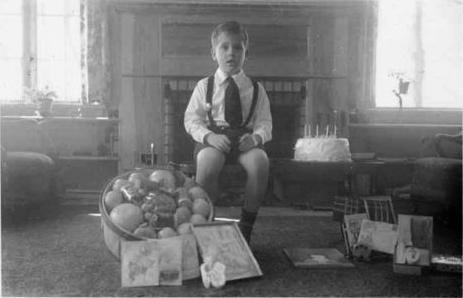
An important activity was parties. There were different kinds of parties. Girls might have tea parties. The favorite parties for younger children was of course birthday parties because of the cake and ice cream, games, and presents. There were also holiday parties. Here Haloween and Christmas parties were especially popular. Older children might have socials where there was dancing. After World War II we see more elaborate parties like pool parties. And birthday parties became much more elaborate. Dress trends of course varied over time. Children in the 19th and early 20th centuryies dressed up for parties. Formal dress was quite common. After World War I and especially World War II, dress became much more common. There were some ethnic and religious parties. Jewish children might have Bar and Bat Mitvas. Hispanic girls might have Quincenillas. Luthern children celebrated their Confirmations.
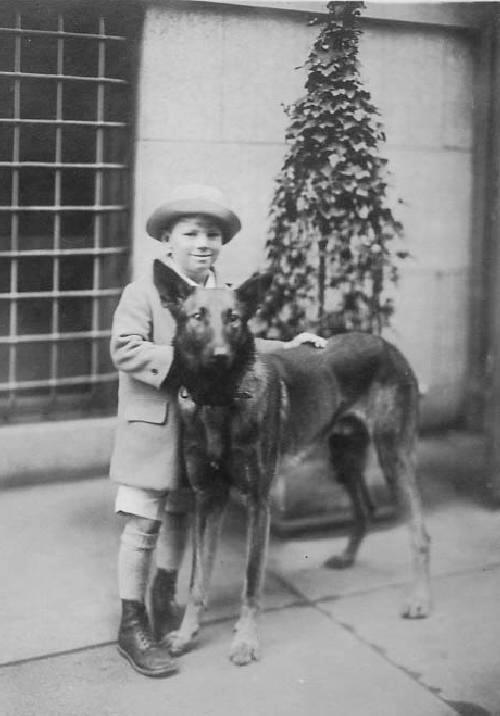
Pets were once a privlidge reserved for the affluent. People in rural areas might hsve dogs, but they were commonly working dogs. Of course that did not stop children from eenjoying them. Large numbers of moderate income people keeping pets is like many other aspects of modern life a creation of capitalism. Capitalism and the Industrial Revolution gave rise to a large middle class and greatly expanding cities. Many of these new middleclass families wanted to have dogs, perhaps rembering their experiences as children in rural areas. New smaller breeds were bred that were ideal for city life. We first see this in Britain, but the same process occurred in America as industrialization after the Civil War gave rise to an expanding affluent middle class and growing cities. World War I helped to make German shepards popular. Movies also affected pet popularity. As One of the joys of childhood is the relationship with the family pet which more often than not was a trusty pooch. This relationship is beautifully captured in many children's classics (Lassie, Old Yeller, Rin-tintin, and others). This was something that both wealthy children like this boy or children in more modest familes could enjoy, although in our more modern world, keeping a pet is becoming increasingly expensive. Boys probably preferred dogs more than cats and girls may have preferred cats more. There was, however, plenty of overlap between the two. And there are many bother possible pet choices. Since World War II, small pets like hamsters have become popular for younger children or children in apoartmenbts where keeping larger oets are difficult.
American boys took a great interest in photography. We seen large numbers of images of boys with cameras, especially after 1990 when Kodak introduced the simple to use and relatively inexpensive Brownie. Boys didn't want to just be photographed, they wanted to do some of the photography. Some girls were also interested, but boys were interested to a fr greater extent. Of course a social class factor was involved here. While the Brownie made photography relatively inexpesive, it still was not cheap and thus the interest in photography was most pronounced among comfortable middle class families and affluent damilies. The available images show both fashion trends over time as well as changing camera types.
An important part of childhood is play. We see all kinds of outdoor play. We see boys enjoying the outdoors alone or with friends. Boys enjoyed looking for insects or small animals or paddling in streams. There were a lot of such unorganized activiries. We also note organized activities. Boys played many different outdoot games. There were party games that both boys and girls played. One favorite for everyday play with mixed groups was hide and go seek. Sand boxes were of course very popular for younger boys. On their own, boys were more likely to play war with different thems such as cowboys and Indians. As they got older sports began to replace games as favorite activities. A few exceptions were marbles, mummelepeg, and flipping baseball cards. Of course this varied over time. Modern boys are no longer allowed to have knives for mummeldepeg. And often marbles and flipping sports cards are discouraged as losers wind up unhappy. And a variety of conveyances, especially waggons, tricycles, and bicycles were very important for outdoor play. There were many other conveyances such as Irish mails, pedal cars, and scooters.
Radio called wireless at the time was a huge technological advance resulting in part from World War I. After the War, commercial radio exploded on to the American scene. Early radios were expensive, but boyus could build chep crystal serts from kits. This continued into the 1960s when some intetested hobbiests still built radio and high-fi/stero tuners from kits. This gradually phased out when the equipment became increasingly inexpensive during the 1970s. Another aspect of radio was long distance communication. Men and boys enjoyed the idea of communicating with other hobiests long distance. This was in the days when long distance calls were very expensive and the iknternet did not exist. At first this was done by morse code, but short-ave ham radio eventually developed. As the equipment was expensive, this was mostly for older teenagers and men.
Boys interest in reading has varied. This is a shame, because any child can get interested in books. This is because books tell stories and every child likes stories. In addition cover the entire gambit of the human experience. Thus there are books to interest any child, whstever his or her interests. Even boys focused in outdoor activities and sports can be led to books by choosing stories and biographies focusing on these activitieds. Teachers play a major role in develop reading skills and to anextent getting children interested in reading. But the key is the parents. A little bed time reading with interesting books can serve kindle a life-long love affair with books. Here American children were at an advantage to children in most other countries because of a wonderful punlic library syste, Parents can not only interest the child with bed time reading sessiion, but help address any learning problems the child my be encounteing with reading. Without this help at home, the child is at a serious disadvantage. And this disadvantage is no small matter. Reading skills are the single most important determinant as to how a child does at sdchool. And this means his or her ability to develop basic academic skills and the ability to persue his education to help achieve career goals. Thus a child who finds enjoyment in reading is well on his way to a succeesful life.
First Communion was a particularly important event in the lives of many immigrant American families, especially Irish and Italian communities. New suits were often purchased for the occasion. Sometimes but not always the suits were white symbolizing the purity of the children. It was much more common to buy white dresses for the girls than white suits for the boys. Irish and Italian mothers were more likely to insist on white suits. The suits through the 1940s were often short pants suits, but since the 1940s they are more likely to be white. The purchase of a new suit, especially a white suit, just for first communion has gradually passed out of fashion, cost being the primary factor especially as a white suit has few other uses. Now boys in many places simply wear white shirts. Girls still often are outfitted in dresses purchased just for the occassion. A Maerican reader has des described his experiences as an altar boy. We note a candle compamy in 1915 that pit altar boys on their promptional calandars.
Public speaking before World War II was much more important 6than the case today. Children would take classes in "speech". Participating in debates were very important bnd often staged in schools. Children would be expected to give recitations for family and visitors at home. This was especially true of middle and upperclass families. Perhaps this was more common in school because until after World War Ii, many children did not finish highschool.
School became increasingly important in the 20th century. American school children, with some exceptions, have not worn school uniforms. America's parochial school children have worn uniforms--although I'm not sure when uniforms were introduced. Private school children--especially America's elite private schools modeled on British preparatory and public schools--also had uniforms. Quite a substantial number of children were involved in the parochial schools, but the number of private school children until recently has been much more limited. American public (state) school children have not worn uniforms, although quite a number
of public schools have begun to study the issue. Many in the 1990s have begun instituting non-compulsory uniform policies.
Children often went shopping, most comminly with their mothers. Sometimes this was because no one else was at home. Of course before World War II, children werenot nearly as cloesly supervised as is the case today. Thus children might be allowed to play on their own with friends outside the hone while mothers went shopping. Sometimes they might be taken along and if old enough could help take home the groceries. I can remember being taken shopping downtown in the 1940s. I considered this an imposition on mu weekend play time, but there was one reddeming benefit--if I behaved myself I would be rewarded with a toy soldier. There have been major changes in shopping since World War II. Americans now go shopping in the family car. Of course the mall has become a forcevin children's lives. Unfortunately shopping is not the sort of thing that is commonly photographed. We notice one image of a general store in 1916 in the days before self serve.
Sports are probably more important in America than in other country. American sports like sports all over the world have been influenced by the sports developed in Britain, in part at public (exclusive private) schools. American sports, reflecting the relative isolation of the United States in the 19th century, developed in a different direction than in most other countries. As a result, soccer is not a major proffessional sport in the United States--although since the 1970s it is commonly played by children. The principal sports played in America Baseball, basketball, and football) are exclisuively played in America or in a small number of other countruies. The one important American professional team sport played internationally is Canada. American teams, however, mostly play other American teams or Canadian teams.
Technology had a real appeal for boys. Chemistry and erector sets used to be of great interest to boys, but appealed to few girls. I'm not entirely sure why this difference developed. It does not appear a simple matter of socialization.Boys also built crystal sets, simple radios whuich appeared after World war I.
Boys of course loved toys, all kinds of toys. They could be use both inside and outside, depending on the toys. Many of the impages of 19th century toys are from studio portraits, meaning that they were probably studio props. With the advent of the amateur snapshot around the turn-of-the 20th century we begin to get more realistic images of boys actually playing with their own toys. There are many different toys. These hve varied over time both by age and changing technology. Some toys like puppets were popilar with boys and hirls, other like toy soldiers were the exclusive territory of boys. And of course toys guns were a much prised toy, not to mention the BB gun. Boys in the 1930s-50s had the prenial confrontation sith mom over getting a BB gun--imprtalized in the film "A Christmas Story. Hoops and balls were perenial favorites. Things that made noise like whistles, trumpets, and drums were also popular. Boys loved to sail boats in the local park. Another favorites was toy trains--especially the model electric train when they became available in the 1900s. The train was a great toy because you could combine it with other items like toy soldiers. Construction toys beginning with blocks were popular. They have included Erector sets, Lincoln Logs and more recentlt Lego sets.
|
Travel was something that was not common for most children in the 17th and 18th centuries. Of course families had to get to America, but once there most Americans stayed put. Many grewup and died within about 50 miles of where they were born. This was because roads were not developed and travel was arduous enough for adults, let along taking along children. This began to change in the mid-19th century. The first major step was the Erie Canal followed by the railroads and steamboats. The railroads revolutionized transportation in America. We do not know a great deal about children on early railroad cars. The one early piece of information is a tragic one. President Elect Pierce and his wife, 2 months before he took office, he and his wife saw their 11-year-old son killed before their eyes. The Pierces On January 6, 1853, during a family trip, were in a train wreck. President-elect and Mrs. Pierce were uninjured, but Benjamin was killed. It was a terrible blow to the parents who had already lost two sons. Mrs. Pierce, completely overcome, lived in seclusion at the White House. The tragedy highlights how dangerous early trains were. We have no idea how American children dressed for trips on railroads, stahe coaches, and steamships. We suspect that they dressed up because formal dress was common in the 19th century. The earlist photographs we have of children taking trips on trains and steamships do show them dressed up. The same is true of the new modes of transport that appeared in the 20th century, busses and planes. This began to change during the 1960s when parents and children began to dress for comfort when traveling.
Many of the Founding Fathers led by Jefferson saw America's future as a great agrarian republic based upon the small farmer. It was, however, Hamilton's vision of America as a mercantile economy that proved to the more astute assessment. Someof the worst conditions experienced in Britain during the early 19th century did
not occur in America because of the more limited industrial devekpment and the beconing Frontier offered opportunity that made it difficult to oppress labor, except in the slae-holding South.
Until the Civil War in fact, large numkbers of American boys labored in slavery, most on southern plantations. After the Civil War (1861-65) as American industry expanded , the Frontier began to close, and immigrants willing to work for low wages
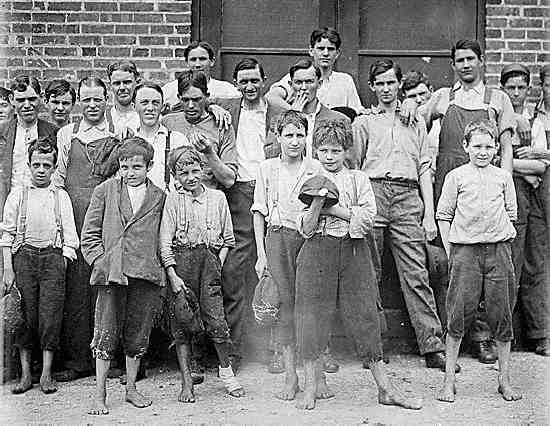
poured into America, working conditions became an increasingly severe problem. As in Europe, conditions for children were especially horendous. Only in the late 19th century did child labor begin to become an important national issue. Boys have traditionally learned various crafts. Boys in cities earned money shining shoes. Many boys even at the turn of the 20th century had to work rather than go to school.
S couting in the principal American youth group in America. The American SCouting movement was stongly influenced by Baden Powell's Enbglish Scouts, but there were several Scout-like
groups which formed in Americam before the Enlish Scouting movement was formed. After Scouting became the dominate movement in the 1900s. One of the most important was Camp Fire. Religious groups, objecting to the secular, non denominational constraints of Scoting formed the royal rangers. Right and left wing groups also formed youth groups of some importance, primarily in the 1930s.

Navigate the Boys' Historical Clothing Web Site:
[Return to the Main U.S. activities page]
[Return to the Main U.S. country page]
[Introduction]
[Activities]
[Biographies]
[Chronology]
[Clothing styles]
[Countries]
[Essays]
[Bibliographies]
[Contributions]
[FAQs]
[Glossaries]
[Images]
[Links]
[Registration]
[Tools]
[ Boys' Clothing Home]