|
American boys' fashions until the 20th century basically followed European fashions. Most boys' clothing looked to Europe for inspiration. This basically meant British and to a lesser extent French fashions. The exengencies of Frontier life had an impact on American fashion. Those that could afford it, however, wanted to wear European fashions. American fashions by the late-19th century began to develop along different lines. And by this time the developing industrialeconomy meant that there were large numbers of Americans who had the where-with-all to indulge their increasing passion for fashion. And this included how they dressed their children. One of the first true American boys' fashions was the Little Lord Fauntlerou suit, but it was inspired by European styles. After World War I, American boys fashions began to develop very differently than European fashions. American boys never wore short pants to the extent thast they were worn in Europe. American boys in the eary-20th century may have worn sgort oants at avery yoing age, but than most began wearing knickers and later long pants instead of shorts. Eventually after World War II, it was American boys' fashions that began to influence fashions in Europe Europe and other areas as a kind of pan-European style developed.
English settlers founed their first colonies along the Atlantic coast of North America (17th century). There were substantial differences between the North and South. The first colony was Jamestown (1609). The clothes the settlers wore were the fashions commonly worn in England at the time. Many of the settler were gentleman looking for gold nd thus reflected the fashions of the upper crust. There were few families among the early settlers. Settlement in the North began differently. Plymouth Colony was founded by the Pilgrims (1620). King James attemptd to prevent this, but once they reached Plymouth, made little effort to control them. They were religious disidents who believed in austerity in both life and clothings. Their clothing was thus very plain, especially in comprisons to the Jamestown settlers. In contrast to Jamestown, there were many Families among the Plymouth settlers. Their goal was to create a pure, devote Christian society. Gradually the sharp destintions between Jamestown and Plymouth declined. The Pilgrims found it difficult to control the faithfull and many diverse groups arrived to settle the middle colonies, including Quakers and Catholics. And this mean that overtime two trends developed. Fashion became more relective of English styles in general. And the pratical extingencies of the New World made for practicAl, easy to sew clothing. Clothing on the Frontier was affectedby Nativ American styles. Of course when the English settlers arrived, North America already had a vibrant Native American population. There were destintive attire and decoration fro tribe to tribe, but also many similarities because of the materials available and the importance of utility. The most important tribe encountered by the Pilgrims was the Wampanoag. The standard garment for men, older boys, young girls and women was the basic breechcloth. This was common among Native Americans because of the basic clothing technology. Breechcloths were made from easily available dear leatther. Soft deerskin was chosen and worn between the legs with each end tucked under a belt. The ends hung down and as flaps in both the front and back. Boys did not commonly bother with clothing until they were about 10 years of age. Of course this varied seasonally. There were dearskin garments to get the Wampanoag through the cold winter weather.
Much of what we know about American fashion during the 18th century is the clothing of the well-to-do elite of the colony. The fashions they wore is what most of the Colonists wanted to wear, if they could afford it. Fashion styles in colonial America was of course set primarily by the mother country, England. This was especiallt true of men's fashions. It was somewhat more complicated in that France influenced English fashion, especially women's fashion. Only the colonial elite, however, could import expensive imported cloth. (Generally cloth material was imported rather than actual garments.) Children's clothing for most of the century were rather restrictive. Stylistically they were essentially scaled-down versions of their parent's clothing. Interesting, America achieved its independence just as major changes were beginning to take hold in children's clothing. Fashion on the frontier is less well described. The Americans carving out farms in the backwoods which was at the time the western frontier by the 18th Century were esentially self sufficient, generating only limited cash income. These families often produced their own cloth, apply named homespun. The overall fashion trends were still influenced by England, but the practical exingencies of the frontier had a powerful influence of its own. Thus long before long trousers appeared in Europe, they made their appearance on the American frontier. Fashions in the bustling colonial urban centers (Boston, New York, Philadelphia, and Charleston), however, were still largely English--although French and other European fashions were also followed. And we also have the fashions of the Native Americans which could be considered. The practicality of Native American clothing had some impact on frontier fashion.
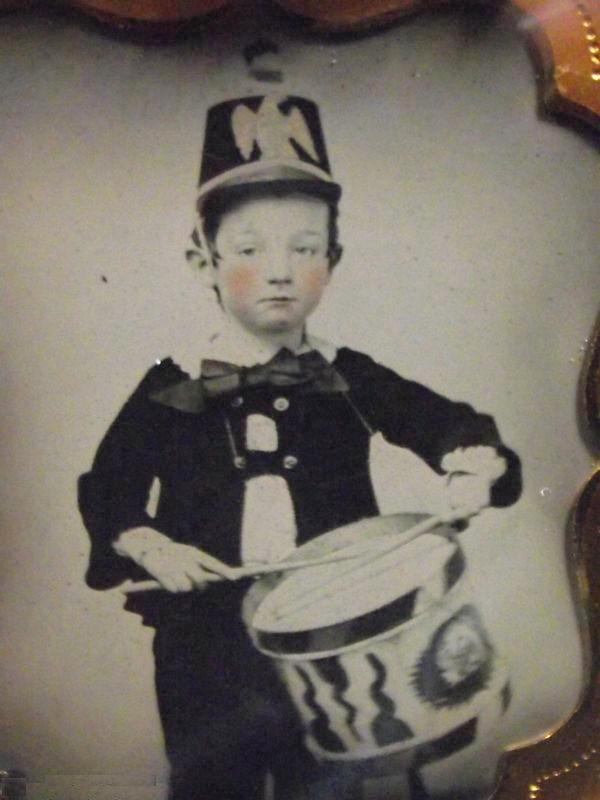
Our information on America in the 19th century is incomplete. We know relatively little about the early-19th century, although art work provides some limited information. We believe that boys in the cities generally were dressed in styles from Europe, especially Britain. We see styles like skeleton suits and tunics in available paintings and drawings. We know much less about rural America. This was wear most Americans lived, but the people there were not wealthy and were not very likely to pay even a naive artist to paint a portrait. This changes at mid-century when photography appeared from Europe. The photography industry exploded in America. As a result, beginning in the 1840s we have increasingly large numbers of images of how people dressed. Along with the development of photography was the steady industrialization and growth of cities in America. The number of images increased even more in the 1860s with the development of the CDV and cabinet card. Most of the images are studio portraits so they generally show people dressed up in their best clothes. The first photographic portraits like Daguerreotypes were expensive, but not nearly as expensive as painted portraits. Prices for Dags and other photographic work steadily declined as the century progressed so by the 1890s the economic bias in the photographic record declined. Shortened-length pants appeared at mid-century, but were worn mostly by boys from well-to-do families in cities. Gradually knee pants bdcome more common until by the 1890s we see boys wearingbknee pants into their teens and increasingly, but to a less extent in rural areas. And by the end of the century, America passed the threshold of a half of the population living in cities.
|
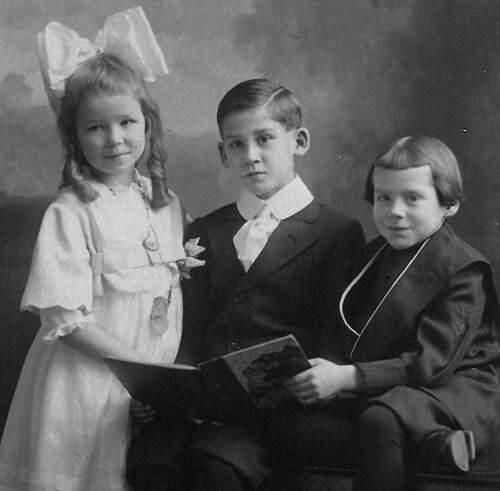
Late 19th century stules continued after the turn of the century. Little boys continued to wears dress, although not with as elaborate trim. The age of boys wearing dresses began to decline, especially in the 1910s.
Little Lord Fauntleroy suits were still popular. After the turn of the century
Fauntleroy suits with short pants (rather than kneepants) began to appear and
were increasingky worn with white stockings or white kneesocks. The size of the jackets increased to cover the blouse entirely. In addition large lace collars began to be replaced with ruffled collars and smaller bows. Some ruffled collars were wore with open necks. Increasinly kneepants and long stockings were replaced with either shortpants or knickers worn with kneesocks. Shortpants became particularly popular in Britain and Europe while knickers became more popular in America. America was a much more rural society in the late 19th and early 20th century tha it is now. Many Americans live on the farm or in small rural towns. When they dressed up they followed the same dressy styles as boys in the cuties wore--although the latest styles probably took a little longer to reach rural America in the days before television. Fashion magazines and mail order catalogs made sure that rural America was never to far removed from the latest fashions. A dramatic change occurred in the clothes worn by America boys
after the First World War (1914-18). Dresses and kilt suits for younger boys disaapeared as did Fauntleroy suits and kilts. Sailor suits were still worn, but most by younger boys. Knee panrs disappeared. Some boys wore the new short pants with kneesocks imported from England, but knickers proved much more popular in America. Boys continued to dress more formally than is common today. American boys mostly wore knicker suits. Suits and jackets were still more commonly worn than today. Double-breasted styles were popular, but single breasted jackets the most common. Parents generally purchased patterned knee socks for boys, although some boys wore ankle socks during the summer. What Americans now refer to as Eton suits for little boys appeared for the first time in the 1920s. Youner boys were the most likely to wear short pants. They were most common with affluent families which were more apt to follow and other European styles. In the early 1920s knickers were worn with long stockings or knee socks, but by the 1930s it became common to wear them with ankle socks--especially during the
summer. Overalls were commonly worn by rural boys, but city boys had not yet begun to wear what we now call jeans. Suits were less commonly worn as casual styles became increasingly accepted when families moved to the suburbs. One casual style popular in the 1940s and early 50s was an open-ecked shirt worn with a wide collar that did not button at the neck. Suits changed from large lapels in the 1940s to very narrow lapels in the 1960s. Flashy sports jackets with contrasting fabrics in the 40s and early 50s changed to more conservative styles in the 60s. Madras and searsuckets jackets were popular. Even by the 60s, some younger boys were still wearing them with short pants. Knickers began to become less common by the early 1940s and were not commonly worn by 1945. Little boys commonly wore shorts, but by the
early 1950s most America boys wore long pants, often jeans. Jeans for pre-teen boys might be lined in red plaid flannel. Jeans were not considered fashionable, however, and many secondary schools did not allow them, although his had begun to change by the late 1960s. The move toward casual clothes was accentuated by the Beatnicks of the 1950s and the Hippies of the 1960s. Major changed occurred in boys clothing beginning in the 1970s. The
move has been to casual clothing. All kinds of jeans were worn and they emerged as fashion statements. The full impact of the Hippies began to filter down to the average child. Children eventually demanded jeans, but not just any jeans--it was designer jeans in the 1970s. Other insisted on buying jeans that looked worn or even torn. The "T" shirt emerged as a major fashion, especially ones with statesments, logos, or athletic or music group images. Boys no longer dressed up in short pants and knee socks, except for the very youngest and even younger boys wanted longs by the 1980s. While boys didn't want to dress up in short pants, they increasingly wanted to wear shorts for casual wear.
As far as a prediction of changes in the coming new year, there is not much to look forward to, except the slimmer styles reemerging perhaps. I have noticed that more pro basketball players are wearing knee socks, at least one on every team, but not sure if this will grow or be picked up by the boys. A few years ago, during the crew sock boom, I was watching local high school basketball championships and the best players were wearing
white knee socks with their uniforms, and I thought they might continued to carry it through their college years and perhaps pro level, but that really hasn't occured. I doubt if the media will beocme so conservative again to allow a proliferation of "proper boys attire." In my opinion, it would take decades to achive the traditional look again, after the proliferation of casualness that has occured. Too many people don't care how they look anymore, sad to say, and it shows. And I seriously doubt that a movie like Angela's Ashes will bring back the short pant fashion, even with the year 2000 retrospectives. Yet, if a streak of conservatism is affecting the scouting movement, there is the chance that the "outside" world might be next.
We have collected many accounts about individual boys. Some are published accounts from biographies and memoirs. Some are journalistic accounts. Others are collections of photographs. Some HBC readers have provided us accounts of their boyhood experiences.
The 1870s: Joseph Breckinridge
The 1880s: Breeching
The 1880s: Dresses (Frank Schoonover)
The 1880s: A Virginia boyhood
The 1890s: The hated Fauntleroy suit
The 1890s: Heywould Broun
The 1890s: Dresses and Fauntleroy suits (Sammy Morrison)
The 1900s: Brother/sister outfits (Ernest Hemmingway)
The 1900s: An Ohio boyhood
The 1920s: First long pants suit
1925: First long pants suit--Eddie
The 1930s: Kindergarten
The 1940s: Short snipits
The late 1930s: Knickers and shorts
The 1940s: My Brother and I
The 1940s: A Philadelphia boyhood
The 1940s: A Catholic boyhood
The 1940s: A sailor suit
The 1940s-50s: Sneakers and jeans
The 1950s: Beaver Goes Shopping
The 1950s: Short pants
The 1950s: Jeans, Jeans, Jeans
The 1950s-60s: Classic American Styles
The 1950s-60s: Texas memories
The 1950s-60s: Northeast memories
The 1960s: Traveling in Europe
The 1960s: Shorts, jeans, and France
The 1960s: The Beautiful People
The 1960s: John's Long Hair
The 1960s: Personal Experiences in the 1960s
The 1960s: Mothers Buy Clothes
The 1960s: Parochial school in Chicago and California
The 1960s: Private school
The 1960s: A California boy
The 1970s: Jeans-A Minority View
The 1970s: The Disco Era
The 1970s: A South African friend and church
The 1980s: Smart Clothes/Mother's efforts
The 1980s: Catholic School--Tony
The 1990s: A Girl's view
The 1990s: Buying a coat

Navigate the Boys' Historical Clothing Web Site:
[Return to the Main U.S. Country Page]
[Return to the Main country chronology page]
[Introduction]
[Activities]
[Biographies]
[Chronology]
[Clothing styles]
[Countries]
[Bibliographies]
[Contributions]
[FAQs]
[Glossaries]
[Images]
[Links]
[Registration]
[Tools]
[Boys' Clothing Home]