United States Boys' Clothes: Late 19th Century


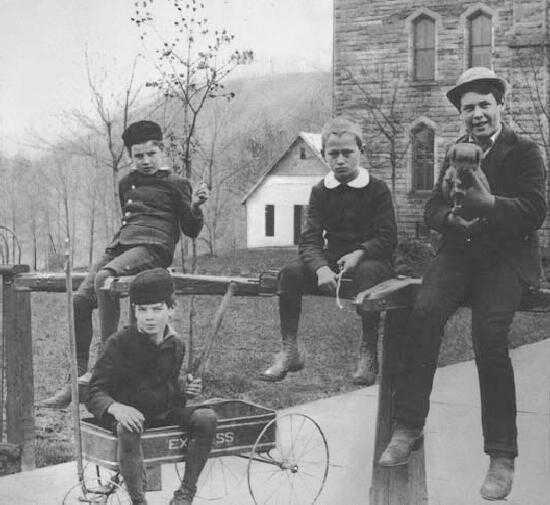
Figure 1.--This photograph was undated, but we believe was taken in 1889. It was taken at Geneva College, a Phrespetryian school north of Pittsburgh. The boys were mostly children of the teaching staff. Click on the image for a discussion of the image and the clothes the boys are wearing.

Little American boys from 3 to 6 years, in the late 19th Centuery still wore skirted garments. Little boys wore dresses, although now dresses especially designed for boys appeared. Older boys wore kilts, sailor suits, Norfolk suits and other English fashions. Smocks were used for both boys and girls to protect expensive clothes, although they were not as popular as in Europe. Easy to care for fabrics were generations away. One new fashion appearing in America in the the 1880s was the Fauntleroy suit. It was the sailor suit, however, that proved to be most enduring of these fashions. It was popular with both mothers and boys, unlike some of the alternatives like Fauntleroy suits and kilts. Even girls in the 1880s began wearing sailor suits, middy blouses with skirts.

Historical Background

The late 19th century after the Civil War (1861-65) was a period of rapid growth in America as America emerged as an industrial giant. A huge railroad grid was created, spanning the continent in 1968. Industries led by the steel industry benefitted by plentiful natural resoyurces and a growing base of skilled workers. America began to match and then exceed Europe in technological inovations like the telephone, electrical energy, scre propellers, and many others. There was a steady growth of an affluent urban middle class. More and more mothers had the time and money to give increasing attention to fashion, both their own clothes and that of their children. Boys' fashion in fact became extronidarily elaborate, such as the classic Little Lord Fauntleroy suit with dark velves, huge frilly lace and ruffles, giant floppy bows, and satin sashes.

Styles

Several destintive boys' fashions became popular in the late-19th Century. Some of the most elaborate outfits ever designed for boys appeared. The more varied styles of mid-century America coalesed in more easily recognized styles. The skeleton suit was no longer worn. An older style, the tunic, appeared as a new style whicgh became enormously popular at the turn of the century. The new styles introduced, mostly in England, like kilts, sailor suits, and knee pants became widely worn.

Garments

Boys wore quite a wide range of clothes. Mass production was beginning to sandardize boys' styles, but the diversity of styles could be starling. A 6-year old boyt, for example, might wear a dress, kilt suit, a Fauntleroy suit, a sailor suit, or a kneepants or long pants suit. After the turn of the century, a boy's fashion options would be much ,ore limited.

Dresses

Boys continued to wear dresses in the later part of the Century. Many continued wearing the same styles as their sisters, but other boys wore the dresses that were now especially styled for boys. Their dresses were little different than those worn by their sisters. The age at which boys wore dresses was extremely varied. Mothers had very different attitudes about when their sons should be breeched and their curls cut. Breeching generally occurred at about age 5 or 6, but it could be sooner or later. The mother had considerable disgression on the matter.


Figure 2.--This boy weras an early kilt suit in a photograph taken about 1870. Note that the jacket is made to be worn open and there is no large floppy bow.

Kilt Suits

The Higland kilt and other Scottish regalia was never very popular in America, although they werre worn--especially in wealthy families. Much more popular was the kilt suit which was a matching jacket and skirt, but not normally in bright Scottish plaid material. The styling of these outfits varied somewhat in the late 1860s and early 1870s, but had become fairly standard by the late 1870s. They were a very popular style for boys in the late 19th century, but declined in popularity after the turn of the century.

The kilt suit was an intermediate step for boys which became popular in the 1870s. Many mothers with boys 4-6 years old did not believe that they were ready to be breeched, but no longer wanted yo outfit them in dresses. I'm not sure if the reluctance to keep boys in dresses came from the mother or perhaps the father intervened. Boys did have their own opinions on the matter, but they were not often considered of great importance by their mothers. At any rate, the kilt suit provided the perfect compromise. It had many boyish features. In fact the jacket could be later paired with kneepants after the boy was breeched.


Figure 3.--The tunic fashion made a come back in the late 1890s. Various styles were worn, including sailor, Russian, and Buster Brown styles. They were worn with bloomer knickers. Click on the image for a full view.

Tunics

Tunics declined in popularity in the 1860s. They reappeared in the late 1890s in a variety of styles, Russian blouse, sailor, and Buster Brown suits. While the various styles differed greatly, almost all had belts and were worn with knicker bloomers that showed below the hem of the tunic. Girls also wore these tunics, but often the knickers did not show like the boys' tunics. Much older girls wore these tunics than boys.

Suits and jackets

The rather non-discript, plain suits with short jackets worn with long pants changed in the late-19th century to better tailored jackets that look increasingly like modern jackets. Despite the extremely fancy styles which developed during this period, many suits had very simple styling. The Norfolk jacket which appeared in the late 19th Century was one of the more elaborate. Some had double breasted styling. Most were much simpler. Sometimes stylistic elements were added from other styles like sailor suits

Suit pants

The pants worn with suits as well as for everyday varied during this period. Kneepants in the 1870s were mostly for younger boys, but by the 1890s, quite old boys were wearing kneepants suits. Suits were made with both long pants and and kneepants. Boys wore both, but kneepants were verybwidely worn. Unlike earlier years, suits were now always made with matching material.


Figure 4.--The tunic fashion made a come back in the late 1890s. Various styles were worn, including sailor, Russian, and Buster Brown styles. They were worn with bloomer knickers. Click on the image for a full view.

Fauntleroy suits

The most recognizable style of the late 19th century is of course the Little Lord Fauntleroy suit made famous by Francis Hobson Burnett's classic novel, Little Lord Fauntleroy which was published in 1885. After the publication of her book, the Fauntleroy craze was on. The velvet suit, lace collar, and of course ringlet curls became the bane of American boyhood. The style persisted for more than a generation. The style was not created in a vaccume. Mothers had begun to dress little boys in fancy velvet suits before the publication of Mrs. Burnett's book, but the publication of the book created a Fauntleroy craze and soon increasingly fancy outfits for small boys. Some mothers even dressed older boys in the elaborate outfits, usually with some resistance on the boy's part--even in those more complant days.

Sailor suits

The sailor suit emerged in the 1870s as an increasingly important style for boys. There were a wide variety of styles worn. The classic styits followed the styling of actual national sailor uniforms. Mother being mothers, many selected more fanciful styling which could include lace and rufles for the younger boys. The popularity grew steadily until the 1890s when it was the single most popular style for boys.


Figure 5.--Lace collars were commonly worn with fancy party suits in the late 19th Century. This boy, however, wears a plain white collar which appeared in the 1890s. Note the back flap and blouse which is not tucked in.

Shirts and blouses

The small collars wore at mid-century grew steadily until collars that seemed to dwarf small boys became fashionable in the 1880s, fueled in part by the Fauntlery craze. Lace collars are the most easily recognizable from this period. Older boys might wear Eton collars. Wide white collars for younger boys, unadorned by lace, appeared in the 1890s.

The classic Eton collar was increasingly seen in he 1880s. A variety of boys' collars, influenced by the Eton collar, were noted in earlier periods. The classic Eton collar, however, was not much worn in America until the 1870s and was not commonly worn until the 1880s. It was quite common to wear them in the 1880s with large floppy bows. This was not common in England, but was a very popular style in America, especially for the younger boys wearing Eton collars.


Figure 6.--This Massachussets boy photographed in 1884 wears a simply styled suir, Eton collar, floppy bow, and kneepants. If he had been a year or two younger, he might have worn a Fauntleroy suit as the craze following the book's publication began in 1885.

Bows

Shirts and blouses by the 1880s were worn with large bows of many different colors and patterns and tied in different bows. Some boys wore ther large lace and other collars without bows, but it was much more popular to wear them with bows. Even Eton collars were worn with bows, at least by the younger boys.

Pants

Boys in the 1870s were increasingly wearing kneepants, although long pants were still common. Boys by the 1890s, however, more commonly wore keepants, including many older boys.

Pantalettes

Pantalettes were occasionaly worn by boys still wearing dresses or even a few boys in Fauntleroy suits. The fashion, however, was rapidly disappearing and except for very young boys, was little seen by the 1890s.

Caps and hats

A wide variety of caps and hats were worn, but it was the wide-brimmed sailor hat that dominated the wardrobe of boys. These large hats were worn both with sailor suits as well as many other outfits such as kilt suits, Fauntleroy suits, and tunic suits. Other types of head gear, especially sailor caps became increasingly common in the 1890s.

Hair Styles

Most American boys in the late-19th century wore short hair. This was in contrast to the longer hair styles popular at mid-century. While short hair was standard, there were other styles. The most famous were ringlet curls. This was part of the the Fauntleroy craze that Mrs. Burnett initiale with her book (1885). Some boys wore long shoulder-length hair done in runglets. American mothers especially liked to curl their son's long hair into fashionable ringlets. This style was not nearly a popular in Europe. While not as common as short hair, the Fauntleroy ringlet curls was widely worn by American boys. It was an established style in the 1890s.

Materials


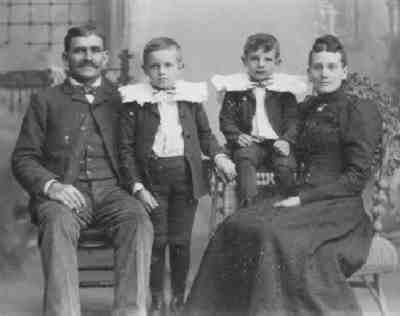
Figure 7.--These Missouri (mid-western) boys and their parents were photographed in the late 1890s. They wear less expensice ruffled collars, rather than lace collars, and no wrist trim. They wear inexpensive versions of the classic velvet Fauntleroy suit which could be quite expensive. Note the very small bows.

Decade Chronolgies

The proliferation and falling cost of photography provide us far greater information about fashion than ever before. Of course there are many more images from the 1890s than the early decades, in part because of rising income levels and falling costs of studio portrits. Even so there are substantial numbers of photograps availablr from the 1870s andc80s. Most of the images, especially of children, were studio images--almost always dressed up in their best outfits. Images of everyday clothes do not begin until the development of amateur snapshots at the turn of the century. Fashion magazines continue to expand, including the publication of patterns. Magazines achieved runs that can be called mass circulation by the 1890s.

The 1870s

Little boys in the 1870s continued to wear dresses. The kilt suit appered in the 1870s. Thios was a fashion inovation based on the Scottish kilt that Queen Victoria had helped popularize for boys. While American boys did not wear Highland outfits, the kilt suits became very popular. Sailor suits appeared in many forms, but were not yet the dominate stule for boys. Fancy velvet suits for boys appaered showing a French influence, but they were not yet called Faintleroy suits. Some had fancy collars and bows, but generally not the huge collars and bows that appeared in the 1880s. Many styles of hats appaered for boys. Collars began to increase in size as did bows by the end of the decade. Boys were increasingly dressed in kneepants rather than long pants. By the end of the decade, kneepants had become a widely accepted fashion for boys, although they were generally not yet commonly weorn by teenage boys, except for the very youngest.

The 1880s

The major development in the 1880s was the appearance of Little Lord Fauntleroy suits. Fancy velvet suits for boys appeared before the publication of the story in 1885, but the popularity exploded after the story appeared in print and on the stage. Soon collars and bows increased greatly in size. Other styles such as Eton collars for older boys and sailor suits grew in popularity.

The 1890s

Younger boys still wore dresses in the 1890s. There seems to be more of a trend to differentiate boys and girls clothing. We note boy dresses bing advertized. The conventionof boys wearing drsses which has existed for centuries seemed to decline in popular in the later part of the decade. We are not entirely sure why. We think the popularity of the kilt suit and Fauntleroy suit were factors here. Smocks were not common in America except in rather affluent families. The styles of the 1880s, such as kilt suits, Fauntleroy suits, and sailors suits continued to be popular. The sailor suit was especiallly popular and was now also worn by girls, but with skirts rather than kneepants. Fancy styles such as Fauntleroy suits reached their peak of popularity in the 1890s as were sailor suits. Boys commonly wore blouses, often with large collars, with knee pants and long stockings, mostly black long stockings. Kneepants were now widely worn by boys of all ages. We see even older teenagers wearing knee pants by the end of the decade. Most boys wore kneepants, mostly with long stockings. Some boys might wear long hair, in some cases in ringlet curls. By the end of the decade many boys were weraing tunic suits. The new style of tunic or blouse suits, made in various styles (sailor, Russian, and Buster Brown) were enormously popular and began to replace the kilt suit. Boys mostly wore short hair in the 1890s. Some boys, however, wore ringlet curls. While worn by a minority of boys, we see many portraits of boys wearig long ringlet curls, especially with fauntleroy suits, but also with sailor suits. The fashion of ringlets was more popular in America than in other countries.

Youth Culture

The Civil War (1861-65) was a great empetus to the growt of industry in the northern satates tomsupport the war effort. This accentuated earlier demographic and social trends like urbanization and industrialization. By the 1870s these trends had significantly changed America from the agrarian andcraft-based economy of the 18th century. By the 1890s, America had become one of the world's industrial powers, on an economic par with the major European powers. The impact was far reaching. Youth were now spending considerable time in school. Almost all children received at least some schooling and increasing numbers were now finishing primary school, although secondary school was still largely for urban children from affluent families. This meant that children were much more dependent on their parents for a longer period. Until the early 19th century, most boys lived on the farm or were apreticed at about age 12. Boys were still apprenticed in the mid-19th century, but many more boys continued their education for longer periods. This development was giving rise to a new phemomenon--youth culture that was to have a great impact on fashion and dress. It was to have other benign consequences. Pre-Civil War newspapers report youth "gangs" and "juvenile delinquency" in the larger cities. High school fraternities and sororities, though not as violent as gangs, were a matter of concern and prohibited by a number of states in the Progressive Era. [Graebner, pp. 11-13.]

Sources

William Graebner, Coming of Age in Buffalo: Youth and Authority in the Postwar Era (Temple University Press, 1990).



HBC


Navigate the Boys' Historical Clothing Web Site:
[Return to the Main U.S. chronology page]
[Return to the Main U.S. page]
[Introduction] [Activities] [Biographies] [Chronology] [Clothing styles] [Countries]
[Bibliographies] [Contributions] [FAQs] [Glossaries] [Images] [Links] [Registration] [Tools]
[Boys' Clothing Home]


Created: June 12, 1999
Last updated: 1:44 AM 5/3/2008