|
he pace of growth quickened at mid-century. The oopulation was still largely rural, but cities and the proprtion of utbsanized population was growinhg. And with urbanization and industriaoization, incomes were rising. This inevitably affected fashion and the clothing industry. Styles werec still set in Eurooe, but more and more Americans were becoming able to affird the trendy European fashions. Boys' fashions at mid-19th Century were in a fluid state. The only styles such as tunics and skeleton suits were now less commonly worn. The new styles introduced, mostly originating in England, like kilts, sailor suits, and knee pants had appeared, but were still being accepted. We see increasingly well-tailored garments, especially by the 1860s. The Civil War was a huge boost to the clothing industry and ready-made clothing. Among other impacts, it brought the cost of clothing down. This and rausing incomes was a formulae for the growing interest in fashion zand the ability to participate in the evolving, increasingly fashionable society. Farm parents might not care all that much with fasgionzble cloythes fir their children, city parents did. Some major styles like Fauntleroy and Buster Brown suits had not yet appeared. Boys tended to wear rather non-discript, plain suits with short jackets and long pants. Their collars and bows were generaly small. One important development was photography, which was perfected at mid-century and increasing numbers of images were soon availabe, revealing fashion trends in increasing details. The fashion magazines also appeared at mid-century, providing even more information.
The mid-19th Century, until the mid-20th Century, was probably the most critical period in the history of the American Republic. The America of the 1850s was a powder-keg that finally erupted in the Civil War which in large part not only decide the fate of the American nation and in turn Western civilizatiion itself. In the end, the Republic was saved, slavery abolished, and the basis the industrial expansion of America began. This tumultuous period was not reflected in major fashion changes. These were, however, to come in the late 19th Century.
Boys' fashions at mid-19th Century were in a fluid state. Old styles were still worn to some extent, but going out of style. The new styles were still new and not yet fully accepted. Fashion trends in the mid-19th Century did not move nearly as rapidly as trends move today. Clothes were still largely hand made and as a result still very expensive. The old styles such as tunics and skeleton suits were now less commonly worn. The new styles introduced, mostly originating in England, like kilts, sailor suits, and knee pants had appeared, but were still being accepted. Some major styles like Fauntleroy and Buster brown suits had not yet appeared.
|
It is interesting to compare the construction and cost of mid-19th century garments with those available later in the century. The garments worn at mid-century were the last era when clothes were hand stiched and made individually. The fit of these garments is noticeably looser than those worn in the late 19th century. This is because the mechnization of clothes production meant that clothes were available in a much wider range of sizes and the cost of producing them plumeted. Clothes at mid-century were still quite costly. They were made by indivudual seamstresses or mothers of varying talents. (Seamstresses generally made boys clothing until they began tio wear adult styles at which point they would be taken tio a tailor. In addition, clothes were not discarded, but worn by a boy until he had fully outgrown thenm at which point theu woukld be passed on to a younger brother or if not yet breeched sister.
Phtoghraphy was invented in France (1839). It began with the Daguerreotype. Within months there were studios in America. No country took to photography as energetically or as rpidly as America. Thus we have a larger and more extensive 19th century photographic record for America than any other country. So we have a huge number of images available for the first time in the mid-19th century. Illustrations of families and individuals for most of history were limited to a relatively small of artistic depictions. These focused heavily on the elites of society. Photography in the mid-19th century revolutionized this. Suddenly we see large numbers of images not only from the elite sectir of scociety, but from the middle-class as well. Daguerreotypes were epensive, but not nearly as expensive as a painted portrait. Ans a new photographic types were developed, the price steadilt declinedespecially with the albumen oroces (DFVs and cabinent cards (1860s). By the end of the century the working-class could also aford portraits. Most of the photographic images in the 19th century, however, were studio images with the subjects dressed up in their best or other clothing. Thus to see how children dressed outside the studio, we have to turn to artists and illustrators. Severl indiviuals are important here. None provide more wonderful images than Winslow Homer (1836-1910). He painted several importnt images of children and not only does he orivide images outside the photographic studio, but they are images of ordinay children and not just the rich and well-to-do middle-class. Given Homer's age, one might have thought he would beter represent the late-19th century. But artists are often influenced s to how they depict children by their earlier years. In addition, children fashions on the frontier and rural are did not change as rapidly as city fashion.
|
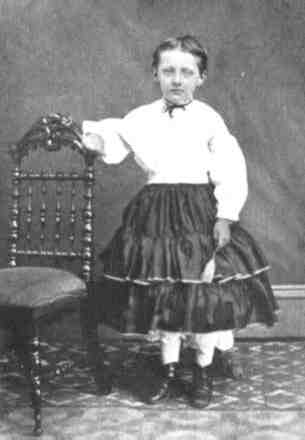
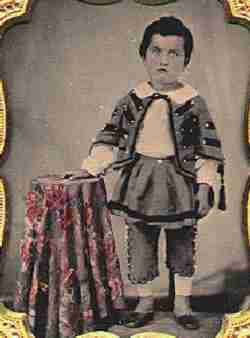
A greater variety of garments may have been worn by boys during the mid 19th century than any other period. The fact that readt-mafe clothing were ot yet widely available was a factor. And during mid-cebtury webegin tonsee growng afflunce from America's developing indystrial economy. This mean that the American people has increasing disposble income to aford fshionble clothes. And because of photography we hace a very detailed photographic record. We note a range of headwear. Rounded-crown hats were very popular. We note some skirted garments. Dresses were widely worn by little boys. Tunics never completely compleletly disappeard. We note a lot of boys wearig shirt-like tunics. at mid-cebtury. By the 1860s we see more nd mot boys wearing suit jackets. We see kilt suits appering in the 1860s. A few boys in the 1840s were still seen in skeleton suits. The new sailor suit and kilt styles from England slowly increased in popularity. The Mexican and Civil Wars introduced military styles. Long pants dominated in the 1840s, but knee pants began to appear by the mid-1860s. They were more of a fashionable style rhan a style widely worm by most boy. We see children wearing long stockings, both girls wearing dresses and boys wearing knee pants. Unlike Europe, we rarely see children, even younger children ith bare legs. We begin to see high-top-shoes in the 1860s. American boys' fashions as adult fashions were still strongly influenced by European fashion trends.
|
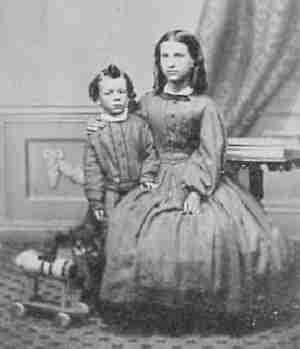
Very young boys might wear long hair and curls. Ringlet curls became increasingly common for girls of all ages during this period, as they did for their mothers. Long ringlets seem rare in the 1840s, but by the 1860s we begin to see short ringlets. Note the boy here with a large ringlet on top of the head (figure 4). I am unsure to what extent boy's hair was dome in ringlets. They might have been ]used for toddlers, but I do not think they were normally used to
style the hair of older boys. Older boys generally wore short, but not very short hair. A good example is Thomas Hardwick about 1840. It was common for boys to wear their hair over their ears. Another example is an unidentified boy. Some boys had long hair and curls, but the norm was generally short hair.
No information developed here.
Information on fashion increases enormously in the mid-19th century. Photography was perfected amd became commercially viable by the 1840s with the Daguerotype. Thius was a photograpgic process invented in France (1839). This was a major development because while still expensive, was much less expensive than a painting. A substantial part of the population could aford a portrait for the first time in history (1840s). Dags provided styling, but not color details. Ambrotypes, tin-types and other processes appeared (1850s) further driving down prices. These were available in Europe, but only substantial numbers of these images were only available in America. Here they were done as cased images that could be carried. Further advances had made photography much less expensive by the 1860s creating ever increasing numbers of images. Ambrotypes (CDVs and acbinet cards) involved negatives. This multiple copies could b made at klow prices. This enable copies to be sent to famoly and friends. Most of the populatioin could now aford a portait of himself or family. As a result, for the first time we have huge numbers of images showing us preciseky how people dressed. The concept of the fashion magazine arrived in America during this period. While circulation was still limited, fashion information was arriving at the American home as never before.
Academic sources report that early as the 1830s, social trends like urbanization and industrialization were beginning to change America from the agrarian and craft-based economy of the 18th century. These trends became much more pronounced in the 1840s and 50s as America moved toward Civil War. The impact was far reaching. One result was to create youth who spent more time in school. In the early 19th century many children did not attend schools at all or got only a few years of schooling. This began to change by mid-century as almost all children received at least some schooling. This mean that children were much more dependent on their parents for a longer period. Until the early 19th century, most boys lived on the farm or were apreticed at about age 12. Boys were still apprenticed in the mid-19th century, but many more boys continued their education for longer periods. This development was giving rise to a new phemomenon--youth culture that was to have a great impact on fashion and dress. It was to have other benign consequences. Pre-Civil War newspapers report youth "gangs" and "juvenile delinquency" in the larger cities. [Graebner, pp. 11-13.]
A sizeable number of Americans through the mid-1860s lived in slavery. These black Americans lived mostly in the southern and border states. The fashions discused on HBC for the mid-19th century are those worn by free whites. Some blacks lived in northern and even southerm states as free, but not all franchised citizens. The vast majority of blacks, however, were slaves living in the South. The clothing worn by these Americans need to be addressed. It is probably fair to say that slave children were dressed poorly. The principal concern here almost certainly was money. Thus with most slave holders the primary concern about clothing was cost. The clothing slave children received depended somewhat on the conditions of servitude. No examination of historical boys' clothing styles in America would be complete wihout an examination of slavery which was a legal institution until 1863-65. HBC has very limited information on slavery and how slave children were dressed at this time, but it is an issue we hope to persue. There are limitations here as there are few photographs of slave children until he arrival of Federal troops in southern slave states. Some of the photogrphs that were taken are of light-complexioned children. These are course are the offpring of white masters and lave women. These children often became houuse servants are were quitely shipped north by theie fathers. The limitations to the photographic record mean that we have to rely hevily on the written record. Here of course considerable must be taken as the philosophical and political orientation of contemporary authors hs to be considered. Slave children were normally provided one or two simple garments. These might be referred to as 'shirts' for boys or 'dresses' for girls. In fact there was only little difference.
We have several American boys from the mid-19th century archived on HBC.
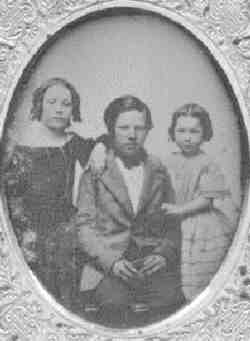
We will gradually archive the examples here. We note an unidentified boy wearing a suit or vest, probably in the 1830s or 40s. Another example is Thomas Hardwick about 1840. We note unidentified brothers and sisters in the 1850s. We note Arthur Hamilton wearing plain pantalettes in 1869.
Graebner, William. Coming of Age in Buffalo: Youth and Authority in the Postwar Era (Temple University Press, 1990).

Navigate the Boys' Historical Clothing Web Site:
[Return to the Main U.S. 19th century page]
[Return to the Main U.S. page]
[Introduction]
[Activities]
[Biographies]
[Chronology]
[Clothing styles]
[Countries]
[Bibliographies]
[Contributions]
[FAQs]
[Glossaries]
[Images]
[Links]
[Registration]
[Tools]
[Boys' Clothing Home]