
United States Boys' Fashion Conventions: Age Gradeing
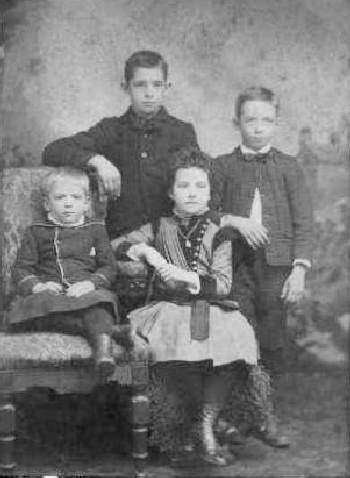
Figure 1.--These children were almost surely siblings. Notice the strict age gradeing of the boys' outfits. The youngest boys wears a simple dress. The middle boy a cut-away jacket and the oldest boy a collar-buttoning jacket. Hair styling is also used. The younger boys has bangs. The two older boys have a hair style with a part. The portrait here is undated, but was probably taken in the 1870s.
|
|
In contrast to identical outfits, another popular fashion convention for children, some parents (mostly mothers) took an age-graded approach. Age grading was adopted in many other countries, but seems especially popular in America. There were different approaches here. Many mothers focused exclusively on clothing. Many age associated clothing conventions these have varied over time as well as the populatrity of age-graded clothing itself. Thus we see families with several children altering the outfits to some extent varying on the child's age. Sometimes the variations are minor such as just changeing the collar and/or neckwear. This was particularly popilar in the late 19th and vert-early 20th century when floppy bows and large collars were stylish. This also made in very easy tto add or remove age gradeing touches. Others are more significant such as varting the type of shirt/blouse and trousers. We have age gradeing discussions on many of the specific garment pages. Clothing was not the only element in age gradeing. Hair styles were also used. Some mothers used clothing items and others hair styles. And others used both clothing and hair styles. This wac largely determined by each mothers fashion sence.
Popular American Convention
In contrast to identical outfits, another popular fashion convention for children, some parents (mostly mothers) took an age-graded approach. Age grading was adopted in many other countries, but seems especially popular in America.
There were different approaches to age gradeing useing clothing. Many mothers focused exclusively on clothing. Many age associated clothing conventions these have varied over time as well as the populatrity of age-graded clothing itself. This varied with the size of the family. Thus we see families with several children altering the outfits to some extent varying on the child's age. Sometimes the variations are minor such as just changeing the collar and/or neckwear. This was particularly popular in the late 19th and vert-early 20th century when floppy bows and large collars were stylish. Here moinor variations could be use for each child in a large family. This also made in very easy tto add or remove age gradeing touches. Others are more significant such as varying the type of shirt/blouse and trousers. Younger boys might wear blouses with sylish, sxometimes very large collars. Younger boys might wear various skirted garments. They also from the mid-19th to the mod-20 century commonly wore shortend-lrngth pants, including knee pants, knickers, and short oants. We have age gradeing discussions on many of the specific garment pages and will link those pages here.
Clothing was not the only element in age gradeing. Hair styles were also used. Some mothers used clothing items and others hair styles. As different hair styles had age connotations at any given point in time, we notice hair styles as well as clothing being commonly used for age gradeing, a common practive in the late-19th and early-20th centuries. Often mothers employed both hair and clothing styles to complement the ages of their boys. This practice often continued into a boy's mid-teens when he began to chose his own clothes and hair styles. Hair styling in age gradeing was most pronounced in the late-19th century. This was because afe gradeing was mmost common during this period and the clothing styles for younger boys particularly destinctive. By the same token there were some very elaborate hair styles for younger boys. Some approaches may seem a little strange. We note some younger boys in the mid-19th century dressed in rather mature suits, but with juvenile hair styles. We note boys in the late-19yh century with both juvenile clothing and hair styles. Age gradeing continued into the 209th century, but with less dectincive outfits and hair styles.
Mixed Approaches
Some mothers used both clothing and hair styles.
Family Conventions
The approaches selected varied widely from family to family. There does not seem to have been any standard American appropaxh here. This was largely determined by each mothers fashion sence. Of course this was in part influenced by her family experiences as a little girl and advise by female family mothers.
Boys and men basically wore the same styles through the 18th century. The primary differences were social class. Rgweee wsedre huge didfferences netween the aristocracy, middle class, and peasantry. This began to change in th 19th century, in part because of the rising affluence of the middle class and working classes and in part because of the declining relative cost of clothing. Age was not vey important because children were seen esssentially as small adults. With the increasing recognition that childhood was a special time of life and that children had special needs we begion to see the development of dedicated boys' styles with the skeleton suit (1800s), we begin to see the idea of age grading appearing, espcially in the second half of the century. Age grading became a well established convention, although the styles involved and the conventions practiced varied substantially over time. Thus we see a range of different garments being used for age grading. They have included headwear, collars, bows, jacket styles, skirted garments, pants type and length, pants suspension hosiery, and footwear.
Age Trends
Social Class
Social class was definitely a factor in age gtading. A reader writes, "I think that a sign of wealth was allowing a child to look more juvenile for longer periods. There is a quote of the mother of one of the Johnson & Johnson heirs and how she was able to keep her son in velvet suits until age 13." We think this was especially true in the late-19th century when American's expanding industrial economy was generating enormous wealth and newly affluent families wanted to show off their new circumstnces. This continued to be the case in the early-20th century, but this association is not necesarily the standard approach of the well-to-do in America and other countries.
HBC

Navigate the Boys' Historical Clothing Web Site:
[Return to the Main Country age grading page]
[Return to the Main Age Convention page]
[Return to the Main U.S. Fashion Convention page]
[Return to the Main U.S. country page]
[Introduction]
[Activities]
[Biographies]
[Chronology]
[Clothing styles]
[Essays]
[Bibliographies]
[Contributions]
[FAQs]
[Glossaries]
[Images]
[Links]
[Registration]
[Tools]
[ Boys' Clothing Home]
Created: 12:36 AM 6/25/2008
Last updated: 12:33 AM 9/3/2013