|
One of the most destinctive styles of neckwear worn by Ameican boys was the floppy bow. This was a style worn by adults at the turn of the 19th century. It was popular during the Regency in Britain where it was worn by Beau Brummel. I thimk it was less common in America. When the floppy bow reappeared beginning in the late 1870s, it seems to have been a style particular popular in America. Large numbers of images show boys wearing large floppy bows in the late-19th century. This may be because our American archive is so substantial, but our Europen archives are growing and it does seem that floppy bows, esoecially large floppy bows were especially popular in America. This makes sence because it was strongly associated with the Fauntleroy style. And the Fauntleroy craze was espeilly pronounced in America. They were also worn in Europe, but we seem to see many more examples in America, especially the large floppy bows. And floppy bow at this time were a distinctly juvenile style. They were worn with equally large collars of various descriptions. Wearing floppy bows with fancy blouses was an optional matters. Some mothers insiste on the bows while others did not. They were worn with more plainly styled bows like Eton collars, but this was less common.
One of the most destinctive styles of neckwear worn by Ameican boys was the floppy bow. It added color and a decorative touch to the often drab or somber-colored outfits worn by boys.. Abd it was a boys' style. Girls did not wear these floppy bows to any extent.
Most of our work on boys' collar bows has involved American boys because most of our images are American. As far as we can tell, the fashion was especially popular in America. Large numbers of images show American boys wearing large floppy bows in the late-19th century. Here it was strongly associated with the Fauntleroy style. Large collar bows, however, were worn with many other types of suits as well as blouses worn by older boys. Many boys dressed up and did not wear bows or other neck wear. This was particularly common in the mid-19th century. A good example here is the Wallis brothers in 1852. Many other boys did wear neckwear and by the 1880s this was often floppy bows. The floppy bow was the most popular tyoe of neckwear for American boys during during the 1880s through the 1900s. A major factor, of course, was Mrs. Burnett and her Little Lord Fauntleroy story that she published (1885). We see boys in other countries wearing them as well, but nowhere were floppy bows as popular as in America. It is a little difficult to estimat, but we woukd say that well over half of the children in studio portraits were photographed wearing floppy bows. And it was a destinctly boy's style.
The floppy bow was a style worn by adults at the turn of the 19th century. It was popular during the Regency in Britain where it was worn by Beau Brummel. I think it was less common in America. Men and boys during the mid-19th century wore inconspicuous and usuall black stocks. Boys often wire no neckwear at all. This began to change in the 1860s when we notice small bows replacing stocks. We notice small bow in the 870s which graduallgrew larger. These bows by the 1880s grew markedly in size and by the late 1880s and 90s could be gigantic, sometimes almost dwarfing a small boy. Around the turn of the 20th century they began to fall in size. An ecample here is the Kemp brothers who wear moderate-sized bows in 1898. We see Harold Howes wearing a moderate-sized bow with an Eton collar and tunic suit in 1905. Floppy bows continue to decline in popularity during the 1910s. We see smaller and simplier bows. A good example is Floyd Van Horne about 1915. After World War I, floppy bows were no longer common, although small boys might wear them.
There were several ways of tieing the bows. We do not know the specific terms for the different knots. The two basic waus was to tie the bows with and without tails. Tieing them with tails was by far the most common trend. We do not know if any conventions were involved here. A good example is the bows worn by the Nethery boys in 1915. The younger brother has a bow withbtails. Th older brother has his bow ties without tails. The other bow commonly worn by Ameican boys was the scarves worn with sailor suits. Here there was avery casual knot and the scarve left to hang. This contrasts sarply with the formal knots German boys wore with sailor suits.
When the floppy bow reappeared beginning in the late 1870s, it seems to have been a style particular popular in America. They were also worn in Europe, but we seem to see many more examples in America, especially the large floppy bows. We are just beginning to assess collar now country trends. Most of our work on boys' collar bows has involved American boys as most of our images are American. As far as we can tell, the fashion was especially popular in America. Large numbers of images show boys wearing large floppy bows in the late 19th century. Here it was strongly associated with the Fauntleroy style. Large collar bows, however, were wiorn with many other suits as well as blouses. We have, however, noted boys in many other countries wearing floppy bows. A good example is a Canadian boy in 1898. Canadian trends seem to have been similar to American trends. They were also worn in Europe, although the popularity varied substantially from country to country. We believe that they were particularly popular in France. We have much less information on other countries.
Floppy bows for boys in the late 19th and early 20th century were a distinctly juvenile style. For this reason they were used by mothers for what was called "age grading". They were not, however, just worn by very little boys. While they were commonly worn by younger boys, they were not exclusively for very young boys. HBC has archived hundreds of photographs of pre-scool and school age boys wearing them, mostly in the late 19th century. We note 4-year old Gordon Bently wearing a sinole flat bow in 1879. We note Bert Dodge wearing a floppy bow at about age 3 in the 1880s. We note Harold Howes at age 5 years wearing a moderate-sized bow with an Eton collar and tunic suit in 1905. Another example is Charles Dorff who looks to be about 8-years old about 1905. And we see Percy Jackman wearing a floppy bow at age 10 in 1899. We also note younger teenagers wearing them. We see some 13-year olds and a few 14-year olds wearing them. Youngr teenagers wearing floppy bows became less common after the turn of the 20th century. We still see them in the early 1900s, buy after about 1905 they begin to declie in popukarity. And the age of boys wearing them as well as the overall popularity of this fashion gradually declined.
We are not yet sure about the gender conventions associated with floppy bows. Them may have changed over time as did the popularity of the bows. We note that in late 19th and very early 20th century that boys often wore floppy bow, sone times quite large ones. We see boys wearing floppy bows quite commonly when dressing up. It was not only boys who wore floppy bows, but we see many more bows wearing them than girls during this period. We note family portraits. In quite a number of these family portraits, when the boys wear floppy bows, the girls do not. After World war I, the floppy bow becme less commonly used, but we do see younger boys wearing them in the 1920s. They seem less common for girls. Here we are just beginning our assessment, but this is our initial findings.
We see boys commonly wearing floppy bows in the late 19th and early 20th century. There were a range of conventions that developed for these bows some of which addressed size. They were not universal. Mothers had very different attitudes so we see quite a variety of choices associated with wearing these bows. We do not know of any actual fashion guidelines actually written down at the time. There were many publications at the time giving fashion advise. They wore them to dress up for parties and church. We also see them commonly worn to school. A good example is a Catholic school in the 1890s. There were a range of conventions associated with wearing floppy bows. We see boys wearing floppy wows without elaborate collars. We also note elaborate collars being worn without floppy bows or other neckwear. Floppy bows were, however, the most common ndeckwear orn with fancy Faunrleroy ruffled and lace collars. Her mothers adoped various convntions. Some mother chose huge collars with modest floppy bows. Other mothers wanted huge bows which covered or almost covered the collar. With other collars such as Eton collars, neckwear was more diverse. We see ,any floppy bows, but we also see oyther nrckwear such as bow ties and neckwear. Here age was often a factor. Gender was also a factor. We note girls with floppy bows, but the huge floppy bows were more common for boys.
Floppy bows came in all kinds of sizes. Some were so small that they look more like bow ties. Others were so large that they they also seem to engulf the boy. This varied chronolhically. Bows in the 1870s were relatively small. We note larger bows in the 1880s. They could be enormous in the 1890s and then declined somewhat in size during the 1900s when they rapidly went out of style. Size conventions varied from family to family. Here it was all up to mother. She could buy as long a length of material as she wanted to make the bows. We don't know much about this, but assume a millenary or department store had all kinds of colors and patterens of bow material in different widths. It must have been a very colorgul section of the store. I'm nor sure what the widths were. Age was another factor. Yonger boys seem to have the largest bows, but of course small sized children make the bows look larger.
Color is a very difficult topic with the floppy bows worn in the late-19th century and to a lesser extent the early 20th century. Photography was black and white, thus providing very few color clues. Another problem is that catalogs were also almost entirely in black and white. We have found only a few painted portraits. What is available or colorized photographic portraits. These of course are less valid than actual color photographs, but we believe that colorizers did try to get the color right if specified. The specific shade, of course, is less likely to be accurately depicted in these colorized images. Photographers varied on the details specified to to colorizers. But even if the details were not specified, the colorizers were likely to chose colors that were commonly worn. We have noted a range of colors, incliding black, blue, brown, green, red, and white. We have not yet found yellow and orange. There were also multi-color bows done un patterns like plaid, pokadots, and stripes. We are not sure about these multiple-color bows. Our color information, however, is still relatively limited.
Floppy bows wre done in a variety of different patterns as well as solid colors. The patterns were quite varied. The most common patterns seem to be stripes, in some cases multi-colored stripes. Plaid patterns weee also popular. There were also some printed patterns. Here polkadots were the most common. We also see various other geometric designs as well as designs that are often difficult to make out, unles we have a high-quality scan. The printed patterns are less common with Fauntlkeroy suits than solid colored bows aor stripes and plaid. We hope to assess these and other conventions associated with pattern bows in greater detail as we develop this section of HBC. We are collecting information on the various patterns ued in floppy bows. All these patterns were mostly seen during the Fauntleroy era, royghly 1885-1905. Before and after we see some floppy bows, but generally smaller bows and plain (solid) colored bows. Unfortunately we are unable to assess the colors used in these patterened bows.
Floppy bows were worn with equally large collars of various descriptions. They were most popular during the Fauntleroy period, because thiswas when large collars were the most popular. They were commonly worn with Fauntleroy suits. A good example is B. Curtlis Sunderland about 1900. Many boys wore them with regulsar suits as well. Even wth Fauntleroy suits, they were not always worn. Some mothers insiste on the bows while others did not. They were worn with more plainly styled bows like Eton collars, but this was less common.
HBC relies heavily on the photographic record to assess fashion trends. We also use to a lesser extent fashion magazines and catalogs. All of these soureces tend to emphasize for various reasons affluent individuals, not necessarily the very rich, but at least propsperous families. The prosperous were, for example, more likely to have photographic portraits taken, especially in the 19th century before family snapshots became popular. We see many boys wearing large floppy bows in the late-19th century. We are not entirely sure how the popularity of floppy bows varied with social class. The photograohic record certainly shows conclusively that they were popular with the well to do. We believe that they were also popular with lower-income families, al least to a certain threshold. We note nnumerous images of boys who do not look like they came from particularly affluent families wearing floppy bows. A factor to be considere here is that the bow was not a particularly expensive item. This most mothers could easilt afford a floppy bow for their sons.
Floppy bows were very popular with American mothers in the late-19th abnd early-20th centuries. They were so popular that they added them to just about everything their sons wore. Boys commonly wore floppy bows when dressing up in suits. Floppy bows were most famously worn with the popular Fauntleroy suits of the day. Not all boys wore floppy bows with Fauntleroy suits, but many did. Boys not only wore floppy bows with actual Fauntleroy suits, but standard sack suits with Fauntleroy items like ruffeled collars. We also see floppy bows being worn with standard sack suits with out Fauntleroy items. We also see floppy bows being worn with kilt suits. Many boys wore floppy bows with fancy blouses during the Summer. Wearing floppy bows with fancy blouses was an optional matters. It was, however quite common. After the turn-of-the 20th century, floppy bows declined in popularity, but we see yonger boys wearing them with the popular fashions of the day.
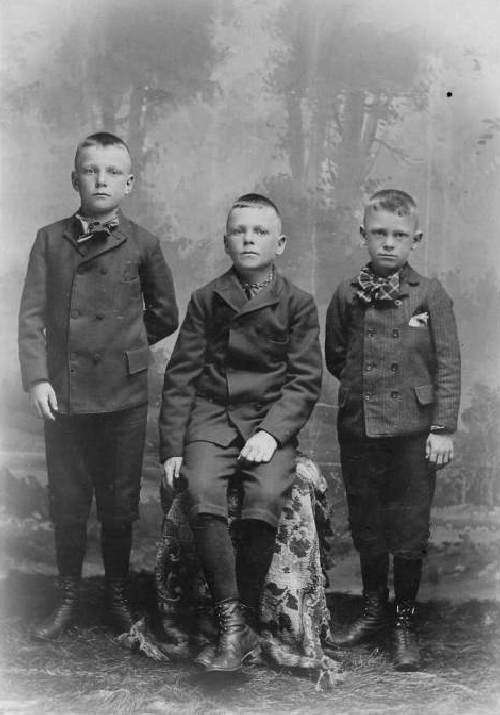
We do not yet have any written sources indicating whn American boys thought about these floppy bows. We suspect that they were not very popular. But they were popular with mothers who often insisted they be worn. Here a single younger boy had no real option, but as boys got older there was more resistance. Here there was also strrength in numbers. Not here how mother has dressed her three sons in similasr suits and identical floppt bows, but one boy has managed to tuck his bow under the suit lapels.

Navigate the Boys' Historical Clothing Web Site:
[Return to the Main U.S. neckwear type page]
[Return to the Main floppy bow country page]
[Return to the Main U.S. country garment page]
[Introduction]
[Activities]
[Biographies]
[Chronology]
[Clothing styles]
[Countries]
[Bibliographies]
[Contributions]
[FAQs]
[Glossary]
[Images]
[Links]
[Registration]
[Tools]
[Boys' Clothing Home]