|
We have looked at various aspcts of cold wwrathrr gear. We know little about the cold weather gear boys wore until the 19th century, largely thanks to photography. The French invented photigraphy (1839). And about that time America was begining to build what would become a huge industrisl economy and once that was propelling Americans into the prosperous middle class Boys at the time had very limited wardrobes. As the textile industry developed, clothing costs declined. And rising income levels gradually meant that Americanse increasingly better dressed. And by the turn-of-the 20th century were the best dressed in the world, bot like moodern children, but better than contemporary boys. And this only increased as the American economy grew. Boys commonly wore suits in the 19th century and had coats for winter. Overcoats were common for boys from from middle-class city families. In the 20th centutry, sweaters andd appeared and jaclkets commonly became more important.
America is a big country. This meant it emcompassed many areas and a variety of climatrs. The most important was the temperatuire range and difference between the nothern and southern states. The winters in thd norther tier od states, especially the Norther Plains could be very severe. The souther tier had relatively mild wunters, but very warm summers. In fact, befire air conditioning, the warm summers meant that the population of the southern states was a relativekly small portion if the oopulation.
We note many different cold weather garments. The most obvious is various types of coats and jackets. These were done in different weights to accomodate both cold winter weather as well cool spring and fall wearher. We also notice capes. There were also a range of other garments including headwear, scarves, mufflers, gloves and mittens, sweaters, and long stockings. Young children might wear leggings and snow suits. The popularity and style of these garments have varied over time. Some have remained virtully inchnged such as the stocking cap. Other garments have changed markedly over time. Some such as capes have largely dissappeared. And whole new product lines have appeared such as ski gear. There were obvious regional differences because of climate. And there were gender differences which have varied over time.
We know little about the colder weather gear boys wore until the 19th century and largely thanks to photography. The French invented photography (1839). And about that time America was begining to build what would become a huge industrisl economy and once that was propelling Americans into the prosperous middle class Boys at the time had very limited wardrobes. As the textile industry developed, clothing costs declined. And rising income levels gradually meant that Americanse increasingly better dressed. And by the turn-of-the 20th century were the best dressed in the world, not like moodern children, but better than contemporary boys. And this only increased as the American economy grew. Boys commonly wore suits in the 19th century anf had coats for winter. Overcoats were common for boys from from middle-class city families. In the 20th centutry, sweaters andd appeared and jaclkets commonly became more important. br
We note many different cold weather garments. The nost obvious is various types of coats and jackets. These were done in different weights to accomodate both cold winter weather as well cool sprng and fall wearher. We also notice capes. There were also a range of other garments including headwear, scarves, mufflers, gloves and mittens, sweaters, and long stockings. Young children might wear leggings and snow suits. The popularity and style of these garments have varied over time. Some have remained virtully inchnged such as the stocking cap. Other garments have changed markedly over time. Some such as capes have largely dissappeared. And whole new product lines have appeared such as ski gear. There were obvious regional differences because of climate. And there were gender differences which have varied over time.
We note a variety of headwear worn during the winter. They include both styles specifically worn for cold weather as well as popular styles that were worn more for fashion than for keeping warm. A key indicator that a headwear was for winterwer was that it had ear flaps or like a stocking czp, could be pulled down o cover the ears. Some cold weather garments have remained virtully unchnged such as the ever popular stocking cap. I'm not entirely sure why the sticking cap has remained so popular over time, but it is sureky a unique combination of effectiveness, inexpensive cist, and practicality. Woodsmen or hunting caps, often done in plaid, wee popular mostly in northern states. Another popular winter styles wre the helmet caps with earflaps that could be worn up or down. Some flat caps also had ear flaps, but we are unsure how common they were.
The scarf is a piece of fabric worn around the neck and over time has become fashionable neckwear. It is an ancient garment primarily worn for warmth. It is also used for sun protection (most niotably by the Arabs), cleanliness, fashion, or religious reasons. They have been made in a variety of different materials, most priminently done in wool, cashmere, linen, or cotton. neckwear. Information on ancient times is limited. There are ancient images dating backb to qbout 1350 BC. The earliest historical information comes from images found in ancint Egypt (Queen Nefertiti) abd China. Romans used a sudarium or sweat cloth to wipe their faces after exercisinge. Overtime the sudarium became a fashion accessory, hung around the neck or knotted as a belt. The scarf was a well established European garment at the time the English began colonizing North America. The earliest reference we havce found to sacrves in America comes from Masachusettes (1721). Apparently it became a commonn practive to give away scarves at funeals. The colonial Masachusettes Legislsature banned the practice. Queen Victioria and helps populsrize many fashion trends, including scarves (mid-19th century). Her fashions strongly influenced Amerivan fasions. European fashion concerns like Burberry also help populatize scrves. At the time American fashion was largely set by following European trends. We have virtually no information on the scarf in Aerica until the advent of photography and we see them in studio portraits. We do not see many early examples because most peole removed their outwear during the unter for studio portraits. And mothers did this for their children. We have found a few examples in the late-19th century. As far as we can tell, the scarfe was a staole of cold eather wear for children (late-19th centutry). This may have been the case earlier, but we can not yet confirm it. With the advent of the snapshot, we know much more about the 20th century. The scarf became a patriotic garment when America entered World War I (1917). Mothers, aunts, wives, sweethearts, and even school children knitted scarves for the Doughboys in France. The most famous American associated with scarves was Isadora Dunca who was famous for her long-flowing scarves. Ironican she dioes in an automobile accident when her scarfe was caught in a wheel (1927).
The most popular knitted garment as in most countries is the sweater. American boys have worn many different styles of sweaters. There are many other knitted garments, mostly cold weather garments like socking caps, scarves, and mittens. We have also noted knitted snow suits, especilly in the northern state near Canada. Stockings were once popular knitted garments, but are now almost never knitted. Some of the fashionable French knit garments like short pants outfits were not nearly as popular as in America.
We do not yet have much information on American sweaters. We do not see boys wearing sweaters in the early and mid-19th century. We first see sweaters in the late-19th centuries. The first ones we note are pull-overs, often with heavy necks, both turtle necks and roll overs. We note cardigans in the early 20th century. The sweater was a major clothing garment for boys by the 1920s. Many boys wore them to school. They were avtually part of the increasing informality in dress. Boys wore sweaters instead of suit jackets. They were a useful garment in that the child could keep his sweater on indoors if it was not warm enough. For parents who wanted a little formality, a V-neck could be purchased which showed a tie. Other boys wire crew necks. Sweaters in bright patterns and colors became very popular. In addition to different neck styles, there were also sleeveless sweaters developed. They were also a popular item for home knitting. The letter-man's sweater was one of a teenagers most prized possessions. Sweaters were at first wool garments. Since World War II, synthetic fibers have been used to produce less-expesive alternatives.
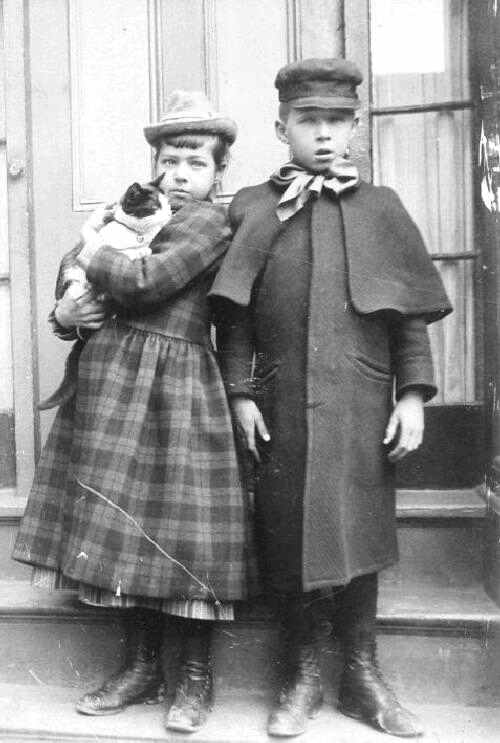
Capes were commonly worn in the 19th century. We do not have much information on the early-19th century, but we see capes in both the mid- and late-19th century. We see both boys and girls wearing capes. Capes were especially common with coats. They were made to be worn with some coats. The cape seems to be an elegant garment worn with overcoats. The ones we have seen were not decorated, but rather plain garments. It was not a major style, but we see a number of children with these caped coats. They seem more common for girls than boys. The caped coat was alsoan expensive garment. It seems to be a style worn by children from affluent families. We are not sure what the functionality of the cape was. It may have been primarily a fashion statement, but it did add an extra layer of fabric over the shoulders and upper torso. Capes seem to largely disappeare after the turn of the 20th century. We do not see boys wearing them after the 1900s.
American boys have worn a wide variety of coats and jackets. Many like sailor styled reefer jackets appear to have been quite similar to European styles. Others such as the plaid lumber jacket appear to have been more American in origin. A popular style by thr 1920s were leather aviator jackets. Many short jackets, some with fur (or imination fur by the 1940s) collars based primarily on the basic styling of the popular aviator jackets. Duffle coats cut longer than jackets have also been popular, but I believe that thery were primarily an English style. In recent years a variety of heavily insulated, often brightly colored jackets and coats have appeared influed by ski styling. There have also been specialized coats, particularly the water proffed rain coat which appeared after the turn of the century.
We do not have a lot of information on snow suits at this time. As far as we can tell they appeared after World War I in the 1920s. We think primary factor was the populasrity of sking and the appearance of ski clothing. Skiing as a sport began to develop in northern Europe (late-19th century). With the advent of the Olympics, skiing became very popular and fashionble. This was especially true of women's skiers. Some one seens to have gotten the ideea that the basic idea was perfect for younger boys and girls who at the time were wearing short pants and skirts which could be a little chilly in cold weather. They would might wear long stockings and lerggings to keep warm, but the idea of covering everying up gave rise to the snow suit. We are not sure just who invented it or when it fgirst appeared, but it was a well-estblished item by the 1930s. An important step here was introduction of lastex in the mid-1930s. Knit bands containing this stretchy yarn were attached to the bottoms snow suit trouser legs and sleeve cuffs. It was also used for knickers. There was a hood, jacket and trousers, augmented with mittens, scarves, and boots. These snow suits were quite bulky. Kids especially the younger kids needed help putting them on and taking them off. and they restricted movement once the child was fully outfitted. Snow suit frustrations are virtully infinite. Mittens almostlways got lost--usully just one of the pair. Nothing fits well for long, whining wa virtutually madatory. One author from the 1950s writes, "I don't recall now what my snow suits were made from. What I recall most is thrashing around the floor, usully the nice warm kitchen floor trying to get my suit on. Mom was adament thsatbIb wear it to mke sure I didn't ctch cold. But she wanted me out of the house for awhile as all cooped up I would get on her nerves." Another readser recalls, "Our uniform of the day was a 'snowsuit.' I think it was invented by the same guy that invented the strait jacket! It took forever to get your legs in and then wrestle your arms in; then someone had to buckle on your overshoes because you couldn't reach your feet anymore. Then the hat and the hood and out the door you went! There would be myself and a flock of cousins propped up in the snow. What's the first thing that happens when we hit the cold air? Got to pee...right now! Cold air does that to you when you're a little kid! Back to the house and a quick strip and into the bathroom. Then repeat the whole operation again. Being little back in those days was a challenge!" Many warly snow suits suits were made of heavy wool fabruc, often lined in cotton flannel. Snow suits are still with us today. For a goof chuckle read about 'Thomas' snowsuit'.
Leggings were winter garments for children, obviously to keep their legs warm. We do not know very much leggings in America at this time. We do note some portraits of of younger children, both boys and girls, wearing leggings. They seem to be most common for pre-school children. The first ones we see are leather. We see some boys wearing them with Fauntleroy suits. The first leggings we see are for boys, but by the turn-of-the 20th century we see both boys and girls wearing them. In the early 20th century we note cloth leggings which gradually replaced leather. We note clothing leggings which matched coats. We see them into the 1940s, but they seem to have gone out of style in the 1950s. We're not sure why. This as far as we can tell was a garment worn by children from wealthy or at least affluent families. They became more midle class in the 1930s and 40s.
Long stockings appeared as a main stay for an American boy in the 1870s when the fashion of kneepants for boys became wide spread. Unlike European boys, few American bpys wore kneepants with short socks. American boys continued to wear long stockingsd through the 1910s and did not commonly shift to socks until the 1920s. Lock stockings comtinued to be worn into the 1940s, although they were by that time not commonly worn. Long stockings were commonly worn in the late 19th and early 20th century. They were worn by both boys and girls. At the time boys commonly wore knee pants and knickers and even short pants year round. Thus long stockings were useful for warmth. This was not the only reason for wearing long stockings, but it was an important one.

Navigate the Boys' Historical Clothing Web Site:
[Return to the Main seasonal and inclement weather page]
[Return to the Main U.S. garment page]
[Introduction]
[Activities]
[Biographies]
[Chronology]
[Clothing styles]
[Countries]
[Topics]
[Bibliographies]
[Contributions]
[FAQs]
[Glossaries]
[Images]
[Registration]
[Tools]
[Boys' Clothing Home]