|
American boys like boys in other countries have worn a variety of skirted garments. The conventions involved was essentially brought to America by European immigrants. Thus fashion trends in Britain, Ireland, and Germany were especially important. There were substantial differences among families as to the conventions. Social class was an important influence. The styles and conventions involved have varied over time. It was very common for younger boys to werars dresses and other skirted garmens. The skirted garments have inclided dresses, skirts, kilts, and tunics as well as smocks and pinafores. For many years the styles worn by boys and girls were essentially identical, but in the late 19th century you begin to see boy-styled dresses. Boys still wore these garments in the late 19th century, but they rapidly went out of fashion after the turn of the 20th century and were no longer commonly seen after World War I. Dresses disappered first. Tunics were worn a lottlke longer. It is not entirely clear why a convention that persisted for so many years disappeared so quickly. The garment that persisted the longest was the tunic. Kilts are occassionally worn, but primarily at ethnic events like Scottish Highland gatterings, Irish feishes, and Greek celebrations.
Younger European boys have worn dresses for several centuries. This convention continued in America with European colonization. The skirted garments worn by Ameeican boys have varied over time. We are not yet sure about the 18th century, but they seem to have been mostly dresses. The 19th century was more varied. We see mostly dresses for younger boys in the first half of the 19th century. Somewhat older boys might wear tunics. We note dresses in the second half of the 19th century, although our archive is somewhat limited because phtographic portraits do not become availave until the 1840s. . We also notice both skirts and kilt outfits, especially kilt suits. We notice more boys wearing these skirt or kilt garmrnts than actual dresses, although dresses were very common very little boys. Some of these outfits are a little difficult to identify as we are often not sure if the boy is wearing a blouse and skirt or a dress with a belted waistline. We note some boys wearing smocks, but this was not very common. At the turn of the 20th century, tunic suits become very popular and other skirted garments for boys rapidly go out of style.
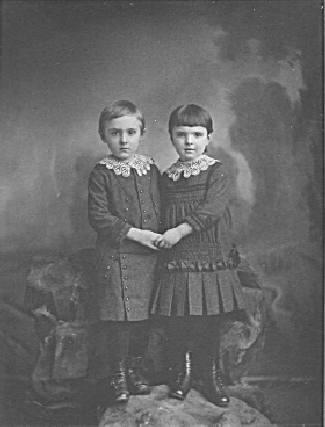
The ages at which boys wore skirted garments has varied over time. We commonly see pre-school age boys wearing dresses during the 19th century. The age of breaching varied, but was usually 3-5 years during the 19th century. Here family conventions varied. Social class was a major factor affecting the age of breaching, but probably not as important as the age of cutting a boy's curls. The type of skirted garment was also a factor. Even though boys, especially older boys, were wearing dresses and kilts less after the turn-of-the 20th-century, we still see even younger school-age boys wearing tunics. We have found vey little written work on age trends for skirted garments. We suspect that it was a topic discussed by family members, but unfortunately not often recorded in writing. Nor have we found much discussion of this in 19th-century women's magazines. We suspect that the issue was discussed, but have not yet found the articles. We have found much important information in the photographic record. Even when the ages of the children is not noted, it is possible to estimate ages fairly effectively. And portraits of all the children are very useful in assessing family conventions. A good example is the Allen children in 1890, suggesting that breeching proibably occurred at about age 4 or 5 years.
Both boys and girls wore skirted garments in America. The gender conventions varied for the different garments. Interestingly, boys wore all the different skirted garments, but girls did not. Both boys and girls wore dresses. American girls in the 19th century and early 20th century almost always wore dressess. Many younger boys also wore them. Kilts were a different matter. Only boys wore kilts. This included all the various kilted garments, Highland kilts and kilt suits. Skirts are more mixed situation. Many younger boys wore skirts, mostly plaid skirts. Some were actually skirts with no kilt styling at all. Girls wore a range of skirts, including plaid skirts. Both boys and girls wore tunics. They were more of a boys' garment in Europe. We see both boys and girls wearing tunics, although they were mpre of a boys' garment. Boys wore tunic suits with matching bloomer knickers. Girls wore tunics that were more styled like dresses.
Skirted garments or often seen as primarily female garments. Many American boys, however, have worn skirted garments. American boys over time have worn several different skirted garments. The most important have been dresses, skirts, kilts, and tunics. Dresses were the principal skirted garmenr for many years. Skirts and kilts were popular in the 19th century. Tunics were widely worn in the early 20th century. There have been some other skirted garments of less importance. Pinafores have been worn by younger boys. Smocks were not as common in America as Europe. The popularity and age conventions for these different have varied substantially over time. Two of these skirted garments, kilts and tunics, are male garments. We have seen some girl's garments referred to as kilts, but almost always these are skirts, often pleated plaid skirts rather than proper kilts. While theseare the principal skirted garments, it is not always possible to place the actual garments that boys wore neatly into one of these categories.
A variety of features are asoociated with skirted garments. These were options available to dressmakers. We have only begun to prepare a list. These featured were employed in both the bodice and skirt parts of skirted garments. We notice smocking on the bodice. Smocking was a embroidering technique used on smocks, dresses, and other skirted garments. There was pleating employed on the skirt part. Another decorative feature is patterns. And especially important in America is plaid. The reason for this of course is that plaid is associated with the Scottish kilt--a male garment. Thus apprently in the American mind made skirted garments more appropriate for boys. This suggsts tom us that there was some second thoughs about the centuries old convention about boys wearing skirted garments. Interestinglu modern school garments including school uniforms include pleated plaid skirts for girls, but this was not the case in the 19th centyry. The most common plaid skorted garemnt for boys besides the kilt was dresses. We also see palid tunics, although not nearly as commomly as plaid dresses.
One question we have about skirted garments is did the boys wear them for all the varied activities in which younger boys pursued. We wonder if breeching took place all at once or if it was a gradual process. We note in the movie "Life with Father" that Harlan wore knee pants for every day, bi=ut had a dress up kilt suit. We are not sure if this was historically accurate. Did mothers dress boys in knee pants for family outings or play and reserve kilt suits for special occassions? Or did they wear kilt suits and dresses for all activities. Of course there may be no simple answer to this question. Families may well have had varied approaches. Here the photographic record is not very helpful. This is because in the 19th century when kilt suits were worn, there was very limited amateir photography producing snap shots that shed light on every day clothing. Most of the photographs of boys in kilt suits are 19th century studio portraits. After the turn of the 20th century when we begin to see large numbers of family snapshots, kilts suits very rapidly went out of style. We have not yet been able to find any written information addressing this issue.
It was commonn to dress younger boys in dresses and other skirted garments. We are not entirely sure about colonial America, but we believe this was common. We have much more information on the 19th cntury. It was quite common for boys to wear skirted garments until they began school at about age 6 years. Thefe was, however not hard and fast rule. We note quite young boys who have been breeched and wearing trousers. Apparently they never wore dresses as boys. We believe that the nor common convention was for the younger boys to wear skirted garments. What varied widely was the age of breeching. We notice boys older than 6 years wearing skirted grments. Conventions here vried greatly from family to family. Families varied as to the age of breeching as well as whethervto cut a boy's hair before or after breeching. Social class was a factor, especially for older boys waring skirted garments. Younger boys still wore dresses in the early 20th century, but the fashion was going out of style and rarely seen after World War I, except for very young boys.
One question we have about boys wearing skirted garments is the importance of social class. It is very clear from the photographic record that boys of all social classes wore skirted garments in the 19th century. What is not so clear id the relative prevalence among different sicial classes. Ee rely heavily on the phographic record in developing our HBC website. This can create some misunderstanding in that the upper- and middle-class families are over represented in the photographic record. This was especially the case in the mid-19th century because most phorographic images are studio portraits and photographic portraits like Daguerreotypes were epesnsive. By the end of the 19th century, portraits were much less expensive. Even so, the affluent are better represented than the working class and the poor are very underrepresented. This continued to be the case in the 20th century when family snapshots became prevalent. There are many more photographs of wealthy and affluent families. Thus mere prevalence in the photographic record can not be used to measure the actual prevalence among working-class families. We not only want to assess prevalence, but variations in the types of skirted garments and styling. The impact of social class on the ages of the children wearing skirted garments is another factor to consider.
American boys wore a range of garments with skirted garments. This of course varied with the tyoe of skirted garments. Skirts and kilts required, for example, blouses and skirts and their was Scottish-styled headwear to go with kilts. Dresses covered the bodice above the waist. We will cover the specific accompanying garments with individual skirted garments separately. Here we will cover some of the general trends as well as images where the type of skirted garments is not obvious. Our primary source is the photigraphic record, but we hope to gradually include other types of information. We need to cover headwear, neckwear, pants, undergarments, hosiery, and footwear. The available photographic record provides considerable detail about these accompanying garments. One problem with this assessment is that many younger boys had very long skirts, in some cases extended almost to their footwear. We note a wide range of headwear. Neckwear varied, but we see floppy bows in the late-19th century. Some boys wore pants, mostly with with kilt suits and tunics. Undergarments are difficult to assess, but some portraits provide hints. Most boys wore long stockings with skirted gsrments. Footwear included both low-cut and high-top styles.
We see boys wearing a range of undergarments with skirted garments. Some boys wore the same undergarments as their sisters. Others wore more boyish garments. And in some cases we see more boyish versions of girls' undergarments. A factor herte is that in the 19th and early-20th century that younger boys might wear the same underwear as girls. Many factyors were involved here, both chronological trends and family conventions. The type of skirted garment was also a factor as was the boy's age. Dresses were worn with both petticoats anhd pantalettes. Boys might wear plainer pantalettes called drawers, but this was not always the case and some girls also wore drawers. Pantalettes were in the early- and mid-19th century worn to show below the hem of the dress, but this was not the case for petticosts. We are not vebtirely sure about skirts. We think that undergarments werre similar to dresses, but we have little actual evidence. Kilts might also be worn with pantalettes and petticoats, but we also see boys wearing knee pants. Tunics were worn with both bloomer knickers and straigh-leg knee pants. Smocks were worn with a boy's regulsr trousers.
One noticeable feature about the skirted garments worn by American boys was length. Many of the skirt lengths we see the boys wearing are very long. This included dresses, kiltsuit kilts, and skirts. Sometimes they reached down to the ankles. This was stylish for girls and women in the early-19th century, but by mid-century girls were wearing hort skits, often with pntalettes. We do not see this in Europe. And we are unsure why the skirt length was cut this long. It is possible that mothers brought long skirts so that they could be worn as the boys grew taller, but this would not explain ankle-length skirts. Adult women wore skirts to their ankles. We are not yet sure about girls at this time. This is somethimg we hope to assess in more detail, but our prelimary assessment is that very young little girls diod not wear such long sskirts in the late-19th century. Another possibility is that the boy inherited his older brother's kilt suit. This can not be determined in single portrait photographs. The length of skirts may have varied from family to family, but so many young boys wore these long-length skirts that it seemns to have been an actual style. The long skirts woren with kilt skirts seem especially strange as kilts were knee-length garments.

Navigate the Boys' Historical Clothing Web Site:
[Return to the Main U.S. garment page]
[Return to the Main skirted garment country page]
[Introduction]
[Activities]
[Biographies]
[Chronology]
[Clothing styles]
[Countries]
[Topics]
[Bibliographies]
[Contributions]
[FAQs]
[Glossaries]
[Images]
[Links]
[Registration]
[Tools]
[Boys' Clothing Home]