
United States Elections: Presidential Elections (1920)
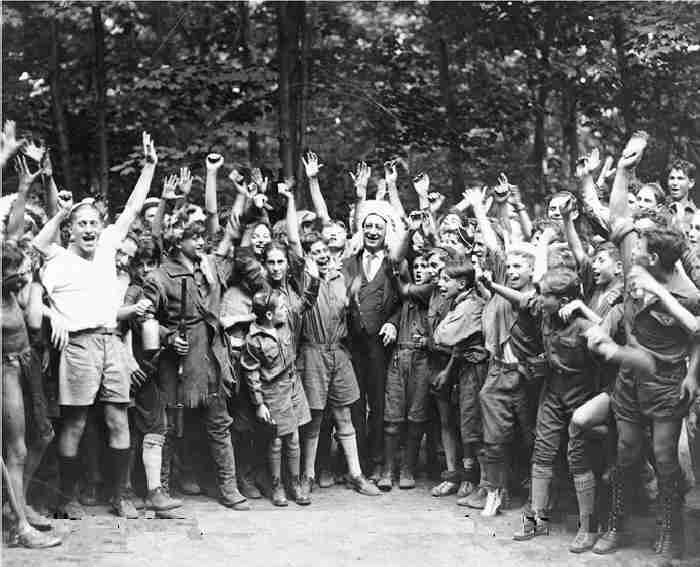
Figure 1.--New York Governor Al Smith began seeking the Democratic nomination for president in 1920. He was a personable campaigner. Here he is with Boys Scouts at Kanohwahke Camp, Bear Mountain in 1920. The Scouts have coronated him "Grand Sachem". The Democratic Party was, however, not ready for a Catholic candidate. Only in 1928 with the chances of a Democratic victory remote did the Party offer him the nomination.
|
|
Warren Harding, a genial newspaper man in Ohio, remained loyal to President Taft in the Rooselvelt insurection. He was choosen to delivered the nominating speech for President Taft at the 1912 Republican Convention. Harding then ran for the U.S. senate in 1914 and was elected. He found the cluby atmosphere of the Senate to be a very congenial place. He described the Senate as "a very pleasant place." An Ohio political opperator, Harry Daugherty, affter Wilson's 1916 victory, began to conceive of Harding as an attractive Republican candiadte in 1920. Daugherty explained, "He looked like a President." The front running Republican candidates in 1920 deadlocked the Convention.
A group of Harding's Senate colleagues promoted Harding as a compromise candidate. Here Harding was acceptable to many delegates, in part because as he had done very little, he had few enemies and he had proven a staunchl loyal Republican. The 1920 presidential election of 1920 was dominated by the aftermath of World War I. Americans had already begun to question the country's participation in the War. The economic boom during the War had disappeared with a recession. The Denocrats were still arguing for American participation in the League of Nations. The Europe Ameruca left was convulsed with wars and revolutiobs of which most Americas wanted no part. Strikes, race riots, and terrorist incidents frightened many Americans. As a result, President Wilson had become very unpopular. Former President Theodore Roosevelt who hasd waged the third party Bull Moose canpaign in 1916 hoped to get the Republican nomination, but he died in 1919. The Republican nomination became a free fight. The Republicans after a lengthy convention fight turned to Ohio Senator Warren G. Harding , a former newspaper editor, primarily because he had so few enemies. After several ballots, party bosses in a “smoke-filled room” settled on Harding. Harry M. Daugherty, Harding's political manager played a major role in these negotiations. Harding appointed him Attorney General after the election. The party bosses wanted Wisconsin Senator Irvine Lenroot as vice president, but a revolt broke out on the convention floor. The delegates chose Massachusetts Governor Calvin Cooldige whose handling of the Bost Police Strike (1919) had made him a popular figure. The Democrats also selected another Ohio candidate, newspaper publisher and Governor James M. Cox. Harding virtually ignored Cox and ran against Wilson. He called for a return to "normalcy". While not an actual word, it proved to be a successful campaign slogan. Harding also had a huge campaign spending advantage. Harding proved a popular choice for the Republicans in 1920. Harding won the Presidential election by an impressive 60 percent of the popular vote, a Republican landslide after 8 years out of office.
America in 1920
America was in ferment in 1920. The Wilson yesars had initiated major changes in American life. And noe Women's suferage and Prohibition were intriduced. The country had fought and largely decided the War in Europe. Diplomats and politicians were debating the peace treaties--especially the Versailles Treaty. American was especially concerned over membership in the League of Nations. Revolution has occurred in Russia and the Civil War there and related wars in Eastern Europe flared. Turkey and Greece were fighting saa War. In America there were an unprecedented number of strikes combined with bombings and riots raising fear of radicals and terrorists. Attorney General Palmer was conductiung the Palmer Raids. Germany had been prevented from dominating Europe. Few Americans saw this as a major accomplishment. Rather the post-War disolusionment had already begun. Many Amnericans began to feel that America should not have entered the War. The focus bega tio be war itself and not aggressioin. Franklin Roosevelt in a recorded speech, "... promised to those that fell war "shall not occur again. Americans demand: The crime of war shall cease." That was a sentiment that many Americans had already reached and more would do so in the future. The probem for the pacifict movement, however, that World War I had set in motion events that was bringing totalitariansd to power that were more than willing to use military force. The economic boom resulting from the War was over and America was adjusting to economic change. Returing Doughboys were looking for jobs. Few presidential campsaigns occurred in such turbulent times.
Theodore Roosevelt
Former President Theodore Roosevelt who had waged another third party Bull Moose canpaign in 1916 decided to rejoin the Republican Party. He hoped to get the Republican nomination. Despite having made possible Wilsons victory in 1912, he probably would have won the nomination. This will never be known as he died in 1919. His unexpected death and the incapitation of President Wilson meant that the giants of American politics (McKinnley, Roosevely, nd Wilson) were now all rempoved from the political equation. This meant that a new political generation of lesser-known figures would have to rise in the 1920s.
Warren Harding
Warren Harding, a genial newspaper man in Ohio, had remained loyal to President Taft during the Rooselvelt insurection. He was choosen to delivere the nominating speech for President Taft at the 1912 Republican Convention. Harding then ran for the U.S. senate in 1914 and was elected. He found the cluby atmosphere of the Senate to be a very congenial place. He described the Senate as "a very pleasant place." An Ohio political opperator, Harry Daugherty, affter Wilson's 1916 victory, began to conceive of Harding as an attractive Republican candiadte in 1920. Daugherty explained, "He looked like a President."
Political Background
The 1920 presidential election of 1920 was dominated by the aftermath of World War I. Americans had already begun to question the country's participation in the War. The economic boom during the War had disappeared with a recession. The Denocrats were still arguing for American participation in the League of Nations. The Europe America left was convulsed with wars and revolutiobs of which most Americas wanted no part. Strikes, race riots, and terrorist incidents frightened many Americans who tended to blame the violence on radical European immigrants. As a result, President Wilson had become increasingly unpopular.
Republican Convention
The front running Republican candidates in 1920 deadlocked the Convention. A group of Harding's Senate colleagues promoted Harding as a compromise candidate. Harding is one of the Dark Horse candidate that emerge from time to time. He was at the time virtually unknown to the American people. Here Harding was acceptable to many delegates, in part because as he had done very little, and thus had made very few enemies. He had proven a staunchly loyal Republican. The Republican nomination after Roosevelt's death became a free fight. The Republicans after a lengthy convention fight turned to Ohio Senator Warren G. Harding , a former newspaper editor, primarily because he had so few enemies. After several ballots, party bosses in a “smoke-filled room” settled on Harding. Harry M. Daugherty, Harding's political manager played a major role in these negotiations. A leading figure in the Ohio Gang, Harding appointed him Attorney General after the election. The Party bosses asked Harding if there was anythong in his background that might be embarassing. He assured them that there was not. Apparently he thought he could continue to cover up his illegitimate daughter. The party bosses wanted Wisconsin Senator Irvine Lenroot as vice president, but a revolt broke out on the convention floor. The delegates chose Massachusetts Governor Calvin Cooldige whose handling of the Bost Police Strike (1919) had made him a popular figure.
Several Democrats worked for the nomination, but there was no one dominany candidate. One leading candidate was Attorney General A. Mitchell who had staged the Palmer Raids on suspected subversives. His stature was damaged with an actual Revoltiion after such drastic action did not materialize. New York Governor Al Smith also had his suporters, but as a Catholic the important southern bloc opposed him. The Democrats were thus like the Republicans were also undecided about a nominee. No one candidate could amass the needed number of delegates. The Democrats on the 44th ballot finally selected an Ohio candidate, another newspaper publisher.
Cox represented Ohio in the United States House of Representatives (1909–1913). He left Washington after winning election as Governor (1913–15 and 1917–21). He was a competent, popular reformer. While popular in Ohio, he was a little-known politican outside of Ohio. The choice of Ohioans was no accident. Ohio was and has continued to be a key state in the election of the presidency. Its mix of agriculture and industry made it a good reflection of the cuntry as a whole. The Convention chose a young Franklin Roosevelt who had served as Assistant Secretary of the Navy in the Wilson administration as their vice presidential candidate. He was also not well known, but of course the name Roosevelt was and that was a factor in his selection. Interestingly the two would play similar routes to the White House. Theodore Roosevelt moved from Assistant Secretary of the Navy to Govenor of New York to Vice President. Franklin would later also be elected govenor.
Harding virtually ignored Cox, the Democratic nominee, and ran against President Wilson. Although it had taken 44 ballots to win the nomination, Govenor Cox was a very capable individual who unlike Harding had the intelectual and administrative skills to be president. [Stone] Cox was a reformed-minded govenor who strongly supported the Wilson Administration and its reform agenda. America in 1920, however, was not looking for a reformer. Cox backed the internationalist policies of Woodrow Wilson and favored U.S. entry into the League of Nations. This also did not help him in the general elction as many Americans had alreay begun to question American participation in the War ad departure from traditional isolationism.
Americans had just experienced 4 tumultous years, including war with substantial casualties, an economic boom and subsequent slump, strikes, and other disorders. They were especiallydisenchanted with the War and American involvement in Europe. The Harding campaign was managed by Republican National Chairman William Harrison Hayes. Harding called for a return to "normalcy". While not an actual word, it proved to be a successful campaign slogan. Harding also had a huge campaign spending advantage. Harding proved a popular choice for the Republicans in 1920. His affable personality and relatively moderate political positions such as advocating a return to "normalcy" appealed to the American public. Harding's wife Florence played a major in the campaign which was at the time unusual. She actively cultivated relations with reporters. And as business manager of the Star she knew how to do it. She also coached her husband in such matters as to how to wave to newsreel cameras. The most notable aspect of the 1920 campaign was that it was the first time women were allowed voted for president. And Harding had supported the 19th Amendment. This and Hardings good looks meant that he dominated this new demographic. Harding also received the support if two previously Democratic constituencies--the Germans and Irish. Both had felt percecuted by the Wilson Administratiin because of the War.
The 19th Amendment
The 1920 electiin saw a doubling of the electorate with the 19th Amendment and the enfranchisement of women.
Election Results
The Republicans with a ptomise to return to Normalcy swept the country. The results were known very early. For the first time thecresults we reported by radio. The only state outside the old Confederacy the Democrats held was Kentucky. The Republicans even took Tennessee. Some Southern states went 90 percent Democratic, but this did not help the electoral count. Harding won the Presidential election by an impressive 60 percent of the popular vote, a Republican landslide after 8 years out of office. It was the largest percentage margin in oresudential elections since James Monroe won a secind term (1820). Eugene Debbs ran again ubder the Socialist banner, ganering nerly million votes.
Relignment
The Republicans had gained a permanent realignment of American politics with the McKinnely victory (1900). Wilson's victory was only possible because the Reoublicans split (1912) ad then he had the power of the incibent (1916). The 1920 victory was areturn to the Reoublican preddominance before the War.
Sources
Stone, Irving. They Also Ran.
CIH

Navigate the Children in History Website Site:
[Return to the Main U.S. 20th century election page]
[Return to the Main U.S. presidential page]
[Return to the Main U.S. political party page]
[Return to the Main U.S. history page]
[About Us]
[Introduction]
[Biographies]
[Chronology]
[Climatology]
[Clothing]
[Disease and Health]
[Economics]
[Freedom]
[Geography]
[History]
[Human Nature]
[Ideology]
[Law]
[Nationalism]
[Presidents]
[Religion]
[Royalty]
[Science]
[Social Class]
[Bibliographies]
[Contributions]
[FAQs]
[Glossaries]
[Images]
[Links]
[Registration]
[Tools]
[Children in History Home]
Created: 3:17 AM 3/5/2008
Last updated: 10:34 PM 11/11/2017