|
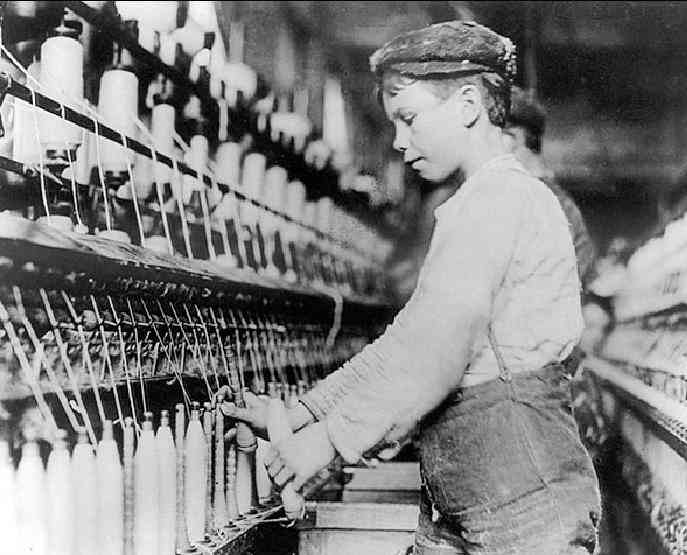
The Progressive Movement in America was an in part an attempt to address social problems that developed in America after the Civil war as a result of industrialization. Progressives also addressed some more long term problems such as woman's sufferage. America had changed considerably since the Civil War. The frontier had been settled, America had emerged as the world's greatest agricultural and industrial power, there was an experiment with imperialism, great cities had developed, and huge numbers of immigrants accepted. America bustled with wealth, optimism, and industrial expansion. Many Americans had benefitted from the rise of America as an industrial power. Many Americans had not. Large numbers of Americans subsisted on an economic edge. Children and women toiled in sweatshops and mills for pitiful sums. Poor children were often unavle to attend school. Public health programs were week and products sols were sometimes unhealthy. Working conditions were often unsafe and there was no work place protections or disability insurance. There was no protection for widows and orphans and no old age protecion schemes. Prisons and state hospitals for the retarded and mentally ill were commomly horror houses. State and Federal goverments were often run on the spoils system. Legislators in many states as well as senators were not selected by direct vote.
Monoplies and trusts gained great power in the American economy. A growing movement to prohibit alcoholic beverages were a part if the progressive movement. And with the outbreak of World war Imny progressives took up the cause of pacifism. Muckraking journalists drew these problems to the attention of the often shocked American public. A new phenomenon, the crusading socially conscious photographer added to the impact. Many at the turn of century believed that the Governments role was to keep expenditures low and to avoid involvement in the economy. President Cleveland made no effort to alieviate economic suffering during the Depression of 1992-93. The central issue raised by the progressives was what is the proper role of the government in social and economic affairs. The progressives were not basically a political party as such, but the progressives influenced the Democrats and Republicans, especially during the Roosevelt, Taft and Wilson administrtions and were a major influence on the Roosevelt's New Deal. While not normally a political party, progressives did organize three challanges to the major parties. The first and most important was Roosevelt's Bull Moose challenge to the Republican Party (1912). There was also the La Follette Progressives (1920s) and Wallace Progressives (late 1940s).
The Progressive Movement was one of several reform periods in American history.
The first reform period in American history occurred in the early 19th century. A major focus at the time was efforts to improve working conditions working conditions abd develop more human methods of treating the mentally ill and retarded. The concept of reform rather tham punishing criminals developed. Another element of the first reform era was the development of utopian communities. Here rther than reform society, reformers sought to create whole new communities apart rom the society at large. Some of these communities were religiously based. Another elelent of the first reform period was abolitionism, a movement that gradually gained strength in the first hslf of the 19th century. the drive to remove what in the eyes of many was the great moral wrong of slavery. The second reform era began with the abolition of slavery during the Civil War and continued with Reconstruction. The Progressive Movement can be viewed as a third reform era.
Slavery was not mentioned in the Constitution, but the Federal system established by the Constitution meant that the Southern states could precent abolition. They could not prevent moral outrage in the north. President Lincoln thought that there were political ways of ending skavery with compensation to the owners. The slave states gave him little opportunity to attempt this, althoigh his efforts in the border states were not very successful. At any rate the issue would be settled by Civil War. Slave states were required to accept abolition to reenter the Union. The Civil War not only ended slavery, it also proved to be an enormous stimlus to northern industry.
The Industrial Revolution began in the England during the 18th century. Immigrants from Europe brought the ne developing technologies to the United States. The Erie Canal was a major empetus to early industrial development which was largely concetrated in the Northern states. Lons from Europe played a role in building an important rail network. Souther cotton played a major role in financing northern industrial development. The Civil War was a major impetus to industrial development which progressed rapidly after the War.
The Progressive Movement in America was an in part an attempt to address social problems that developed in America after the Civil war as a result of industrialization. Progressives also addressed some more long term problems such as woman's sufferage. America had changed considerably since the Civil War. The frontier had been settled, America had emerged as the world's greatest agricultural and industrial power, there was an experiment with imperialism, great cities had developed, and huge numbers of immigrants accepted. America bustled with wealth, optimism, and industrial expansion. Many Americans had benefitted from the rise of America as an industrial power. Many Americans had not. Large numbers of Americans subsisted on an economic edge. Children and women toiled in sweatshops and mills for pitiful sums. Poor children were often unavle to attend school. Public health programs were week and products sols were sometimes unhealthy. Working conditions were often unsafe and there was no work place protections or disability insurance. There was no protection for widows and orphans and no old age protecion schemes. Eugenics was a discipline endorsed by some progressives. Prisons and state hospitals for the retarded and mentally ill were commomly horror houses. State and Federal goverments were often run on the spoils system. Legislators in many states as well as senators were not selected by direct vote. Monoplies and trusts gained great power in the American economy. A growing movement to prohibit alcoholic beverages were a part if the progressive movement. And with the outbreak of World war Imny progressives took up the cause of pacifism.
The progressives took on virtually every major Ameican social problem. There was one glaring exception--civil rights. The late-19th and early-20 centuty progressives wanted mothing to do wuth the issue. The Progressive Era was thde peak of Amerivan racist thinking with the Ku Klux Klann masatixiing from the South and rising in northern states. Many progressibes saw civil rights as an issue which if they becom associated with would only damagfe theur efforts on other issues more important to them--especially women's sufferage. Given the level of racist thinking, it is likely that many progressives at the time harbored rascist attitudes. it was during the progressive era that the Supreme Court issued the landnark Plessy vs. Fergfusson legitimatizing racial segregation in public schools--and pubkic accomodations (1896). This is kind interesting because the term progrssive has become increasingly popular since the Obama presidency (2009-17). Democratic politicina seem to think that the term socialist or liberal tended to turn off voters. And that 'progressive' was more palitable. Even though today civil rights issues are very high on Democeatic Party priorities. Racist attitudes weee akso at the heart of eugenic, a movement very popular with oprigressives.
Muckraking journalists drew these problems to the attention of the often shocked American public. The publicity generated by the muckrakers were a major factor in the successes achieved. Muckakers in popular masgazines and books described the impact of poverty, city slums, dangerous working conditions, child labor and other societal ills. Perhaps the best known of the muckraking journalist was Ida Traball who took on John. D. Roickefeller. and Standard Oil.
A new phenomenon, the crusading socially conscious photographer added to the campaiign against serious social problems. Here the most ilustrious was Lewis Wickes Hine.
Progressive reformers believed that society was capable of improving the lot of the common man. Many in the 19th century, especially the well-to-do felt that the poor were a natural compoment of society. Some endorsed Social Darwinism (a concept never endorsed by Darwin himself, in which the rich and powerful insisted that their privilges were the result of inate superiority.
Many at the turn of century believed that the Governments role was to keep expenditures low and to avoid involvement in the economy. President Cleveland made no effort to alieviate economic suffering during the Depression of 1892-93. The central issue raised by the progressives was what is the proper role of the government to intervene in social and economic affairs.
The industrial expansion of the United Staates began in earnest after the Civil War (1861-65). Gradually a number of industrials managed to establish monopolies or near-monoplies in key industries: Oil (Rockefeller), Steel (Carnegie). These monopolies became known as trusts in the United states. At the time there was virtually no legislation limiting take overs and mobopolies. Once established, these monopolies could set prices and dominate their industry. These industrialists were more influential than the Government. And by the late 19th century, the American economy was the most productive and powerful in the world. The Progressive Movement a it developed took on the trusts, The one that was most powerful was the railroads. The railroad industry was not as monoploized as oil and steel, but in local areas, the large rail roads could set prices and farmers and small companies had no bargaining power. Ironically many of the other trusts actually lowered prices. The legislative basis for action against the trusts was the Sherman Antitrust Act (1890). It was Republican presidents who launched upon trust busting. President William McKinley appointed the U.S. Industrial Commission on Trusts which actually interrogated steel magnate Andrew Carnegie. The Commission's report was acted upon by Roosevelt sone after he became president (1901). Roosevelt used the Sherman Anti-Trust Act to break up a large railroad conglomerate--the Northern Securities Company. He continued this effort during his two terms with legal action against 43 other important corporations. As a result, he became known as a "Trust Buster". President Roosevelt who is most associated with trust busting. Actually it was his chosen successor, William Howard Taft, who is often criticized for back tracking on the Roosevelt reforms whose administration initiated the most actions against the trusts. Legal actions during his single term broke up 90 trusts in one term. The process was continued during te Wilson Administration, although by this time
the largest trusts had already been disolved. The Clayton Antitrust Act (1914) gave the Federal Government even greater authority to act against the trusts.
The progressives were not basically a political party as such, but the progressives influenced the Democrats and Republicans, especially during the Roosevelt, Taft and Wilson administrtions and were a major influence on the Roosevelt's New Deal.
Some prominent progressives were important supporters of eugenics. The Progressive Movement fundamentally changed America. It transformed how Americans began to vew their gvernment, especially the government's role in regulating the economy. It was in the Progressive Era that the regulatory state was founded. As the Progressives began to push for major reforms, another important movement was ganering considerable support--the eugenics movement. Charles Darwin's Origoin of the Species was one of the world's most influential scientific works. Although Darwin never addressed the topic, social and economic reformers began to apply Darwin's biological work to human society, the result was Social Darwinism. These reformers and other social scientists and political thinkers argued that society should eliminate those unfit for productive work, often labeled as "unemployables," "parasites," and the "industrial residuum". The idea was to uplift superior, more capable workers. The definition of who the unempployables varied, but often included immigrants, blacks, the handicapped, amd others. Today we tend to see these groupsas victims if the Industrial Revolution and other social and economic trends. Many Progressives at the time. often influenced by racial attitudes, tended to view them very differently. They were seen as threats to the well-being of productive workers and of society as a whole. One of the most notable Progressive champions of eugenics was Margaret Sanger, the crusader for birth control. As historians tend to lionize many of the progressive leaders, this connecton with eugernics is often conveniently ignored. Proigressive leaders influenced by eugenics played a major role in the labor and immigration reforms enacted during the Progressive Era. [Leonard]
The Progressive Movement riung upmquite an few imprtant reforms. This was primarily because the Reublicans (theodire Roosevelt) and Democratrs (Presuisent Wilson) adopted progressive refoms as part of their program. The Democrats in particular after the Roosevelt Presidency becme the primry suppoter of progressibe reforms. Roosevelt enentered the 1912 election primarly because he was disappoinjted with Taft's performance. They had been personal friends. It is likely that he was just bored and disliked being out of 'the arena'. Yhe turning point was when Taft relieved Gifford Pinchot as head of the Bureau of Forestry. Pinchot was a friend of Roosevelt and an ardent conservationist and progressive reformer. Of all the progressive reforms, it was probably conservation that was cloest to his heart. The two key reforms that affected children were child labor laws and compulsory school attendance. The two were related because if the children were in school they could not hold full-time jobs. States began passing these laws, but a Federalm child labor law was a major aschievement. Roosevelt's failed Bull Moose campaign (1912) meant that it was primaarily the Democrats that would take up the mantle of Progressive reform. And this would be continued Frankklin Roosecelt and the New Deal.
While not normally a political party, progressives did organize three challanges to the major parties. The first and most important was Roosevelt's Bull Moose challenge to the Republican Party (1912). There was also the La Follette Progressives (1920s) and Wallace Progressives (late 1940s).
Leonard, Thomas C. "Protecting family and race: the progressive case for regulating women's work," American Journal of Economics and Sociology (July 2005).

Navigate the Boys' Historical Clothing Web Site:
[Return to American 19th century history page]
[Return to American 20th century history page]
[Return to Main political party page]
[Return to Main U.S. history page]
[About Us]
[Introduction]
[Biographies]
[Chronology]
[Clothing]
[Disease and Health]
[Economics]
[Environmental issues]
[Geography]
[History]
[Human Nature]
[Law]
[Nationalism]
[Presidents]
[Religion]
[Royalty]
[Science]
[Social Class]
[Bibliographies]
[Contributions]
[FAQs]
[Glossaries]
[Images]
[Links]
[Registration]
[Tools]
[Children in History Home]