|
The account of Marco Polo with actual descriptions of Cathay (China) and the Spice Islands fueled a desire by Eurpdeans to establish direct trading links. At the same time Europeans by the 14th century had significantly imroved their navigational and ship building skills. The astrolabe helped mariners determine latitude. (Longitude proved a much more difficult undertaking. The magnetic compass permitted mariners to determine which direction was north. Great improvements were made in maps. Here Portuguese cartographers played a key role. Europeans also made great strides in shipbuilding. Large capacity ships called galleons were adopted. Powered by sail and woth large holds, they greatly reduce the cost of transporting good over distances. These developments permitted Europeans to begin to make voyages of substantial distances and the goal was to reach the East to develop direct trade contacts with China. Many of the advances were made by the Itlalian mariners of the eastern Mediterranean. The wealth of Venice and the other Italian trading states funded important navies and thus seafaring skills including navigation. They also funded academic endevors like geography and map making,
It is no accident that the three most important figures in the earliest voyages of discovery were Italians (Christopher Columbus, Giovani Caboto, and Amerigo Vespucci). Each of these men were born virtually at the same time (1449-53) and only about 100 miles of each other (Florence and Genoa). One historian even suggests that Columbus and Cabot may have collaborated with each other [Boyle] Each of these important explorers were almost certainly influenced by Paola Toscanelli--"the sage of Florence". He urged enterprising explorers to sail west to reach the riches of Marco Polo's storied Cathay. Toscanelli had carefully calculated that Cathy was within an easy sail of Western European ports. He was right about the direction, but as he used Ptolemy's flawed calculation, he was seriously wrong about the distance. Another Greek geographer, Eratosthenes, actually had a roughly accurate calculation. Perhaps this error was fortuitous. Columbus and Cabot may have had second thoughts if they had know of the true distances involved. While the Italians had the geographic and navigational knowledge, given where their ports were located, it would be the western European countries of the Atlantic that would finance the great voyages of discovery. And the great explorers needed a royal dispensation. This was because without a royal charter and protection, there would be no way for them to rise the needed funds or reep the benefits of any trade routes they opened. It was these three explorwrs (Columbus, Cabot, and Vespucci) who were at the heart of Europe's outreach, one of the primary developments which moved Europe out of the Medieval era and ino our modern age.
The Vikings were the northern ermanic tibes. For centuries they were farmers without notable maritime skills. The invention of the Long Boat gave them tremendous mobilty. This made possible the first European voyages of discovery. Thet moved east into Russia and down the Volga. They moved west attacking the British Isles and founding colonies on Iceland and Greenland. They reached North America, but probably because of well-established Native American populastions were unable to found colonies on the mainland of North America. The Vikings were not a literate people and were not Christian. They were thus outside the mainstream of European culture. This meant that their geographical knowledge was not easily transmitted, although the existence of the Grand Banks cod resource did somewhow reach European fishermen, perhapsd through Irish monks. The precise medium is unknown.
The Silk Road played a major role in Medieval history. Marco Polo was the most famous Westerner to travel the Silk Road, reach China, and return. He was a boy when he began his remarable journey. Chinese goods were known to the West, but China itself was unknown and Polo's account was seemibly so fantastic that he was at first not believed. It is well he began as a boy. His journeys through Asia extended for 24 years. He traveled further and farther east than any of his predecessors. He not only traveled beyond Mongolia to the unknown realm of China, but he became a confidant of Emperor Kublai Khan (1214-1294). After traveling throughout China he retuned to Venice where he wrote the greatest travelogue ever compiled. Marco Polo's life appears to be so incredible that it belies belief. Some historians are skeptical about Marco's accounts, especially because of certain aspects of Chinese life that are not mentioned as well as obviously erronious observations. Marco's accounts are, however, so detailed and many much of it verifiably accurate that his account overall seems generally accurate. His book not only makes for fascinating reading, but was to have a profound impact on Europe. The account of Marco Polo with actual descriptions of Cathay (China) and the Spice Islands fueled a desire by Eurpdeans to establish direct trading links.
At the same time Europeans by the 14th century had significantly imroved their navigational and ship building skills. The astrolabe helped mariners determine latitude. (Longitude proved a much more difficult undertaking. The magnetic compass permitted mariners to determine which direction was north.
Europeans also made great strides in shipbuilding. The lateen sail and centrally mounted stern post rudder were major advances. Large capacity ships called galleons were adopted. Powered by sail and with large holds, they greatly reduce the cost of transporting good over distances. These developments permitted Europeans to begin to make voyages of substantial distances and the goal was to reach the East to develop direct trade contacts with China. Many of the advances were made by the Itlalian mariners of the eastern Mediterranean.
Byzantium was a great storehouse of classical knowledge. The Ottoman Turks for more than a century had reduced Byzantiym to a a small state protected by massive walls and its navy. When the Turks began to build their own navy, Constantinople was doomed. Greek scholars from Constantinople began to flee west ton Italy, realizing that Byzantium could not long survive. They brought with them some of the clasical treasure of the libraries in Byzantium. Many were works unknown to Western scholars. [Gasiorczyk] They were works on many subjects, but included works on geography. Byzantium finally fell to the Ottomans (1453).
Fish are of course not evenly distributed thoroghout the ocean. Most fishery resources are located within 200-miles of coastlines, principally because shallow waters are the most productive. And perhaps the most productive ground in the world is the Grand Banks. This is a large area of submerged highlands located southeast of Newfoundland and east of the Laurentian Channel on the North American continental shelf. It is so extensive that it extends beyond the 200-mile coastl zones of Canada and the United states and covers 93,200 sq kilometers. The submerged higlands mesans that the Grand Banks are relatively shallow (25 to 100 meters). This is perfect habitat for cod and other groundfish. And by an accident of nature, over this shallow water the the cold southerly flowing Labrador Current mixes with the warm northly flowing Gulf Stream. The cold water is oxygen rich. The Gulf Stream is nutrient rich. And the mixing of these waters over te shallow bottom lifts nutrients to the surface in arocess clled upwelling. For eons this resource was untouched by humans. North America including Labrador had a substantial Native American population. The Beothuk, the Nsative American inhabitants of Newfoundland, are not know to have utilized this abundant resource. Not did the Native Ameicans living further south. The Vikings sailing west from Iceland are believed to be the first humans to have encountered the cod of the Grand Banks. The Vikings were, however, a farming people. One of the reasons thast the Viking colony on Greenland failed was that they failed to shift from fasrming tonfishing and hunting marine mammals. The Vikings who we know reached North america appear to have passed information the Grand Banks. The intermediary may have been Irish monks. Here there are no real records as to how information about the Grand Banks were passed on to Europeans. All we know is that European fishermen well before voyages of discovery began to fish on the Grand Banks. Just when the European fisheries began we do not know. We do know that Basque fishermen were fishing on the Grand Banks and it is believed that other European fishermen were involved, although the time line is uncear. The existence of the fishery in the 15th century is well established, just when it began is not known with any certainty. Texts from that era refer to a land called Bacalao (the land of the codfish) which is almost certainly Newfoundland. Reports of this fihery is some of the informastion that would have been accessable by the early navigators like Columbus and Cabot. John Cabot noted the abundance of sea life (1497). And it was from this report that the rich fishing grounds of the Grand Banks became became widely known. European fishermen (England, France, Portugal, and Spain) developed rich seasonal inshore fisheries. The fish was dried and sold in southern European markets. To this day the term for dried cod is bacalao.
Great improvements were made in maps. Here Italian and Portuguese cartographers played key roles. These men who often were not mariners themselves, collected information from many different sources.
The wealth of Venice and the other Italian trading states funded important navies and thus seafaring skills including navigation. They also funded academic endevors like geography and map making, They were aided by scholars from Byzantium fleeing the Ottomans, but bringing West important classical works. They arrived just at the time that the Eurooean inrlectual pace had been quickened by the Renaissance. It is no accident that the three most important figures in the earliest voyages of discovery were Italians (Christopher Columbus, Giovani Caboto, and Amerigo Vespucci). Each of these men were born virtually at the same time (1449-53) and only about 100 miles of each other (Florence and Genoa). One historian even suggests that Columbus and Cabot may have collaborated with each other [Boyle] Each of these important explorers were almost certainly influenced by Paola Toscanelli--"the sage of Florence". He urged enterprising explorers to sail west to reach the riches of Marco Polo's storied Cathay. Toscanelli had carefully calculated that Cathy was within an easy sail of Western European ports. He was right about the direction, but as he used Ptolemy's flawed calculation, he was serioulys wrong about the distance. Another Greek geographer, Eratosthenes, actually had a roughly accurate calculation. Perhaps this error was fortuitous. Columbus and Cabot may have had second thoughts if they had know of the true distnces involved.
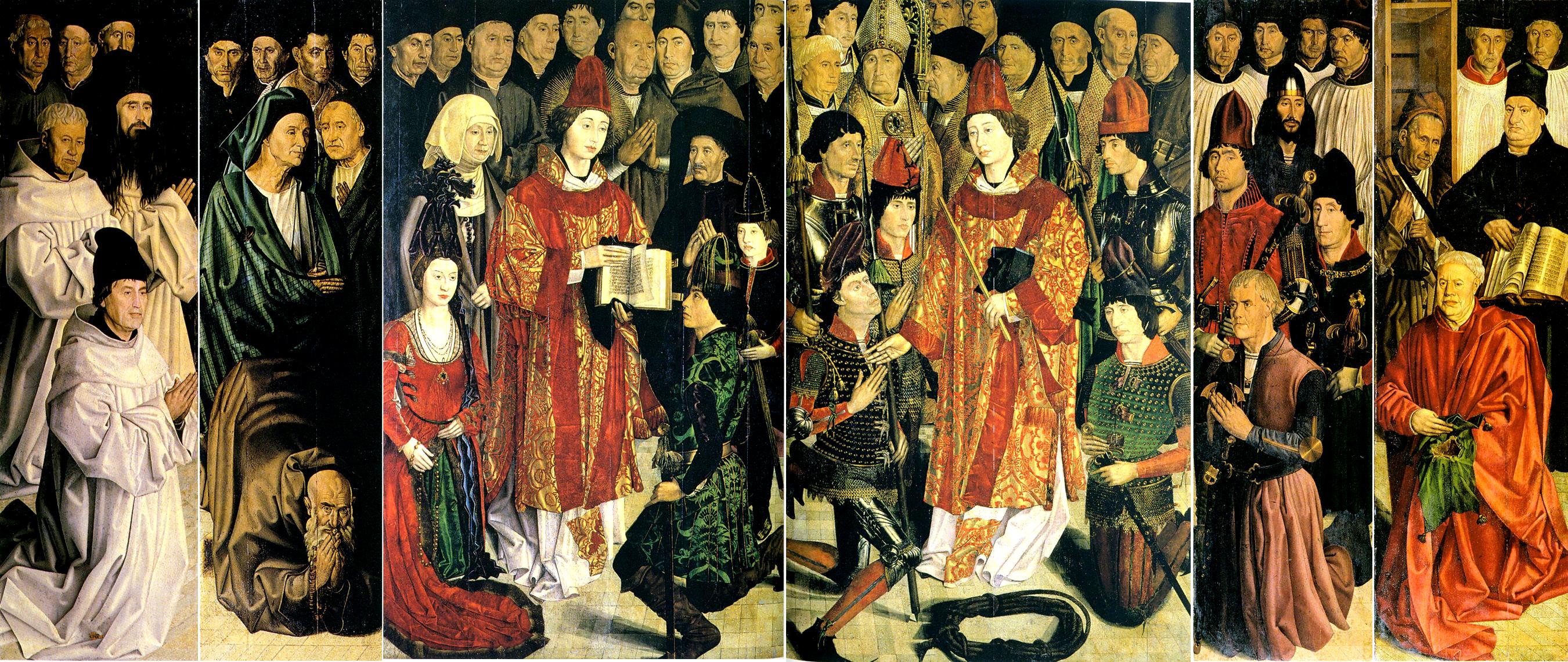
Prince Henry the Navigator (1394- ) founded the Institute at Sagres on the southwestern-most point of Portugal, Cape Saint Vincent (1415). The site was carefully chosen. Classical geographers called it the western edge of the earth. The Prince's Institute might be described as a 15th century think tank and research center. The first such facility in Europe and one that would not be recreated until the 19th century. The Institute included libraries, an astronomical observatory, ship-building facilities, a chapel, and necessary housing for the staff. Prince Henry wanted to train Portuguese mariners in navigational skills and to improve vessel design. The library was created to collect geographical and navigational information. An important source of informatiion was fishermen. Prince Henry employed the leading geographers, cartographers, astronomers, and mathematicians from around Europe to work at the Institute.
In addition to building a storehouse of geographical data, the Portuguese developed a new type of ship, called a caravel. It was both fast and maneuverable.
A major purpose was the riches to be gained by trade with the East which was blocked by the Ottomans and Arabs. And at any rate Portugal did not hace a Mediterranean coast. The Institute was to support expeditions to the East which could supply Europe with porcelin, spices, silk, and other valuable trade goods. But also important to the Portuguese was spreading Christianity. Prince Henry hoped to find Prestor John. He did not, but as a result of the Institute, Portuguese navigators diminated the first phase of the European outreach to the rest of the world.
Portugal was a very small country. They faced the danger of competition from other European countries, especially their larger neighbor Spain. The Portuguese were thus extremely secrative about their findings. They kept their navigational charts and the location of trading posts secret as much as possible.
They composed faked documents to protect thir secrets and to confuse competitors. As a result, historians are unsure today just how much the Portuguese knew and even actual Portuguese documents have to be treated with caution. One of the main issues is the Americas. Some historians speculate that Portuguese expeditions headed south had landed on the coast of what is now Brazil. And the way the coast of Brazil juts out into the South Atlantic, this seems a destinct possibility. Portuguese fisherman on the Grand Banks may have even provided information about North America.
Thus King John II may have access to very valuavle geographic information. Some suggest that this explains why he wanted a more westerly line in the Treaty of Tordesillas (1494). Some historians believe that the major documents with real data wwre archived in the Library of Lisbon. Unfortunately, Lisbon was struck by a devestating earthquake (1755). The university library were destroyed in the earthquate and resulting fire. This we will probably never know just how much the Portuguese actually knew.
While the Italians had the geographic and navigational knowledge, given where their ports were located, it would be the western European countries of the Atlantic that would finance the great voyages of discovery. And the great explorers needed a royal dispensation. This was because without a royal charter and protection, there would be no way for them to rise the needed funds or reep the benefits of any trade routes they opened. It was these three explorwrs (Columbus, Cabot, and Vespucci) who were at the heart of Europe's outreach, one of the primary developments which moved Europe out of the Medieval era and ino our modern age.
Boyle, David. Towards the Setting Sun: Columbus, Cabot, Vespucci, and the Race for America (Walker & Company, 2008).
Gasiorczyk, P. K. "PORTUGUESE GEOGRAPHICAL KNOWLEDGE OF AFRICA IN THE LATE MIDDLE AGES: AN OUTLINE," Studia Historyczne (Historical Studies) (2008) vol: 51, number: 1 (201), pp. 3-16.

Navigate the Boys' Historical Clothing Web Site:
[Return to the Main Economics page]
[Return to the Main 15th century page]
[Return to the Main 16th century page]
[Introduction]
[Activities]
[Biographies]
[Chronology]
[Clothing styles]
[Countries]
[Bibliographies]
[Contributions]
[FAQs]
[Glossaries]
[Images]
[Links]
[Registration]
[Tools]
[Boys' Clothing Home]