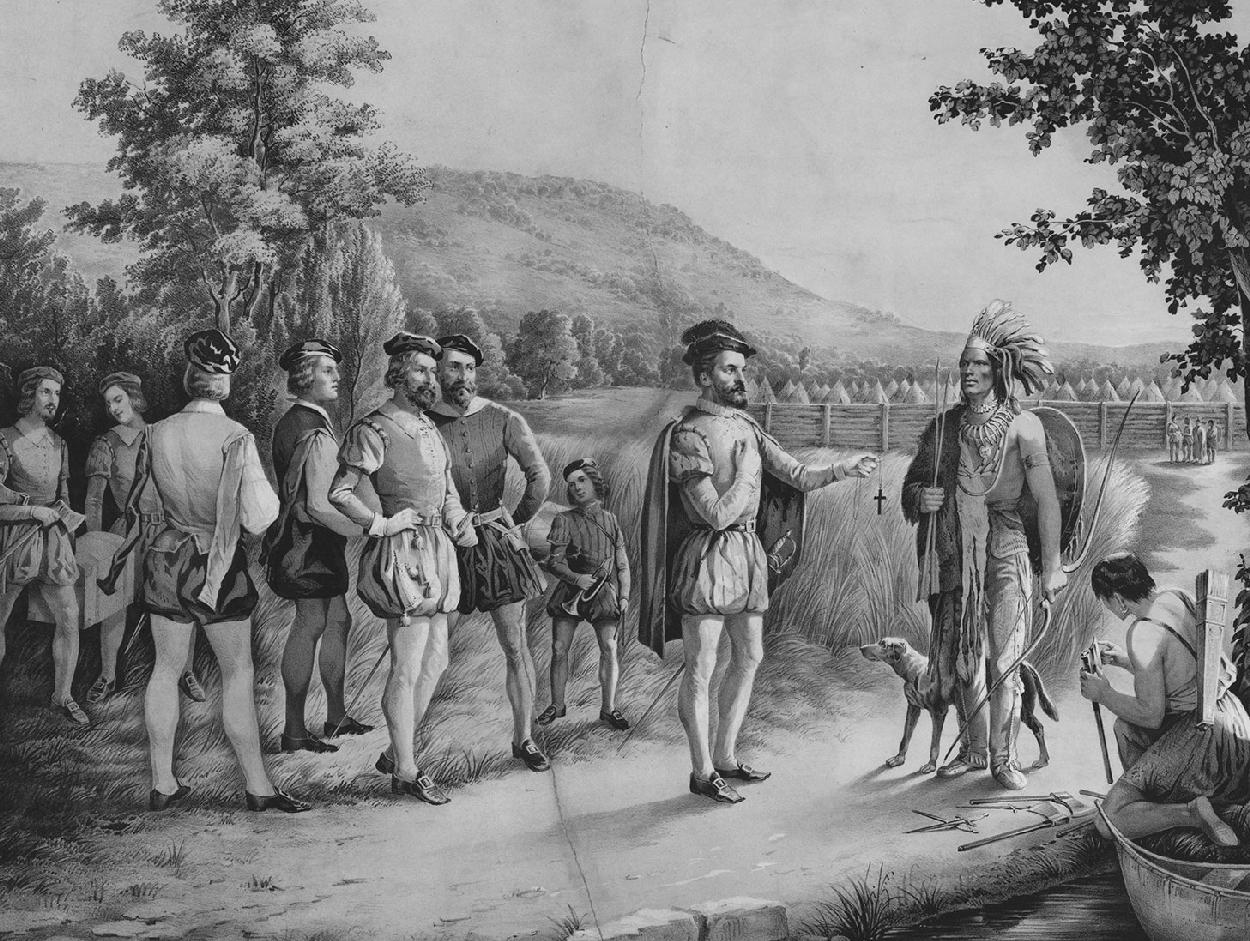
Figure 1.--This illustration shows the meeting between Chief Donnacona and French explorer Jacques Cartier at Hichelaga (1534). Donnacona is a rare Native American we know a little about. He was the chief of Stadacona (modern Québec City), at the time village of about 500 people. He allowed two of his sons (Domagaya and Taignoagny) to accompany Cartier back to France. Cartier returned them on his his second voyage to New France (1535). He wintered near Stadacona. They were saved from scurvy because of Donnacona's remedy. Even so, Cartier seized the chief, his two sons and six other Iroquoians and fociably took them back to France. Donnacona met King Francis I and told him of the riches of North Americas. He helped generate interest in further exploration. He never returned to Stadacona. He died in France (about 1539). We are not sure who the illustrator wa, but it apparently dates to 1850.
The rich North Atlantic fisheries played an important role in early French explorations. French navigator Jacques Cartier may have sailed to to the waters off Newfoundland as part of a fishing fleet in the early 1500s. He may have also been involved with Giovanni de Verrazano's expeditions. King Francis
I commissioned Cartier to find the Northwest Passage (1531). Cartier with two small ships and 61 crew members. After reaching Newfoundland, he discovered the Magdalen and Prince Edward islands and the Gaspe Peninsula, claiming them for France. Cartier�s accounts of his expedition created great interest in France and inspired many young men to persue their fortunes un North America. Francis I ordered a second expedition (1535). This time Cartier sailed up the St. Lawrence River founding Mont Real now known as Montreal. Rene-Robert LaSalle (1643-87) sailed to Canada to persue the enormously profitable fur trade (1666). Indians accounts of two great rivers (the Ohio and the Mississippi) intrugued him especially the possibility that one might flow into the Pacific. He began his search in 1667 and pusued it for sevral years without success. After returning to France, King Louis XIV granted him land and a trading post he opened made him one of the most powerful man in Canada. LaSalle returned to France again (1679) and Louis XIV approved an expedition to find and explore the Mississippi River. LaSalle sailed through the Great Lakes claining them for France and then lead a small excpedition down the Illinois River in canoes to the Mississippi River. They canoed the Mississippi River, but found it flowed into the Gulf of Mexio rather than the Pacific (1682). LaSalle claimed the Great Lakes and Mississippi Valley for France.
Jacques Cartier (1491-1557)
Jacques Cartier was born in Saint-Malo, France (1491). The rich North Atlantic fisheries played an important role in early French explorations. French navigator Jacques Cartier may have sailed to to the waters off Newfoundland as part of a fishing fleet in the early 1500s. He may have also been involved with Giovanni de Verrazano's expeditions. King Francis I commissioned Cartier to find the Northwest Passage (1531). Cartier with two small ships and 61 crew members. After reaching Newfoundland, he discovered the Magdalen and Prince Edward islands and the Gaspe Peninsula, claiming them for France. Cartier's accounts of his expedition created great interest in France and inspired many young men to persue their fortunes un North America. Francis I ordered a second expedition (1535). This time Cartier sailed up the St. Lawrence River founding Mont Real now known as Montreal. Cartier on his third voyage founded establishes the first French colony in the New World at Charlesbourg-Royal, near modern Québec (1541).
Rene-Robert LaSalle (1643-87)
Rene-Robert LaSalle (1643-87) sailed to Canada to persue the enormously profitable fur trade (1666). Indians accounts of two great rivers (the Ohio and the Mississippi) intrugued him especially the possibility that one might flow into the Pacific. He began his search in 1667 and pusued it for sevral years without success. After returning to France, King Louis XIV granted him land and a trading post he opened made him one of the most powerful man in Canada. LaSalle returned to France again (1679) and Louis XIV approved an expedition to find and explore the Mississippi River. LaSalle sailed through the Great Lakes claining them for France and then lead a small excpedition down the Illinois River in canoes to the Mississippi River. They canoed the Mississippi River, but found it flowed into the Gulf of Mexio rather than the Pacific (1682). LaSalle claimed the Great Lakes and Mississippi Valley for France.
Jacques Marquette (1637-75)
Jacques Marquette was born in Laon, France (1637). He was a Jesuit missionary explorer. He studied and taught in the Jesuit colleges of France for some 12 years before Jesuiye suthoritiesv ordered him to become a missionary to the Native American peoples of North America (1666). He traveled to Quebec in that same year. Marquette had a remarkable gift for lanaguage. He set out to learn the Native American languages, all by ear as these were not written lnguages. Marquette was not only able to quickly converse fluently in six different Native American dialects. And he became an expert in the Huron language. He then set out from Quebec to establish more missions farther up the St. Lawrence River in the western Great Lakes region (1668). He helped establish missions at Sault Ste. Marie. TThis became Michigan's first European settlement (1668). And another at St. Ignace, also in Michigan (1671). He departed St. Ignace with Louis Jolliet (1673). Jolliet was a friend and fur trader/explorer. Louis, comte de Frontenac, governor of New France, wanted to know about what we now know as the Mississippi River. The orders were to find the direction and mouth of the Mississippi River. Native Americns clled it Messipi--'the Great Water'. They set outwith an expedition that included five men and two canoes (1673). They travelled down the northern portion of the Mississippi River and provided the first accurate data on the importannce of the River and its course.