**
European voyages of discovery -- Portugal voyages de descubrimento
European Voyages of Discovery: Portugal
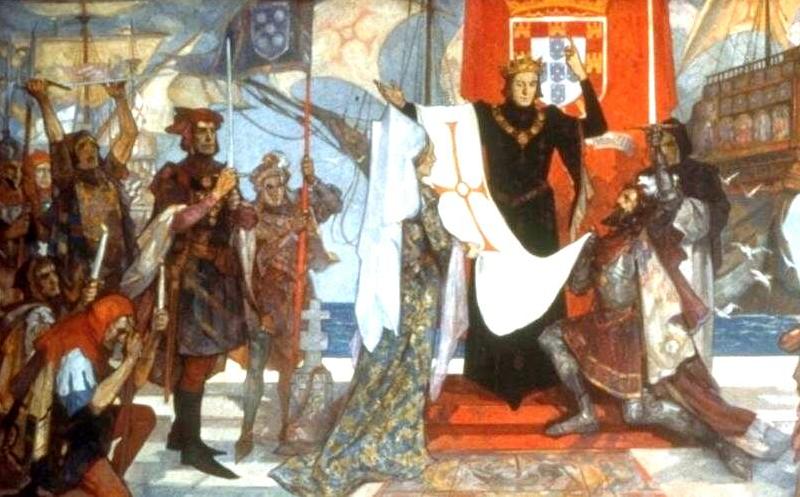
Figure 1.--This mural depicts Vasco da Gama sailing from Portugal in a voyage in which he will round the Cape of Good Hope and reach India. Here De Gama pays homage to the King John II before his departure from Lisbon in 1497. Put your cursor on the image to see Abraham ben Samuel Zacuto, a Jew who had been expelled from Spain, presenting his astronomical tables to da Gama. Zacuto soon after was forced to fleed Portugal as well to avoid forced conversion. The mural is in at the William Cullen Library at the University of the Witwatersrand, Johannesburg. Artist: John Henry Amshewitz. Put your cursor on the image to see the rest of the mural.
The accumulating knowledge of geopgraphy and improvements in shipbuilding and navoigation led Prince Henry and King John II of Portugal to seek a route to the Indies through the still largely unknown Atlantic. Portuguese mariners began sailing south along the coast of Africa. Information provided by travelers was refined by explorers who began to sail south along the African coast. Each voyage added to the accumulating data and gradually improving maps and charts. The Portuguese eventually reached the equator (1471). One unaswered question of history is just how much Portuguese navigators knew. Some historians argue that it was the Portuguese who first discovered the America, landing in Brazil. Even a cursory study of the may suggests that Portuguese saemen sailing south must have stumbled on the buldge of Brazil where it juts out ibnto the South Atlantic. Unfortunately we will never know as the famed Portuguese archive was lost to fire. We do know, of course, that Bartholomeu Dias reached the Cape of Good Hope at the southern tip of Africa (1486), showing that Ptolemy was wrong about the possibility of a sea route to Asia. Vasco da Gama reached India (1498). Portugal was thus the first European nation to reach India, the Indies, and China. Soon after Columbus first reached Ameruica, Pedro Alvares Cabral (1467-1520) discovered Brazil (1500). Gaspar Corte Real sailed to North America and although he founded no colony helped to found a flourishing fishery. Ferdinand Magellan (1480?-1521) served in the forces of the Portugese crown involved in military campaigns in India and the Spice Islands (1508-12). Magellan conceived of reaching the Spice Islands (Indonesia) via the Atlantic, but King Emanuel was uninterested, causing Magellan to renounce his Portuguese citizenship.
Geographical Information
The accumulating knowledge of geopgraphy and improvements in shipbuilding and navoigation led Prince Henry and King John II of Portugal to seek a route to the Indies through the still largely unknown Atlantic. Prince Henry the Navigator founded the Institute at Sagres on the southwestern-most point of Portugal, Cape Saint Vincent (1415). The site was closeky chisen. Classical geographers called it the western edge of the earth. The Prince's Institute might be described as a 15th century think tank and research center. The first such facility in Europe and one that would not be recreated until the 19th century. The Institute included libraries, an astronomical observatory, ship-building facilities, a chapel, and necessary housing for the staff. Prince Henry wanted to train Portuguese mariners in navigational skills and to improve vessel design. The library was created to collect geographical and navigational information. Pronce Henry employed the leading geographers, cartographers, astronomers, and mathematicians from around Europe to work at the Institute. In addition to building a storehouse of geographical data, the Portuguese developed a new type of ship, called a caravel. It was both fast and maneuverable. A major purpose was the riches to be gained by trade with the East which was blocked by the Ottomans and Arabs. And at any rate Portugal did not hace a Mediterranean coast. The Institute was to support expeditions to the East which could supply Europe with porcelin, spices, silk, and other valuable trade goods. But also important to the Portuguese was spreading Christianity. Prince Henry hoped to find Prestor John. He did not, but as a result of the Institute, Portuguese navigators diminated the first phase of the European outreach to the rest of the world. Portugal was a very small country. They faced the danger of competition from other European countries, especially their larger neighbor Spain. The Portuguese were thus extremely secrative about their findings. They kept their navigational charts and the location of trading posts secret as much as possible. They composed faked documents to protect thir secrets and to confuse competitors. As a result, historians are unsure today just how much the Portuguese knew an even actual Portuguese documents have to be treated with caution. One of the main issues is the Americas. Some historians speculate that Portuguese expeditions headed south had landed on the coast of what is now Brazil. And the way the coast of Brazil juts out into the South Atlantic, this seems a destinct possibility. Portuguese fisherman on the Grand Banks may have even provided information about North America. Thus King John II may have access to very valuavle geographic information. Some suggest that this explains why he wanted a more westerly line in the Treaty of Tordesillas (1494). Some historians believe that the major documents with real data wwre archived in the Library of Lisbon. Unfortunately, Lisbon was struck by a devestating earthquake (1755). The university library were destroyed in the earthquate and resulting fire. This we will probably never know just how much the Portuguese actually knew.
Africa
Portuguese mariners began sailing south along the coast of Africa. Information provided by travelers was refined by explorers who began to sail south along the African coast. Prince Henry dispatched 15 expeditions to navigate south, but all failed to pass Cape Bojador south of the Canaries (1424-34). Primce Henry is often seen as a scholar prince. And this was certainly part of his historical acvhievement, but it shoyuls also be noted that part of his paymebnts fron the Crown for services was African captives. The enslavement of Africans did not begin withthe Portuguese voyages, but this was the beginning of the Allantic slave trade nd increasing numbers that wouls soon follow. The suffering of the African capives did not bother Prince Henry, but wa noted by others from an early stage. A Portugese scribe wrote what he observed, "Oh poweful destiny, doing and undoing with your turning wheels, arranging the things of this world as you please! Do you even disclose to those miserable people some knowledge of what is to become of them, so that they may receivesome consalation in the midst of their tremendous sorrow? And you who labor so hard to divide them up, look with pity, upon so much misery, and see how they cling to each other, so that you can hardly seoarate them! Who could accomplish that divisionwithout the greatest toil;becAuse as soon as they had put the children in one place, seeing their parents in another, they rose up energeticallyand went over to them; mothers clasped their other children in their arms and threw themselves face downupon the ground with them, receiving blows with little regard for their own flesh, if only they might not be parted from them!" [Eannes de Azurara, p. 10.] Until the 15th century while the Arabs for centuries had operated in sub-Saharan Africa, Christian Europe had no knowledge of it. Rumors spread that sea monsters blocked the pasage south. Finally, Captain Gil Eannes attempted the voyage (1434). He first sailed west rather than south. Than he turned south, only heading eastward after passibg the Cape. It was a major breakthrough for Portuguese explorers. After this, Portuguese exploration of the Africa coast pushed steadily south. Each voyage added to the accumulating data and gradually improving maps and charts. The Portuguese reached Cape Blanc (1441). Captain Eannes returned with the first boatload of enslaved Africans (1444). The Portugese reached the important Gambia River (1446). Prince Henry the Navigator died (1460). His nephew King John II continued the work at Sagres. The Portuguese eventually reached the equator (1471). It was the Institute at Sagres that Prince Henry founded which would support expeditions progressively further south which would eventually round the Cape of Good Hope and sail east to India, the Spice islands, and eventually China.
America
One unaswered question of history is just how much Portuguese navigators knew. Some historians argue that it was the Portuguese who first discovered the Americas, landing in Brazil. Even a cursory study of the map suggests that Portuguese saemen sailing south must have stumbled on the buldge of Brazil where it juts out ibnto the South Atlantic. Unfortunately we will never know as the famed Portuguese archive was lost to fire. Pedro Alvares Cabral (1467-1520) discovered Brazil (1500). Gaspar Corte Real sailed to North America and although he founded no colony helped to found a flourishing fishery.
Indian Ocean
We do know, of course, that Bartholomeu Dias reached the Cape of Good Hope at the southern tip of Africa (1486), showing that Ptolemy was wrong about the possibility of a sea route to Asia. Vasco da Gama reached India (1498). Portugal was thus the first European nation to reach India, the Indies, and China. This was an accomplishment od enormous importance. Portugal thus broke the Mamreluke-Venetian monopoly. The balance of power not only began to shift from eastern to wrsten Rurope, bur in fsact from Asia to Europe. It opened a new chapter in international reltions. Soon after Columbus first reached America.
Ferdinand Magellan (1480?-1521) served in the forces of the Portugese crown involved in military campaigns in India.
Pacific Ocean
Magellan also fought for the Poruguese in the Spice Islands (1508-12). Magellan conceived of reaching the Spice Islands (Indonesia) via the Atlantic, but King Emanuel was uninterested, causing Magellan to renounce his Portuguese citizenship.
It was the Portuguese who first rounded the Cape of Good Hope and established trade with first India and eventually China and Japan. There were more than commercial consequences. The character of Islam was changing from an emlighted outlook oromoting enquiry and learning to a closed theocratic sociry that supressed secilarblearning. Portugal was one of two tiny European countries that were able to establish vast trading and colonial empire. The Portugese eventually built one of longest-lived empires in history, enduring nearly 6 centuries. The Portugese Kingsom was fouded durung the Reconquista (1139). The Kingdom's Empire began with the seizure of Ceuta in North Africa (1415), but this was more an extension f the Reconquista. The creation of an empire beagn as part of Age of Discovery. The foundation of the Empire began in the 15th century and from the early 16th century it stretched across the globe, with possessions in the Americas, Africa, Asia, amd extending into Oceania, mearly encircking the globe. Firedwith the Catholic spirit of the Reconquista and the knowlwdge acquired by Prince Henry the Navigator and his School of Navigation, Portuguese sailors began temtatively exploring the coast of Africa and Atlantic Atlantic islands (1418-19). They benefitted from developments in navigation, cartography and maritime technology in which they played annimportant role. This led to the famed caravel which the Portuguese used to find a sea route to the East seeking spices, silks, porrcelin and other valuable products. As Portuhguese navigators moved south aling the African Atlanric ciast it set up trading posts which evebtually became collomies. As Brazil bulges out into the Atalantic, they also discobered the America at about the same time Columbus made his famous voyage, perhaps earlier. After Vasco de Gama rounded the Cape of Good Hope (1498) the Portuguese began to expand east. The destruction of Arab sea power at the Battle of Diu left Portugal in control of the India Ocean (1509). Bartolomeu Dias finally reached the Cape of Good Hope (1488). Vasco da Gama reached India (1498). Pedro Ãlvares Cabral discovered Brazil (1500). Some believe Brazil was actually discovered earlier. It was tiny Portugal that first reached China and first dominated the Oriental trade (16th and 17th century). Portugal ammased a huge empire, but in the long run it could not match the power of the other European maritime countries. This was in part becuause Portugal was a small country, but size was not the only factor. Portugal was first displaced in many areas by the eqaually small, embattled Dutch Republic. The Porthugese Empire essetially ended with the indeprndence of Angola and Mozambique (1970s). The final outpost, Macau, was returndto China (1999).
Sources
Eannes de Azurara, Gomes in Robert E. Conrad, Children of God's Fire: A Documentary History of Black Slavery in Brazil (Princeton University Press: Princeton, N.J., 1983).