*
war and social upheaval: The Cold War country trends Greece
The Cold War: Country Trends--Greece
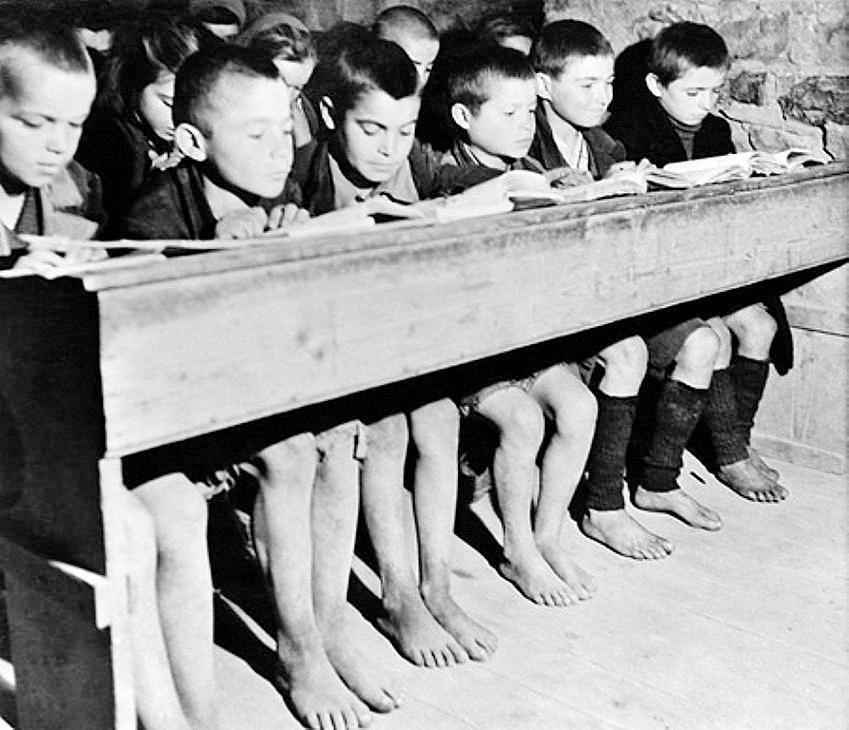
Figure 1.--Greece was devestated by World Wat II and even before the Germans withdrew (1944), another war had begun when the Communist partisans attempting to seize control of the country. The Greek economny was near collapse when the British arrived and the British wwere unable to provide adequate support to either support vthe economy or to defeat the Communist guerillas. This photo was taken in Greece after World War II (probably in 1946). It was taken in Karamoula, a village in the mountains near Agrinion. It was in these motaneous areas that the Communist insurection was the strongest. Mote that two boys are wearing leg warmers. (We suspect that they are knee socks with the feet cut off because their parents could no longer afford shoes.) This means that the photo was taken in cold weather. Note that all the boys were barefoot. They came to school barefoot despite the cold weather. Obviously they didn't own any footwear.
Greece became an early battleground of the Cold War. The struggle for Greece began even before the Germans had wihdrawn. The British after the German withdrawl landed and prevented the partisans from seizing power. Eventually the partisans effort to use their military strength to seize power would lead to the Civil War (1944-49). The deteriorating situation in Greece was one of several contentious issues that were raised at the Potsdam Conference (1945). President Truman was less willing to accomodate Marshall Stalin than President Roosevelt had been. Truman was in fact disturbed by the Stalin's refusal to cooperate, especially in Poland. Difference on the future of Germany surfaced. Stalin was determined to impose heavy reparations on Germany. Stalin for his part accused the British of supporting a reactionary monarchy in Greece and a Fascist regime in Trieste. Greece was devestated by the War. The economy was near collsapse when the Allies arrived and having to fight a war against Soviet-backed guerrillas was beyond its capacity. Observers may disagree about the program advocated by the Government and the partisans. What is indisputable is that the political parties participating in the Government were willing to take the debate to the people and settle the issues in democraric elections. It is sometimes difficult to cut through the fog of ideologally based debate, but one ujndeniable fact is that Communists do not like competing in free elections and once in power hold either sham elections or no elections at all. The Communist guerillas wanted to settle the issue of Grece's future by force of arms. Britain supported non-Communist forces in Greece against the Soviet-directed Communist guerillas. The combined impact of the cost of World War II and Atlee's Labour Government's socialist policies undermined the British Economy. The British had to retain war-time rationing long after the War ended. The Atlee Government announced it could not continue financial and military aid to the enatteled Greek government (February 24, 1947). At the same time, the communist guerillas were receiving military assistance from Yugoslavia and the Soviet Union. Seeing it important to prevent Greece from falling behind the developing Iron Curtain, President Trumsan decided to act and proclaimed the what has come to be known as the Truman Doctrine (March 12, 1947). He proclaimed thsat "it must be the policy of the United States to support free peoples who are resisting attempted subjugation by armed minorities or by outside pressure." The Soviet Union beginning with its policy in Poland had begun fighting the Cold War before the end of World War II (1944). This was the first major American action in the Cold War. It was in essence a declaration of war upon Soviet efforts to subvert democratic governments in Europe. The President backed up the tough language in his speech with massive military and economic assistance to both Greece and Turkey, another country under Soviet pressure.
tlainan Duche Benito Mussolini launched an invasion of Greece on October 28, 1940 from Albania. Mussolini had earlier invaded an occupied Albania in 1939. In contarast to the close coordination that developed among the Allied countries, Mussolini not only did not coordinate his attack with the Germans, but did not even inform them of his plans until the attack was underway. Mussolini assumed that the Greeks woukd easily fall to his conquering army. Greek's small army of 150,000 men not only stopped the Italian thrust toward Salonika using rugged mountaneous terraine to their advantage, but with British assistance including RAF units, drove the Italians back into Albania. The Italain attack had been unwanted by Hitler who was preoccupied with the Battle of Braitan and forming a grand coalition of NAZI satellites, occupied countries, Fascist Spain, and Vichy France for an uncoming invasio of the Soviet Union. Mussolini's invasion had turned the sympathetic Metaxis Fascist Government in Greece into a British ally. This was of emense strategic significance because from bases in Greece, the British could threaten the Romanian oil fields--NAZI Germany's primary source of oil. The Greeks by November 1940 had seized Korçë, the principal Italian base in Albania. The lack of martial ardour of Italian soldies during the War is surprising given the pretentions of military greatness by Mussolini and the Fascists which had governed Italy since the 1920s. This was in sharp contrast to Hitler's success in ideoligically preparing the German soldier. The threat to the Balkans and Germny's souther flank forced Hitler to fivert his attention south away from Britain. Hitler forced the Balkan states to join the Axis: Hungary (November 20, 1940), Romania (November 23, 1940), Bulagaria (March 1, 1941), and Yugoslavia (March 25). Had Mussolini not invaded Greece, Hitler may have forced Metaxis into the Axis as well or at least he would have remained neutral and there would have been no British forces threatening the Balkans. The Wehrmacht in April 1941 invaded Greece, quickly defeating the Greek and British armies. While the Germans rapidly achieved their goals, the effort was a dissaster fpr the German war effot. The invasion of Yugoslavia and Greece forced the Wehrmacht to delay operation Barbarossa--the invasion of the Soviet Union. This lead to 4 years of hideous barbarism. The Greeks did not submit meekly to Axis (German, Italian, and Bulgarian) occupation and Ressistance groups soon fornmed. The German reaction was brutal beyond description. The war and the experience of the occupation threw traditional family roles into question as women became breadwinners and children took up arms. NAZI reprisals were severe. The Greek children were especially affected by the German occupation. In addition, the NAZI program of plundering the occupied countries resulting in large quantities of food being shipped from Greece to Germany. This caused a mass famine in Greece. Thousands of children starved.
The Greek Communist Party (KKE) after the NAZI invadsion of the Soviet Union formed the Natiojnal Liberation Front (September 1941). It was a popular front group of the left wing parties, right wing parties refused to join. EAM's militar force was the National People's Liberation Army (ELAS). ELAS fought the German, Italian and Bulgarian occupation forces, but because of their vicious reprisals, spent as much time fighting right-wing resistance groups, the National Republican Greek League (EDES) and the National and Social Liberation (EKKA). British agents in Greece attemoted to negotiate a ceasefire so the Resistance could focus on the Germans--the Plaka agreement) (February 1944). The Resistance groups by 1944, however, understood that the Germans were defeated and focused on the country's future after liberation. ELAS broke the agreement by murdering Dimitrios Psarros, EKKA's eader. The precise circumstances are unclear. ELAS has completely destroyed the right-wing groups (by April 1944). Because of the limited German occupation force, ELAS succeeded in liberating a large area of the mountainous Greek mainland, mainly because the German wihdrew into the population centers and rail corridors north. EAM established a separate government--the Political Committee of National Liberation (PEEA) (March 1944). EAM even conducted elections to a PEEA parliament--the National Council (April 1944). EAM allowed women to voite for the first time. PEEA and the Greek Governmentb in exile did not recohnize each other.
German Withdrawl (September 1944)
The Germans in September 1944 finally decided to evacuate the Greek mainland so that they would not be cut off in the Balkans by the advancing Red Army which was pushing into Bulgaria and Hungary. The Germans attempt to keep the evacuatioin secret as units are quietly shifted north. The Germans succeeded in airlifting some combat units off Crete, but British aircraft carriers moving into the eastern Meditteranean meant that German garisons on other Greek islands were isolated. The Germans in May 1945 surendered the last of the Greek islands under their control.
The Italian withdrawl from the Axis and surrender to the Allies greatly complicated the German occupation of Greece. Most of the occupation force in the Balkans was Italian. Not only did this weaken the occupation force, but the Resistance forces received large quantities of arms and supplies from the Italians. The Germans rushed additional forces into the Balkans, but they were not capable of supressing the guerilla forces. The situation worsened when Bulgaria switched sides as the Red Army approached. The Germans in September 1944 finally evacuated the Greek mainland so that they would not be cut off in the Balkans by the Red Army which was pushing into Bulgaria and Hungary. The Germans succeeded in airlifting some combat units off Crete, but British aircraft carriers moving into the eastern Meditteranean mean that German garisons were isolated. The Germans in May 1945 surendered the last of the Greek islands under their control. Liberation in Greece, however, did not bring peace. Conflict developed between the Communist Resistance forces EAM/ELAS and the British-backed conservative Papandreou government. Athens was liberated on October 12, 1944. The struggle for control of liberated Greece resulted in conflict between EAM/ELAS and the British-backed conservative government. There was considerable concern about a possible Communist seizure of power. The British, as a result, toughened their position against ELAS and their soldiers--the andartes. In some cases the British even made common cause with rightest elements that had collaborated with the NAZIs. [Manzower] These differences made it difficult for the Greek resistance and the Btitish who landed to persue the Germans as they left Athens and moved north.
The Greek Civil War was one of the opening phases of the Cold War which decended on Europe after the defeat of the NAZIs. The German Wehrmacht was in 1944 being relentlessly pushed west by the Soviet Red Army. Rather than being cut off in the Balkans and Greece, the Wehrmacht begam to withdraw in 1944. British troops in 1944 entered Greece as the Wehrmact withdrew north. The Resistance groups attacked the fleeing Germans. Elections return to Greece after the the Germans withdrew in 1944, but were hotly contested. The Communists boycotted the elections and a bloody guerilla campaign that amounted to a Civil War which tore the country apart. The Greek People's Liberation Army (ELAS) organized by the Greek Communist Party was the strongest force in the Resistance and tried to seize control of Greece. Only 2 months after the departure of the Germans from Athens, the ELAS and British fought strret battles. An armistice was signed with the British in 1945, but a civil war developed among the Greek political parties. The British were weakened by nearly 6 years of War and were unable to fully support the non-communists. Britain which had shouldered enormous costs during the War was essentially a bankrupt nation. Very substantial costs followed the War such as the occupation of Germany and contining respnsibilities in Cyprus, Greece, Palestine, and other countries. This is one reason why rationing had to be continued in Britain after the War. This proved extremely unpopular with serious domestic political consequences. The British also turned to rightest elements in Greece, including some who had collaborated with the Germans. Soon some members of the anti-NAZI Resistance movement were being arrested. The British asked for American assistance. The United States beginning in 1947 began supplying arms to the Greek Government. The Americans helped construct damaged infrastructure like air fields, bridges, docks, railways and communication networks. Fighting in the Civil War continued for 4 years. The Communists finally in 1949 declared a cease fire.
American Policy
Seeing it important to prevent Greece from falling behind the developing Iron Curtain, President Trumsan decided to act and proclaimed the what has come to be known as the Truman Doctrine (March 12, 1947). He proclaimed that "it must be the policy of the United States to support free peoples who are resisting attempted subjugation by armed minorities or by outside pressure." The Soviet Union beginning with its policy in Poland had begun fighting the Cold War before the end of World War II (1944). This was the first major American action in the Cold War. It was in essence a declaration of war upon Soviet efforts to subvert democratic governments in Europe. The President backed up the tough language in his speech with massive military and economic assistance to both Greece and Turkey, another country under Soviet pressure. This was followed by the Marshall Plan, an economic assistance program to help post-War Europe recover from the devestation of World War II. American officials somewhat simplistically assumed that Greece once the Communist guerrilas were defeated would follow the script of the rest of the Western European parlimentary democracies. Despite Greece's ancient bheritage, the principles of parlimentarian rule and democratic compromise were less well established in Greece than the rest of Western Europe. They expected Greece to become a stable, democratic ally in the Cold War struggle with the Soviet Union. This expectation gave too great an emphasis on the distant Soviet threat and too little emphasis on domestic Greek political tensions.
Domestic Politics
The King, Army, and non-Communist political parties faced a commony enemy after World War II--the Soviet Union and the Communist guerillas. Greece's several non-Communist political parties thus closely cooperated during the Civil War, recognizing the danger posed by the Soviets and the Greek Communuist Party. This was essentially a continuation of the struggle with leftist elements during the German occupation. The non-Communist parties had no illusions about the chsracter of their adversaries as a result of clsshes with EAM-ELAS during the German occupation. This was an important factor in the defeat of the Communists guerillas in the Greek Civil War (1947-49). Thus Greek anti-Communist domestic politics during the immediate post-War era were complimentary to American Cold War policies resisting Soviet expansionism. With the defeat of the Communist insurection, however, the coalition of non-Communist parties became more unstable. Differences began to emerge among republicans and royalists. Royalist support was pronounced in the Army.
The devestated World War II economy was further damaged by a Communist inspired civil war. Although not fully understood at the time, the Cold War began in Poland and Greece (1944). Stalin used the NKVD and Red army to supress anti-Communist Poles. In Greece, the British and eventually the Americans supported the royalists. The insuing Greek Civil War raged (1944-48) and added to the damaged during the World War II Axis occupation. As a result, not only was very little progress was made repairing the economy, but living standardards remin far below pre-War levels. Percpita income levels were below that of the poorer European countries as well as the Third World countries like Mexico. Only American food aid prevented widespread famine. Britain was unable to maintain its former international commitments, inlarge measure because of its faltering economy. President Harry S. Truman declared in an address to Congress that the foreign policy of the United States was to assist any country whose stability was threatened by Soviet-backed communism (March 1947). His initial request to Congress was $400 million to assist Greece and Turkey. Congress quickly approved. This became known as the Truman Doctrine. Greece and Turkey became primary beneficiaries of the Truman Doctrine. After the Civil War, Greece began benefitting from a recovering European economy. Greeks moved to countries like Germany and their remitences became an important part of the economy. Greece became a popular tourist destination and tourism became an important part of the Greek economy as the European economy rebounded an average Europeans could afford vacation trips. Shipping also rebounded as an important sector. Shipbuilding also became important. Greece began to report enviable economic growth, albeit from a low base. Lving standards began rising toward those of prosperous European countries.
NATO
The United States after the Soviet-sponsored coup in Czechoslovakia helped organize the North Atlantic Treatu Organization (NATO) to guarantee the security of Western Eiropean democracies (1948). Greece joined (1952).
Anti-Americanism (1955-58)
Soviet Bloc Relations
Balkan Developments
There was a regional dimension to the Cold War. Here the principal issues were Greece policy toward Communist Yugoslavia which exited the Soviet Bloc anf NATO ally Turkey. Here neat Cold War divisions became complicated. Greece foreign policy, especialy after Marshall Tito broke with Stalin had manageable issues with Yugoslavia. This was not the case with its NATO ally--Turkey. Conflict with Turkey had deep historical roots, most recently with a disatrous Greek-Turkish War which followed World War I. With regards to Turkey, the Cyprus crisis (1964-67) complicated NATO security arrangements.
The monarchy became an increasingly contentious issue in Greek politics after World War I (1914-18) and the disatrous war with Turkey (1900-22). Constantine I was forced to abdicate (1922). It is at this time that Prince Philip left Greece. This brought King George II to a shaky throne. He was ousted by a plebiscite which abolished the monarchy (1924). The monarchy and George II was restored to the throne when Greece held another plebecite (1935), but in the rising tide of Fascism, Metakis controlled the Government. The Greeks resisted the Italian invasion (1940, but even with British assistance we not able to stop the Germans (1941). The royal family left with the British to establish a government-in-exile. The British brought the royal family back after the Germans evacuated (1944). The monarchy was restablished (1946). King George and Queen Elizabeth divorced (1935) and there were no children. Thus when King George died (1947), he was succeeded by his brother Paul. It was thus King Paul who played a role in the post-War effort to defeat Communist insurgents and establishing a parlimentarian democracy. We notice references on the internet of the British resestablish a "corrupt monarchy". We are not sure how to interpret this charge. This period in Greek history is controversial and Greek authors are prone to write ideolgically based accounts rather than real history. We welcome reader comments on this. King Constantine II inherited the throne after his fsther died (1964). Constantine was only 24 years old. He married Princess Anne-Marie of Denmark. The new King was popular in Greece. King Constantine attemopted to reverse the Colonel's coup and was exiled (1967).
Cyprus
Greek politicans promoted enosis with Cyprus (1950s). This was poopsed by Turkey because of the Turkish minority on the island. Britain rejected enosis, but British withdraw (1960) meant that the issie would become a serious probken between Greece and Turkey. Independent Cyprus prived tp highly unstable. And enosis became a major issue in complicated Greek domestic politics. George Papandreou's Center Union party was prcariously balanced between the pro-Communist United Democratic Left and Konstantin Karamanlis' right-wing National Radical Union. Papandreou and his center regime refused to pursue enosis (union).
Military Coup (1967)
The Greek military seized control of the country (April 1967). The coup was varried out by a group of middle-level Army officers ("the Colonels"). The king attempted a counter-coup, butbit failed (December 1967). He was exiled by the junta.
Sources
Hatzivassiliou, Evanthis. Greece and the Cold War Front Line State, 1952-1967 (Routledge, UK).