|
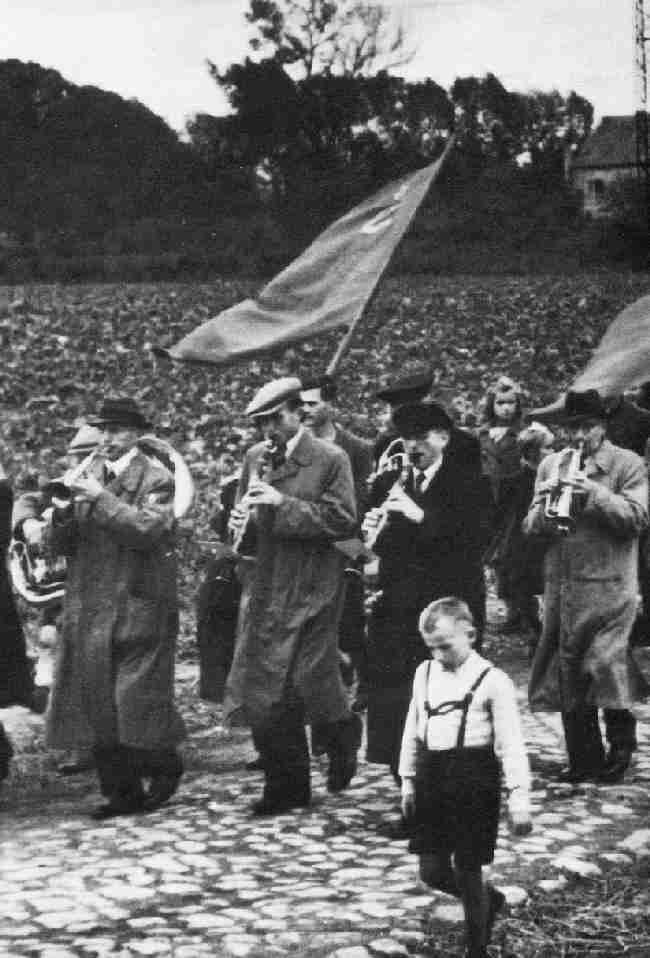
Stalin was left after World War II by virtue of the Red Army's victories was able to seize control of Eastern Europe. He proceeded to install totalitarian puppet satellite governments in Poland and other countries in his control. Stalin also proceeded to use Communist parties in Greece, France, and Italy to attempt tp broaden the Soviet Empire. American and European democracies sharply criticised the Soviet actions. Winston Churchill warned in 1946 that an "iron curtain" was descending through the middle of Europe. Western Europe in the aftermath of the War were weak politically and economically as well as militarily. World War II had left Europe devastated. A staggering 40 million people were killed. Western Europe by itself was not capable of resisting Soviet power. President Truman decided to support Western Europe The Cold War as it developed was a period of intense East-West competition, tension, and conflict, but always short of full-scale war in Europe. Joseph Stalin who had virtually allied himself with Hitler in 1939 to launch World War II, blamed the War on "capitalist imperialism" and threatened Western Europe. Many in the West with leftist views accepted this view of the post-War era. The American policy throughout the nearly 50 years of the Cold War was once of "Containment". It was first enunciated by George Kennan writing as "X" in a celebrated article on Foreign Affairs. In the Nuclear Age, war between super powers was unthinkable. America sought to contain the expansion of the Soviet Empire while internal forces would weaken Soviet imposed Communist regimes from within.
Soviet Dictator JosephStalin was left after World War II in total control of Eastern Europe, This was the deal he had cut with Hitler as the two dictators launched World War II. His calculation was that Germany and the Allies (Bitain and France) would fight a long debilitating war in the West. This of coursewas not how it worked out. It would be the Germans and the Soviet Union that would fight th long, debilitating war. But now Stalin has Eastern Europe that he had coveted. Stalin proceeded with the Rd Army and NKVD to install repressive puppet satellite governments along the Soviet model in a dozen countries with often substantially different trditions, cultures, economies, and religions. This would be radically differeny political, economic, and moral system. Stalin set out to bend the people in these countries to his will in an often freigtening fashion. [Applebaum] The people of the region had to confront a range of dilemas as major changs to their society were made in Moscow and beyond their control. They had no choice but to adjust to a new life that challenged core beliefs and demolished the feedoms they had acquired earlier in the 20th century. There had been Communist parties in these counrries, but not governing parties. In Poland and other countries. Stalin proceeded to install People's Republics in these states which meant Stalinist police states subservient to the Soviet Union. Little did Stalin know that the virus of freedom was still alive in a devestated Poland that would not just unravel the Soviet empire, but the Siviet Union itself.
Recent research on Stalin and the Cold War has benefitted from the opening of Soviet archives after the disolution of the Cold war. One historian accessing the Soviet archuives describes how Stalin "exercised a orofound influence, far more hands on than often suppoed" in directing the Red Army abnd NKVD as they orcestrated the 'nationl front' take overs of one Eastern European country after another. Stalin explained his master plan to a group of Yugoslavs (1948). "You strike wgenyou can, ad avoid the battke when you cannot. We will jon the fghtvwhen conditiins favor us and not when they favor the enneny." [Gellately] Staklin was for the most part unflinching in Eastern Europe. Elsewhere he pulled back from conflict (Berlin, Greece, Iran, China, and Korea). His decesion to equivocate here priobabky reflets the fact that the Americand had the atomic bomb and the Sovuet Union did not.
One can only wonder what would have happaned if the traitors working for Soviet spy rings who provideed American atomic secrets to the Sovies had succeeded in doing so earlier.
Stalin's initial vision in signing the Non-Aggression Pact with Hitler was that war between Germany and the Western Allies woukd so weaken them that he could extend Soviet control into Western Europe. While this did not occur as he planned, He now had eastern Germany and an opportunity to expand Soviet Control beyond Eastern Europe. Stalin thus proceeded to use Communist parties in Greece, France, and Italy to broaden the Soviet Empire. Communist influence had been expanded by their role in resisting German occupation. The only real limitation to Soviet expansion west was the United States which was now entrenched in western Europe and thnks to President Truman's determination, prepared to resust further Soviet expansion.
Little noted at the time was a famine in Eastern Europe and Russia. While not engineered by Stalin, Stalin turned what was a manageable poor harvest into a genocidal famine. It was limited by the standards of the Ukranian famine Stalin also enginered (early-30s), but still some 1.0 million people perished. [Gellately] Some authors give estimated deaths of up to 1.5 million people. This was the last major famine to be experienced by the Soviet Union. Thre were subsequent poor harvests, but the Soviet Government managed them to avert famine, even importing grain. The famine began after the War (July 1946). It peaked (February–August 1947) until the next havest began. Famine deaths rapidky diminished, although because so many oeople were weakened by malnutrition, there were still some deaths into 1948. [Ellman] The famine was experienced across the grain-producing regions of the Soviet Union (Ukraine, Moldavia and areas of central Russia). Poor harvests were caused by drought and the huge damage resuklting from the War in the Ukraine. Animals and farm macinery had been largey destroyed and the farm labor population had been reduced. The Soviet grain harvest in 1946 was only 39.6 million tons, a fraction of the 95.6 million t harvested in 1940 before the German invasion. Soviet Government grain reserves helped to feed the affected area. Soviet authorities appealed to the United Nations for assistance. The Ukrainian diaspora in North America provuided grain shipments. The Soviet Union had the reserves to feed people in the affected areas ad could have prevented most if not allmof the mortalities. [Ellman] Much of the grain destribution went to the cities. Most of the mortalities occurred in the countryside and that Soviet officals were resonsible. [Rosefielde, p. 46.] Another author writes that Stalin blieved that the faminne was a replay of the earlier Ukranian famine with wily peasants trying to trick gulible Soviet city authorities. [Service, p. 498.] All through the famine, the Soviet Union continued exporting grain, most of it to Germany and Poland to help establish Soviet rule there. [Hanson]. Soviet historians tend to reject the claims of Staklin's culpabiliy and insst thatvmortlities were very limited. [Kulchitsky] The Western assessments are more believable. Soviet officiaks would have not appealed for Western aid had not conmdituions been desperate. In addition, unlike many European countries and Amerrica, the Soviet Union partly due to the famine did not experience a Post–World War II baby boom.
Ethnic cleansing is as old as history. This is because ethnicity has not only cultural, but political consequences. Thus a conquering power is motivated to eliminate or force out potentially hostile peoples from newly conquered territory. This was true in the ancient wirld and is still true today. This was a policyb used by Hebrew people when they conquered Canaan and by the Asyrians and the Babylonians when the conquered Israel and Judea and the Rimans centuries later. There are countless examples of ethnic cleanings throughout history. Hitler and Stalin as part of the NAZI-Soviet Non-Agression Pact (1939) pursued a policy of ethnic cleaning as they proceeded to carve up Europe between them. Both had deadly consequences for the people involved. Hutler's plan, Generalplan Ost, was the most deadly as it was biolgically based and he planned to kill, enslave, or expel the population and replace them with German colonists. This surely the most terrible crime in human history. The survival of the Red Army in Barbarossa made it impossible to carry out what was planned, but even so millions of people died. Stalin's ethnic cleanings was more politically based and while less deadly than Hitler plan, did result in millions of deaths, in part because Stalin unlike Hitler had time to carry out his plans. Stalin's goals were to solidify Soviet control of conmquered areas and to sinplify Soviet rule by eliminating or reducing some ethnic groups (such as the Chechans and Ukranians), dispersing others (the Balts), and concentrating others in their national areas (the Poles and Ukraines). Stalin began this process as soon as he had control of the Soviet state. The first action was the Ukranian Famine (early-1930s). Largely anti-Soviet Ukranian farmers were replace with more compliant Russian farmers. World War II offered even greater opportunuities for ethnic cleansing. Major deadly actions were inituated by the NKVD after Stalin as Hitler'invased and seized eastern Poland, Lithuania, Latvia, Estonia, and parts of Romania. The same would have occurred in Finland, except that Finish resistance in the Winter War (1939-40) allowed the civilan population time to evacuate. Stalin's ethnic cleansing continued after the War, although the goal was no longer to destroy the Polish nation. Stalin oversaw massive polulation trasfers of Balts, Poles, Bylorussians, Ukranians, and others. [Gellately]
Western publics developed huge sympathy for the valliant Soviet people for the role in breaking the NAZIs jugernaught as part of the titanic struggle on the Eastern Front. Largely forgotten was the NAZI-Soviet Pact alliance and the Soviet aggressions in the East as a NAZI ally (1939-41). Or the terruble attrociries commited by the NKVD, similar in character to the NAZI SS, except for Hitler's Jewish mania. The Soviet aggressions was not nearly as well covered as the NAZI aggssions in the world media. And the NKVD did a better job of covering up incidents like Katyn then the SS did its killing. Unlike the modern Wesrern press, the coverage did not have an ideological bent. There was a left-wing media, especially in Europe, but the lack of reporting in the East had other causes. It was in part because of the country's involved. Poland, Finland, the Baltics, and Romania in the East were simply not of the same interest as Britain and France in the West. The western campaigns were also easier to cover than the wastern campaigns. A major factior here was that Britain did not fall. American reports like Edward R. Murrow reported daily from Britain, even during the height of the Blitz. Eastern Europe fter the NAZI and Soviet conquests was a journlistic black hole. All of thids changed dramatically when Hitler launchd Barbarossa, the NAZI invasion of the Soviet Union. At a time that Britain was largey impotent and America was not yet in the War, the Red Army ans Soviet people fought massive battles with the seemingly invincible Wehrmacht. The Soviet Union this gained great sympathy throughout Europe and America for the fight agaunst the Axis and the Germans in particular. Ant mention of Soviet attrocities and aggression disappeared in the press. President Roosevelt began taklking aboyut 'Uncle Joe' and refused to even consider that Katyn was the work of the Soviets. (His major concern during ghe War was tht Stalin would nmake a separate peace with the NAZIs.) The trearment of the Soviets in the Wesrern press was nothing, but glowing. Not only was the Red Army fighting spirit lionized, but also the resistance of the Soviet people. The full story of NAZI barbarity in the East was not yet known, but the resistance of the people was given great coverage. This a the Cold War began toi unfold with a continuing series of Soviet suppression of occupied people, it took some time for public opinion to change. Americans still thought of the Soviets as valiant fighting allies. Here the situation was different in Euroope. Several European countries (especially Italy and France) has string Communist partis. And Brittain after the 1945 general election had aabout (Socialist) Governent. Sympathy for the Soviet Union was evem more entrenched.
American and European democracies sharply criticised the Soviet actions. Public statements in both East and West soon defined a new world conflict. Joseph Stalin who had virtually allied himself with Hitler in 1939 to launch World War II, blamed the War on "capitalist imperialism" and threatened Western Europe. Stalin was the first to define the conflict. He declared in 1946 that international peace was impossible 'under the present capitalist development
of the world economy'. Winston Churchill warned in 1946 that an 'iron curtain' was descending through the middle of Europe. After the struggle against the Axis, the Western public was not ware of the Soviet threat as the Soviets had played a major role in the defeat of NAZI Germay. President Truman was having political problems and there was resistance to the hard line he was taking with Stalin. The first major statement dscribing the Cold War that Stalin had launched even before the Germans were defeated. He dlivered speech at Westminster College in Fulton, Missouri (Match 5, 1946). [Watson} Churchill explained in graphic terms what Stalin was doing an introced the idea of the Iron Curtain. "From Stettin in the Baltic to Trieste in the Adriatic an iron curtain has descended across the Continent. Behind that line lie all the capitals of the ancient states of Central and Eastern Europe. Warsaw, Berlin, Prague, Vienna, Budapest, Belgrade, Bucharest and Sofia, all these famous cities and the populations around them lie in what I must call the Soviet sphere, and all are subject in one form or another, not only to Soviet influence but to a very high and, in some cases, increasing measure of control from Moscow." Churchill warned that Britain and the United would have to work together to meet the Soviet threat. President Truman decided to support Western Europe. The Cold War was a period of intense East-West competition, tension, and conflict, but always short of full-scale war between the Soviets and the Americans.
The year 1948 very early in the Cold War would prove to be the year of decission, although few people in East or West recognized it to be so. America and the West in the aftermath of World War II were unprepared for another epic struggle. The Soviet Union had been a key ally in the struggle against NAZI Germany. Largely forgotten was the fact that Stalin had begun the War as essentially a NAZI ally. The Soviet Union gained enormous prestige as a result of its role in smashing the NAZI tyranny. In the appaulung relevations about the NAZIs at the end of ghe War, largely unreported were the horrors of Stalimism. Resistance to Communism was weakened by Stalin's growing prestige and the collapse of the European ecinomies as a result of the War. And there was no certainty that American would remain engaged in Eutope and not, as after World War I, again withdraw. And there was considerable support in the United States to do just that. Without America, there was little possibility that the Europeans could resist Stalin with the huge army and substantial Community Party allies in France, Italy, and other Ruropean countries. A victorious, but bankeupt Britain was incapable of stoping the Sovietization of Western Europe. And Stalin thought he was on the verge of scjieving just that. Unlike the rest, Stalin from the moment he seized power saw himself engaged in a war with the West. And now he thought victory was at hand. He began the year by seizing Czechoslovakia, the country that played the key role in demonstrating the charcter of Hitler and the NAZI regime (February 1948). Then Stlin moved on Berlin, establishing a blockade (June 1948). Changing American thinking about the Soviet Union required a major shift in public opinion. The first Western leader to clearly enunciate the evolving struggle was former British Prime Minister Winson Churchill. President Truman invited Churchill to speak at Independence College in Fulton, Missouri. The American policy throughout the nearly 50 years of the Cold War was once of "Containment". It was first enunciated by George Kennan writing as "X" in a celebrated article on Foreign Affairs. In the Nuclear Age, war between super powers was unthinkable. America sought to contain the expansion of the Soviet Empire while internal forces would weaken Soviet imposed Communist regimes from within. But it was not just America which had to decide. Although defeated and occupied, and perhaps not fully understood byeither the Soviets or American, the German people also had to decide. And it would be Germany, at the heart of Europe that in the end woyld decide the Cold War and future of Europe.
World War II had left Europe devastated. A staggering 40 million people were killed in World War II. German cities had been levelled by the Allied strategic bombing. Fighting on the Eastern Front had also destroyed cities in Russia and Eastern Europe. The economies were prostrate. Jobs did not exist and capital was scarce to revitalise the economies. The performance of the Communists in the Resistance had increased their prestige. The desperate economic conditions also increased support for the Communists. After the War, the Communists were one of the largest political parties throughout Western Europe, especially in France and Italy. Only in Germany where people feared the Russians did the Communists not build an electoral threat. In an effort to promote economic recovery, the United States implemented the Marshall Plan. (It was not called the Truman Plan because that would have doomed it in the Republican controlled American Congress.) The Plan was proposed by American Secretary of State George C. Marshall in 1947. Eventually over $12 billion (in
1948 dollars) was provided. This assistance is generally credited with helping to launch the European economic recovery. Some authors down play the importance of the Marshall Plan, maintaining that the recovery was already well underway. [Hitchcock] Marshall Plan assistance was offered to Russia and the Eastern European satellites. Stalin, suspicious of American intentions, rejected the offer and speeded the establishment of Stalinist regimes throughout Eastern Europe. [Hitchcock]
The Soviets enginered a coup in Czechoslovakia in February 1948. Czechoslovakia was the last Eastern European country occupied by the Soviets that had any semblance of a democratic government. Elections had made the Communists the largest political party. Heavily industrialized Bohemia had a well-established Communist following before World War II. Many Czechs were sympathetic toward the Russians because they had challenged the German Hapsburgs which had dominated Bohemia and Slovakia. Also many Czechs were bitter with how the West had abandoned them at Munich in 1938. The Communists did not, however, have a majority in Parliament. This forced them to form a coalition with non-Communist parties. Many Czechs were hopeful that their country because of its geographic location and historical links coukld serve as a kind of political bridge between East and West. The Czech Gobernment had welcomed the Marshall Plan, but Soviet presure forced them to reject it. Stalin was not interested in bridge building. He wanted a reliable, compliant Czechoslovakia like the other satellite states of Eastern Europe. The Communists armed their supporters and staged street demonstragtions. They were supported by th police because the Ministry of the Interioir was in the hands of the Communists. The army might have supoorted the Government if President Benes had decided to resist, but he believed that Soviet troops would intervene. Czecholslovakia at the time was almost entire surounded by Soviet satellites or Soviet occupied eastern Germanya nd Austria. He therefore yielded to the Communiksts and the country soon had a Stalinist Government. [Hudson, p. 60.] The Soviet takeover of Czecheslovakia in 1948 had many unintended consequences for Stalin. It helped convince the Western Allies to unite their occupation zones in Germany and it helped build support in America for entering in a military alliance with the Western European democracies.
Berlin was at the center if the Cold War. Many believe that the Cold War began and ended in Berlin. The beginning would be the Soviet efforts to push the Western Allies out of Berlin. The end was the fall of the Berlin Wall in 1989. Berlin was conquered by the Red Army in savage fighting during the end of April 1945. Stalin was itent on the Red Army taking the prize and lied to General Eisenhower about his intentions. Wehrmacht commanders west of Berlin could not understand why the Americand did not push for Berlin. When the Red Army approached his bunker, Hitler committed suicide. As decided at the Yalta Conference, the three principal Western Allies (Britain, France, and the United States) were given occupation zones in the conquered NAZI capital. As Berlin was located well within the Soviet occupation zone of Germany, all supplies had to pass through the Soviet zone. As a result, the Western allies and the Berlin people were vulnerable to Soviet pressure. This and the symbolic value of Berlin made it the focal point of the Cold War. It was at Berlin that the first major confrontation of the Cold War occurred. Stalin decided in 1948 that he could blockade Berlin and force the Western allies out and the people of West Berlin into submission. Ironically the people of West Berlin were saved by American and British pilots, in most cases the same men that only 3 years earlier had been bombing German cities and had reduced Berlin to ruble. President Truman was determined that the United States would not leave Berlin and a massive airlift was organized and even during the winter, more supploes were reaching Berlin than before tht Soviets had instituted the blockade. One of the pilots was struck by the Berlin children who still lived in desperate conditions after the War. The children of course had little idea of the larger issues involved, but were caught up in the episode when one of the pilots began dropping chocolates in little parachutes when he reached Berlin. Other pilots began doing the same. The Berlin children began calling him Uncle Chocolate and thousands wrote with directions as to how to how the American pilots could hit their homes! Finally with the success of the Airlift, Stalin relented and rail and road links were reopened in 1949.
The Allies during World War II shifted support from the Royalist Chetniks to Tito's Soviet-backed Partisans. A great deal of weaponry and supplies were delivered to the Partisans. Yugoslavia was the only country liberated by the resistance movement during the War. Despite Westen aid , after the NAZI surrender (May 1945), Tito set up a Stalinist-style peope's republic in Yugoslavia. He took a hard-line attitude toward the West. He instituted a police state, thousands died in concentration camps, and democratic parties were suppressed. British and American planes were shot down along the border.
While Tito set up a Stalinist police state, it was different than in the rest of Eastern Europe because he was not a puppet installed by Stalin. Gradually Tito became uneasy about Stalin's efforts to gain control in Yugoslavia as he had done in the rest of Eastern Europe. There were also economic problems. The Soviets as they were doing in the rest of the East Bloc were deivering low quality goods at very high pfrices. Yugoslav state-owned companies were unable to obtain needed equipment. Officials in other East Bloc countries did not dare complain about such matters. Stalin was increasingly concerned about Tito's independence. Stalin did not permit discesion in the Soviet Union or within the Eact Bloc satellite countries. Hr saw Tito's independence at setting a bad example. Red Army units were distpacted to the border. For awhile it looked like aoviet invasion would occur. Soviet propaganda charged that Tito wash "pursuing an unfriendly policy to the Soviet Union" abd called Tito a Trostkyite. This was virtually the worst thing you could say about someone in the Soviet Emipre. (Stalin had Trosty killed--an ice pick through the skull. This of course was not lost on Tito. Stalin cut off trade with Yugoslavia and incouraged dissent with the Yugoslav Communist Party. The Soviets had the Yugoslav Communist Party expelled from the Cominform. Tito turned to the West. He accepted U.S. Marshall Plan assistance (1950).
Throughout history war has pushed technology more than any other mechanism. Weapons productiin has always been at the forefront of technical advances even thousands of years before science was invented. And on science di develop, states marshalled its scientists to support the war effort. Usually little could be accomplished during a war, espcially short wars, but longer wars involving powerful nation states were a different matter. This occiurred during World War I, but World War II more than any other war was a war in which scientific establishments played a major role. The War involved all of the great world industrial powers and their scientiic establishments. The Germans began the War wth perhaps the world's most impressive scientific establishment closely followed by the British and with the funds poured into weapons development had an important lead. Fortunately for the world, Germany lacked the industrial capacity to take full advntage of its scientific capabilities. The War set the parameters for the Cold War arms race. Hitler essentially diarmed Germany from the nuclear arms race by attacking Jews including important nuclear scientists. These and other European scientists coiming to America helped turn America from an industrial powerhouse to a technological giant as well. Here Britain's desperate War-time decsion to share its tecchnology with America also played an important role in this process. The Soviet Union emerged from World War II badly damaged, but a super power capable of sweeping over a devestated Europe. The country had a large industrial infrastructure and was training a huge numbers of scientists and engineers, many of whom were assigned to a vast weapons development effot. As in America, German technology and scientists played an important role. This set the stage for an explosive growth in weapons development with two super powers rushing to develop new and destructive weaponry. Many thought after Wold War II that the Soviets would win the Cold War. The growing Soviet scientific establishment impressed many. But in the end, Soviet science failed their Cold war effort. The Soviets proved adroit and stealing Western military secrets from the West, but less successful at developing new technologies. This is not to say that the Soviet weapons industry did not produce excellent weapons, they did. But they did not produce the innovative high-tech weaponry capable of gaining a military advantage in the Cold War. The Soviet weakness in electronics meant that when Soviet and military weaponry met in Cold war battlefield, especially the Middle East, their weapons proved disappointing. And their failure to allow industry to capitalize on scientific advances meant that the Soviet economy did not benefit from the advances their scientists were making. As a result the Soviet weaons industry was never able to gain a lead in weapons development. And in the end the failure of socialist state planning to compete with the dynamic capitalist economies meant tht the Soviet Union could not sustain the enormous costs neded to compere with the United States. At the same time the United States work in communications, radar, aircraft, nuclear submarines and carriers, space, and nuclear energy gradually found their way into industry and built the dynamic modern economy, including computers and the internet.
Britain, Ftance, and the Low Countries created a Western Union alliance. These countries, however, by themselves could not have resisted a determined offensive by the Soviet Union. We cannot at this time assess the economic debate. The Marshal Plan was important, but it was only seed money, It was the Europeans who played the key role in generating the ecomnomic miracle that swept Western Eroe in sharp contrast to the moribund economies of Sovier dominated Eastern Europe. While the role of the United States in financing recovery can be debated, it is clear that only the military shield of the Unites States prevented the establishment of Eastern European People's Republics in Western Europe. America did not withdraw from Europe after World War II as it had done after World War I and many assmed would occur after the NAZI surrender. American participation in a miltary pact to defend Western Europe was not a foregone conclussion in 1945. It was Soviet actions after the War that created political support in America for a continuing military presence in Western Europe. It was genrally thought that America's rejection of Wilson's League of Nations and isolationist policies after World War I had made possible Hitler's rise to power. Many Americans became convinced that the mistake should not be repeated after World War II. It was Stalin more than any other individuals that helped bring about that commitment. Stalin after seizing control of the Bltics, Poland, omania, nd Bulgaria, moved to seized total control of Czechoslovakia (1948), ending all pretence of democracy. It was not lost on many that Czechoslovakia was Hiler's first victim. But it was the Sovier blockade of West Berlin that made it clear that a strong Western military capability was necessary to counter Soviet power. The United States helped organize the North Atlantic Treaty Organization (NATO)--a mutual assistance military treaty. Even befoire the Soviet blockade was lifited, the United States and 11 other countries on April 4, 1949 signed the treaty. [Hudson, p. 62.] Thanks to Stalin, there was little debate in the Senate which approved ratification in an overwealming 82 to 13 vote. Stalin's foreign policy had brought about just what he did not want, a powerful, determined military capability on the the western edge of the Soviet Empire. Despitethe the treaty vote, many Americans were uneasy about President Eisenhoer's commitment to Europe. His choice of General Eisenhower as NATO Supreme Commander was adeft political move. Eisenhower as a result of his orld war II role was tremendously popular in both America and Europe. And interestngly, despite leading Allied armies into Germany, he was even popular in Germany. While mnot critical when NATO was established, in the long run, AO and the defense of Western Europe would depend on Herman prticipation.
After the Japanese surrender at the end of World War II, the Civil War between the Nationalists and Communists resumed in earnest. The Soviets who had smashed the Japanese army in Manchuria and turned massive quantities of arms over to the Communists. America tried to mediate the war, but this was a pipe dream evolving from a limited knowledge of China. The corrupt Natioanlist Government suffered major defeats in northern battles and Communist armies swept south. Chang and the remaining forces fled to Taiwan which had been liberated from the Japanese. The success of the Communist Revolution led by Mao-Tse-Tung in 1949 began a massive change in Chinese society.
As the Cold war intensified, a wave of anti-Communist histeria developed in America. This was fueled by Soviet actions in Eastern Europe and, unlike the United States, unwillingness to substantially reduce military forces. The Communist Victory in China added to the public fear as did the annoncement that the Soviets had developed an atomic bomb. The public began to think that the Truman Administration was mismanaging the Cold War. Some Republicans began to intimate that disloyal Americans were undermining the American effort against the Communists. Relevations concerning the Rosenbergs passing atomic secrets were especially sensatuoinal. The Reoublican Congressional effort to root out susposed Communists began in ernest during 1947. The House of Un-American Activities Committee (HUAC), chaired by J. Parnell Thomas, in 1947 began investigating Hollywood.
The Committee named people who they accused of holding left-wing views. Major Hollywood stars testified against friends. Others refused to testify and received prison terms. Three former FBI agents and a right-wing television producer, in published "Red Channels", a widely circulated pamphlet listing the names of 151 writers, directors and performers who they claimed were members of subversive organisations. A blacklist developed and people's careers were ruined. Some of the best known individuals were: Leonard Bernstein, Charlie Chaplin, Aaron Copland, John Garfield, Dashiell Hammett, Burl Ives, Arthur Miller, Dorothy Parker, Philip Loeb, Pete Seeger, Orson Welles, Paul Robeson, and Richard Wright. The Govdernment began using the Alien Registration Act against the American Communist Party. Leaders of the Party were arrested and tried in 1949. Spy cases at the time involving Alger Hiss and Julius and Ethel Rosenberg added to the public concer about an internal Communist threat. Senator Joseph McCarthy, a Republican from Wisconsin, saw political capital in the public hysteria.
The North Koreans Army crossed the 38th parallel on June 25, 1950 to forcibly unify Korea. The Soviets had provided modernwapons in great quantity to the Noryth Koreans. Embolded by the Communist victory in China during 1948-49, Kim-il-Jong obtained Stalin's approval for the attack. President Truman immediately ordered war material be provided the South Koreans and then air support for the South Korean Army. Seoul fell within days. Truman went to the United Nations which, because the Soviets were boycotting the Security Council, approved a military opperation to repell the North Korean attack. Truman than ordered American military intervention. The Soviets had helped the North Koreans build a powerful military force. The United states after World War II had significantly scled back its conventional military force. As a result, the North Koreans pushed the South Koreans back to a small peromiter around the southern port of Pusan. Generl MacArthir from Japan organized an amphibious invasion at Inchon which caught the North Koreans between teo forces. North Korem resistance collapsed and MacArthur rushed north accross th 38th parallel to completely defeat and occupy North Korea. Tuman was skeptical, but MacArthur assured him that Chinese warnings to intervene were bluff. They were not an America norces approaching the Yalu River were mauled by a massive Chinese attack. For a while it looked like the Chiese would tota;lly defeat the U.N. forces, but the front was finally stabilized north of Seoul. What followed was 2 years of stalemate which became a major political issue. Peace talks with the Communists were frustrating. Th major issue became the Communist demand that all POWs be returned, even the ones who did not want to be repatriated. Finally a ceasefire was reached. Stalin died in 1953. Eisenhower became president in 1953 and fulfilling a campaign promise, went to Korea. The armistice wnt into force on July 27, 1953. More than 3 million Koreans were killed as a result of te War. Millions more were made homeless refugees. About 1 million Chinese soldiers are believe to have been killed. American casualties totaled nearly 55,000.
The United States established Radio Free Europe (RFE) during the Cold War with the mission of promoting democratic values and institutions around the world. Its initial assignment was to broadcast news to countries absored by the Soviet Union in Easter Europe. Winston Churchill coined the phrase Iron Curtain because of Soviet efforts to control the new available to the public in the countries it controlled. It was the only source of uncensored news to the population. RFE merged with Radio Liberty (RL), a similar effoty firected at the Soviet Union itself. Both efforts are funded bu the U.S. Congress, initially through the Central Intelligence Agency (CIA). The United States decided to change the funding relationship (1971). The funds began to be awarded in the the form of grants through the Broadcasting Board of Governors of the U.S. Information Agency. The disolution of the Soviet Union brought about a range of changes, especially budget cuts. The offices were relocated from Munich, Germany, to Prague in the then democratic Czech Republic. More changed occurred (1995). . Broadcasts were terminated in certain areas and added in others. They are currently directed at Eastern and Southeastern Europe, Russia, the Caucasus, Central Asia, and the Middle East. The broacasts continue to include news, political commentaries, sports, and music, and to be written, produced, and broadcast by nationals committed the democracu and open socities from the audience countries. There are a range of formats. RFE/RL now broadcasts over shortwave, AM/FM channels, and the Internet.
Stalin has expected American forces to leave Western Europe after World War II as they had done in World War I. President Roosevelt has assumed that the American public would demnand this and told Stain at Tehran (1943) that this would be the case. But it did not happen. American public opoinion shifted. We are not sure why. We expect that it in part reflected the impact of Pearl harbor on the anerucan psyche. The Berlin Air Lift and the Korean War were also important. Worse still was that Germant and the Western countries were repoerting economic miracles. while Soviet-controlled Eastern Eurooe was in economic doldrumns. We are not sure just what was affecting Stalin's thinking, but the Soviet dictator decided on a major policy initive--a peace plan. He may have began to realize that West Germany would eventually join NATO creating a real military deterent. These were all issues whirling around in 1952. There is no way of knowing, however, just whay was on Stalin's mind, but he made an offer to the West--unify AND neutralize Germany. He even offered to tolerate free elections--essentially Finlandization. Germany located in he heart of Europe was potentially the strongest economy in Europe and was already strongly recovering from the War in 1952. There could be no crediatable defense of Western Europe without Germany. And in essencevthevCold War was a struggle for Germany. In the end the German peoples would have to decide tgeir future. There was the appeal of unity in Stalin's offer. The East German people definitely would have supported it because it meant loosening the Soviet grip. The question was waht did the West German people want. And the politicans (less so the people) were divided. The Social Democrats wanted to accept the offer. The Christain Democrats wanted no part of it.
The Doctor's Plot (врачи-вредители was concoted by Stalin to begin a wave of anti-Semitism in the Soviet Union. As far as we know, it was a creation of Stalin's own dark mind. We know of no aid or adviser who brought the idea tyo him as was often the case with Hitler. The full details are not completely understood because they were in Stalin's mind. There is, however, quite a bit known because after Stalin died, there was some documentary evidence and personal accounts as the doctors were released and new Soviet leaders began the preparations for the subsequent de-Stalinization campaign. The reason for the campaign seems to have been the same as the anti-Semetic campaign of Tsar Alexander III. By playing off the existing anti-Semitism of many Russians, the attention of the average Russian could be focused on Jews rather than deficenies of the Soviet state and Stalin's dictatorial rule. And by charging poison, Stalin was was playing into the prejudices of many Russians. A widely held medieval belief was that Jews poised Christians. They were widely blamed for the 14th century plague that devestated Europe. Other historicans believe that Stalin was preparing a major confrontation with the West now that he also had a nuclear arsenal. He calculated that that Soviet actions against the Jews would have helped to raise the level of internaional strife. Stalin like Hitler believed that Jews had great influence within the American Government and would have reacted to an anti-Semetic campaign. Stalin launched his campaign by accusing nine doctors, including six Jews, of planning to poison the Soviet leadership. The completely innocent doctors. Stalin's personal instruction to tortured them to obtain confessions needed for a show trial. His orders to the NKVD interogators were reportedly, "Beat, beat, and again beat." Along with the arrest of the nine doctors, an unknown number of other Soviet Jews were dismissed from their jobs, arrested, shipped to the Gulag, or executed. The NKVD which was expert in such matters obtained the confessions, and a show trial scheduled. Some scholars believe that the next step after the doctors were found guilty in the show trial was to launch old-fashioned pogroms throughout the Soviet Union after which Jews would be transported to Siberia en masse. Stalin reportedly already had the NKVD obtain signed appeals from prominent Soviet Jews begging him to protect Jews by sending them to Siberia. Other scholars deny these charges. There seems to be, however, no disagreement that Stalin planned a massive purge of Jews in the Communist Party and Soviet Government. Only days before the Doctors' Trials were schuled to begin, Stalin unexpectedly died (March 5, 1953). The trials were never held. Pravda announced that the arrested doctors were innocent and had been released (April 1953). [Rappaport] Ironically, the fact that his Jewish doctors as well as other Moscow doctors were arrested meant that Stalin did not get very good medical attention when he collapsed. A further irony is that while this massive attack on Soviet Jews (who were the only remaining large population of European Jews), progressives in the United States were accusing the United States of anti-Semitism because of the scheduled execution of atomic spies Juilius and Ethel Rossenberg. And they had helped steal atomic secrets because they believed that the Soviet Union was a haven for Jews. In reality, it was Stalin's possession of nuclear weapons that have him the confidence to move against the Jews and the West.
Many Soviet citizens hoped that the relaxation of political repression that occurred during the Great Patriotic war would continue and expand after the war. This did not occur. Instead Stalin aided by by fellow Georgian NKVD Chief Lavrentiy Beria began to retigten his grip. Bolstered by victory over Hitler and the NAZIs, that grip was unasiable. And the NKVD was an instrument of repression unparalleled in history, more formidable even than Hitler's SS. The Doctor's Plot was to usher in a sweeping repression of Soviet Jews and preceived opponents as well as a more agressive confrontation with the America and the West. Unfortunately for Stalin and fortunately for the world, one of the Jewish dictors arrested was Stalin;s own personal dictor. And while he was being beaten in the Lubyanka prison, Stalin suffered cebreal hemmorage that led to his death. Only then was a reform process possible, although not guaranteed. What followed is now referred to De-Stalinization, descontructing the murderous police state, expansive police state and personal agrandizement that Stalin created. Scholars debate the time period involved, but seems roughly concurrent with the reign of Nikita Khrushchev (1954-64). The process began with Stalin's death and the arrest and excution of Beria. It was announced by Khrushchev at the 20th Party Congress who shocked the delegates. After securing his position, he shocked the Communist world when he denounced Stalin and the 'cult of personality' with his Secret Speech at the 1956 20th Party Congress.
Khrushchev himself had to reign in the process after the Hungarians took him seriously. Even so, the Destalinization process was very real. First there were official pronouncements, not all made public. Second, were major poltical policy changes (especially the end of terror as a governing tool and a return to a more collective leadership. Khrushchev did begin to wind down the Gulag. Third, there were important economic changes. Fourth, there was real, if limited liberalization of intelectial life. This was highly varible. Pasternak was persecuted during the Khrushchev era. Fifth, there were symolic changes. Here especially important was the end of the Stalin cult, meaning using the full resources of the state to litwrally deify the leader. Destalinization was finally ended by Brezhnev who seized control from the mercurial Khrushchev (October 1964). Denouncing Stalin was one thing, allowing people in the soviet Empire indepndence and democracy was a cery different matter. There were limits on how far Khrushchev and other Soviet leaders were prepared to go in opening up the Soviet Union. Most had been active participants in the Great Terror. Khrushchev owed his position to Stalin and in agreed with Stalin on many issues. [Taubman] When Khrushchev was replaced in 1964, the Party line changed. There was no further discussion of Stalin's crimes although there was also no return to mass terror. Some Leftist thinkers were convinced that Stalin had perverted Communism and that Khrushchev could radically transform the system to create a humane society. [Deutscher]
Stalin and his sucessors encountered much more difficulty subjecting the people of Eastern Europe to totalitarian rule than the Russian people. The Soviets brutally suppressed attempts by Eastern Europeans to overthrow Soviet imposed governments: East Germany (1953), Poland (1956), Hungary (1956), Czechoslovakia (1978), and other outbreaks--espoecially in Poland. The first revolt broke out in East Germany after the death of Stalin. Efforts to end the mass terror and liberalize the Soviet system were met in East Germany by demands for real democratic rule. Soviet officials concluded that reforms were dangerous and threatened the Soviet system. [Harrison] As a result, for three decades efforts at reform were brutally supressed. The Hungarian Revolution occurred in the midst of Nikita Khruschev's de-Stalinization program. One historian contends that Kruschev did not want to appear weak in the face of Western Operations in Suez, thus explaining the force of the Soviet reaction in Hungary. [Hitchcock] Finally it was in Eastern Europe that the whole Soviet system would begin unraveling.
Berlin throughout the Cold War continued to be a very dangerous place. It was there Soviet and American tanks faced each other. It was notable hotbed for spies. The most famous example was a tunnel American and British agents dug into East Berlin to tap the telephone trunk line to Moscow. Apparently the Soviets knew about it because they had penetrated MI-6. [Stafford] Berlin was also an increasing embarassment for the Soviets as the economic affluemnce of the West became increasingly conspicious in comparion to the poor conditions in the East. This was an especially significant problem for the East German Communist Party because East Germans aware of the growing affluence in West Germany. With a common language and living within range of West German TV and radio, every commercial for consumer goods was a cutting piece of unintended propagabnda. In addition, the ease of crossing into West Berlin was adversely impacting the East German economy. The East Germans increased pleas on the Soviets for action on this matter.
The United States after the Communist victory in the Chinese Civil War initially made no commitment to the Nationalists on Taiwan (1949). The Korean War changed this. President Truman ordered a naval cordon around Taiwan which had the dual purpose of protecting the Nationalists and preventing either side from launching attacks. President Eisenhiower after ending the fighting in Korea, removed the naval cordon. This had the impact of causing the First Taiwan Straits Crisis as the Nationalists and Communists fought over offshore islands (1954-55). The Formosa Resolution and the Taiwan-American Security Pact (1955). The Communists were responsible for the second Straits Crisis (1958-60). Sinologists spectulate as to the factors behinf Mao's actions, but he was vareful to limit the attacks on Natiinazlists positions and not attack U.S. forces in the Straits.
The Cold War was to be won or lost in Germany. Although newspapers headlines followed dramatic events as they occurred around the world, it was in Germany that the outcome of the Cold War was determined. The country was even with deminished borders the powerhouse of Europe. The Red Army and Stalin's ruthlessness early owned settled the matter in the minds of most Germans. The question became moreone of whether America had the determination to support the Germans in the face of the Soviet threat. The Western Allied in 1949 began to allow the Federal Republic of German to administer the Western occupation zones and formally ended ocupation in 1955. The larger and more important economy allowed the FRG to dominate the East German Democratic Republic (DDR). The FRG worked to prevent other countries recognizing the DDR which was effctive through the 1960s. It also meant that the West Germans lost opportunities to pursue potentially beneficial commercial opportunities in Eastrn Europe and the Soviet Union. [Gray] This did not change until Arab countries began recognizing the DDR in the 1970s. By that time, Willy Brandt in the 1960s began his Ostpolitik, to build realtions with Eastern Europe and the United States.
There were proxy wars and competition for influence in the newly independent countries of the developing world, many of which introduced Soviet command economics. India adopted a command economy with a democratic political system. Many other countries discarded all but the trappings of democratic government. There was also an arms race between the two super powers. America and the Soviet Union adopted client states in the Third World to support their respectivde sides. Neither country was often that converned with domestic politics in those client states. The Soviets supported Iraq even though the Bath Party arrested and executed Iraqi Communists. The United States supported many non-democratic regimes, in some cases brutal regimes. The Cold War lasted over 50 years. Ase have said, it was not always fought well or wisely. Significant mistakes were made. America was involved in areas in which it was unfamiliar. Of course it easy now to criticize many of those actions. Much of the danger that America and the West faced during the Cold War is now lost. The collapse of the Soviet Union makes it seem that the West was never in mortal danger. But of course it was. Military analysts believe that the Soviets had the millitary potential to sweep to the English Channel. Only the American nuclear umbrella stood in the way. Thus any asessment of American Cold War actions has to be taken in that context. Some historians have criticized America as militarily reckless and to willing to bomb third world countries. This criticism has become increasingly sharp as the spector of Soviet Union faded in Europe and American and European public opinion increasingly diverges on a variety of issues.
World War II war hero President Dwight Eisenhower, played a key role in America's developing Cold War policy. De-Stalinization meant that a less-bloodthirsty, more collegial leadership emerge in the Kremlin. They were still committed to Communism and a confrimation with the capitalist West. They were not, however, willing to risk it all with a nuclear war. When Khruschchev blustered, "We will bury you," he firmly believed that the expected efficencies of Communism would defeat America and the West economically. President Truman served at a time where America posessed a nuclear monopoly or a clear predominance of nucler power. This balanced the Soviet Union' dominant ground military power arrayed against Western Europe. President Eisenhower faced a different situation. The Soviet Union was rapidly developing its nuclear arsenal and while not equalling that of the United States, certainly began closing the gap. The Communist victory in China further complicated the picture. And some in the militry felt the only way of surviving was to lunch a first strike. Ike's answer was a policy of massive retaliation, a nuclear umbrella around Western Europe. Eisenhower threatened the use of nuclear weapons if the Sviets invaded Western Europe. One perceptive historian calls this 'Ike's Bluff'. It was based on his assessment that Khruschev was unlikely to use his nuclear arsenaland that much of the nuclear power and misles existed only on paper. Although siometimes depictd in the media as a good natured simpleton, Eisenhower was a sophisticated practioner of geo-politics. And Eisenhowr was willing to tolerate this because it helped desiguse the high-stakes game to which he was committing the American people. One historian writes, "Eisenhower put trendous--some would say risky--reliance on his own intuition about his former friends and present foes in the Kremlin. He believd, as he once privately wrote a colleague, that the Russian leaders were not 'early Christian mrtyrs'. But he did not widely share this view ... nor did [he] try as hard as he should have to calm the fears of schoolchildren about the threat of Soviet nuclear attack. To do so mightbhave steadied nerves, but would also have shown cards. Public terror was a price--politically as well as psychologically--well below Armageddon." [Thomas] In essence, Eisenhower confirmed the Truman policy of blocking Soviet military expansion so the Cold War became an economic conflict between free market capitalism and Communist state planning.
A power struggle followed Stalin's death in 1953. Former Ukranian Party boss Nikita Khrushchev emerged victorious in that struggle. Nowhere had Stalin's policies been more murderous than in the Ukraine. Khruschev was not a Ukranian. He was born in the Russian village of Kalinovka (1894), close to the Ukrainian border. .He was all to aware of what Stalin had done there and was in fact complicit himself. Stalin appointed him Ukranian Party boss (1939). He served in World War II as a political commisar. He participated in the Barrle of Stalingrad. Perhaps his single most important achievement as the new Soviet leader was launching the De-Stalinization process (1956). While Stlalin was a mass murder, Khrushchev may have been even more dangerous. His behavior was often crude and spontaneous, such as when he famously took his shoe off and banged his desk at the United Nations after a speaker displeased him. He told Americans, "We will bury you" and appears to have believed it because he was convinced that Communism was auoperior economic system. De-Stalinization was not an indication that he was not a fervent believer in Communism. He was willing to use brutal force as he showed in Hungary (1956), but unlike Stalin he was not willing to use terror on completely innocent people. He rarely listen to advisors, often making important decissions on whim or assumptions. His belief in Communist ideology combined with his mercurial personality and willingness to gamble brought the world close to nuclear war over Cuba (1962). It was the closest the world would come to nuclear disaster. He once confided with Nassar that a Mideast crisis was like "playing chess in the dark". He was finally replaced by faceless party aparatcheks in 1964 for his "adventurism". [Taubman] The aparatcheks that followed him did not have Khrushchev's common touch, but were less willing to take military risks on the international stage. And after Khrushchev, the inefficencies of the Soviet system began to become more pronounced.
Mao and his supporters, once the Communists were firmly in power, launched a massive effort to remake the Chinese economy, convinced that "scientific" Markist ideology and central control gave them the capacity to achieve in decades what took centuries in the West. Mao and his associates conceived of the idea that the organization of large-scale rural communes could meet the country's industrial and agricultural challenges. Capital as a result of Markist ideology had negative implications. Thus Mao decided to use labor-intensive methods to develop the economy. Rather than capital and machiery, Mao set about mobilizing manpower. This was a plan prepared by poorly educated politicans who saw themnselves as infalable soicial engineeers despite the experimental nature of their undertaking. Not involved in the planning were competent agromomists and engineers. The economic goal behind the endevor was to bypass the slow, gradual process of industrialization followed by capitalist countries. The most famous example of the Great Leap Forward approaches was communities throughout China build "backyard" steel furnaces. These furnaces required little capital to build, only the mobilization of local labor. The iron and steel profuced, however, was of such poor quality that it was virtually useless. As with much of the production in Communist countries, the product produced was actually worth less that the inputs. In the Soviet Union which possessed enmense raw material resources, productive agricultural land, highly competent technicians, and the ability to expoloit its Eastern European Empire. This the impact of Communist economics was a poor standard of living compared to the Capitalit West. China was in a much more precarious situation and, as a result, the result of the Great Leap forward was a social and economic disaster of emense proportions.
The Soviet Union opened a brand new front of the Cold War with the launching of Sputnik (Otober 4, 1957). Often accounts of the Cold War focus on ideological differences between East and West. Technology played a critical role in the Cold War which is often overlooked. Marxists proclaimed Communism as a new, scientific approach to organizing human society. As a result, science assumed an important ideological status in the Cold war. Obviously if Marxism was the optimal organization of human society, the Soviet Union should be able to produce the best science. And Soviet propaganda trumpeted Sputnik as a symbol of the superiority of Soviet science. President Kennedy understood both the scientific and ideological importance of the space race and committed the Unitesd States to land on the moon. Both America and the Soviets mobilized their sciebtific and industrial resources for a race to the moon. In the long run, superior Western technology played an important role in the West's victory. The West's superiority was, however, not apparent in the 1950s.
In the midst of the debate on thec spave race and scince came a fascinating brief interlude--the Great Moscow Kitchen Debate. The Cold War was often waged with great speeches and lofty platitudes. Now I was a teenager at the time and only minimally informed about most issues. But like most teem agers, espcially if your mom was a good cook, there was one thing we knew a lot about--and that was the family kitchen. The Kitchen Debate was a series of ad lib exchanges between U.S. Vice President Richard Nixon and Soviet Premier Nikita Khrushchev. Future Soviet leader Leonid Brezhnev (who ironically would have to contend with the inability of the Soviet system to supply consumer goods when he replaved Khrushchev) was in attendance. The debate occurred at the opening of the American National Exhibit at Sokolniki Park in Moscow (July 24, 1959). The Soviet Unin and the United States concluded a Cultural Agreement (1958), part of an attemot to to promote mutual understanding and defuse Cold War tensions. As part of this agreement, The Soviets and the Americans agreed to permitb exhibits in each other’s countries. Nixon traveled to Moscow for the opening of the exhibit and offered ton lead Khrushchev on a tour. Thec exhibit highlighted the abunsance of American consumer goods with examples provided by over 450 companies. The two leaders discussed each other's technological achievements and economic policies. Nixon presented the standard capitalist argument, "Diversity, the right to choose, the fact that we have 1,000 builders building 1,000 different houses is the most important thing. We don’t have one decision made at the top by one government official. This is the difference." Khrushchev responded with a rather florid response and claimed in 7 years, the Soviet Union will be at the technological "level of America, and after that we’ll go farther. As we pass you by, we’ll wave 'hi' to you, and then if you want, we’ll stop and say, please come along behind us. …. If you want to live under capitalism, go ahead, that’s your question, an internal matter, it doesn’t concern us. We can feel sorry for you." Khrushchev punctuated this with a little wabe, bye-bye. For whatever reason, afterc seeing all these American consumer devices, it was the arrival at the model kitchen that set him off. He charged that the American exhibit was phony propaganda and that few Americans had kichens any way like this, only rich people has such kitchens in their homes. Which I found fascinating because the model kitchen was not realkly all that fancy and was not unlike our kichen. And we certainly were not rich.
Literary experts can helped but notice the outpouring of great litrature from Russia during the the Tsarist era and then after the Revolution, especially after the beginning of the Stalinist era the almost total lack of published literature of real caliber. The reason of course was the regime's insistance on "Soviet realism" and the fate of authors who were brought to the attention of the security services. Even after Stalin died, authors of real merit had difficulties publishing their work. There were of course gifted authors, but getting their work published was virtually impossible. Nothing illustrates this better than the experiences of Boris Pasternak with his great work Dr. Zivago. The book is asaga of the Revolution and probably the greatest work of literature written during the Soviet era. Pasternak dispaired of ever publishing his masterpiece. Two Italian Communists played a key role in publishing the book. Giangiacomo Feltrinelli was the wealthy founder of a new publishing firm in Milan. He asked a fellow Communist who had just secured a position in Moscow to keep his eyes open for Russian books that he could publish in Italy. Sergio D'Angelo was a young Italian Communist who got a job with the Italian Service of Rasio Moscow (1956). While in Moscow he learned about Dr. Zivago and assumed it would soon be published. The KGB ws not yet paying much attention to it. Such matters were normally effectively handled by the Writers Union and publishing houses. D'Angelo asked his associates to set up a metting with Pasternak who afreed to meet him. D'Angelo offered to get Dr. Zivago published and promosed it would not be released until it was published in the Soviet Union. Pasternak shocked D'Angelo, who was becoming increasingly disalunionsed with the Soviets, when he told him that the book would never be pubished in the Soviet Union because it didn't "conform to official cultural guidelines". Paternak disappeared in to his hous and reappeared in a few minutes wih a package. He told D'Angelo, "This is Dr. Zivago. May it make its way around the world." The two departed with Pasternak saying, "You are invited at attend my execution." The next week D'Angelo flew to East Berlin. As an honored guest of the Soviet Union and flying to East Berlin, D'Angelo was not searched. The Berlin Wall was not yet built and D'Angelo simmoly crossed to West Berlin. Omce the KGB learned that a manucript had reached the West, the Soviets, the KGB was now involved, made a major effort to prevent its publication. They pressured Pasternak to get the manuscript back. The KGB arrested his lover, Olga Ivinskaya, and used her to further pressure Pasternak. (Here accounts vary.) The Soviets published hysterial attacks on Pasternak and Dr. Zivago. [D'Angelo] The Cultural Sector of the Central Committee of the Communist Party called it a "perfidious calumny against our revolution, and against our entire way of life". The book was a sensation in the West. It reveived the Nobel Prize for Literature (1958). It was later turned into a materful movie (1965). The Soviets forced Pasternak to refuse the Nonel Prize. Pasternak was treated as an outcast and viciously attacked by his colleagues. He died in isoltion (1960).
Appelbaum, Anne. Iron Curtain: The Crushing of Eastern Europe (2012), 560p.
Chigirin, Ivan. White and Dirty Spots in History.
D'Angelo, Sergio. The Pasternak Case: Memoirs of a Witness (2007). The Russian publisher of D'Angelo's book included a 20-page epilogue by Pastenak's son Yevgeny Pasternak which D'Angelo did not authorize. The son disputes some details, especially concerning Olga Ivinskaya. His main objection, however, appears to be with the share of royalties D'Angelo received.
Deutscher, Issac. Deutscher is Trotsky's biographer.
Ellman, Michael. "The 1947 Soviet famine and the entitlement approach to famines, Cambridge Journal of Economics Vol. 24 (2000), pp.: 603-30.
Gellately, Robert. Stalin's Curse: Battling for Communism in War and Cold War (2013), 496p.
Gray, William Glenn. Germany's Cold War: The Global Campaign to Isolate East Germany, 1949-69 (University of North Carolina), 251p.
Harrison, Hope. George Washington University. Library of Congress Panel, March 5, 2003.
Hitchcock, William I. The Struggle for Europe: The Turbulent History of a Divided Continent (Doubleday), 513p. This is a thought provoking,
well researched book. He has gained access to never before used Soviet archives. We do not agree with all of his conclusions. The author in many instances, for example, tends to explain Soviet actions as response to American policies rather than the inherent nature of brutal
regime.
Hanson, P. The rise and Fall of the Soviet Economy: An Economic History of the USSR from 1945 (Pearson Education Limited: London.2003).
Hudson, G.F. The Hard and Bitter Peace: World Politics Since 1945 (Praeger: New York, 1967), 319p.
Kennan, George. Foreign Affairs.
Kulchitsky, S.
Mandelbaum, Michael. The Ideas that Conquered the World: Peace, Democracy, and Free Markets in the 21st Century.
Muhin, Jury. Murder of Beria and Stalin.
Prados, John. Lost Crusader: The Secret Wars of CIA Director William Colby (Oxford Unicersity, 2003), 380p.
Rappaport, Louis. Stalin's War Against the Jews: The Doctors' Plot and the Soviet Solution.
Reed, Thomas C. and Danny B. Stillman. The Nuclear Express: A Political History of the Bomb and Its Proliferation.
Rosefielde, Steven. Red Holocaust (Routledge, 2009). -
Service, Robert. Stalin.
Stafford, David. Spies beneath Berlin (Overlook), 211p.
Taubman, William. Khrushchev: The Man and His Era (Norton), 876p.
Thomas, Evan. Ike's Bluff: President Eisenhower's Secret Battle to Save the World (2012), 496p.
Watson, Alan. Churchill's Legacy: Two Speeches to Save the World (Bloomsbury Publishing: 2016).
Navigate the Boys' Historical Clothing Web Site:Ethnic Cleansing
World War II Sympathy
The Cold War Emerges
Year of Decission: 1948
Marshall Plan (1948)
Czechoslovakia (1948)
Berlin Air Lift (1948-49)
Soviet-Yugoslav Split (1948)
Weaponry
North Atlantic Treaty Organization (NATO) (1949)
China (1945-49)
Anti-Communist Hysteria
Korean War (1950-53)
Radio Free Europe
Stalin's Peace Offer (1952)
The Doctor's Plot (1953)
Destalinization (1956)
Eastern European Revolts (1950s-70s)
Berlin (1950s)
Taiwan Straits (1950s)
Germany
France
The Cold War is often seen as a bi-polar struggle between East and West. The reality was much more complicated. France had been humbled by the Germans in World War II. After the War, France attempted to resurrect its colonial empire. This led to two failed colonial wars (Vietnam and Algeria). In search of an independent defence capability, France under General De Gaulle built an atomic bomb and pulled out of the NATO combined command. French leaders also sought to develop a new relationship with Germany and out of that effort the European Union has grown helping to fashion a new Europe. The new relationship with Germany was a key aspect in the West's success in the Cold War. France's estrangement from the United States is more difficult to assess. The collapse of the Soviet threat has resulted in major shifts in the European American relationship.
Developing Countries
Dwight Eisenhower (1953-61)
Nikita Khrushchev (1954-64)
China: Great Leap Forward (1957-60)
Sputnik and the Space Race (1957)
The Great Moscow Kitchen Debate (1959)
Soviet Literature
Sources
CIH -- Cold War

[Return to Main Cold war phase page]
[Return to Main Cold War page]
[Return to Main Communism page]
[About Us]
[Assessment]
[Biogrphies]
[Countries]
[Communism]
[Culture]
[Decolonization]
[Economics]
[Famines]
[Fashion]
[Freedom]
[Hot wars]
[Human rights]
[Inteligence]
[Mass killing]
[Military]
[Pacifism]
[Phases]
[Science]
[Totalitarianism]
[Bibliographies]
[Contributions]
[FAQs]
[Images]
[Links]
[Registration]
[Tools]
[Return to the Cold war Home page]
[Return to the 20th century wars and crises]
Created: February 25, 2003
Spell checked: March 7, 2003
Last updated: 7:08 PM 9/12/2023