Stalinist Era: Agriculture--Assault on the Peasantry
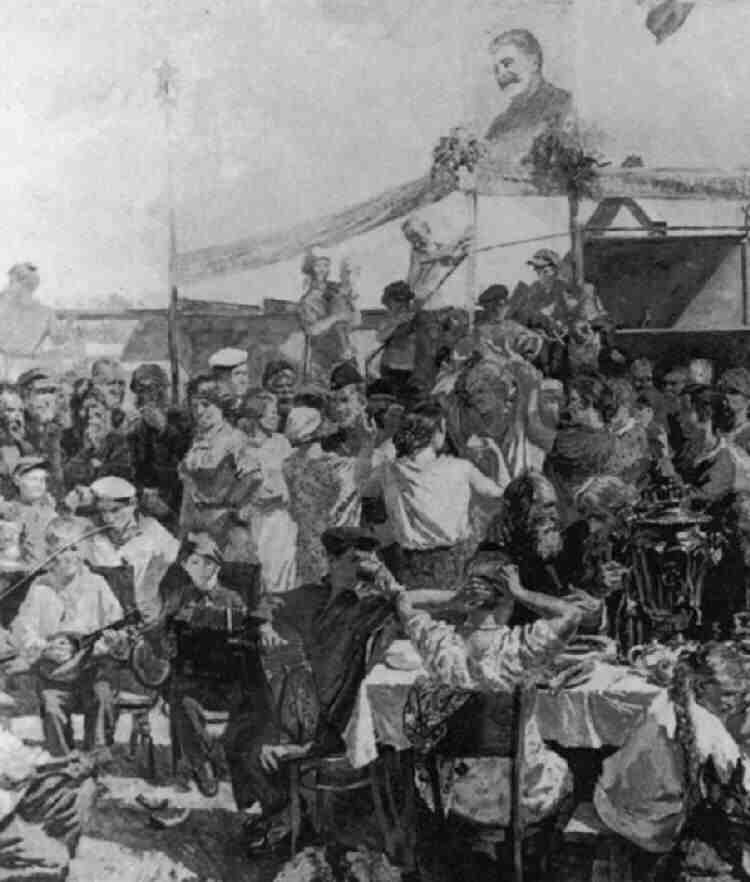
Figure 1.--Stalin imposed collectivization on the Russian and Ukranian peasantry. It was a disaster in human abd economic terms. It did put Stalin in a position that he could extract the bouty of the countryside to finance his industrialization effort. Artists were also to do their part by depicting the Soviet Union that Stalin wanted projeted. Here is an idealized scene from a collective farm painted by Arkadt Plastov.
Agricultural production after impressive gains durng the NEP of the 1920s declined in the 1930s. This was in sharp contrast to rising industrial production and wholly the result of Stalin's decession to end individual peasant propretorship (1929-31). We do not fully understand Stalin's thought processes here. There may have been an element of idelogical purity involved. The organization of the collective proved useful in fighting the NAZI invasion. The principal reason, however, appears to be that private proprietors were an independent interest group outside his control and he wanted total control of not only the Sovet state, but of Soviet society as well. The mechanisms used were brutal. Successful peasants were vilified as Kulaks. Most were forced into collectives others were deported to Siberia where many died. Resistance flared. Many peeasants slaughtered their livestock rather than turn it over to the collectives. [Wells, pp. 960-961] The Soviet livestock industry did not recover until well after World War II. Resistance was espcially pronounced in the. and was brutally supressed by the NKVD. The center of resistance was the Ukraine. There a terrible famine not only resulted, but was enginered by Stalin.
Tsarist Agriculture
Tsarist Russia at the beginning of the 19th century was one of the major European powers. It was the Tsarist Army and Russian Winter that defeated Napoleon's Grand Armee (1812-13). Russia after the Napoleonic Wars did, however, not participate in the Industrial Revolution like Western Europe and thus the balance of power between Russia and Western Europe began to shift. This becamne apparent in the Crimean War (1854-56). The Russian economy unlike Western Europe continued to be almost feudal and largely agrarian. Not only was there only limited industrialization, but there had been little investment in agriculture. Agricultural techniques were medieval, some might even say pre-medieval. On some esrates and free holdings there were very few tools or other investment in other capital goods.Yields as a result were relatively yields, but the fertility of the black soil zone and the vast size of Russia produced very large grain harvests which were key to the Tsarist ecomomy. Large quantities of grain were exported to Western Europe. Much but not all of the land was owned by the aristocracy which was a major support of the Tsarist state. They were for the most case absentee landlords who had little interest in agricultural technology are improving the life of the serfs who worked them. It was largely unfashionable to invest funds in their holdings or take much interest in them beyomd the income which could be extracted. One author suggests that the great aristocrats saw such concerns derisively as rather 'middle
class'. Tsar Alexander II freed the serfs (1861). It was, however, a halfway meassure as the debts resultingfor debts crippled the peasantry and made it difficult for them to fully benefit from their freedom. Despite these problemds, however, Tsarist agriculture produced vast quantities of grain which supported the Tsarist sate and helped feed Westrn Europe. The grain harvests before World War I were larger than those achieved by Soviet agriculture until many years after World War II. And the peasantry despite the claims of Soviet propaganda was better off under Tsarist than Soviet rule. It is true that the aristocracy took the lion's share of the production, but under Stalin, the Soviet state would extract and even greater share of the harvest.
The Bolshevicks
The Blshecicks were a minority among the revolutionary forces that overthre the Tsar. They were, however, the best organized and under Lenin's ledership the most resolute. They offered bread to the prople and land to the pesants that work the great estates of aristocratic landlords. They also offered peace to war weary country. The Tsar's largely peasanted army was descimated by the Germans. Some rebelled to join the Revolution. Many deserted to return to the crumbling estates and seize their piece of land. The Bolshevicks at the time did not hint at collectivization. Most had no clearly thoughout plan of government, in part because Marxist theory foresaw the Revolution coming first in the heavily industrialized countries of Western Europe.
New Economic Policy--NEP (1921-28)
The Russian economy inckluding the agricultural sphere was devestated by first World War I (1914-18) and then the Civil War (1919-21) which followed the Revoultion. Lenin adopted the New Economic Policy (NEP) to get the economy functioning again (1921). Soviet War Communism, the seizure of factories and other productive facilities caused further disruptions. The NEP was designed as a temprary porogram to reintroduce limited private owenership back into the Soviet economy. The NEP was a considerable success. The fact that it resulted in increased production and relatibe prosperity does not seem to have ebntered into Stalin's thinking. Stalin who was gaining control of the Party and Soviet state had other goals in mind, namely the absolute control of the Soviet economy and rapid industriaklization. Stalin replaced the NEP with the First Five Year Plan (1928).
Nowhere was the NEP more sucessful than in the countryside. As a result of the Revolution, the Bolseevicks had given the long-suffering peasantry actual ownweship of their land. Serfdom was ended by Tsar Alexander II, the liberator Tsar, (1861). Even so the peasantry continued to be exploited laboring on huge rural estates owned by aristocrats. The Bloshevicks and deserting soldiers had disposed of the landlaords, often brutally, if they had not fled. The NEP had in essence granted the Soviet peasant economic freedom. The NEP essentially gave the peasant in large measure the right to sell his crop as he saw fit. Here there were limitations with bost priceing and taxing policies, but during the 1920s the Soviet peasantry under the NEP experienced considerable propsperity and Soviet agricultural production reached impressive levels. The land and the wealth produced from it was in the hands of the person who tilled it. [Conquest, p. 13.]
Joseph Stalin is undeniably one of the most important figures of the 20th century. His impact on the devolopment of the Soviet state and society and the international Communist movement was immense. He is also one of the most evil figures in world history and was directly and indirectly responsible for the deaths of millions in the Soviet Union and Eastern Europe, a death toll even exceeding that of Adolf Hitler. Even so, the Russian peple are deeply conflicted about his legacy. Stalin soon after Lenin's death (1924). He began to elimminate the opposition (1926) and was soon in control of the Soviet state (1929). It is at this time that he launced his essentially genocidal assault on the Soviet peasant. No one knows precisely the number of peeasants Stalin murdered, but one historian estimates the figure at 14.5 million people, during 1930-37. . Some estimates are higher. [Conquest] Estimates in the Ukraine alone are 5-7 million people.
Revolution from Above (1927)
Lennin who had initiated the New Economic Policy (NEP) to save the Soviet economy with a does of capitalism died (1924). Stalin who was General Secretary of the Communist Party moved to seize control of the Soviet state. As this process was well in hand, he announced a "revolution from above" (November 1927). His two major goals were 1) rapid industrialization and 2) collectivization of agriculture. His principal aim was to rapidly industrialize the new Soviet Union. The Germans had defeated the Russians in World War I because they were more industrialized and had a better equipped, if smaller army. He was intent on pursuing this goal without regard to cost, both material and human. The two goals were not unrelated, Stalin wanted to gain control of the agricultural harvest so more of it could be used to feed the growing indusyrial work force in the cities. There were also ideological and personal factors involved. He also believed because of his faith in Commjunism that collecgives would be more productive than small peasant farms. Collectivization would also help eliminated traces of capitalism permitted under Lennin's NEP. Stalin's efforts had the added advantage of brining more of the Soviet economy under state control, meaning in the developing Stalinist dictatorship under his personal control.
First Five Year Plan (1928)
The first major program of Stalin's leadership was the First Five Year Plan. Stalin announced a "revolution from above" (November 1927). Stalin was determined to end the vestiges of capitalism that had been permitted under the NEP. Stalin's goal was to transform the still largely agrarian Soviet Union into an ideologically pure socialist society as well as create a fully industrial economy. Stalin saw with considerable clarity that the Soviet Union's future and military security required industrialization as rapidly as possible. A matter of no regard to Stalin was the human cost of this transformation. The Party now under Stalin's control agreed to the Plan (1928). The goals set by the plan were extrodinary and unobtainable. We are not entirely sure why the goals were set so high. Perhaps Stalin thought they were achievable and even if not schieved, they proivided him leverage to incentivize managers. There was a massive emphasis on heavy indusyry. Stalin ordered a 250 percent increase in industrial production and a 330 percent increase in heavy industry. The Plan involved both the nationalization of factories as well as small shops offering services. Central planners set production quotas and factory managers were responsible for meeting those quotas. The nature of trade unions were fundamentally changed. Rather than organizations to persue worker interests, they became state agencies to maximize worker output or productivity. The Plan involved building whole new industrial centers, especually in the Ural Montains. Before the Revolution, Russian industry was located primarily in western Russia, Under the First Year Plan, new industrial centers were developed throughout the country. Many were located in the poorly developed regions in the Ural Mountains and beyond. These new facilities would prove crucial in World war II as they were beyond the reach of NAZI bombers. The Soviets built thousands of new industrial plants, several of massive size. The unachievable production goals led to a variety of problems. The emphasis on heavy industry led to shortages of consumer goods. The primary aspect of agricultural policy was collectivization.
Stalin's Goals
Stalin's thought processes with collectivization may not be readily apparent. It was closely associated with the drive to industrialize which Stalin saw as key to the Soviet Union's survival. Ironically the peasantry held the key's to the success of the industrialization effort. First, the Soviet Union's most imprtant export was the agricultural production of the peasantry. These export earnings were needed to finance industril expansion. Second, the peasantry's agricultural production would be needed to feed the expanding urban insustrial workforce. The peasntry had to be motivated to produce as much as possible. In an market economy this would be one by paying them high prices for their produce,but this would mean that less capital would be available to finance the industrial program. And in 1928 grain shortages were developing because peasants were not bringing their prduce to market. Stalin's solution was to simple, seize the farms. There may have also been an element of idelogical purity involved. We believe that Stalin like some other Soviet planners thought that collectivization would make Soviet agriculture more efficient. The killing that resulted may have been Stalin's reaction to opposition. The organization of the collective proved useful in fighting the NAZI invasion. The elimination of the independent peasantry had another advantage. The peasants were an independent interest group outside his control and he wanted total control of not only the Sovet state, but of Soviet society as well. We are unsure if this was part of Stalin's thought processes. It is more likely that his brutal actions wwre a reaction to the peasantry's resistance to collectivization.
The second pole of Stalin's First Five-Year Plan was to fundamentally change the organization of Soviet agriculture. The individual peasant-owned farms would be combined into a system of state-owned collective farms. The idea was to put a permanent end to private ownership. The theory was that collectivization would make Soviet agriculture more efficient. Boending private ownersip and increasing mechanization werre seen as imprvng efficency and harvests. And the production increases would help finance industrial expansion and feed the resulting expanding urban population. In addition, as collectivization was seen as more efficient, Soviet planners believed that fewer peasants would be needed to work the land, making more workers available for industrial projects. From Stalin's point of few there was also a political dimension. The peasantry was the last sector of the Soviet population not inder state control. They were able to decidec how much of their harvest to consume or sell. It state purchasing agents offered low prices they could decidecto horde the harvest nd to reduce plantings the following year. Worst still, many had anti-Soviet attitudes, either because of religious beliefs or because of national/ethnic orientation. Here Stalin was particularly concerned with the Ukranians. The initial goals were realatively modest. The First Five Year Plan called for collectivising only 20 percent of peasant families. The draconian measures enployed by Stalin, however, set in motion a process that once begun destroyed peasant agriculuture and tragically many of the peasants as well, especially in the Ukraine. Several millions would be killed in the process of collectivization. By the time that World War II began estimates suggest that 97 percent of peasant families had been collectivized.
Resistance and Repression
Most of the peasantry objected to collectivization. The peasant farmers of the Soviet Union, however wanted nothing to do with collectivization. To most it seemed like the Soviet state was simply assuming the pre-Revolutioinary role of Tsarist land owners.This was particularly true of the better off peasants, meaning the best farmers wiuth the best land. Stalin labeled them kulaks. We are not sure to what extent they actually resisted or just how. Soviet propaganda charged that they attacked Communist Party officials and agents as well as state employees like teachers. We do not know how muvch of this occurred, but it was surely magnified way out of proportion by state propaganda. The NKVD quickly suppressed any resistance. Teams of Young Communists wee sent into the countryside to search for produce tht the kulaks were susposedly harvesting. An estimated one million peasant households (an estimated 5 million people) were deported. Most were never heard from again. Peasants were forced from their farms, even in the winter and either froze or starved to death. The result was precipitous disruption of agricultural productivity made worse by a dreadful famine manufactured by Stalin (1932-33). The Ukranian famine as Stalin intended was especially severe. At the height of the famine in the Ukraine, the Siviet Union possessed grain reserves that coukd have oprevented the famine. New peasants more amenable to collectivization were moved into the Ukraine. Stalin won the fight for collectivization. Harvests revovered--to an extent. Harvests by the new collectives were far below that of the independent peasant farmers even though mechanization increased wih collectivization. Here a range of factors were involved. First, indeoendent farmers worked harder and were more efficent than collective groups. Second, as part of the collectivization pricess, Stalin mirdered many of the best farmers in the country. But the producers and the harvests were now under Stalin's control. The overall result was, in sharp contrast to Marxist videology, production was adversely affected and agriculture would remain a problem throughout the existence of the Soviet Union. Soviet consumers often had to stand in long lines to buy substandard food, even in the lte Soviet period.
We have little information at this time as to the new collective farms and life on the farms. We are not sure just who was put in charge of the collectives. We do not know what kind of facilities were built or accomodations for the families. Apparently there was some attemp at mechanizing agriculture through the new collectives. This would seemingly increase production. More significant apparently was the elimination of many competent farmers (the so-called kulaks) and undermining the work ethic created by actual ownership. The new collectives had schools, but we know little about them at this time. There are pripaganda impages of the collectives, but we have not yet found reliable reports about conditions on these collectives and how it changed over time.
Agricultural production after impressive gains durng the NEP of the 1920s declined sharply in the 1930s. This was in sharp contrast to rising industrial production and wholly the result of Stalin's decession to end individual peasant propretorship (1929-31). Soviet planners were to learn that ideology could not bend the iron laws of economics. Throughout the Soviet era beginning with the First Five Year Plan, agriculture would prove to be a great failure. The initial disruptions associated with collectivization might have been expected. Killing off 1 million of the country's best farmers explain in part why agricultural production did not recover. But even after World War II, agricultural harvests continued to disappoint, suggesting that there were inherent weaknesses in the collective system itself and the concept of state managed agriculture. This was in sharp contrast to agriculture in the United States where the problem was over abundant harvests forcing the state to pay farmers not to produce. While farm productivity declined, it was wholly in the state's control and could be used to finance and support the country's industrialization. The question arises is if the Soviets would have better better off without collectivization. Certainly production would have been higher, but it would also have been more difficult to extract as much from an independent peasantry. The Sovieets in effect reduced rural income and transferred this to industrial workers. Actual farm oroductioin declined substantially and would not recover until many years after World War II. Of course production was not only affected by collectivization, but also by the terrible destruction occurring during the War. And even after harvests began to increase, there was no longer a surplus available for export. Soviet agriculture was unable to even satisfty domestic demand.
Kulacks
Successful peasants were vilified as Kulaks. These were not families that managed large estates. In many cases they were simply the better farmers and harder workers. Stalin persued a policy of dekulakization. The so-called kulaks not only had their land taken over by the state, but they and their families were deported. Stalin directed terrible retribution on the wealthier peasants. Wealthy of course was a matter of degrees. Historians estimate that about one million kulak households (some five million people) were deported. This was a virtual death sentence for the entire family. The peasants that resisted were no match for the NKVD, but the result was massive declines in agricultural production in sharp contrast to what Stalin and other Soviet officals expected. Most were forced into collectives others were deported to Siberia where many died. Resistance flared. Many peasants slaughtered their livestock rather than turn it over to the collectives. [Wells, pp. 960-961] The Soviet livestock industry did not recover until well after World War II. Resistance was espcially pronounced in the Ukraine and was brutally supressed by the NKVD. The terrible famine was enginered by Stalin.
One of the greatest crimes of the Stalinist era was horific famine in the Ukraine. The famine area included both the Ukraine and the Soviet northern Caucasus, as well as Russian areas in the lower Volga River basin. Famines are historically primarily the results of natural events such as drought, heat, diseases, insect infestations, and other natural causes. The Ukrsanian famine was primarily caused by Stalin's program of collectiving Soviet agriulture, especially the forced collectivization of the Ukraine. The Ukraine had been the bread basket of Russia. It was the prize sought by the Germans in two world wars. The rich, well watered soil made the Ukraine the most productive agrivcultural area of the Soviet Union. Two issues merged which resulted in dissaster for the Ukranian people. Not only did the Ukranian peasantry resist collectivization, but there was a strong Ukranian national spirit, especially in the western Ukraine. Stalin was determined to both bring agicultural under central control, but to crush Ukrainian nationalism at the same time. Stalin not only used the famine to crush the spirit of the Ukranisn peole, but he also purged the Ukrainian intelligentsia. Stalin even purged the Ukrainian Communist party. At the cost of millions of lives, many of them children, the famine succeedded in breaking any organized redsistance on the part of the peasantry to collectivization. Stalin's purges also succeeded in smashing the Ukranian national movement. Stalin's actions in the Ukraine were not without costs beyond the deaths of Ukranians. Agricultural production plummeted. Soviet agricultural became one of the most inefficent agricultural operations in the world. Stalin bought Ukranian agricultural under his control through collectivization, he also signicantly reduced the output of Soviet agriculture.
Household or private plots were very important in both Tsarust and Soviet agrculture. It was a legally defined agricultural unit in the Soviet Union. It refers to a small plot of land (usually less than 0.5 hectares) adjacent to residences on collective farms. The collective workers werre not allowed to take part of the collective farms. During the the Stalinist period the law was very strict ob this. The private household plot, however, could be cultivated for family subsistence. The purpose was the same as in Tsarist times, to provide food for the collective families. Surplus products from the household plot could be sold or traded with neighbors and relatives. And there were farmer markets in nearby towns where it could be sold. These household plots were the only form of private enterprise allowed farmers during the Soviet era. Notably these plots constituted a miniscule part of the farm land of the Soviet Union, but a substantial part of the fruits nd vegetables produced as well as a not inconsequebtial production of poultry and hogs. And all of this without any of the inpurs lavished on the collective sector. One might have thought that over the decades that this would have clued Soviet officals into the apauling inefficency of collectivization. It dd not, or at least no one dare suggest privitizzation. And this continued even after Stalin died (1953). The Soviets tried everything to improve agricultural production. The situation was so bad that regulations had to be issued to keep farm workers from moving into the city and seeking factory and other jobs. This of course was a situation shckingly simmilar to serfdom. There was no shortage of progrms and ideas--all of which filed. But only at the very end of the Soviet Union were small independent family farms authorized for larger areas of agricultural land, plots 10-50 hectares (1990).
Assessment
We note that many authors suggest that collectivization was a useful step in the industrialization of the Soviet Union, albeit at a terrible cost. We do not think this is the case. Rather a healthy peasant agricultural sector would have been a far greater assett, producing a surplus that could have helped finance industrialization. If any thing, collectivization impeded the industrialization of the Soviet Union. From Stalin's point of view, however, it probably was a success because it brought this important sector of the Soviet economy under his control. One aspect of collectivization that does appear to have proven beneficial was resistance to the NAZIs when Hitler launched Barbarossa (June 1941). This is, however, a topic that we have not fully accessed.
One of the biggest enticements to Hitler from a very early point was the agricukltural lands of the East. He believed with some accuracy that once in possessions of these lands along with the petroleum and munerakl resources of the Soviet Union, Germany would be immune from the Allied naval blockade that critically underlined the World War I war effort. Germanu would be able to fight on indefininitely. German's greatest weakness in launcing World War II that its ecinomy was dependent on imported food and most crirtical war materials, especially petroleum and iron ore. Seizing Soviet resources solved most of these problems in one fellswoop. The problem was the Red Army, amasive force which would have to be defeated. Hitler came close to achieving this with Barbarossa (June 1941). The Red Army managed, however, not only to survice, but inflect massive losses of men and material on the Whermacht with the Offensive before Moscow (December 1941). This meant that the campaign in the East would not be another quick victory, but a long gruelinfg struggle and Hitler atv the same time declared war on America. Hitler saw the East as providing an agricultural bonanza. It might well have done so had Hitler not pursued a racial war against the Slavs (Poles, Beylorussians, Ukranians, and Russians). Although the Germans occupied much of the best agricultural land of the Soviet Union (the black soil zone), there proved to be no resulting agricultural bonaza to sustain the Reich. The Germans did extract sufficient food to sustanin Whermacht operations in the East, but not to support the Reich war economy. Here it was the exploitation of the Western European counties, especially Framnce, that sustained the Reich. And although it made little impact on German policies, the countries most generously treated (like Denmark) proved the most productive and supportive of the German war effort. Had the Germans pursued the same policies in the Ukraine, the War may have turned out veery differently. Occupation of the East did effectively deny food to the Soviet population and Red Army. This might have crippled the Soviet war effort, but Lend Lease supplies, especially by 1943, were reaching the Soviet Union and included large quantities of food which helped sustain the Soviet war economy. Much is written about the starvation in Lenningrad during the German bloclade (1941-44), in fact food was extremely scarce througout the Soviet Union and it is believed that some 2 million Soviers outside of Lenningrad starved. Almost all Soviet citizens outside of the Party elite who had access to special stores were hungary throughout the War. [Collingham, pp. 317-46.] And even after the agrocultural alnfs were linerated (1943-44), it was not easy to bring devestated areas quickly back to production. Interestingly as much as is said about German rurklessness, the NKVD proved more effective than the Whermacht in fiorcing the peasantry to hand over most of their harvest.
With the disolution of the Soviet Union, major adjustments had to be made as the economies of the various post-Soviet states addressed the issue of privatization. The process varied from republic to republic. The two largest republics were Russia and the Ukraine. Agriculture in Russia suffered a great shock even before the privitization process began. Collectives and state farms were the core of Soviet agriculture. The Russian africultural reforms are complicated. They began under Gorbechov before the disolutin of the Soviet Union (1990) and accelerated after disoluioin (1992). Suddenly they had to pay for needed inputs which were priced for the first time in realistic terms. The result was a substantial contraction of the agricultural sector. Livestock inventories declined by one-half (1990s). This reduced demand for grain used as livestock foodstuffs. Grain plantings also dropped by 25 percent. The collectives and state farms had troubke paying for fertilizer and other needed supplies. This reduced yields. Most farms were unable to afford needed new machinery and other capital improvements. Slowly Russian agriculture began to improve (2000s). The transition to a market-oriented system has caused the collective abd state farm managers to adopt more prudent fiscal policies. There has also been changes in the structure of the agriculture sector. The state sector has been substantially reduced. Their was not a massive shift to small family farms both because of Government policy and individual choicr. There has been some land turned over to private owners, but more important in this regard has been the expansion of the area devoted to family plots. Smll farmers called peasanr farmd have slowly increased. The major shift has been from the government to corporate farming neaning that many state farms have been turned into corporations. While perhaps mot as efficent as family farms, the corporate farms and the increasing number of family farms has resulted in larger Russian farm harvests. The shift to family farms has been more pronounced in other republics, epecilly the Baltic republics.
Sources
Collingham, Lizzie. The Taste of War: World War II and the Battle for Food (Penguin Books: New York, 1962), 634p.
Conquest, Robert. The Harvest of Sorrow: Soviet Collectivization and the Terror-Famine.
Wells, H.G. The Outline of History: The Whole Story of Man (Doubleday & Company: Ne York, 1971), 1103p.