|
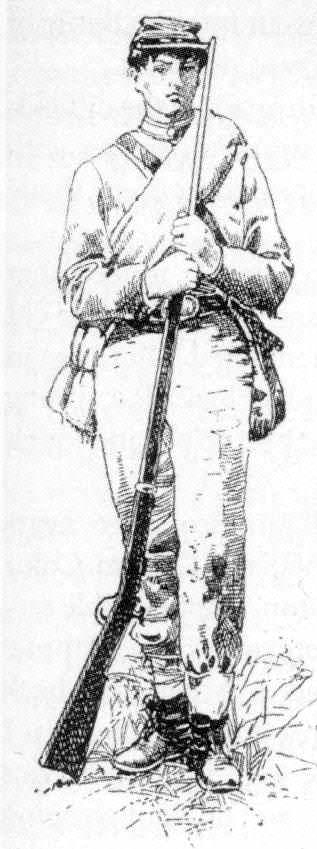
American military academies, except for West Point are a not very well developed subject, surprising given the huge body of academic work on the Civil War. Several military academies existed in the United States when the Civil War broke out in 1861. The most famous was the U.S. Military Academy at West Point which many of the best known Federal and Confederate officers attended as well as Confederate President Jefferson Davis. There were several other less known academies, most of which were for secondary-level studies. For reasons we do not fully understand, many American private schools at the time were military schools. This seems a distinctive aspect of American education. Quite a few were in the South, probably an aspect of the militarization of southern society as a result of slavery and the widespread fear of a slave revolt. We have found several period academies, but believe that there were quite a few more. We also notice military schools in the post-War era. We are not sure at this time how many were founded after the War. We believe that many were.
We do not know the name of this military academy. We do not even know if it is northern or southern. All we have showing that the school existed is a sleeved tin-type. Here we see CCA on the cap, although we are not entirely sure about the order of the letters. The boy pictures is old enough to have serve. He looks to be about16 years old. Many youth that age served. Enlisted Confederate soldiers often had very basic uniforms, often regular clothes died with grey dye or as the War progressed more commonly locally produced beech nut or acorns giving a grayish brown look often called butternut. And few would have had badges like this. Military academies did have uniforms and badges. And grey was a common color for cadet uniforms, including academies in the North. Even West Point had grey uniforms. The rest of the uniform looks more like an academy uniform than a an actual military uniform. The tintype sleeve helps date the image. Tintypes appeared in the mid-1850s. Early tintypes were cased like Dags ans Ambros. We see elaborate heavy embossed sleeves beginning about 1863. We ar not sure when simple paper sleeves appeared, but believe that it was the era just after the Civil War, Thus we would date this portrait to the the late-1860s - early-70s. This rather confirms that the portrait is of an academy pupil and not a youthful soldier. The rest of the uniform also looks more like the 70s than 60s. Hopefully readers might know what school CCA is.
The South Carolina Legislature in 1822 passed "An Act to Establish a Competent Force to act as a Municipal Guard for the Protection of the City of Charleston and Vicinity." A site on the north end of Marion Square was selected for an arsenal and guard house. Architect Frederick Wesner in 1829 completed the building which became known a the Citadel. A similar edifice was built in Columbia, the state capital, and became known as The Arsenal. Governor John P. Richardson concluded that guard duties should include some military training. The South Carolina Legislature on December 20, 1842, passed an act to officially establish the South Carolina Military Academy. Both the Citadel and The Arsenal were used for the new state academy and cadets replaced the state militia. The Academy decided to use the Columbia Arsenal to train incoming freshmen. The cadets would then transfer to Charleston for the 3 remaining years. The South Carolina Military Academy established a reputation for academic standards as well as strict military discipline. There were 34 cadets in 1843, but the Academy expanded and by 1864 there were nearly 300 boys. Attending the school was rather expensive. The tuition was set at $200, but by 1864 had been raised to $1,200. That sounds like a substantial sum, but may reflect the declining value of the Confederate currency. South Carolina was the first state to secede from the Union in December 1860. The small Federal garrison in Charleston was commanded by Major Robert Anderson. He moved his men to Fort Sumter in Charleston harbor and requested that he be reinforced. Most Federal garrisons in the South surrendered. Major Anderson was one of the few to hold out. Citadel Cadets manned harbor defenses. Cadets at Morris Island on January 9, 1861, fired on the U.S. steamer, Star of the West as it tried to reinforce Fort Sumter with men and supplies. This was the first hostilities which were lead to the Civil war. The Citadel cadets on January 28, 1861, was incorporated into the state military forces and was known as The Battalion of State Cadets. The Arsenal and The Citadel continued to operate as military academies in the early phase of the War. Classes were often disrupted, however, when the governor called the cadets up for military service. They manned heavy guns, performed guard duty, and escorted prisoners . The Citadel on February 18, 1865, ceased operating as a military academy when Federal troops entered Charleston and occupied the site. The Arsenal was burned by Sherman�s troops when they entered Colombia and never reopened. The Citadel in Charleston would not be opened again as a military for decades.
The Porter Military Academy did not operate during the Civil War, but we have included it here as it opened so soon after the War. Dr. Porter was a former South Carolina rice planter. After the War he became a minister to help normalize South Carolina society after the War. While mourning the death of his son in 1867, Porter founded what he named the the Holy Communion Church Institute. His wife was a partner in the school. Their goal was to educate former soldiers and boys left orphaned or destitute by the War. Dr. Porter wanted to use the former
facilities of the South Carolina Military Academy which were called The Arsenal. He received support from General William T. Sherman whose troops had burned The arsenal in 1865. The Holy Communion Church Institute moved to The Arsenal which had been rebuilt in 1880. The school became known as the Porter Military Academy in the the late
19th century. The school expanded, adding new buildings. The school also used and modified The Arsenal buildings for school use. The school needed a chapel. Dr. Porter remodeled the artillery shed in 1883 by removing the roof and raising the walls. He added a Gothic roof and stained glass windows. It is now known as St. Luke's Chapel today.
St. Charles County was founded in 1835. It was located in Mississippi and was reportedly the first boy's school west of the Mississippi. An available photograph probably taken in the 1860 shows a group of boys drilling in what look like Federal uniforms. Perhaps the photograph was taken before the War began. The boys look to be teenagers. There are two younger boys serving as drummer boys, but they are mot in uniform. Perhaps they were not enrolled in the school.
The Virginia Legislature in 1839 founded a military academy at Lexington in 1839--the Virginia Military Academy (VMI). Lexington was the site of a state arsenal which was placed in the care of the VMI officers and cadets. The superintendent was Colonel Francis H. Smith, a graduate of West Point. VMI was the largest and best equipped military
school in the southern states. It was also to send its cadets as a body into battle, at New Market in 1864. The regulation age for the cadets was 16, but some younger boys were admitted. VMI by 1862 was virtually the only school that continued to function in the state. Other colleges were closed or used to care for wounded soldiers. The students and many teachers at University of Maryland, William and Mary, and Washington College had marched off to war. The older boys at VMI had done the same, but the school was crowded by new cadets from all over the South. President Davis referred to them as "the seed corn of the Confederacy". Uniforms at the school became increasingly make do as the boys were reduced to whatever their parents could provide, from "Melton grey to Georgia butternut". The cadets were afraid that they were going to miss out on the War. The cadets were called on May 10, 1864 to aid
General Breckenridge who was hard pressed in the Shenandoah Valley. One cadet reports, "We jeered the little boys who were left behind." I'm not sure what that meant, it seems to suggest there were some younger boys at VMI. One the way to battle, a veteran regiment sang "Rock-a-bye, Baby" when the cadets marched by. There were 350 cadets,
225 were mustered for the battle. There were 56 killed or wounded at
Newmarket. [Wise]
Congress in March, 1802 passed an act establishing the United States Military Academy at West Point, New York. The Academy appropriately enough opened July, 4, 1802. It was a t first primarily used as an apprentice school for military engineers. Another act of Congress in April, 1812, reorganized the academy to create a college to train and educate students to be officers in the United States Army. Additional staff were engaged and a new 4 year curriculum was developed. Many of the major Federal and Confederate best known officers attended as well as Confederate President Jefferson Davis. Perhaps the best known cadet was Robert E. Lee who not only graduated second in his class, but never received a demerit. West Point graduates included Ulysses S. Grant, Stonewall Jackson, Philip H. Sheridan, William T. Sherman, and most of the other principal Civil War commanders.
We note an ambrotype portrait of two military school cadets. The boys are dressed in military academy uniforms. They are not identified. We do not know the school they attended. Hopefully the distinctive uniforms will help us to eventually identify the school. While the portrait is not dated, the fact that it is an ambrotype suggests that it was taken in the late-1850s or early-60s. The uniform style suggesting the late-50s is most likely. The boys probably served in the Civil War
Wise, John S., "The West Point of the Confederacy: Boys in battle at New Market, Virginia, May 15, 1864," The CenturybMagazine, May
15, 1864.

Navigate the CIH Civil War Section:
[Return to Main Civil War boys' page]
[About Us]
[Biographies]
[Campaign]
[Causes]
[Emancipation]
[Families and youth]
[Fiscal policy]
[Formations and units]
[Law]
[Railroads]
[Reconstruction]
[Slavery]
[Soldiers]
[Uniforms]
[Weaponry]
[Lost Cause]
[Civil Rights movement]
[Return to the Min Civil War page]
[Return to CIH Home page]