|
Naval operations were critical to the Federal victory. While naval operations are the least reported aspect of the War, they undoubtedly shortened the War and made posible the Federal victory. It is clear that by 1864 the Northern public was tiring of the war. If victory had not been achieved in 1865, a Democratic victory in the 1866 Congressional byelections forcing a negotiated peace almost certainly would have occurred. Unlike the Army, most of the Navy remained loyal to the Federal Government and Union. And unlike the Army, the U.S. Navy was a force in being, albeit small, that the United States could immeditely deploy. The early implementation of the Anaconda Plan blockade began the economic strangulation of the South. The Navy made possible the seizure of New Orleans, the first iportnt southern city to fall. And the Navy played a major role in seizing control of the Mississippi which split the Confederacy in two.
The Condederacy as a result of seizing the Norfolk Navy Yards had a few ships, but much of its naval action was conducted by privateers, civilian mariners authorized to engage in military action. They preyed on Federal shipping. Lincoln wanted them tried for piracy which carried the death penalty. The privateer Savanah was taken byb the USS Perry (June 1861). They were tried for piracy. The trial, however, resulted in a mistrail. And the Confederacy threatened to hold Federal prisoners hostage if the Confederate sailors were executed. The naval war was notable for the first appearance of iron sides.
Naval operations were critical to the Federal victory. While naval operations are the least reported aspect of the War, they undoubtedly shortened the War and made posible the Federal victory. It is clear that by 1864 the Northern public was tiring of the war. If victory had not been achieved in 1865, a Democratic victory in the 1866 Congressional byelections forcing a negotiated peace almost certainly would have occurred.
After the secession of the Southern states, Confederate forces took over Federal forts and other facilities. This occurred without incident and the Federal soldiers were allowed to return north without any restrint--of course leaving all weapons and military supplies behind in Confederate hands. President Bucannan took no action to opose secession or the seizure of Federal facilities. If the Union was to be pieced together it would be up to the new president. The one exception was Fort Sumter in the heart of the Confederacy--Charleston Harbor. South Carolina was the first state to seceeed and no where was secessionist sentiment stronger than in South Carolina. Being located offshore and commanded by a strong Union man (Major Anderson), Fort Sumter was hard for the Conderates to get to, explaining why it was able to hold out. After Lincoln's inaguration (March 4, 1861), Fort Sumter was the only Federal fort left in the Confederacy. Lincoln was presented with a touchy situation. The Fort if it was to be held would have to be resupplied. The Condfederates demanded the Fort be surrendered and threatened to fire on any Federal ships that attempted to resupply the fort. Major Anderson's situation by April was desperate. Lincoln wanted to resupply the Fort, but he did not want to force the issue and fire the first shots of the War. His concern here was the Border states. Almost surely if the Federals had fired the first shots, Lincoln would have lost some of the Border states as well as the support of many northerners. The loss of Kentucky and Mossurri alone would have significantly affected the strategic picture. The loss of Maryland would have meant that Washington, the Federal Capital, would have been located within the Confederacy. In the end, Jefferson Davis lacking Lincoln's political acumen, settled the issue. He ordered the Confederate forces in Charles to fire on and take Fort Sumter. Confederate batteries opened fire (April 12, 1861). In doing so, Davis essentially doomed the Confederacy. The Northern public was outraged, both abolitionists and those not opposed to slavery. It gave President Lincoln the public support he badly needed to end the rebellion the only way possible--with force.
President Abraham Lincoln from the outset of the War, at Gen. Winfield Scott's urging, gave the U.S. Navy an enormous task -- to blockade the entire Southern coast. This was a huge coast from Virginia west to Texas. The goal was to cut off Southern imports of war material and exports of the Confederacy's cotton, its major crop. For this a huge navy would be required--a navy the Union at the time did not have. Fortunately, unlike the Army, most of the Navy remained loyal to the Federal Government and Union. About 80 percent of the officers stayed with the Union. And unlike the Army, the U.S. Navy was a force in being, albeit small, that the United States could immeditely deploy. The Navy was, however, not prepared for War when it came. It was a small force of 1,457 officers and 7,600 men and wee scattered when the fighting broke out at Charleston Harbor (April 1861). Many vessels were even on overseas missions. And wihout overseas cables and radios, bringing the fleet home expeditions was not an easy undertaking. Many vessels were old and obsolelete. One assessment suggests that less than half of the 90 U.S. Navy ships were ready for combat and extended patrolling. President Linclon appointed Gideon Welles his Scretary of the Navy. Wells and his able Assistant Secretary Gustavus V. Fox oversaw the construction of one of the world's major navies. The Federal Government immediately began building dozens of new warships. That would take time. More immedistely they purchased hundreds of merchant ships which could deasoly be converted into blockaders by simply adding a few cannons. The result was what might be seen as a motley assortment. It caried from old sailing ships to even New York harbor ferryboats. At the tyime some Critics called it Welles' 'soapbox navy'. But it worked. By 1862 an effective blockade was in place that was growing in effectiveness. The U.S. Navy in just 4 years expanded from 23 major combat ready vessels to an incredible 641 ships including both poweerful traditional sail ships, byt innovstive ironclads that would fundamentslly change naval warfare. Ships at the time could be built relatively quickly. Even the revolutionary USS monitor was in action in less thsn a year (March 1862). Most of these ships were wooden ships, but ironsides play an important role. There was also the issue of training the naval personnel. The United States had a very substantial merchant flee to execute the Anaconda Plan. We are unsure to what extent that personnel was obtained fron the merchant fleet or trained from scratch. The Confederacy did not have a substantial battle fleet. A riverine navy was also needed because rivers played ahuge role in the War--especially the Mississippi River. Here the goal was not just economic (in yhis case splitting the Confederscy in two) but to directly support the armiers in the field.
The Confederate Navy is one of the few Civil War topics that have not been exported in detail by historians.
The Condederacy as a result of seizing the Norfolk Navy Yards had a few ships. Under President Bucannan, Federal facilities and the ordinance in them had been meekly turned over ton the Confederates. The Confederates obtained 11 ships and 3,000 pieces of ordnance. There were defections from the Federal Navy. The Conderate naval officer corps included 16 captains, 34 commanders, 76 lieutenants, and 111 regular and acting midshipmen. 【Miller, VI, 78.】 The major problem for the Confederate Navy was the lack of ships and the inability to build new ships in large numbers. The largest haul of ships came when the Federal Navy abandoned the Norfolk Navy Yard (April 20-21, 1861). The Federals burned the facilities, however, partially destroying them to prevent the Confederates from taking over a functional naval yard (April 20). This was done on President Kincoln's orders, pat of the decisive actions he took upon becoming president. Nothing like this had happened elsewhere in the South where facilities had been turnedover to the Confederates. Although their resources were slim, the Confederate Navy acted with considerable daring, adopting innovative tactics to compensate fortheirlack of resources. They launched a commerce war to some effect and constructed an iron clad to breal the Federal bloxkade. They also built the first submarine to sink an ememy ship. In the end, howeve, they simply could not ovr come the superior Federal resources. 【McPherson】
The Anaconda Plan developed into the centralnaval strategy of the Federal Government to defeat the Confederacy, although theterm firstappeared in thepressas aerisive term. The strategy was developed by General-in-Chief Winfield Scott and presented to President Lincoln after his innaguration. Scott's imprtant contribution to the War is too often ignored. It was the first military strategy offered to the new president and had the advantage of avoiding massed armed conflict and the resulting huge casualties. Scott briefed the president daily, commonly in person on the develping military situation (April-May 1861). Lincoln had virtually no military experience or knowledge. The briefings were thus a primer on military affairs. One outcome was Lincoln's action following the Confederate seizure of Fort Sumter, a proclamation declaring a blockade of Southern ports from South Carolina to Texas (April 19). This was extended north after North Carolina and Virgini seceeded The meetings with Lincoln gave Scott the policy leads he needed to develop a Federal military strategy and in particular the Anaconda Plan. Scott's strategy as conveyed to his protege, Maj. Gen. George B. McClellan, was that an effective "Blockade" of Southern ports, a strong thrust down the Mississippi Valley with a large force, and the establishment of a line of strong Federal positions there would isolate the disorganized Confederate nation "and bring it to terms." (May 3). McClellan began referring to it as Scott's "boa-constrictor" plan. Scott presented a detailed plan along those lines to President Lincoln. His war strtegy was for a force of 60,000 men to move south down the Mississippi with naval gunboats to control the the river from Cairo, Illinois inthe North to New Orlans on the Gulf in the South. This in connection with a naval blockade would seal off the South. Federal troops should he believed be prepred, but held back, waiting for Southern Union sympathizers and disaffectd civilans to turn on their pro-slavery Confederate governors and force them to end the rebellion. Scott believed, almost certainly in error, that sympathy for secession was not as pervasive as it seemed. He was convinced that that isolation and the resulting economic pressure would make the Rebel 'fire-eaters' rethink their acion and allow calmer heads to sert control. He wanted to avoid massed conflict between armies. Scott was an elderly man atthe time of the War. Many in the North wanted a more decisive commander abd real action. Thus while the nval blockade move forward, the straregyb of holding back Federal armies was not adopted. The Northern public, not yet knowing what lay ahead, wanted immediatemilitary action to supress therebellion. Scott's plan was just to passive and he and his plan 'to squeeze the South to military death' was rediculed in the press. Some reporters picked up on McClellan's 'boa-constrictor' remark, began calling it the Anaconda Plan. We are not sure about the change in repitile, but anaconda probanly sounded more rediculous in print. These were terms that Scott himself never used. Scott's plan was never adopted in its entirity. The naval blockade was, however, put into force. While the Navy did not at first have the force for a tight blockade, a major ship building campaign and naval expansion followed. By the end of theWar, the once small U.S. Navy had the largest naval force in the world with the exception of the British Royl Navy. Scott's proposed drive up and down the Misissippi was also adopted. New Orleans was the first major southern city to fall to Federal forces (May 1862). Lt. Gen. Ulysses S. Grant made his name in the West, culminating with the fall of Vicksburg (July 1863) and the U.S. Navy played a major role in this strategic victory .
The ships were at the beginning of the War were wooden sail ships little-changed from those employed during the Napoleonic Wars and the War of 1812. Iron ships and steam engines werefirst employed in nval warfare during the War. It is notable that it was the United States that built the first modern war ship--the USS Monitor. One might have expected thzat it would have been Britsin to do this.
The Federal Naval operations were conducted on three fronts: the Atlantic, Gulf of Mexico, and Mississippi River. These actions for the most part are not as well reported as gthe bloody land battles,but were of emense strategic imprtance.
Commander S. C. Rowan, U.S.S Pawnee carried out the first naval action of the War. Sailing from the Washington Navy Yard, his force demanded the surrender of Alexandria, Virginia after which the town was occupied (May 24, 1861). The first step in the Anaconda Plan was conducted by a combined Navy-Army operation. Flag Officer S. H. Stringham and General B. F. Butler accepted the surrender of the Confederate Forts Hatteras and Clark on the North Carolina Outer Banks (August 29, 1861). This effectively closed Pamlico Sound. The Confederates, however, still controlled the Sound itself. A Confederate naval force (CSS Curlew, Raleigh, and Junaluska) commanded by Flag Officer W. F. Lynch captured the steamer USS Fanny (converted to the CSS Fanny) in Pamlico Sound with Federal soldiers aboard (October 1, 1861). Another Federal Naval force commanded by Flag Officer S. F. Du Pont captured Port Royal Sound (November 7, 1861). Another joint amphibious expedition under Flag Officer L. M. Goldsborough and Brigadier General A. E. Burnside captured Roanoke Island (February 7-8, 1862). This was the key to Albemarle Sound. This completed the actions along the northern North Carolina coast. Control of coastal forts and batteries meant that constant naval patrols were not needed and naval resources could now be concentrated further south. It also meant that the most important Confederate force, the Army of Northern Virginia had no nearby coastal port it could use for imported supplies. The U.S. Navy next focused on Florida. The state's small population meant that the Confederacy could not easily mobilize forces to resist the Federl incursions. And bases in Florida could help support naval actions both north along the Atlantic coast and west into the Gulf of Mexico. Flag Officer S. F. Du Pont commanded forces which seized Fernandina, Florida (March 3, 1862). This was the beginning of joint operations against the Confederacy's South Atlantic coast.
Federal forces under Commander S. C. Rowan and Brigadier General A. E. Burnside launched a joint amphibious assault up river toward New Bern, North Carolina. They captured the town and 'an immense depot of army fixtures and manufactures, of shot and shell...' (March 14, 1962).
The U.S. Navy appointed Flag Officer D. G. Farragut to command the Western Gulf Blockading Squadron. This was the first step in the New Orleans campaign. (January 9, 1862). New Orleans was criitical to the Anaconda Plan. New Orleans was located at the mouth of the Mississppi. Thus seizing the city essentially blocked the Rover to the Confederates. As New Orleans was the most important port for exporting cotton. This was a matter of crucial importance. Taking New Orleans would not give the Federals control of the River, but it would make it imposible to effectively use the River to transport cotton to aport. And given the Confederacy's limited rail infrastrucure, this mean that the cotton grown in large areas of the Confederacy could no longer be exported. It would significantly weaken the Confederate economy and financial sytem. The U.S. Navy made possible the seizure of New Orleans, the first importnt southern city to fall.
The Misippippi River and its tributaries like the Ohio and Tennessee Rivers dominated the American heartland and was much larger area than the area east of the Apalaschans. It had become a vital part of the economy. Riverboats were a vital part of the ecomony of this area. The railroads were by the time of the War competing, but the riverboats were still vital, especially to the Confedercy. A key objective of the Federal Government was to seize control of the Mississppi River and cut the Confederacy in two. This would prevent supplies from the western states, especially Texas from reaching the Confederate armies in the east. This process was begun by General U.S. Grant at the Battle of Belmont, Missouri. Grant's 3,000 men were supported by Commander H. Walke on the USS Tyler and Commander R. Stembel on the USS Lexington (November 7, 1861). These were the first Federal gunboats to engage Confederate batteries on the Mississippi. These U.S. Navy gunboats would play a major role in the Federal campaign to seize the Mississippi. The U.S. Navy commissioned seven armored river gunboats (January 16, 1862). The Confederacy had nothing to compare with these gunboats. It mean that the U.S. Navy could easily move these gunboats up and down the river to support Federal land operations. Theu would prove a major assett in the West. This and the aggressive tactics of General U.S, Grant were key factors in the important Federal victories in the West. Flag Officer A. H. Foote commanded Naval forces which seized strategic Fort Henry on the Tennessee River (February 6, 1862). The Tennessee was the the second most important river system in the Confederacy. Fort Henry was opened the Tennesse and thus the Deep South to advancing Federal armies. Flag Officer A. H. Foote deployed gunboats to bombard Fort Donelson on the Cumberland River to support Brigadier General U. S. Grant's attacking forces (February 14, 1862). The Confederates capitulated (February 16).
Blockading the South was essential to the Union war plan. The blockade, however, meant not only closing Southern ports to Southern shipping, but also to foreign shipping which was more important. This posed a problem because actions against British shipping meant the possible intervention of the poweful Royal Navy. This was a force capable of breaking the Americam embargo. The Confederacy at frst hoped that the British and French would recognize and support them. There was indeed some support for the Confederacy within the Government and among cotton industrialists. There was a general feeling
in Europe that Southern secession was inevitable. The British had a port very close to the Confederacy--Bermuda. Condederate ships did not have to sail all the way fto Britain or France. They could order supplies and pick them up in Bermuda. The relaively short trip made blockade running easier. It is also one of the reasons the first American naval actions were aimed at the Outer Banks. nd the Unioin hdc two forsts thereto support the blockde. Another British colony where supplied could be purchased was the Bahamas. This was very close to Florida, but this was a state with a small population and very limited cotton productionm. The Bahamas was located at some distance to important Confederate ports.
The Bahamas Channel was an important international passage. The USS San Jacinto commanded by an imulsive Captain C. Wilkes, stopped the British mail steamer Trent in the Old Bahamas Channel and arrested Confederate Commissioners James Mason and John Slidell (November 8, 1861). The British Royal Navy was the time of the Civil War the only naval force that could have broken the Federal naval blockade. And there was pressure in Britain to do just that. The South was the primary source of cotton that supplied British cotton mills, a key component of British industry at the time. In the end, thanks in part to Prince Albert, and judicious Union diplomacy, the Trent Affair was setlled diplomatically. The future ramifications are incaluable, but probably meant that a united American Reoublic woukd not exist to come to Britain's defense in World War I. Winston Churchill even wrote an essay on this very subject. 【Churchill】 And tere would not have been a united America to save Britain in World War II. In fact, a race obsessed Confederacy may well have joined the Germans in World War II.
The Confederates were not able to initiate a massive ship building program like the one began by the Federals. They did, however, order ships from foreign shipyards. The Conderate Government purchased the Fingal in England. It was able to run the Federal blockade which in 1861 was still fairly loose. The Fingal reached Savannah harbor loaded with critical military supplies (November 12). This was the first Confederate government ship to run the blockade. The ship was commissioned the CSS Atlanta.
The FederalNavl Blockade was very effecive in cutting off the Confederacy from trade with Europe, bith cotton exports and miliary suppies and arms imports. Thus the Confederacy had to rely primarily on its poorly developed domestic industry. Therewas, however a loophole in the Federal blockade. Supplies in the North were trading with the Confederacy. Many if not most of the supplies that managed to get through to the Confederacy origunated in the North, rather than Europe. This clandestine commerce is not well studied. Southern cotton got through to northern mills. Gen. Sherman complained about Cincinnati weapons manufacturers supplying the Confederacy. After the Wilderness campaign, supplies shipped through Federal-controlled Norfolk prevented starvation in Richmond. President Lincoln recognized that both military officers and public officials were involved in this dirty trade, but did not move against it. One historian describes a typical incident, "On June 7, 1863, the Confederate commerce raider Clarence forced the US flagged Alfred H. Partidge to stop off the North Carolina coast. The raider anticipated the Partridge would be the second of an eventual string of twenty-one prizes. Normally, seized merchant ships were burned or used to transport previously captured crews to a safe harbor. But upon boarding the scooner, the Rebels discovered it was bound for Matamoros, Mexico, out of New York with a cargo of arms and clothing for Texas Confederates. (Matamoros is on the Texas border.) Consequently, the Partridge was set free." 【Leich】
Without a battle fleet, Much of the Confederate naval action was conducted by privateers and riders. Privateers were civilian mariners authorized to engage in military action and seize merchantships. They preyed on Federal shipping. President Lincoln wanted them tried for piracy which carried the death penalty. The privateer Savanah was taken by the USS Perry (June 1861). They were tried for piracy. The trial, however, resulted in a mistrail. And the Confederacy threatened to hold Federal prisoners hostage if the Confederate sailors were executed. Privateering proved to be largely unworkable for the Confederacy. For privateering to work, the privateers needed ports where they could bring their captured prizes (seized ships) back to so the cargoes could be sold. And as the U.S. Navy blockaded more and more southern ports, this became virtually impossible. And the growing U.S. Navy began tracking down the privateers. One of the most successful Confederate raiders was the CSS Alabama, built in a British shipyard. The Confederacy managed to do this before the British Government had decided on its policy towrd the Confederacy. The CSS Alabama was built by Laird Brothers shipyard at Birkenhead and manned by an English crew led by Confederate officers. Overtime Confederate crew were added. It had both both sail and steam power and thus capable of running down merchant shipping. It began its raiding operations (summer 1862). It proved to be by far the most successful raider of the Civil War becoming notouious in the North. In less than 2 years, it captured 65 American vessels and 1 Union warship. Like privateers, there was no way to get its prizes back to southern ports. Most of the prizes had to burned at sea. Many Union ship owners began registering their vessels under foreign flags. Alabama managed to spread panic among American merchant shipers. And as a result diverted part of the U.S. Navy from blockade duties around southern ports. It was a rare ray of hope as Union armies advanced further and further south. Albama's end came in a battle with USS Kerdage in the English Channel (June 1864). This ked to a poctracted diplomatic spat with Britain after the War. American diplomats demanded that Britain pay for the damage caused by Alabama.
The naval war was notable for the first appearance of iron sides. The blockade of the Chesapeake Bay at Hampton Roads was militarily the most important part of the Federal blockade effort. It denied the Army of Northern Virginia foreign supplies. The Confederate Navy built a ironclad--the CSS Virginia. (It was also known as the Merimac, the name of the original Federal vessel seized by the Confederates and converted to an ironclad. It was basically a gunboat with angled iron shielding. The CSS Virginia commanded by Captain F. Buchanan destroyed the wooden sail ships blockading Norfolk, the USS Cumberland and Congress at Hampton Roads (March 8, 1862). The U.S. Navy was also developing ironclads. They produced the innovative USS Monitor, albeit with considerable resistance from the Navy. The USS Monitor was innovative, but not capable of extended sea voyages. It had to be toed south. And it arrived just in time. The Monitor commanded by Lieutenant J. L. Worden engaged the CSS Virginia commanded by Lieutenant Cap. R. Jones when he tried to renew the attack on the Fedral wooden sail ships March 9). This was the first engagement if ironssides in naval history. The engagement was a stabdoff. The Virginia had aarger battery, but could not hit the Monitor which had a very low profile. The Monitor on the other hand scored several hits. This was enough to force the Virginia to discontinue the attack on the blockading ships. Before it could be repaired, General McClellans advancing Federal Army as part of his Peninsula Campaign forced the Confederacy to abandon Hampton Roads and burn Virginia. The Virginia was not the Confederate's only ironside. There was also the CssAlbemarle.Commander William Barker Cushing led the attack on the Albemarle (October 1864). "Flying at full speed, the cutter smacked the logs. Cushing hoped that the slime on the timbers would act as a lubricant, and that his momentum would carry him over. He made it only halfway; after impact there was a grinding, tearing sound, and then the launch hung there., stick over the barrier. For a moment, the tableau was frozen, as raiders and rebels alike held their breath. Then Captain Warley, atop the casemate of the Albemarle, shouted, 'What boat is that?" 'We'll soon let you know!' Cushing replied and yanked on the lanyard of the howitzer, ending a load f cannister against the ironclad, clearing the deck." 【Malanowski】
When the Civil War broke out, many free northern blacks unlike white Amerricans understood the implications and wanted to enlist in the Federal Army. At the time, there were no blacks in the U.S. Army. And recruiters did not accept Blacks wishing to inlist. There was, however, one branch of the U,S. military thsat was integrated--the U.S. Navy. Seafaring at the time was aspealized trade. Training a sailor was much more complicated than training a sailor. Blacks had plsayed a role in the Americam merchan marimne from an early stage. And even asa British colony, America had an important merchsant marine. And after independence, blacks continued to work on merchant ships and whaling vessels which were in constant need of trained crew nenbers. It was thus natural for the U.S. Navy to draw from this pool of trained mariners. President Lincoln assigned the U.S. Navy an enormous task--to blockade the rebelious Confederate States. This required a massive expansion of the Navy, making able seamen more in demand than ever. Ths unlike the Army, the Navy accepted black volunteers from the very beginning of the War. At a time when Federal commanders were returning runaway slaves to their masters, Secretary of the Navy Gideon Welles went through "almost Machiavellian machinations" to make sure that both free blacks and runaway slaves could enlidst in the U.S. Navy. 【Ramold】 Not only did blacks volunteer, but additional black sailors were seized from Confederate blockade ruuners. One boy we have noted, Jack Wasp, may be such a boy. More than 18,000 blacks (including a few women) served in the U.S. Navy. Many more served in the Army, but the Navy was a much smaller force. It was about 15 percent of the naval force, a higher percentage than in the Army. Blacks served on almost every one of expanded fleet--nearly 700 navy vessels. This included both ocean-going ships as well as the Mississippi River Squadron. Eight black sailors were awarded the Medal of Honor for heroism in combat. 【HCWSP】
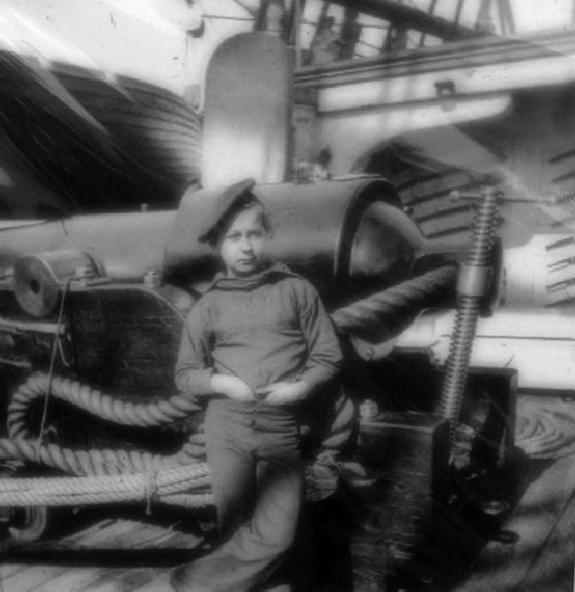
Boys served on many U.S. Nacy vessels. They served both as cabin boys and powder boys. The photograph here of a 'powder boy' was taken in 1864 aboard a Federal ship blockading Charleston Harbor and supporting Federal units trying to seize Charleston (figure 1). The photographer is unknown. These boys were also called 'powder monkies'. Our information is limited at this time, but boys this age seem to have been involved in naval combat. Boys this age in the land armies were mostly used as musicians. Unlike Army drummer boys, however, there was no way to send boys to the rear on a naval vessel involved in combat. And powder boys were in the thick of the fighting as they were delivering powder to the gunners. Of course there was much less combat at sea by the blockading vesselthn was the case on land.
Civil War accounts focus primrily on the dramatic land battles of the War. It was the Federal victories in the naval battles that made many of the Federal victories possible. 【McPherson】 The Condederacy began the War with fewer men, destinct disadvantage. Arming those men and even feeding them becme an increasing problem as the War dragged on. The South did not have the industrial caoacity to build weapns in the needed numbers, esoecially artillery. And the Federal nacal blockade prevented imports. The South ith its agricutural economyvcould not even adequate provision and feed its armies. Throughout the wa, provisions and supplies were a major problem for Confedeate armies. Neither Lee or Meede planned the battle of Gettysberg. It began largely because Confederate units were attempting to secure boots for its barefoot soldiers. A factor here was splitting the south at the Misisippi, a military feat in which navy gunboats played a key role. Thus Southern armies were denied food and other supplies from the westen states, especually Texas. And unable to export its primary product (cotton), the Condederacy could not finance the war effort. By the end of the War, the Confederate dollar was worthless and its surviving armies starving.
Churchill, Winston S. "If Lee Had Not Won the Battle of Gettysburg" in If It Had Happened Otherwise (1931). This was written before Hitler hadseized power in Germany which would have added fuel to Churchill's account.
Howard Civil War Sailors Project (HCWSP).
Leich, Pgilip. Ytading wih he Enemy: The Covert Economy durung the merican Civil War (2014), 200p.
McPherson, James M. War on the Waters: The Union and Confederate Navies, 1861-65 (2012), 304p.
Malanowski, Jamie. Commander Will Cushing: Daredevil Hero of the Civil War (2014).
Miller, VI.
Ramold, Steven J. Slaves, Sailors, Citizens: African Americans in the Union Navy (Delalb, Illiiois: Northern
Illinois University Press, 2001), 262p.

Navigate the CIH Civil War Pages:
[Return to Main Civil War military campaign page]
[Return to Main Civil War page]
[Biographies]
[Campaign]
[Causes]
[Emancipation]
[Families and youth]
[Fiscal policy]
[Formations and units]
[Law]
[Railroads]
[Slavery]
[Soldiers]
[Uniforms]
[Weaponry]
[Lost Cause]
[Civil Rights movement]
[Return to CIH Home page]