|
People in 1929 before the New Deal had a very different attitude toward the role of Government. The Government was there to provide national defense and to maintain law and order as well to administer the legal system. The Progressive Era had introduced laws to provide governent regulation in economic areas such as labor laws to protect women and children and food and drug legislation to protect the public. The Government was, however, not seen as responsible for the economic well being of individuals. This was seen as a private responsibility. There was no unemployment insurance or old age retirement systems. Nor were there programs to assess the poor. Poverty and unemployment were seen as character flaws and not the result of ecomomic fluctustions beyound the capability of individuals to deal with. Some state Governments attempted to address the problem, but the crisis was beyound the abolity of state government to handele. Ironically President Hoover was noted for his humanitarian efforts in Europe during and After World war I. His ideological mindset, however, his ability to address the challenge of the Great Depression. Private charities struggled to provide food and other support. The demessions of what was needed went far beyond the capabilities of chaity to address. Hoover's initial resomse was to cut Government spending and ballance the budget. Hoover announced that while he would keep the Federal budget balanced, he would cut taxes and expand public works spending. In would be wrong to suggest that Hoover was unfeeling or that he did nothing to address the Depression. Rpercussions from Europe by 1931 were deepening the crisis, even though the President presented to Congress a program asking for creation of the Reconstruction Finance Corporation to aid business, additional help for farmers facing mortgage foreclosures, banking reform, a loan to states for feeding the unemployed, expansion of public works, and drastic governmental economy. At the same time he reiterated his view that while people must not suffer from hunger and cold, caring for them must be primarily a local and voluntary responsibility.
People in 1929 before the New Deal had a very different attitude toward the role of Government. The Government was there to provide national defense and to maintain law and order as well to administer the legal system. The Progressive Era had introduced laws to provide governent regulation in economic areas such as labor laws to protect women and children and food and drug legislation to protect the public. The Government was, however, not seen as responsible for the economic well being of individuals. This was seen as a private responsibility. Poverty and unemployment were seen as character flaws and not the result of ecomomic fluctustions beyound the capability of individuals to deal with.
The Federal Reserve was created to regulate the money supply. The Fed in response to the Stock Market Crash and economic decline severly cut the money supply by more than 25 pecent. Monetary policy was not a major issue at the time. Political discourse was more focused on fiscal policy (taxes and spending). It now appears that monetary policy was the key factor. One noted economnist believes that this turned what might have been a severe recession into the Great Depression. 【Friedman] Another important economist aggrees and believes that inappropriate tight monetary policy/increased in value of debt which help intensify a deflationary spiral. 【Bernanke. Essays] This was a factor that was not widely recognized at the time and for quite some time after the Depression. It is difficult to believe that this ws not a factor in the Depression. And perhaps if the Fed had eased rather than tightened it might have moderated the dimensions of the Depression. Friedman and his disciple, Ben Bernanke, clearly beliece that it was the primary factor. Bernanke of course put this theory into action with Quatatative Easing during the financial crisis of 2008-09. 【Bernanke. Courage.】 It clearly staved off financial disaster. What is not yet clear is if it has prevented disaster or meerly postponed it and perhaps set he stge for an even more serious financial crisis. Less popular today is the idea that more imprtant was undetmining markets. The U.S. export sector in the industrial heartland got drastically over-built in response to booming but unsustainable global demand for U.S. exports funded by debt raised on Wall Street during the 1920s. Also because the farm belt became a bubble when Washington's war loans during 1915-1920 turned it into the granary of the world. In the 1920s, agriclture was a much larger sector than is the case today.
Ironically President Hoover was noted for his humanitarian efforts in Europe during and After World war I. His ideological mindset, however, his ability to address the challenge of the Great Depression. Hoover's initial resomse was to cut Government spending and ballance the budget. Hoover announced that while he would keep the Federal budget balanced, he would cut taxes and expand public works spending. In would be wrong to suggest that Hoover was unfeeling or that he did nothing to address the Depression. Rpercussions from Europe by 1931 were deepening the crisis, even though the President presented to Congress a program asking for creation of the Reconstruction Finance Corporation to aid business, additional help for farmers facing mortgage foreclosures, banking reform, a loan to states for feeding the unemployed, expansion of public works, and drastic governmental economy. At the same time he reiterated his view that while people must not suffer from hunger and cold, caring for them must be primarily a local and voluntary responsibility.
There was no unemployment insurance or old age retirement systems. Nor were there programs to asisst the poor. There is a widespread belief that President Hoover did nothing the address the Depression and pursued laissez-faire economics. This is simply not the case. President Hoover's policies can be criticized on several accounts, but failing to act is not one of them. The president was is seen in the public mind as championing limited government and 'Rugged Individualism'. President Hoover after the Wall Street crash and iniitial down turn overdaw a massive Government intervention in the economy. It was limited in comparison with the subsequent New Deal, but was the most massive Federsl intervention in the economy up to the time. President Hoover instituted many different emergency measures. Many of the measures associated with the New Deal were in fact first imple,ented by the Hoover Administration. The Hoover Administration attempted to support wages, instututed some price controls, expanded credit, and supported troubled corporations. The Administration also expanded public spending to support the unenployed and launch public works projects. The Administration also pursued an inflationary monetary policy. This was the first time the Federal Government attempted in any major way to stop an economic down turn instead of letting the economic cycle follow its natural course. Many of these actions can be justified as assisting those people adversely impacted by the economy. And they pribably did not have a major impact on worsening the down turn. Unfortunately, other actions taken by the Hoover Administration did. The Administration to finance the expaned Government spending, increased taxes because Hoover was concerned about the widening defecits. While the Smoot Hartley Tariff was a Congressional initiative, but President Hoover sined it into law, setting off a downward spiral in internatiinal trade. His steadfast support of the Gold Standard was also harmfully. And one action he did not take, shoring up the banking system, almost brought down the financial system.
Congress also addressed the Depression. One of its principal initiatives was the Smoot-Hartley Tariff (1930). which actually worsened the problem. Here it should be recalled, however, that increasing the tariff received broad bipartisan support. The Tariff was a Congressional iniative. The two co-sponsers were Republicans, but many Democrsts supported the bill. This is important to remember because too often because President Hoover was a Republican, the Depression is seen as having been caused by the Republicans. There is no doubt that the Hoover Administration made serious policy mistakes such as holding on to the Gold Standard and failing to support the banking system. But Democraric politicans shared many of the policy misconceptions that guided the Hoover Administration. President Hoover during the 1929 campaign had supported higher tariffs on agricultural commodities. The Smoot-Hartley Tariff as it emerged provided higher tariffs on both agricuktural commodities and industrial products. President Hoover opposed this, but yielded to pressure from his Party to sign the bill into law. Govenor Roosevelt in the 1932 presidential electiin critucised the Smoot-Hartley Tariff. The Democratic gains in the 1930 Congressiional byelection did nothing to address the growing problem.
Some state Governments attempted to address the problem. A leeder here was New York when newly elected Franklon Rossevelted ushered in some innovative efforts. Roosevelt had been elected in the Republican 1928 landslide. The crisis was, however, beyond the abolity of state government to handle.
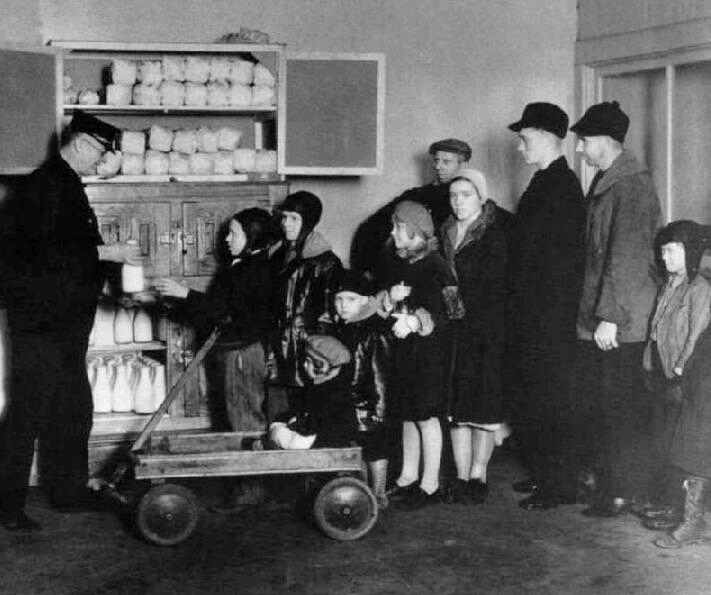
Private charities struggled to provide food and other support. The demessions of what was nned went far beyond the capabilities of chaity to address.
One of the shabiest chapters in America's treatment of its veterans is the Bonus March that occurred during the Great Depression. Tanks and banyonets deployed against unenployed veterans against the background of the Depression caused mant to question the future of America.
As a result of the Depression there had been a number of small marches on Washington, but nothing along the domensions of the Bonus March. Congress after World War I promised veterans a bonus to honor their service. Congress passed the Adjusted Service Certificate Law (1924). The bonus was to be paid in 1945. The American Legion has pushed for the legislation. The Law was not just what the Legion wanted and they pushed for revisions, especially after the Depression began.
Veterans were of course among the millions of unemloyed Americans.The Legion pushed for a bill allowing veterans to borrow against 50 percent of the nonus certificate value (March 1931). Congress passed the bil, but President Hoover vetoed it. He believed that the Government could not afford it and deficit spending would just impede recovery from the Depression. Congress passed the bill over Hoover's veto (February 1932). Thus many veterans began to see money from their bonus as a real possibility. Walter W. Walters and a group of other unemployed cannery workers decided that the Government should pay their bonus now when they really needed it. They came to WAshington and set up camp, calling themselves the "Bonus Expeditionary Forces" (May 1932). Army Chief of Staff Douglas MacArthur, a veteran himself, did so see the Bonus Marchers as needy veterans. Rather he saw, with virtually no evidence, a dangerous communist conspiracy to tke over the national government. MacArthur's own intelligence staff informed him that he was mistaken. As word spread of the initial encampment, thousands of veterans, many brining their family, headed for Washington. Eventually about 20,000 veteranns massed in Washington. Some of the veterans set up the Mall, but most built a "Hooverville" at nearby Anacostia Flats. The House of Representatives passed the Patman Bonus Bill moving up the payment date (June 15). The Bonus Army demonstrated at the Capitol as the Senate considered the bill (June 17). The Senate rejected it. Congress did appropriate money to help the veterans return home. Some marchers decided to do so, but many decided to stay to press their case. . The District of Columbia police attempted to evict some of the remaining Bonus Marchers from a Federal construction site (July 28). In the ensuing mele the police shot and killed two Bonus Marchers. The Marchers then attacked the police. They did not use fire arms, but they managed to injure several policemen who fell back. District of Columbia authotities informed President Herbert Hoover that they could not deal with the situation. President Hoover ordered Secretary of War Hurly to "surround the affected area and clear it without delay." Hoover did not order an attack on the major encampment at Anacostia. The resulting attack, however, would be one more action that would descredit President Hoover in the eyes of many Americans.
Bernanke, Ben. Essays on the Great Depression (Princetoin University Press). Bernanke is a former Princeton University economist appointed to chair the Federal Reserve by President Bush. He is widely considered the pre-eminent living scholar of the Great Depression.
Bernanke, Ben. The Courage to Act.
Friedman, Milton.

Navigate the Boys' Historical Clothing Web Site:
[Return to Main Depression page]
[About Us]
[Introduction]
[Biographies]
[Chronology]
[Clothing]
[Disease and Health]
[Economics]
[Environmental issues]
[Feminism]
[Geography]
[History]
[Human Nature]
[Law]
[Nationalism]
[Presidents]
[Religion]
[Royalty]
[Science]
[Social Class]
[Bibliographies]
[Contributions]
[FAQs]
[Glossaries]
[Images]
[Index]
[Links]
[Registration]
[Search]
[Tools]
[Children in History Home]