|
Railrods played a major role in American history and the development of the American economy. Eclipsed by air travel and the automobile in the 1950s, the critical importance of railroads to American is sometimes forgotten. Canals like the Erie Canal played an important role in America's early economic growth. They were, however, soon eclipsed by the inherent efficency of the railroads. The canals and railroads helped open the west, but by the 1850s there was still no connection between the east and west. The railway helped in the opening up of America. Many hundreds of immigrants travelled by train to their new homes. To travel to California, however, one had to trek overland by wagon train or sail. There were two routes, one around Cape Horn or two make a land portage across Central America. The desire to connect the east and west coast by rail played an important role in the coming of the Civil War. Southerners wanted a southern route and northerners a northern route. The greatest proponent of the trans-conninental railway was Senator Stephen A. Douglas from Illinois who was willing to compromise with the South to get his railway. The result was the Kansas-Nebraska Act which opened westewrn territories to slavery (1854). Bleeding Kansas became the opening round of the Civil War. The greater industrial power of the North including a much more extensive railway infrastructure proved decisive in the Civil War (1861-65). The commitment to build the transcontinental railway was made during the Civil war, but real progress only occurred after the War. The Union Pacific was chartered in 1862. The Union Pacific built west from Omaha and the Central Pacific built east. Imigrants after the Civil War began pouring into America and played a key role in building the transcontinental railway. The two rail lines met at Promitory Heights, Utah (1869). Railways by the 1890s linked all parts of the country. Travellers could go by train to any part of the country. The railroads became ione of the major targets of the Progressive movement in the late-19th century. For the first half of the 20th century, the railroads were the main way Americans traveled from place to place. It was at the railway stations that Americans said their goodbyes and welcomed family home. It was the railroads that moved the output of the Arsenal of Democracy to the ports from which they were shipped to American and Allied fighting men. The imporance of the railroads did not change until after World War II when as a result of the post-War boom that Americans began buying cars and the Federal Government began an extensive highway building program. And for longer trips people began flying. But this was just passanger travel Freight was still shipped largely by rail.
Roads in colonial America were rudimentary at best. To the extent they existed, they led to ports from which cargo could be transported to distant locations. A person might travel by horse. Shipping cargo any distance was impossible. Actualy there were no developed ads between major cities until the development of the automobile, especially the Ford Model-T, in the 20th century.
Rivers were the only way of transporting goods any dustance in land. But river traffic only went one way at first, down river. This was why New Orleans was so important gto the early American Republic. And why the British attemptd to seize it in the War of 1812. All of the United States west of the Apalachins, which meant more than half the land area, drained into the Missssippi and the produce of the Mississippli basin could not be econimically marketed by crossing the Appalachins. It had to be taken doen the great rivers to New Orleans. No less than Abraham Lincoln made this trip.
Canals were a great improvement over rivers because cargo could be moved in both directions. canals like the Erie Canal played an important role in America's early economic growth. They were, however, soon eclipsed by the inherent efficency of the railroads. The canals had helped open the early west meaning the western territory east of the Missippi. Canals had, however, serious limitations. There were expensive to build an operate and limited to where they could be built. They required the construction of walls, channels, bridges, and othr structures. All of this not only hd to built, butg also maintzined. And they had to be near rivers and streams to supply the water. In additiion, traffic was slow basically limited to mule speed. .
As late at the 1850s there was still no connection between the east and west. There were rxtensive lines east of the Mississipp and few short lines raeching into Kansas and Nebraska, but only a few miles beyond St. Louis. The railway helped in the opening up of America. Many hundreds of immigrants travelled by train to their new homes. To travel to California, however, one had to trek overland by wagon train or sail. There were two routes, one around Cape Horn or two make a land portage across Central America. The desire to connect the east and west coast by rail played an important role in the coming of the Civil War. Southerners wanted a southern route and northerners a northern route. The greatest proponent of the trans-conninental railway was Senator Stephen A. Douglas from Illinois who was willing to compromise with the South to get his railway. The result was the Kansas-Nebraska Act which opened westewrn territories to slavery (1854).
Bleeding Kansas became the opening round of the Civil War. The greater industrial power of the North including a much more extensive railway infrastructure proved decisive in the Civil War (1861-65). Railroads played a major role in the Civil War. The railroads in fact played a role in exacerbating the slavery issue. A major issue before the War was the building of an trans-continental railway to connect California and the Pacific coast with the East. There was general agreement that this was needed. The political problem case over a disagreement about the route. Southern states wanted a southern route while northern states wanted a more central route. Senator Stephen A. Douglas was a major proponent of the railway and in an effort to win Congressional approval, he was willing to make concessions to the South on slavery. These concessions, however, angered northerners, hightening sectional politics. His sollution was to undo the Missori comptmise with popular soverignity. This was one of the major issues debated by Douglas and his political challenger for the Senate--Abraham Lincoln. When war came the inter-continental railway project had not yet been resolved because of the sectional strife. The project was finally approved by the Republican controlled Congress suring the War, although actual construction did not begin until after the War ended. During the War, the North had a huge advantage becuse of its much more extensive railway network. Railways played an important role in several battles, but the major significance was in supplying field armies. Here the South had an increasing problem as the war progressed. The Southern commitment to states rights was relected in the railway system which was poorly connected between states. And with the limited industrial capability, they could not build new locomotives and had trouble maintaining railway cars and lines. Thus the limited, poorly connected system deteriorated badly as the war progressed. [Gordon]
The commitment to build the transcontinental railway was made during the Civil war, but real progress only occurred after the War. The Union Pacific was chartered in 1862. The Union Pacific built west from Omaha and the Central Pacific built east. Imigrants after the Civil War began pouring into America and played a key role in building the transcontinental railway. The two rail lines met at Promitory Heights, Utah (1869). Railways by the 1890s linked all parts of the country. Travellers could go by train to any part of the country.
Immigration was imprtant to Ameica even before the creatiin of the Republic. The history of immigration is closely linked to the the developmnt of railroads in the United States. It was at first a fairly simmple matter because the English colonies were locatd along the Eastern Seaboard, penned in by the Appalachins an British colonial policy. he Revolution removed the British imposed restrictions. The natural barriers rmained. Crossing the Appalachins and moving west was an ardous undertaking. Thus growth was teady, but the numbers of immigrants were relatively small. Canals were the first important technology useful to opening the West. The Eire Canal in particular made a huge difference in opning up the eastern Midwest (1830s), but was soon largely eclipsed by the railroad industry. The Louisiana Purchase (1803) Mexican War created the modern Ametican borders (1840s), butg the vast distances limited the movement of people into these areas. Waggon trains brought people west, but in limited numbers. This changes with the completion of the inter-continental rail link after the Civil War. Immigrarts were not only important edStates even before the creatin of the Republic. history of railroads. Immigrants (especially Irish and Chinese) not only hlped construct the transcontinental railroad, but then followed the rails est to industrial jobs in the new midwestrn cuties and new agricutural lands west of the Mississippi River. This of course gretly that facilitated western expansion. The rails were not only an easy, inexpensive transport route, but because the railroads were paid by the government in land, they recruited immigrants so these lands could be sold and made profurable. The railroads were vital to the imogrnts, not only so they could reach jobs and land, but because the railroads meant that the agricuktural and industrial products the immigrants produced could be delivered to markets. Before the rilroads, the primary nationl transportation hub was the Mississippi River which was of course a one-way route before the railrods nd related river boats (both used steam engines). And the Missippi and tributary rivers as Lewis and Clark could testify to, did not help immigrants move west.
There was a srious post-Civil War financial panic (1873). It is probably best described as a depression lasing for the rest of the decade. Some economists mintain it lasted even longer bleeding into the Panic of 1893. It was not just an American phenomenon, but was experienced globally. Financial problems began in Europe. The initial impact in America was the failure of Jay Cooke & Company, at the time the largest bank in the United States. This suddenly burst the post-Civil War speculative bubble. As is often the case, Govrnment action exacerbated the the financial crisis. Congress passed the Coinage Act of 1873. This immediately depressed the price of silver, damaging North American mining companies. The resulting deflation and wage cuts of the era resulting in labor turmoil. Strongly capitalized banks easily weathered the crisis, but many weaker banks failed. This had casacading impactsbecause thevU.S. Government at the time had no depository insurance program ans state bank regulation varied widely from state to state. A major part of the panic was the railroad industry which now covered the country and had repaired the damage in the South as a result of the Civil War. The American rail system had grown at a meteoric rate since the 1840s. This included somevill conceivedand poorly financed projecrs. The industry consisted of some important rail companies and a large number of small lines. This created considerable complication for riders in traveling a long distance because you had to change to different company lines. Many of these small lines were not well capitalized. The Panic was the end of America's rapid rail expansion. The railroad were affected because of the economic down turn. This mean declining shipments and thus revenue. Many mostly small lines went bankrupt. Some just managed to pay the interest on their bonds. Rail workers who had come to expect secure employment were laid off on a mass scale. Those who kept their jobs experienced substntial wage cuts. This led to many mostly local strikes by rail workers. Eventually rail workers organized the Great Railroad Strike of 1877. The rail industry by 1880 was playing a major role in th country's economic life. There were 17,800 freight locomotives carrying 23,600 tons of freight, and 22,200 passenger locomotives. This system played a huge role in the America's rapid industrialization. Rails opened hundreds of millions of acres of farm land and brought European immigrants nxious to homestead the new lands as well as work in the new factories. These lands wer amenable to mechanization creating a vast new market. his lowered the cost of food and other goods. The rails created a vast national market, the largest in the world. There were many other impacts including a national time system, a culture of engineering excellence, and the creation of the modern system of industrial management. In short the railroads were at the hear f transforming America from an isolated agricultural state to potentially the most owerful country in th world. Unlike the Europeans, however, Americans hd no interest in converting their economic success into milirary power. After the Panic of 1873, American stopped expanding its rail system, but began to consolidate it. New York financier J.P. Morgan played a central role in that consolidation. He engineered a series of reorganizations and consolidations within the fractured and sometimes chaotic American railroad industry. Morgan managed to raise large sums in Europe for thos process. H was, howevr, not judt a broaker. He asisted the industry in achieving important new efficiencies.
The importance of the railroads and Morgan's efforts to consolidate the industry did not go unnoticed. The railroads became one of the major targets of the Progressive movement in the late-19th century. Consolidation led to greatr efficencies. It also created fewer, more powerful companies that had the capacity to manipulate markets and demand higher fares. Farmers in particular often had no option, but to pay the fares the railroad companies demanded.
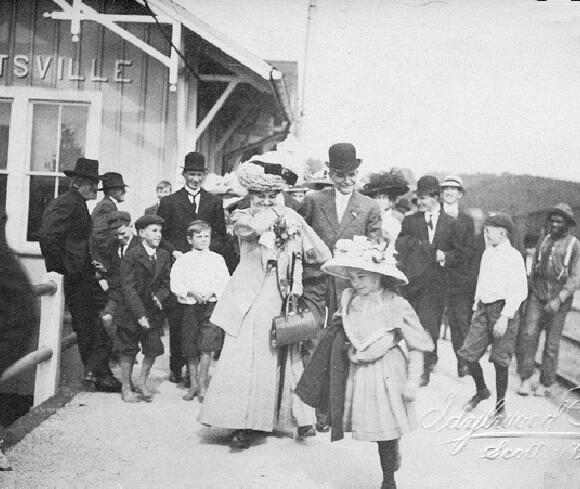
For the first half of the 20th century, the railroads were the main way Americans traveled from place to place. It was at the railway stations that Americans said their goodbyes and welcomed family home. The American railway systen was still growing rapidly. The track milage was some 164,000 miles (1890). By the turn of the 20th century, the United States rail mileage reached over 193,000 miles (1900). It was the largest rail system in the world. Track milage would continue to grow for another decade, albeit at a slower page. The all-time peak was reached during the World War I era (1914-18). Railroads were supreme in America. It was rails that tied America together, a vital function in such a large country. Not only did the rails supply American factories and istribute the output. Rail is how Americans traveled and delivered retail orders. Rail is how the Post Office transported the mail and how people received their Sears and Mongomery Ward packages. By the early-20th century, the railroads reached even small towns throughout the country. Trains dominated the American economy in every possible way. This was the work of men like Cornelius Vanderbilt, Edward Harriman, Jay Gould, J.P. Mprgan, James Hill, Collis P. Huntington. The Progressive Movement took on the power of the railways. And the Federal Government began to address the issue of their power. This effort began with the Congress passing the Interstate Commerce Act (1887). President Roosevelt would eventually take them on. Henry Ford at the peak of the Rail Road's power introduced the Model T Ford. Ford would fundamentally change the American transport landscaped, althouh when introduced the coyhntry did not have a well developed highway system. There was no highway yet that spanned the Continent.
It was the railroads that moved the output of the Arsenal of Democracy to the ports from which they were shipped to American and Allied fighting men.
The imporance of the railroads did not change until after World War II when as a result of the post-War boom that Americans began buying cars and the Federal Government began an extensive highway building program. And for longer trips people began flying. But this was just passanger travel Freight was still shipped largely by rail.

Navigate the Children in History Website:
[Return to Main railroad page]
[Return to Main war essay page]
[Introduction]
[Animals]
[Biographies]
[Chronology]
[Climatology]
[Clothing]
[Disease and Health]
[Economics]
[Ethnicity]
[Geography]
[History]
[Human Nature]
[Law]
[Nationalism]
[Presidents]
[Religion]
[Royalty]
[Science]
[Social Class]
[Bibliographies]
[Contributions]
[FAQs]
[Glossaries]
[Images]
[Links]
[Registration]
[Tools]
[Children in History Home]