War and Social Upheaval: The Conquest of Mexico--The Campaign (1519-21)
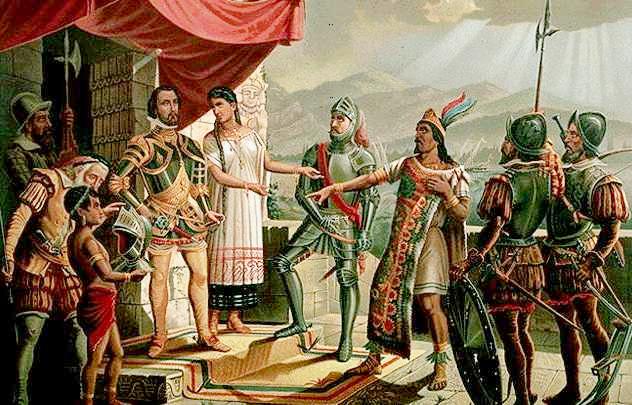
Figure 1.--Here Cortez is depicted with Malinche who proved to be an important ally becuse of her langiage skills. She is controversial figure in Mexican history. We are not sure if the Native America chief depucred is Moctezuma. Also note the Native Anerican boy depicted as page. We are not sure who the artist here was or when it was painted. It looks to have been done probably centuries after the conquest. Thus the accuracy of the depiction is questionable.
Diego Velasquez, Spanish Governor of Cuba, put a trusted soldier, Hernando Cortez, in charge of an expedition to the mainland. Hernando Cortés sailed from Cuba in 1519. He had only a small force, but it was equipped with horses, fire arms, and cannon. His men had steel body armor. Cortez confronted Indian armies that were vastly superior. He seized upon the strateguy of forming alliances with vassal Indian nations within the Aztec Empire that were willing to fight with him. The first alliance was with the Totonacs. Some of his soldiers, mostly Vlasquez loyalists planned to seize on of the ships and return to Cuba. Cortez took the dramatic action of sinking all but one of the shipps. He then made a dramatic appeal to the men, wining the support of mot of the expedition. Cortez's army left the Totonac capital (August 16, 1519). The expedition counted 400 soldiers, 15 horses, and 7 artillery pieces. With them were 1,300 Totonac warriors, and 1,000 porters. The Totonac force was small in comparison to the forces the Aztecs could marshall. Even so it was significant. Not only did it quadruple Cortez's force, but it provide allies which were familiar with local conditions. Without the Tononac alliance, Cortez's expedition may not have even reached Tenochtitlan.
Cozumel Island
Cortez's first landing was on Conzumel, now a resort island, off the western coast of the Yucatan Peninsula. This was not the intended target. After departing from Cuba, Cortez's fleet was caught by hurricane winds which forced them off course, south rather than west toward Mexico. Purely by accident, their first land fll was Conzumel. (Some sources suggest they went to Ciozumel as a secure stepping off point.) Other vessels in the fleet reached the island before Cortez. One of Cortez's leiutenits, Pedro de Alvarado, had aliented the local natives when he removed the ornaments from the island temples . (Alvarado was to play a role later in the conquest of Central America.) The Cozumelans flead to the center of the island. Cortez was both experiencd and calculating. He was aware that with his small force, caution was required. He publicly reprimanded Alvarado which helped to calm the natives as well to make his command clear to his men. Cortez met with two Cozumelan chiefs and told them that his visit was of a peaceful nature to make trade contcts. Trading relations were established. The Spanish traded various trinkets for gold ornaments which help convince the Spanish that rumours about gold on the mainland may have substance. Cortez anf the missionary friars attempted to peacefully convet the natives. The friars did their best but failed. Cortez took the responibility (under Spanish law) to convert the natives seriously. When peaceful conversion failed, Cortez took more foreceful action. He ordered the idols in the temples removed and had an altar and images of the Virgin Mary and Christ child set up. Faced with Cortez's army, the natives agreed to convert, not fully understanding what they were doing. Jeronimo de Aguilar, a Spaniard who had been marooned for 8 years was brought by the Maya from the mainland made contact with Cortez. Aguilar's had learned the Mayan language. His knowledge of the language and local conditions proved an important addition to the expediton.
Tabasco
Cortez's next prepared to land on the mainland and sailed west toward the Gulf of Mexico, retracing the route that the hirricane had driven them off course. Efforts to land were repulsed by hostile Mayan Indians. Cortez finally managed to land in what is now the Mexican Gulf coast state of Tabasco, located along the Gulf of Mexico coast at the base if the Yucatan Peninsula. The Tabascans (a Mayan tribe) with a force of about 40,000. [Prescott, p. 17.] The Tabascans charged in waves, even the Spanish cnnons did not stop them. Then he Spanish calvary forced charged the rear of the Tabascans. A member of Cortez's army described the ensuing battle, "After the cannon failed to deter the attackers, who ignored their losses and came on in repeated waves, the Spanish cavalry, led by Cortes, charged at the back of the Tabascan army. In the words of Bernal Diaz del Castillo, a participant in the voyage: Just at this moment we caught sight of our horsemen. But the great host of Indians was so crazed by their attack that they did not at once see them approaching behind their backs. As the plain was bare and the horsemen were good riders, and some of the horses were very swift and nimble, they came quickly upon them and speared them as they chose. As soon as we saw the horsemen we fell on the enemy
so vigorously that, caught between the horsemen and ourselves, they soon turned tail. The Indians thought at the time that the horse and rider were one creature, for they had never seen a horse before.[Diaz, p. 76.] Spanish sources often report that the Indians thought that horse nd rider were one terrible beast thus inspiring fear. There are no Indian sources, however, confirming this. After the battle, relased two tribal chiefs with a peace offer. He urged the Tabascans who had suffered grevious losses, to surrender and offered to reat them generously saying that he would "overlook the past."[Prescott, p. 17.]
The Tabascans anxious toavoid further fighting accted Cortez's terms and traded with the Spaniards. The Tabascans gave the Spanish 20 slave girls as well as food, cotton, and gold. The Tabascans, noticing the Spanish desire for gold, began the Indin pracice of telling the Spanish that distant tribes hadvast amounts of gold. Cortez forced the Tabascans to convrert and then began to move toward the Aztec capital on Palm Sunday, sailing the fleet west along the southern Gulf coast.
La Malinche
One of the slave girls that the Tabascans gave to Cortez proved morevaluable than their gold. One of the slave girls was actually an Aztec girl that had been sold into slavry. As a result, she was able to speak Nahuatl (the Aztec language) as well as the Mayan language. Working for the Spanish, she quickly learned their language as well. As a result she becme Cortez's official translator, as well as mistress. Although very young and without formal training, she appears to have been observant and had a facility for language. Sold as a slave, she had no affinity or loyalty for her own people. She had no sophisticated understanding of the Aztec politics, military, or diplomacy. She did know a key fact--Aztec rule was deeply resented by conquered people within their empire. [Wells, 656.] Cortez was to use this as key element in his strategy. Cotez called her Marina, but is now referred to as "La Malinche". Both Malinche and Cortez are controversial figures in Mexican history. Together they played key roles in the forging of modern Mexico. Even so Malinche is viewed by many as a traitor and Cortez as a brutal tyrant ho brutalized the native peoples. Yet these two people in esence founded today's Mexico. It was Malinche who helped provide Cortez detailed information about the powerful and wealthy inland empire and their king Moctezuma. Cortez encountered a group of Aztecs at San Juan de Ulua and Malinche translated for Cortez.
Moctezuma
At about the same time that Cortez learned of Moctezuma through Malinche, Moctezuma learned of Cortez anbd his Spanish force. Aztec accounts written down after the conquest list several omens appearing in the Aztec capital of Tenochtitlan. The omens suposedly predicted. the coming of the Spanish and disaster. There are, however, no contemprary accounts of such omens. The suosed omens included: 1) A dreadful column of fire burning at night over Tenochtitlan. 2) The temple of Huitzilopochtli was consumed by fire. 3) The Xiuhtecuhtli temple was struck by lightning. 4) Fire was seen in the sky during the day. 5) Lake Texcoco boiled and flooded, destroying residences. 6) A weeping woman cried in the night, warming the people to flee. 7) Moctezuma saw a strange and through a mirror in its head he could see first stars and then a land where men rode on the backs of animals and fought against each other. 8) Huge teo-headed men ran through the streets, but
disappeared when brought before Moctezuma.[Leon-Portilla, pp. 3-6.] These omens are most likely inventions fter the Conquest, but they illustrate the importance given to omens from the gods by thge Aztecs. Moctezuma himself was a strong believer in omens and ws knwn to base decissions on them. The reports of the Spanish fleet, white men, cannons, horses, and other seemingly incredible accounts which reached Moctezuma seemed so incredible that it seemed like a legend coming true. Moctezuma in particular thought that Quetzalcoatl and other deities could be returning to Mexico as Aztec legends predicted. This unevered Moctezuma leading him undecided as to how to respond.. Obviously if Coortez and his men were gods, it would be suiside to oppose him. Thus when decisive leadership was needed by the Aztecs, Moctezuma equivocated..
Vera Cruz
After disemarking from Tabasco, Cortez landed at what he proclaimed as Vera Cruz (April 21, 1519). The natives there were a subject ribe paying tribute to the Aztecs. They did not resist Cortez like the Maya. They even brought gifts when Cortez llanded. The local cacique (chief) greeted Cortez and the Spanish performed Easter Mass. The two then exchanged gifts. Cortes presented glass--a substance unknon to Native Americans. While Cortez was in Vera Cruz, Moctezuma ws still unsure as to whether Cortez and the Spanish was divine or mortal sent fabuous gifts of gold and silver objects to Cortez, but frbid him from coming to Tenochtitlan. Of course the gold and silver only served to convince Cortez that the ztec capital was the fabulos source of gold. Among the Spanish, there was dissension. The expedition had been financed by both Cortez and Velazquez.. As a result, loyalties varied. Some of the expedtion wanted to immeiately march on Tenochititlan and ebgage the Aztecs. Others were convinced that their force was too small and wanted to return to Cuba and report what they had learned to Governor Velasquez.
Totonas
News of the Spnish was spreading among the Indian nations. The Aztec Empire consisted of many conquiered peoples. The Aztecs after defeating a tribe would not destroy it, but allow it to surviv and pay tribute. As a result, within the empire wer many peoples who hated the Aztecs. One of these was the Totonacs, a recently conquiered tribe. They sent messages to Cortez offering an alliance. Cortez with his small forcein Vera Cruz ws unsure how to proceed. The prospect of Indian allies, however, changed the situation dramatically. Cortes sailed his fleet north to the Totonac capital at Cempoalla. The cacique of Cempoalla not only Totonac oldiers to fight the Aztecs, but he provided invaluable information as to geography and political loyalties within te Empire, especially other subject people that might join Cortez to fight the Aztecs. Cortes founded the first Spanish colony (Villa Rica) on the mainland at Cempoalla as a safe base for future operations. At Chiahuitztla a local cacique provided 400 bearers to carry supplies. Cortez then proceeded to a town where they found five Aztec tribute collectors. . Cortes instructed the Totonacs to imprison them, an action that would have meant war. Cortez treated them with disrepect and then released two with a non-beligerant message to Moctezuma. Cortez' defiance to the Aztecs helped encourage other Indians to join the rapidly growing rebellion. Some of his soldiers, mostly Vlasquez loyalists planned to seize on of the ships and return to Cuba. Cortez took the dramatic action of sinking all but one of the shipps. He then made a dramatic appeal to the men, wining the support of mot of the expedition. Cortez's army left the Totonac capital (August 16, 1519). The expedition counted 400 soldiers, 15 horses, and 7 artillery pieces. With them were 1,300 Totonac warriors, and 1,000 porters. The Totonac force was small in comparison to the forces the Aztecs could marshall. Even so it was significant. Not only did it quadruple Cortez's force, but it provide allies which were familiar with local conditions. Without the Tononac alliance, Cortez's expedition may not have even reached Tenochtitlan.
Tlascalan Republic
Cotez and his small army marched inland through the Cordilleras and on to the Mexican plateau reaching the Tlascalan republic, one of the few nations in central Mexica that had managed to maintain its independence from the Aztecs. I have only limiyed information on the Tlascalan republic and just why it is referred to as a republic. The major question was if Tlascala would resist or cooperate with Cortez. We do not know just what decission maing process was involved on thepart of the Tlascalans, but there appears to be a Council as a central governing body. There ws a skirmish hen Cortez first entered Tlascalan after which Cortez received assurances that his army could pass through Tlascala. In fact, the Tlascalans after having fought off repeated Aztecs atacks, were no about to allow another invading force enter their territory. After matching only a few miles, however, Cortez encountered a major Tlascalan army of about 30,000 warriors. Cortez army managed to oveecome this force only to encounter an even larger force (September 5). Again Cortez inflicted substantial losses on the Tlascalans. After this the Tlascalans chnged tactics and launched a night attack. Cortez was not only prepared for the asult, but ambushed the Tlascalans, inflicting additional substantial losses on them. The Tlascalans had no desire to engage Cortez's agreed to let Cortes's army pass through their lands and also provide needed provisions. Cortez was then permitted to continue his march onto the Tlascalan capital without interference. Here Cortez ordered that a cross be erected and a mass performed. The Tlascalan then provided Cortez 500 porters and 1,000 soldiers. It is interesting how both Tononacs and Tlascalans provided Cortez a relatively small number of soldiers relative to the total size of their army. We are unsure about the negotiuations involved here or evn if Cortez wanted a larger force. The change in the Tlascalan position from opposition to neutrality and hen to an alliance with the Spainards was due to Cortez's clever if disengenious diplomacy. He told the Tlascalans that they shared the same enemy--the Aztecs. He assured them that he had no designs on their territoy. The Tlascalans faced with Cortez's powerful force and their hated of the Aztecs, decided to ally themselves with Cortez,
Cholulans
Cortez next decided to proceed through Cholula. We are unsure why Cortez made this decission. His new Tlascalan allies strongly advised against this route. They explained to Cortez that he Cholulans were close allies of the Aztecs. pawns of Moctezuma. The events that follow are still debated by historians. Unlike the Tlascalan, the Cholulans did not engage Cortez's army when he marched into Cholulan territory. This strongly suggests that the>Cholulans were operating under Moctezuma's orders. Moctezuma stlill though that Cotez and the Spanish were gods and was reluctant to attack them. When Cortez entered the Cholulan capital, the caciques greeted Cortez. After conferring the caciques agreed to allowed Cortez to choose 6,000 soldiers from the Cholulan army. This seems suspious as it was a much larger force than Cortez's other allies provided him. The caciques also provided porters. Up to this point, contemporary accounts generally agree. What happened next is sharply contested. The primary Spanish account elates a Cholulan conspiracy ordered by Moctezuma himself. The plot was to catch the Spanish offguard and slaughter them.[Diaz, pp. 193-199.] Cortez seems to have been resuced from destruction by Malinche who must have overheard some of the plotters. Instead of being suprized, Cortez planned to strike first. An Aztec account clims that it was not the Cholulans,but the Spanish that were guilty of treachery. [Leon-Portilla, pp. 40-41] While the historical assesments of the motivations vary. The Cholulan caciques produced the promissed porters. It was at this time that Cortes ordered his army to massacre them. The Cholulan then assembled and attacked the Spanish. There were two hours of brutal fighting in which the Cholulans like the other Indian armies suffered serious losses. Finally the two sides agreed to a truce. Cortes's army was allowed to march on without interference. Before leaving the capital, however, Cortez had a cross erected.
Tenochtitlan
Finally Cortez's army began the descent into the Valley of Mexico. It was at this time that Cortez first saw the magnificent city of Tenochtitlan in the distance. The Aztec capital Tenochtitlan was unknown to Europe, but was one of the great cities of the world.
Cortes Enters Tenochtitlan (November 1519)
After descending into the valley, the army passed through many prosperous villages. here they were greated by the local inhabitents without ant resistance. Here Moctezuma send emissaries with generous bribes entrating him to turn back. Cortez refused and continued on the road to Tenochtitlán. Finally Moctezuma accepted the inevitable. He dispateched his nephew who welcomed Cortes and his army, including the allied Indian soldiers, and escorted them to Tenochtitlán. Cortez finally arrived in the capital (November 8, 1519). Cortes was welcomed by several hundred officials representing Moctezuma, emissaries from the king. The Spaniards were amazed by the splendor of te Aztec capital. He wrote back to Emperor Charles V, " This great city of Temixtitan is built on the salt lake, and no matter by what road you travel there are two leagues from the main body of the city to the mainland. There are four artificial causeways leading to it, and each is as wide as two cavalry lances. The city is as big as Seville or Cordoba. The main streets are very straight. Some of these are on the land, but the smaller ones are half on land, half canals where they paddle their canoes. All the streets have openings in places so that the water may pass from one canal to another. Over all these openings, and some of them are very wide, there are bridges made of long and wide beams joined together very firmly and so well made that on some of them ten horsemen may ride abreast. [Cortez, pp. 102-103.] Moctezuma finally arrived to greet Cortez himself. Moctezuma gave Cortez the palaces of his father, Axayacatl, to quarter his army. Concerned that the Aztecs might attack his army insidethe city, Cortes seized Moctezuma, making him a prisoner. He demanded that Moctezuma collect gold and silver. Once a vast amount of precious metal objects were collected, one portion was sent back to Charles V in Spain and the rest divided among Cortes's army.
Threat from Velasquez
Relations between Cortez's army and the Aztcs in Tenochtitlán steadily deteriorated. Cortes was, however, compeled to split his force and return to Vera Cruz with 266 Spaniards. He had learned that Governor Velasquez had accussed him of insubordination and sent Panfilo de Narvaez with a substantial force to arrest him. Somehow Cortes although badly outnumbered by Narvaez's force gained a stunning victory. Most of the defeated soldiers elected to join Cortes when offered a share of the spolis.
Alvarado in Tenochtitlan
Meanwhile in Tenochtitlan, relations between the Spanish and Aztecs desintegrated. Cortes chose Captain Pedro de Alvarado to command the force left in the capital. Alvarado was a valiant soldier, but unlike Cortez no diplomat. This was demonsrated early in the expedition at Cozumel. Cortes was, however, impressed with Alvarado's fighting skills. Alvarado had ordered he massacre of 600 Aztecs during an religious holiday (the Feast of Huitzilopochtli) and seized all the gold he could find in the city--including many religius objects.
Noche Triste (July 1, 1520)
Cortez found Alvarado's forces under a state of seige when he arrived back at Tenochtitlán. Cortes augmented with the recruits from Narvaez's force totaled 1,250 Spaniards and 8,000 Mexican warriors. A huge Aztec army threaten to overwealm Cortes' army within the restricted confines of the city. Cortes retreated in to the palaces being used as a barracks. The next day Cortes produced Moctezuma ordering him to stop the violence. Moctezuma had by then, however, lost all standing in the eyes of his people. They taunted him, accusing him of weakness. At this point Moctezuma was killed, although accounts vary as to whether the Spanish or Aztecs were responsible. [Moctezuma, p. 18.] Cortes turned Moctezuma's body over to the Aztecs. Although reviled by many, his death was mourned. Fighting resumed that night. The Spanish destroyed the great temple of Huitzilopochtli and many homes. They were, however, driven back to their barracks palace. Cortez saw that fighting within the restrictive environs of the city favored the Aztecs. In addition surounded in their barracks, they were cutoff from supplies. He realized that the only alternative was to withdraw from Tenochtitlán. Cortes began the retreat at night (July 1, 1520). The retreat proved to be a dissaster. It has become known in Mexican history as the 'Night of Sorrows'. The Aztecs set upon the retreating Spanish army, especially while crossing a bridge leading to the causeway. One of the problems for Cortes was that many of his soldiers were carrying large quaniies of heavy gold and silver. Many drowned in Lake Texcoco. An estimated 450 Spanish and 2,000 allied Indian soldiers were killed in the fighting--many drownded. Cortes and the survivors were persued by the Aztecs, but managed to set up a defensive position on a high knoll near Tlacopan.
Refuge in Tlascala
Cotes determined that they would have to seek refuge in Tlascala which had formed an alliance with the Spanish. Cortes' army had escaped from Tenochtitlán without supplies. Many of his men were wounded. Thus the retreating army suffered from hunger and disease. They were also pursued by the vengeful Aztecs,. Cortez retreatig army was blocked by an Aztec force at Otumba. The force was commnded by Cuitlahuac, Moctezuma's brother, who had succeeded him to the throne. Cuitlahuac led an army of 200,000 warriors. Cortes despite the condition of his army scored a decisive victory at the battle of Otumba. Suffering grevious losses, the Aztecs broke off the battle and stoped the pursuit of Cortes and his army.
Texcoco (December 1520)
Cortez's army left Tlascala to begin its campaigmin against the Aztecs (late December 1520) The first step was to take Texcoco, a city on the lake. This was accomplished without resistance. Cortes then ordered the destruction of the nearby town of Iztapalapan and the massacre of all its inhabitants. The massacre sent shockwaves among the chiefs in the surrounding villages. Rather than risk a similar fate, the caciques joined Cortes.
Spring Offensive (Spring 1521)
Cortes' army with his native allies begin to systematically conquer the Aztec-towns located around Lake Texcoco. This in effect cut Tenochtitlán off from supplies creating an increasingly effective seige. Cortes orered the construction of a fleet of brigantines (small boats). The possesion of the lake-side towns and the brigantine gave Cortes increasing command of the lakes. Cortez's army was strengthened by Spanish reinforcements as well as additional native forces. Cortes added 200 Spanish soldiers and 50,000 Tlascalan warriors.
Smallpox in Tenochtitlán
The Aztec defenders of were greatly weakened by a smallpox epedemic. Smallpox was a European disese to which rhe Aztecs and and other native Americans had no resistance. Cortes' native allies were not unaffected, but the Aztec confined within the confined limits of Tenochtitlán were especially affected. In addition, as the seige on the city became increasingly effective, food became scare. Wakened by hunger, the Aztecs became even more vulnerable to disease. Smallpox killed Cuitlahuac. Large numbers of the inhabitants of the city were killed or immobilized. Cuahtemoc, a nephew of Moctezuma, was chosen to replace him. Cuahtemoc proved to be an effective military commander who was convinced that his army backed by Huitzilopochtli could withstand the Spanish assault.
After being driven from Teniochititlán on La Noche Triste, Cortes regrouped signed on more native allies and forced others to join him. This enabled him to gain control of Lake Texcoco and to beseige the Aztec capital. Soon with disease running rampant, food and warer short, anbs no possibility of supplies and reenforcement, Cortes with his native allies was ready for the final step assautiung the city. This was the final battle of Cortez and Spanish conquistadores with Aztec warriors. Tenochtitlán, the capital of the Aztec Empire, in the 16th century was among the great cities of the world in the 16th century and probably the most beautiful and healthy. Conquistador Hernán Cortés had been driven fron the city on what becane known as La Noche Triste (The Night of Sorrows) (June 30, 1520). Cortez regrouped and developed new tactics with his native allies to persue the battle with the Aztecs. Major battles were fought to get to Tenochtitlán and even more occurred after Noche Triste. Cortez's army was composed primarily of Native American allies. Gradually Cirtez gained control of Lake Texcoco and laid seige to the Aztec capital. Horses and weaponry were important to the Spanish victory, but even more important was the European diseases causing terrible plagues within the beseiged city. Cortez ordered a massive assault on Tenochtitlán. All three divisions of the army attacked on the causeways. They were supported by the brigantines armed with cannon as well as canoes of the native allies. The army fought its way down the causeways.
Result
Tenochititlán would become the Spanish capital of New Spain. The first priority was the search for gold and silver. They had imagined vast hordes. Very little was found, at least far below what was expected.
le gold was found in the city as compared to what was expected. Cortes banished the surviving Aztecs from their own city. He began the process cleaning up the bodies that lat ritting anbd the rubble of a destroyed city that had been perhaps the most beautiful city in the world. No one know hiw manby people may have died. Estimates suggest siomething like 120,000 and 240,000 may have been killed in the battle. [Prescott] The pyramid temples had to be torn down. Churches would be built over the major temples. Many of the Aztec homes were left rubble. What remained was leveled and new homes for the victorious conquistadors. The work was done by enslaved Aztec laborors. Cortes for 4 years oversaw the reconstruction of Tenochtitlán. He remaned it Mexico now known as Mexico City. He encouraged colonists from Spain to come to New Spain, understanding that Spanish rule would be secure only if large numbers of Spainards settled in New Spain. King ??? appointed Cortes Governor, Captain-General, and Chief Justice of New Spain.
Assessment
The Spnish justified their actions by the need to Christinize anhd save the souls if the Aztecs and other native peoples. And they were truly horifiued by the barbarous nature of the Aztec religion, especially the central importance of human sacrifice. It is difficult to argue that the Aztec relgion was not barbaric. Even the suyriounding tribes made this assessment. But the Spanish treatment of native Americans was itself brutal and no credit to Christianity, essentially enslaving the native people under the explotive Encomienda System.
Explanation
The small size of Cortes' force compared to the huge Aztec army has astoinished many historians. . It has been explained by Spaniush war horses, large dogs, armor and weapons. Often lost in the discussion is Cortes' remarkable military anbd diplomatic skills. He was brutal, but so was Alexander anb Ceasar. The fact is that he was a brilliant commander. And he wisely took advntage of the weakness he detected in the Aztec Empire. There was widespread dissension among the subject people in the Empire. The Aztecs used their control to extract substantial tribute, including people go be sed for mass human sacrifuices. Human sacrifice were practiced by other Native Americab opeioople, but n the mass scale prscticed by the Aztecs. And the Aztecs did not even attemko to assimilate conquered peoples. This laid the foundation for an rmed insurection as soon as Cortes appeared with a fiorce capsable of taking on the Aztecs. Without his native allies, Cortez would have has difficulty taking on the Aztec army.
Sources
Bernal, Ignacio. Mexico Before Cortez: Art, History, and Legend (Garden City, New York: Doubleday and Company, Inc., 1963) .
Cortez, Hernando. Letters from Mexico (New York: Grossman Publishers, 1971) .
Diaz, Bernal. The Conquest of New Spain (Baltimore, Maryland: Penguin Books, Inc., 1963).
Gibson, Charles. Spain in America (New York: Harper & Row, Publishers, 1966).
Leon-Portilla, Miguel. ed., The Brohen Spears: The Aztec Account of the Conquest of Mexico (Boston: Beacon Press, 1962). [ Miguel Leon-Portilla is a Mexican anthropologist who collected Aztec accounts, some written shortly after the conquest. Of course the closer to the actual event, the more reliaable the account.]
Moctezuma, Eduardo Matos. The Aztecs (New York: Rizzoli International Publications, Inc., 1989).
Prescott, William H. The Conquest of Mexico Beatrice Berler, ed. (San Antonio, Texas: Corona Publishing Company, 1988) . [Precott was a blind Massacusetts historian. His studies of the conquest of Mexico and Peru are perhaps the two best written studies of the Cinquistadores. Although Precott did not have the benefit of modern scolarship, his studies are not only very well written but historivally accurate.]
Wells, H.G. The Outline of History: The Whole Story of Man (Doubleday: NewYork, 1971), 1103p.