
American Efforts to Save the Armenians: Near East Relief
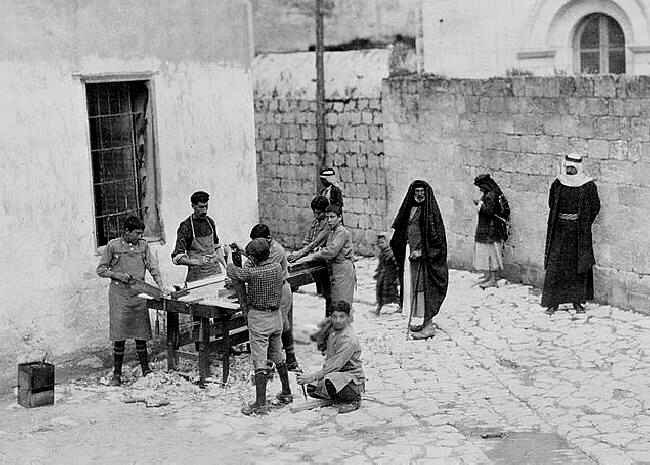
Figure 1.--The Armenian orphans here are being cared for by of Near East Relief. They are learning carpentry in the courtyard of a chapel in Nazareth, Palestine. The photograph was taken by NER, probably in 1916 while America was still neurtral. Photograph by Near East Relief--Bain News Service photograph. Image couresy of George Grantham Bain Collection (Library of Congress).
|
|
The Ottoman actions against the Armenians was widely published in the Western media. The resulting publicity generated considerable support for the Armenians. Relief funds were collected to aid those Armenians who managed to escape from Turkey. One of the most important groups was in the United States was Near East Relief. Ambassador Henry Morgenthau, Sr. urged the U.S. government to act. One of those actions was to provide emergency humanitarian assistance. The Department of State asked the American Board of Commissioners of Foreign Missions to urgently collect funds. James L. Barton and Cleveland H. Dodge led the effort and founded the American Committee for Armenian and Syrian Relief (1915). President Woodrow Wilson supported the effort.
The Committe held well publicized public rallies to save "the starving Armenians". They convinced churches throughout the country to take collections. The Committe also received extensive support from many charitable organizations and foundations. The Committee succeeded in raised millions of dollars. Because America was still neutral, The Committee was able to forward funds to the American Embassy in Constantinople which used missionaries and consuls to reach the Armenians. The Turks did much of the the actual killing in Anatolia. Armenians who reached other sections of the Ottomon Empire (such as Syria and Palestine) could be saved with the Committee's finds. The United States entered the War (April 1917) thus cutting this conduit to the Armenians. The Committe was only able to resume its operations after the War. The Committe after the War provided aid to Armenians who had fled to Russian-controlled areas. The Committe was renamed the American Committee for Relief in the Near East (1918). Congress incorporated the Committee as the Near East Relief (NER) (1919). This guaranted the NER the sole right to use the name in fund raising efforts. The NER under its various names collected and distributed $117 million to assist the Armenian people. That doesn't sound like much today, but in 2000 dollars that was probably close to $2 billion. The aid was delivered in various forms, including food, clothing, and various materials for shelter. Such aid arrived by the shipload. The NER established and supported refugee camps, clinics, hospitals, orphanages, and vocational training facilities. The NER helped save an estimated 132,000 Armenian orphans in the Near East. Many of the Armenians who survived the Tirtkisg genocide did no because of the NER. Large numbers of the people in modern Armenian have ancestors sho were saved or aided by the NER. The NER finally closed its oprtations (1930).
The Ottoman Empire which was heavily courted by Germany had been hard-pressed by Russia saw the opportunity to win back lost territory and joined the Central Powers. The Ottomans entered the War after the Western Front had settled down to static trench warfare, but the Germans had achieved major victories against the Russians on the Eastern Front. The Ottomons declared war on Russia on October 29, 1914. The first operation was a combined German-Turkish bombardment of Russian Black Sea ports. Russia and Britain and France quickly declared war on Turkey (November 2-5). The first Ottoman offensive was aimed at the Russian Caucauses (December). After initial successes, the Russiand retook much lost ground (August 1915). Russian pleas for assistance was one of the factors leading to the dusastrous Allied offensive at Galipoli (February 15). The Turkish forces at Galipoli were commanded by Mustafa Kemal who later as Kemal Attaturk was to found the Turkish Republic. After heavy losses of both ships and men, the Allies withdrew (December 1915). Beritish Indian forces launched an offensive against Turkish held Mesopotamia (late 1914). The campaign there seasawed Back and forth (1915). A British Army was destoyed, but the British finally took Bagdad and moved into northern Mesopotamia. The campaign in Egypt and Palesine began with an Ottoman attack on Suez. The Brirish struck back and finally took Jerusalem. The Arab Revolt further undercut the Ottoman poition. The final British offensive destoyed three Ottoman armies. The Ottomans with their armies being destroyed in the field agreed to an armistice on Mudros, endng the fighting. After four centuries of dominating the Balkans and the Middle East, the Ottoman Empire collapsed.
More than a million mostly Christian Armenians were murdered by Ottoman authorities or died as a result of efforts to deport them to Syria during World War I. Clara Barton led the first Red Cross relief effort conducted outside the United States. While most of the killings occurred during the War, Ottoman actions against the Armenians began in the 1890s. Western newspapers carried articles about 'barbaric Mohammedans' murdering Christian martyrs during 1894-96. The killings provoked wide-spread international contamination, but no country intervened to stop the killings. Another series of pogroms occurred in 1909. The Ottomans entered World war I on the side of the Central Powers (Germany and Austria-Hungary) (October 1914). The wide-spread, organized genocide against the Armenians began the next year (1915). Ottoman officials believed that the Armenian minority was sumpathetic with the Christian Russians and had a preexisting desire to clear a Christian era between Aatolia and the Caucauses. The result was the Tehcir Law (May 29 1915). Authorities began a massive ethnic cleansing operation--the forcible deportation of the Christian Armenians from Anatolia to mainly Ottoman Syria and Mosul Province, both non-Turkish part of the Ottoman Empire. There were also killing operations. The deportations turned into a large-scale killing operation. Accounts on the numbers of Armenians vary. The estimate of 1.0 million is often used, but some accounts are as high as 1.5 million. [Balakian] The Ottomans used World war I as the NAZIs used World War II as a cover for the killings. The Turkish Government denied at the time and Turkish Governments even today continue to deny that the killings took place and were coordinated by Turkish authorities. Turkish law prohhibits mention of the Genocide.
Reporting on the Armenian Genocide
The Ottoman genocide of the Armenians was widely published in the Western media. The resulting publicity generated considerable support for the Armenians. Relief funds were collected to aid those Armenians who managed to escape from Turkey. Britain and France were not in a position to help because they were at war with the Ottoman Empire. America was, however, neutral.
Foundation
The effort to help the Armenians was different than many other American humanitarian efforts. As a country of immigrants, when tragedies occurred in Europe, there were often organized civic or church groups to help various countries. But in America there were vert few Armenians. One of the most important groups to come to the aid of the Armenians was in the United States--Near East Relief. Ambassador Henry Morgenthau, Sr. urged the U.S. government to act. Morgenthau had played an important role in raising funnds in Governor Wilson's 1912 election campaign. He was rewarded by being aponted ambassadir to Turkey. This post was used as a kind of Jewish diplomatic ghetto for Jewish supporters. Morgenthau was not happy with the appointment bit took it. (He was the father of Henry Morgenthau Jr. who was President Franklin Roosevelt;s NEW Deal Sectretary of the Treasury.) Morgentahau began reporting on the Armenian Genocide from an early point, but had a hard time getting the State Department to get involved. One of the actions that Morgenthau pleaded for was emergency humanitarian assistance. The Department of State asked the American Board of Commissioners of Foreign Missions to urgently collect funds. James L. Barton and Cleveland H. Dodge led the effort and founded the American Committee for Armenian and Syrian Relief ACRNE) (1915). President Woodrow Wilson supported the effort.
Public Rallies
The Near East Committe held well publicized public rallies to save 'the starving Armenians'. They convinced churches throughout the country to take collections.
Other Groups
The Committe also received extensive support from many charitable organizations and foundations. The Committee succeeded in raised millions of dollars.
Relief Activities (1915-17)
Because America was still neutral, The Committee was able to forward funds to the American Embassy in Constantinople which used missionaries and consuls to reach the Armenians. The Turks did much of the the actual killing in Anatolia. Armenians who reached other sections of the Ottomon Empire (such as Syria and Palestine) could be saved with the Committee's finds. Ottoman authorities there did not continue the killing. The Ottoman did not interfere. The Ottoman parliament even passed a law to regularize the relief efforts. The Ottoman Government allowed the money and supplies to be directly transferred to the Armenians by the missionaries and U.S. diplomats without any government interference. American diplomats and missionaries in Syria assisted over 150,000 refugees. Aid also reached Armenians in Egypt and Greece. American aid reached even more in the Caucasuses, but we are unsure just how the aid got through, perhaps the Ottomans allowed American ships through the Dardenelles. ACRNE managed to expand relief activities in 1916 with help even reaching Anatolia. Missionaries in Aleppo were caring for 1,350 orphans ans attemptying to obtain additional funds to care for more. [Winter, p. 193.]
America Enters the War (1917-18)
The United States entered the War on the Allied side (April 1917). American military operations were largely confined to France. Thus there were little or no American military operations against the Ottoman Empire. The War made it difficult to deliver relief supplies to the Armenians in Ottomon-occupied areas like Syria. The ACRNE continued its fund raising activities, realizing thatvthere would be a need after the War. ACRNE Chairman announced "$10,000,000 had already been raised and distributed from the onset of the program, the need would continue into the postwar years" (July 1918). Even though the Ottoman Empire was at war with America, they did not move against the American an Christian missionaries working in Syria and other areas of the Empire.
The Committe was only able to resume its operations after the War. The Committe after the War provided aid to Armenians who had fled to Russian-controlled areas. The Committe was renamed the American Committee for Relief in the Near East (1918). Congress incorporated the Committee as the Near East Relief (NER) (1919). This guaranted the NER the sole right to use the name in fund raising efforts. The NER under its various names collected and distributed $102 million to assist the Armenian people. [Goldberg] That doesn't sound like much today, but in 2000 dollars that was probably close to $2 billion. Many groups assisted the NER such as the Boy Scouts and the Red Cross. The aid was delivered in various forms, including food, clothing, and various materials for shelter. Such aid arrived by the shipload. The NER established and supported refugee camps, clinics, hospitals, orphanages, and vocational training facilities. The NER helped save an estimated 132,000 Armenian orphans in the Near East. Aid is believed to have reach 2 million people. [Moranian] Many of the Armenians who survived the Turkish genocide did so largely because of the NER. Large numbers of the people in modern Armenian have ancestors sho were saved or aided by the NER. The NER finally closed its oprtations (1930).
Sources
Goldberg, Andrew. The Armenian Genocide (Two Cats Productions, 2006).
Moranian, Suzanne E. “The Armenian Genocide and American Missionary Relief Efforts,” in Jay Winter, ed. America and the Armenian Genocide of 1915 (Cambridge: Cambridge University Press, 2004).
Winter, Jay Murray. America and the Armenian Genocide of 1915.
CIH

Navigate the Children in istory Website:
[Return to American food relief efforts]
[Return to Main Armenian Genocide page]
[About Us]
[Aftermath]
[Alliances]
[Animals]
[Armistace]
[Biographies]
[Causes]
[Campaigns]
[Casualties]
[Children]
[Countries]
[Declaration of war]
[Deciding factors]
-------[Diplomacy]
[Economics]
-------[Geo-political crisis]
[Home front]
[Intelligence]
[Military forces]
[Neutrality]
[Pacifism]
[People]
[Peace treaties]
[Propaganda]
[POWs]
[Russian Revolution]
[Terrorism]
[Trench warfare]
------[Technology]
[Weaponry]
[Bibliographies]
[Contributions]
[FAQs]
[Images]
[Links]
[Registration]
[Tools]
[Return to Main World War I page]
[Return to Main war essay page]
[Return to CIH Home page]
Created: 7:17 AM 11/10/2005
Last updated: 1:21 PM 1/18/2016