|
The Royal Navy was founded by Henry VIII in the 16th century and four the next four centuries has played a central role in modern history. It is no exageration to say that Royal Navy was the critical force in the creation of the modern world. One historian writes that the Royal Navy "forged a nation, than an empire--and then our world". [Herman] The Royal Navy is common seen as an instrument of British colonialism and the suppression of many Asian and african peoples. This is certainly true. It is also true that the Royal Navy helped establish the modern world trading system. It broke up the closed international system established by Spain and Portugal and replaced it with a much more open system. The Royal Navy impact on the modern world is extensive and pervasive. The Royal Navy chartered sea lanes around the world. There are few ports and sea coasts that have not been touched in some way by the Royal Navy. The Royal Navy played an important role in the Indistrial Revolution. It helped to defeat series of opponents for the most part countries goverened by authoritarian or dictatorial rulers (Philip II, Louis XIV, Napoleon, Kaiser Wilhelm II, and Hitler). Thus the Royal Navy played a key role in establishing parlimentary democracies in the modern world. It was the Royal Navy that ended the slave trade. Although the Royal Navy played a major role in the Revolutionary war, it is also true that for much of the early history, the Royal Navy provided a shield from European interference behind which the American Republic developed. The prestige of the Royal Navy by the 19th century was such that the uniform of the British enlisted sailor became a standard outfit not only for British boys, but also for boys throughout Europe and North America.
Britain is located on the prerifery of Europe. For most of their history, the people of the British Isles were not a seafaring nation. Nor was there a navy to protect the island. There were repeated invasions of Britain by the Romans, Germans (Anglo-Saxons), Vikings, and Normans. One historian identifies eight successful invasions between 1066 and 1485. [Rodger] England had a population a fraction the size of its cross-country rival France. England was backward economically. It primarily prodyced raw wool which supplied skilled weavers in the Low Countries. England did participate in the early voyages of discovery and thus Spain and Portugal carved out vast colonial empires and huge fleets to maintain those empires. One might think that those fleets and the wealth of the empire to support them that Spain and Portugal not to mention the French would dominate a relatively small nation like Britain. It is as this stage, however, that the Royal Navy propells England on to the world stage. The defeat of the Spanish Armada (1588) in many ways was one of the great turning points of history.
The Royal Navy was founded by King Henry VIII in the 16th century. One of the great historical treasures of England is the Mary Rose, a Tudor warship that was preserved when it sunk. Queen Elizabeth I sponsored privateering. And it us with the Sea Dogs that the Royal Navy begins to become an important, albeit still small force. The defeat of the Armada (1588) was in part of the superior gunnery, better designed ships (race built), and superior samenship of the English commanders. It is telling that the Spanish with all the wealth of the Indies at their disposal did not have superior technology. Perhaps even more important were the ineptitude of the Spanish commanders and the weather. Over the next 100 years there was a gradual improvement in the organization and technical capability of the Royal Navy. Samnuel Pepys played an important role in improving the organizational foundation of the Admiralty. Oliver Cromwell saw the Royal Navy as an imprtant force for the British nation. The Glorious Revolution (1688) occurred in part becaise William of Orange saw it as essential for Dutch independence to keep the Royal Mavy out of French/Catholic hands. James II was clearly taking Dngland into an alliance with Louis XIV and tghe Catholic powers of Europe.
The Royal Navy made possible overseas empire. The strength if the Royal Navy is the principal reason that Britain acquired the largest empire of any of the European maritime states. A consenus on the impact of the Empire has yet to be written. The Royal Navy is commonly seen as an instrument of British colonialism and the suppression of many Asian and African peoples. This is certainly true. It is also true that Britain broyght the modern world to many of the colonies, including science, tehnology, and modern health. Other British imports were parlimentary democracy, law, and capitalism. In the rush for independence after World War II, many of the colonies failed to appreciate the value of these British institutions and instead turned to Soviet style one-party government, socialism, and central planning. There is today a reassessment of this decesion.
It is also true that the Royal Navy helped establish the modern world trading system. It broke up the closed international system established by Spain and Portugal and replaced it with a much more open system. Sea trade is of course the central vehicle for international trade. Even today, something like 95 percent of international commerce takes place by sea. There have essentially been three world trading systems. The first was the Silk Road. This was the medium connecting China and Europe. The Silk Road commerce was conducted over a Millenium and affected bboth by Byzantium, the rise of Islam. the advent of the Monguls. This trading system was suplanted by the rise of the Portuguese and Spanish empires and trading system beginning in the 15th century. It was this system that the fledgling Royal Navy began to attack, first as freedooters and then in the spectacular engagement of the Spanish Armada in the English Channel and the North Sea. The defeat of the Armada meant the beginning of the end of the world trading system dominated by Spain and Portugal and the beginning of the new trading system which would be made possible by the rise of the Royal Navy.
The Reformation and the experience with first Queen Mary's attempt to restablish the Catholic Church and then the Spanish Armada (1588) created a desire for security in Britain. Mary had burned Protestants at the stake. Under Queen Elizabeth accounts of the Spanish Inquisition, embellishing the actual attrocities, made for very effective propaganda. The result was a widespread public consenus for very sizeable public outlays for a Royal Navy to protect Britain. It was this consensus to finance not only a naval force, but a substantial administrative structure that oversaw the navy and developed improved ship types and armament. One historian maintains that this consensus was the key factor in the emergence of Britain as the preminent naval power, more important than training and tactics. "Fear provided the motive to maintain a fleet whose primary purpose was always defensive." [Rodger]
Slavery played an important role in financing the Industrial Revolution in Britain. This was primarily through the enormously profitable British colonies in the Caribbean which produced sugar. The economy ofthese islands were based on the slave trade. The slaves lived under such brutal conditions that fresh shipments of slaves were needed to replace the slaves that died. It was the Royal Navy that largely maintained the sea lanes open that permitted the slave trade and the commerce that flowed from it to esist.
The turning point for the Royal Navy came in 1759 durng the 7 Years War/French and Indian War. Accounts of the 7 Years War often focus on the land battles in Europe. Less well considered is the duel between Britain and France at sea and the conflict over colonial possessions. By 1759, Clive had achieved British dominance in India and the British seized Quebec--thus ending France's role as an important colonial power. The British naval victory at Quiberon Bay off France was key to ensuring British naval dominance (1759). One historian argues that the British victories made 1759 the hinge of modern history. [McLynn] British victory in North America removed the threat of the French to the English colonists--an inmportant step in the move toward American independence. The British as a result of the victories in the Seven Years War would control the seas into the 20th century. The one key exception was off the Virginia Capes (1781), making possible Washington's victory at Yorktown. The Royal Navy made possible the defeat of the French in both India and North America. It is notable that Britain's mastery at sea came at just the time that that Britain launched the Industrial Revolution. The two of course are not unrelated.
The Royal Navy played an important role in the Indistrial Revolution. The Royal Navy began to emerge as a dominant military force in the 18th century, just at the time that the Industriial Revolution was beginning to remake the economy of Britain. The Royal Navy in the 18th century was the largest industrail employer in the world as such in began a critical impetus for the Industrrial Revolution in Britain.
Naval commanders like Drake and Nelso feature prominently in any history of the Royal Navy. No one, hiwever, played a more important role in building the modern Royal Navy than William Pitt the Elder. Pitt made "the Royal Navy the pivot of his global strategy and had been successful beyond anything he could have imagined". [McLynn] Pitt objected to the War of the Austrian Sucession. He denounced Government policy in the opening phase of the Seven Years War. He then led a coalition government that adopted policies leadig to British victory. Later he criticised government policy toward the American colonists, urging conciliation.
The Royal Navy for much of its history has been on the cutting edge of military technology. As many areas of technology have both civilan and military ramifications, the Royal Navy also made important contributions in many different areas. The Royal Navy chartered sea lanes around the world. Other European countries were aldo charing the seas, a tradition began by Italian mariners and Prince Henry the Navigator of Portugal. What made the Royal Navy different was not only the dimensions of the enterprise, but the fact that the British in the interest of trade and commerce published the Royal Navy charts. Captain Cook's voyages in the Pacific was one of countless expeditions in this enterprise. They were thus not only available to British merchant seamen, but foreign seamen and navies as well. Up until this, naval charts were held as closely guarded state secrets. The reacgh of the Royal Navy is truly amazing. There are few ports and sea coasts that have not been touched in some way by the Royal Navy. Some such as Hong Kong were essentially created by the Royal Navy. As part of the process of charting the seas was a great scientific endeavor. The Royal Navy commissioned a scientific enterprise to develop a method to determine longitude which neceitated the development of accurate clocks that could keep time at sea. There were other scientific projects involving natural history. Of course Charles Darwin's voyage on HMS Beagle would leave to his ground-breaking book The Origin of the Species and the concept of evolution.
The Royal Navy was the first important state instiitution in which advancement was based upon merits. Of course family connections and aristocratic connections were important. The Royal Navy was the one area in British society in which family standing and money were not required for advancement. Nor was an education required. This naval service provided. Naval officers rose to high rank even though their families were of low social class. There are many examples including well known individuals such as Cook and Bligh. Others such as James Pasco, Nelson's signals officer, are less well known. Joseph Perkins was the son of a slave. [Herman]
One interesting aspect of the Royal Navy is the nationality of the crews on the on Royal Naval vessels. The officers were British. The crews were another matter. The crew on Nelson's flagship HMS Victory was compped of 12 nationalities. Many Royal Navy ships at the time had large numbers of Irish among the crew. It was not uncommon for a third of the crew to be Irish. There were commonly individuals from many European countries. And until after the War of 1812, many Americans were impressed on British vessels. This impressment was a major cause of the War and would poison Anglo-American relations throughout the 19th century. This was a complicated issue because at the time not only were most Americans ere born British subjects, but quite a numbedr of Royal Navy sailors jumped ship and joined American ships where the descipline was not as severe and the pay better. The United States did not have a large navy, but even as a young country had a substantial merchant marine. Thus they were a handy target for any British ship that found itself short of hands. There were also black Africans on Royal Naval vessels. In many ways the Napoleonic Royal Navy was an international force with a global outlook. After the Napoleonic Wars, the composition of the Royal Navy gradually became more British.
It was the Royal Navy that made possible the British colonies in Australia and New Zealand. The first prison ship arriving in Botony Bay was escorted by HMS Sirus.
It may be no coincidence that democracy developed first in Europe's principal naval power. Some have suggested that the Royal Navy played an important role in British democracy. Here the most obvious relationship is that the Royal Navy could protect Britain without the need of a standing army. Continental powers needed armies to maintain their independence. A strong standing army, however, could not only be used to protect a country against foreign attack, but could be used as force to establish and maintain royal absolutism. A naval force, however, could not be used to supress the domestic population. Other factors may be involved as well. One historian maintains that there is an interconnection between the influence of merchasnts, limitations on royal absolutism, naval power, and freedom. [Padfield, Maritime Power] Considerable funds were required to build and maintain a modern navy. The need to adequately fund and support the Royal Navy played a part in the development of parlimentary democracy in Britain. [Herman] The monarchy had to seek funds and taxes from Parliament. While unwilling to fund a standing army, Parliament was willing to support a navy. Thus the Royal Navy played a key role in establishing parlimentary democracies in the modern world. This has been the case in Europe with the defeat of those who sought to dominate the continent. It has also been the case in former colonies, including Australia, Canada, India, Malaysia, New Zealand, Singapore, and other countries. Another historian focusing on the Royal Navy agrees, "Only flexible and integrated societies could surmount the very considerable difficulties of combining the wide range of human, industrial, technical, commercial and managerial resources required to build and fight a seagoing fleet. .... Seapower was most successful in countries with flexible and open social and political systems. They were the same that favored trade and industry, and for the same reason, for a navy was the supreme industrial activity." Other examples are the Dutch Republic and the United States. Germany, Japan, and the Soviet Union do not quite fit into this thesis, but in these cases the navy was an adjunct to authoritarian/totalitarian regimes that were held in place by powerful standing armies.
Discipline in the Royal Navy was strict, compounded by the disdain until the 20th century with which officers looked on enlisted men. One of tghe most important incidents raising questions about Royal Navy discipline was the mutiny on the HMS Bounty. The mutineers sought scabntury on the remote Pictcarin Islands. The severity of the discipline has been overemphasized by some authors. Flogging was apparently more common in the American Navy during its early years. [Rodger] The penalties for mutiny was sevre for those involved, but the captaind involved often had their careers ruined. Often the other officers were more of a discipline threat than the crew. [Rodger] The physical demands of sailoing and the danger is often emphasized, but they were probably less than those involved in merchant vessels and fishing boats as well as a range of landside occupations like mining. [Rodger]
The Royal Navy has been at the center of world affairs and major international conflict since its creation in the 16th century. The Royal Navy has helped to defeat a series of opponents for the most part countries goverened by authoritarian or dictatorial rulers (Philip II, Louis XIV, Napoleon, Kaiser Wilhelm II, and Hitler). The Royal Navy came to be a significant military force wieldy agressively against the forces of world empire persued by authoritarian and totalitarian rulers.
Britain fought a series of wars with France in the 18th and early 19th century. The wars began with the French and Indian War/Seven Years War (1754-63) which was essentially the first world war. The American Revoution (1776-83) was a continuation of that war. With the French Revolution (1789) and the rise of Napoleon these wars continued. The naval aspect of the war was settled at Trafalgur (1805), years before Napoleon was finally defeated at Waterloo (1815). Years of warfare had put a great strain in Britain and the Royal Navy which massively expanded the fleet. Perhaps the most severe problem was finding the crews to man the ships. The Royal Navy would seize crew members from foreign ships. Presumably they were looking for British subjects, but a captain needing to obtain crew members was not particular about who he impressed. This was, for example, one of the primary reasons for the War of 1812 with America. The Royal Navy also organized press gangs to seize British subjects, often but not always in port cities. This activity achieved considerable notiriety in Britain. For the individuals seized, there was no legal way of avoiding service once seized. Conditions on the ships were both miserable and dangerous. One historian believes that the Royal Navy press gangs were in reason that the anti-slavery movement achiebved such ressonance after the Napoleonic Wars. [Hochschild]
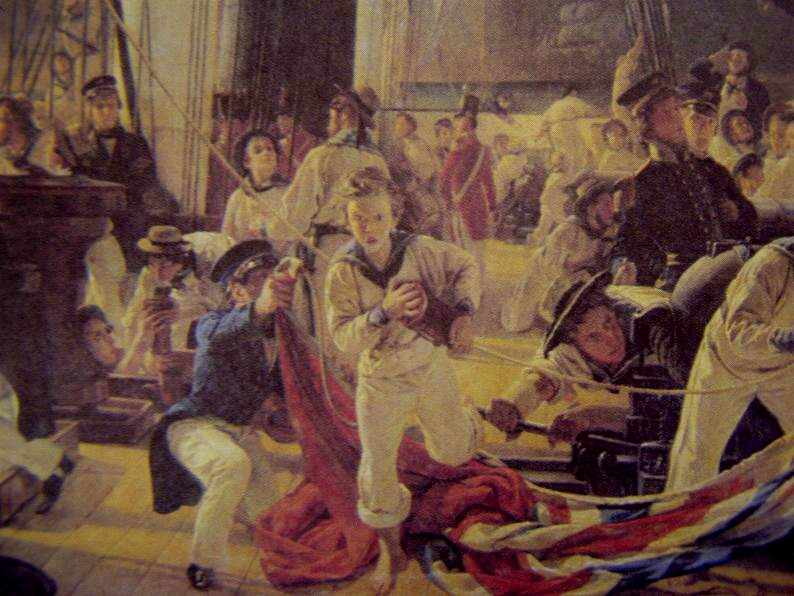
Both boys and youth commonly served on Royal Navy ships up to the early 19th century. This varied over time. During the Napoleonic Wars the British Government hugely expanded the Royal Navy. Captains were desperate to fill out their crews. But even in less desperate times boys and youths served on the ships. We are not sure just how many boys would have been on a ship. This would have course varied with the size of the ship. We suspect that most ships had some boys on the crew. This included both enlisted men (ratings) and officers. The boys serving as enlisted men commonly filled a range of duties, including cabin boys and powder monkies as well as helping out with as variety of other duties while learning the trade oif being a sailor. Cabins boys were essentially personal sevants for the captain and ranking officers. Powder monkies help load the ships gins. Their small size and nimbel fingers made them particularly useful in the cramped gun decks. There were also boys among the officers. Officers begun their naval carrers as midshipmen. Until the 19th cenbtury there were no naval traing schools for either ratings or officers. Boys at age 12-14 years of age served on asctive durt vessls learning to be officvers. This continued through World war I. Prince George (the future George VI) served as a midshipmen before World War I. We think he was about 13-14 years old.
It was the Royal Navy that eventually ended the slave trade. The slave trade had been a lynch pin in thr triangular trade that has been a key element of the British economy and helped bring great wealth to Britain. It had in part helped to finance the growth of the Royal Navy. The expansion of the British merchant fleet under the protection of the Royal Navy resulted in Britain dominating the slave trade by the 18th century. British ships beginning about 1650 are believed to have transported as many as 4 million Africans to the New Wiorld and slavery. The British Parliament during the Napoleonic Wars banned the slave trade (1807). This was a decession made on moral grounds after a long campaign in Britain against slavery at considerable cost at a time of War. After Trafalgur (1805) the powerful British Royal Navy could intercept suspected slave ships under belligerent rights. After the cesation of hostilities this became more complicated. The only internationally recognized reason for boarding foreign ships was suspected piracy. Thus Britain had to persue a major diplomatic effort to convince other countries to sign anti-slavery treaties which permitted the Royal Navy to board their vessels if suspected of transporting slaves. Nearly 30 countries eventually signed these treaties. The anti-slavery effort required a substantial effort on the part of the Royal Navy. The major effort was carried out by the West Coast of Africa Station which the Admiralty referred to as the 'preventive squadron'. The Royal Navy from this station for 50 years conducted operations to intercept slavers. At the peak of these operartions abour 25 ships and 2,000 officers and men were deployed. There were about 1,000 Kroomen, African sailors, operating West African Station. The Royal Navy deployed smaller, shallow draft vessels so that slavers could be persued in shallow waters. Britain also targeted African leaders who engaged in the slave trade. A British forced in one operation deposed the King of Lagos (1851). The climate and exposure to filthy diseased laden slave ships made the West African station dangerous. The officers and men were rewarded with Prize money for both freeing slaves and capturing the ships. The Royal Navy's task in East Africa and the Indian Ocean was even more difficult. This was in part because of the support for slavery among Islamic powers (both Arabian and Persian). The slave trade persisted into the 1860s, in part because of the continued existence of slavery in the United states. Eventhough thecslave trade was outlawed in America, the American Navy was not used to aggresively inters=dict the slave trade. This did not change until President Lincoln signed the Right of Search Treaty in 1862, a year before the Emancipation Proclamation. The Cuban trade ended (1866).
The Royal Navy played a major role in the Revolutionary war, providing the British a great advantage in the War. It was, however, a French victory at the Battle of the Capes (1781) that doomed Ciorwallis; army at Yorktown. The Royal Navy again provided thec British a great advantage in the War of 1812. The Royal Navy, however, provided a shield from European interference behind which the American Republic developed. Although the Confederat raider Alabama was built in a British shipyard, British neutrality on the Civil War meant that it was possible for the American Navy to blockade the Confederacy. The American and Royal Navy in the 20th century fought together in two great world wars. Anglo-American naval cooperation began before America entered the World War II and was critical in the Battle of Atlantic, arguably the most most critical campaign of the War.
After the revolutions against Spain in South America, the Royal Navy prevented the reimposition of European rule. Americans often look to the Monroe Docrtine as guranteeing the independence of Lain American republics. Actually at the time, the United States had no military forces with which to enforce the Monroe Doctrine. The force that did this was the Royal Navy.
The Royal Navy played an important role in the independence of Greece and the unification of Italy.
The Royal Navy established its naval dominance at Trafalgar, still in the age of sail (1805). The Industrial Revolution had already begin in Britain (mid-18th century). The industrial evolution began with textiles and the Royal Navy played a role in it. Part of the success of the Royal Navy in the 18th century was standardization an early mass production. After the Napoleonic Wars (1800-15), the sun was setting on sail power and shifting to steam and iron. (Naval power is ultimately based on industrial power--something the Japanese in the 20th century failed to comprehend.) Britain as the leading industrial power would be able to continue its naval dominance throughout the 19th century. Sail boats could not moved without wind. And there were times that sea was becalmed. Steam power not only solved that problem, but as technology improved, offered more power than wind could generate. This had huge implications for naval warfare. Jut as rail roads collapsed time and distance, steamboats did the same at sea. And it also meant that first iron plating defensive armor could be added and eventually whole steel ships. The Royal Navy was slow to change, in part because there was no real naval threat. Some of the changes came came from America in the Civil War (1860s). In addition, the paddle wheel was not very effective at sea. And for some reason the Royal Navy was convinced that the screw propeller was not suitable for naval vessels. Isambard Kingdom Brunel's SS Great Britain proved them wrong (1843). An then France launched Gloria, the first ocean-going ironclad (1859). Britain responded with HMS Warrior (1860) which would guarantee British naval supremacy for the rest of the century. Advances on the other side of the Atlantic as part of the Civil War included gun turrets and screw propellers -- the USS Monitor (1862). John Erickson who had played a major role with screw propeller was the genius behind Monitior. This ended the era of wooden-hulled sailing ships gave way to that of steam-powered iron ships. Phenomenal changes ensued during the second half of the 19th century in nearly every aspect of warship design, operation, and tactics. But the United States (except for the Civil War) which was surpassing Britain in industrial power was was not interested in massive arms spending until the 20th century. The Royal Navy's only real threat would come from Germany and the Kaiser's Navy.
It was not until the first all big gun battleship appeared -- HMS Deadnought (1906). At the time Britain was involved in its first serious naval challenge since Napoleonic France. Imperial Germany and America both had the industrial might to challege Britain. At the time the United States had not major strategic concerns with briaiun and its Empire. Imperial Germany did.
The prestige of the Royal Navy by the 19th century was such that the uniform of the British enlisted sailor became a standard outfit not only for British boys, but also for boys throughout Europe and North America. This is somewhat ironic because until the Victoriabn Era, the British enlisted seaman was seen as a loutish no account. Even during the Victorian era, the enlisted seamen was still seen as a rather rogish character witha woman in every port. Hardly the role moddle one would think that Victorian parents would want their sons to emulate. Of course the Royal Navy itself was a different matter.
The British were drawn into the Middle East for two reasons, both of which concerned the Royal Navy and sea commerce. The fitst was Suez. The trade route through Suez, especially once the Canal was built were the most direct connection between Britain and Induia. This resulted in converting Egypt into a protecorate. This brought Britain into conflict with the Ottoman Empire, the same Empire they had acted to save at great cost in the Crimean War. With the advent of steam power, the Royal Navy used coal, a resource Britain had in great quantity. There were, however, disadvantages to coal. One was the time needed to load it. Even more importantly was the smoke which made ships an easy target. To convert to oil, the British needed a source of oil. It could be purchased in America, but that made Britain dependant on the United states. The British found oil in Persia, modern Iran which became the major source of oil for the Royal Navy. When the Ottomons joined the Central Powers, Britain became even more involved in the Middle East, seizing Palestine and the Levant as well as Iraq from the Turks. After the War, oil was also discovered in Iraq. After World War I, further oil discoveries were made in northern Iraq. Iraqi oil would play an important role in supplying the Royal Navy in World War II.
At the turn of the 20th century the Royal Navy had about 60,000 men. Unlike the Army there was no need for an extensive training program. The Navy did not have recruiting officers like the Army. In fact the Navy had 10 volunteers for every position available on its training ships. Naval training ships are a topic that we do not yet fully understand. We have seen several ships referred to as royal navy training ships over time. Here we will list ships both chrologically and by ship name. As far as we know, the Royal Navy trained boys aboard active duty ships until 1855 when the first naval training ship was commissioned.Some naval schools for younger lads, particularly reform schools, were based in old hulks, tied up in port that were referred to as naval training ships. The Royal Navy had training ships preparing boys for both the Navy a Marchant Navy. There were quite a few other ships dotted along the coast of the Britsih Isles run by Asylums and other organizations. They took in delinquent youth and transforming the boys into dependable recruits for the Royal and Merchant navies.
The Dominion naval sevices, including the Royal Canadian Navy, Royal Australian Navy and Royal New Zealand Navies are all modelled on the Royal Navy with the same structure and uniforms. The ships are HMCS for Canada, HMAS for Australia and HMNZS for New Zealand. They all have cadet programmes for young people wishing to enter the navy. he Royal Navy has also been influential in the development of other naval services, most notably the Imperial Japanese Navy which the Royal Navy and the American Navy had to fight in World War II. The Dominions were not heavily industrialized, althigh Canada birdering in America did have an indistruial sector. None were csapsble of building war ships or an econmy capable if maintaining a major naval force. As a result the Empire did not okay a major role in the naval war, with one exception--Canada. The Royal Navy as a result of inter-War cuts did not have the ships needed to escort the convoys. Canada set out to build a navy designed to escort the convoys. While Canada did not have the cpability to buiold large ships, they could build small escorts, like the Flower Corvettes. And Canada builr tghemn in qunity oopening new small shipyards.
The naval arms race between Germany and Britain was a factor contributing to World War I. Germany was not the only industrial power capable of contesting control of the seas in the early 20th century. The other was the United States. And the British were concerned about growing American power. There was a serious confrontation between America anfd Britain over Venezuela (1890s). America for its part retained a historic objection to British empire building. It is not impossible that condlict could have occurred between America and Britain in the 20th century. When World War I broke out in Europe there were disputes between Britain which established a blockade on Germany and the other Central Powers and America which insisted on the rights of neutral shipping. This was an issue that had developed between America and Britain from the very foundation of the Republic (1790s). President Wilson's closest advisor, Col. House, advised him not to challenge Britain on the issue. This was a factor in President Wilson's decesion to support a naval building program (1916). Incredibly recklass German policy with U-boats had the affect of overwealming disputes with the British. Afer the War, President Wilson wanted to raise the issue of neutral shipping rights at the Versailles Peace Conference. The British managed to persuade thenm not to. Wilson who was primarily focused on the League of Nations reluctabntky agreed. The Americans had not, however, forgotten about the issue. This led to a major decesion by Britain. Britain during the 19th and early 20th century was the the dominant world naval power.
The British Royal Navy was still the dominant naval force of the day. The British had virtual undispute control of the seas since Trafalgur (1805). The Royal Navy between Traflgur and World War I fought no major fleet engagements. It had, however many responsibilities as a result of Britain's far-flung Empire and all impotant merchant fleet. It was the Royal Navy's responsibility policie the colonies and trade routes and defending the British coastline. It also wa used to imposing blockades. This was a major factor in the Napoleomic Wars, but Until World War I this primarily meant small countries that were not paying their bills. Successive British government adopted the policy that to accomplish its responsibilities and to guarante British security, the Royal Navy needed a battlefleet that was larger than the world's two next largest navies put together. Thus the Royal Navy could prevail against even an alliance of hostile European powers. The only serious threat was the new German High Seas Fleet built by Kaiser Wilhelm and Admiral Tirpitz. The growing U.S. Navy before the War was also a concern, but it was the bombastic Kaiser and German High Ses Fleet that dominated British thought. The Royal Navy at the time of the War outnumbered the Germans in all important classes of surface vessels. The Royal Navy at the outbreak of World War I had 18 modern dreadnoughts (with 6 more under construction), 10 battlecruisers (lightly armored but heavily gunned), 20 town cruisers, 15 scout cruisers, 200 destroyers, 29 battleships (pre-dreadnought design) and 150 older cruisers (built before 1907). The Royall Navy's numerical superority in capital ships thus made its control of the Sea virtually unassailable. Britain's long naval tradition was also an important advantage.The German calculation was that this was unimportant. They thought that Britain mght even stay out of the War and at any rate the British had only amall Army. The Germanswere convinced tht using the Schhliffen Plan that the German Army would quickly win the War quickly by defeating the French Army as they did in the Franco-Prussian War. With France knocked out of the War, the British would quickly sue for peace. Thus the poerful Royal Navy was not a major concern. Unfortuntely for the Germans, not only did the Belgians fight, but the British did enter the War and rushed the small British Expeditionary Force (BEF) ws quickly deployed to Belgium and slowed the German advance. ARussian offensive in the East forced the Germans to shift forces east. And the French Army held at the Marne September 1914). The War turned into a protracted war of attrition and the Royal Navy supported by the French fleet tured into a key element of the War by eforcing a crippling blockade of Germany and its allies. Rather than being unimportant it became a central element in the War. Most of the Royal Navy's capital ships stationed at Scapa Flow in the Orkneys or Rosyth in Scotland. Here the Grand Fleet stood in readiness to stop any major German fleet action go break te blockade. Britain's smaller ships (cruisers, destroyers, submarines and light forces) were clustered at various points around the British coast. There were also smaller forces in Mediterranean, Indian Ocean, and Pacific. The German High Seas fleet was the only force capable of mouning a serious challenge to the British. And as Admiral Jelocoe famously stated, he was the only man who could lose the War in a single day.
World War I had brought Britain close to bankruptsy. The British could ill aford a naval building race with America. The United States not only had a larger industrial base, but it emerged from the War economically more prosperous than Britain. Thus the British had to decide whether to contest b=naval dominance with America are accept a rival naval power. This decession was addressed by the Committee of Naval Defence (winter 1920-21). Prime Minister Lloyd George later wrote that it was the most important and difficult that the Committee had ever considered. The conclusion tghey reached was difficult, but obvious, Britain no longer had the capability to control the seas. It could not outbuild the United States. This with little fanfare or publicity command of the seas began to shift from Britain to America. The British decided that rather than try to outbuild America, they would seek to negotiate arms control agreements.
The United States had anted to sponsor a general arms control agreement. The failire of thecSenate to approve ratification of the Versailles Treaty, meant that France was left without American and British guarantees. The French Government thus made it ckear that it would not support any limnitations on its army. The United States thus decided to focus on naval arms limitations. The Royal Navy beginning with the defeat of the Spanish Army began to play an increasingly important role in world affairs. Nelson's victory at Trafalgur (1805) left the Royal Navy unchallenged on the world's oceans. This dominance continued until the Washington Naval Conference. The result of the Naval Limitations Treaty was parity with the United States, but this meant in realiy accepting American naval dominance because Britain as a result of World War I could no longer afford to maintain the world's most powerful navy.
The White Ensign Clubs appear to be associations of Royal Navy veterans. The name comes from the white ensign flpown by all Royal Navy ships. We sare not sure when they began to form. We kbow that some existed at the gime of World War II so it seems to have before the War. They seem to hve been rather like fratermal orders which provided recreational activities as well as a range of services and assistabce to veterans and their families. This appears to hve been done exclisively at the local leval. Clubs were organized not only in Britain, but i port cities of the Empire witha naval presence. We do not know of any nationl orgnization. A national association was eventually formed and registered as a charity--the White Ensign Assocition (1959). It weas founded jointly by the Royal Navy and the City of London in 1958.
The Association was set up to provide a financial advisory service for all serving and retired personnel of the Royal Navy, the Royal Marines, the Queen Alexandra’s Naval Nursing Service, the former Women’s Royal Naval Service, Royal Fleet Auxiliary, their respective Reserves and families. The Assocition gradully expande to include help in resettlement and employment in civilian life.
British defense policy was to have greater naval power than the next two naval powers combined. The first serious challenge to British sea power was Imperial Germany. Admiral Jericole was aware that only he could lose the War in a single day. The German Highseas Fleet challenged the Royal Navy, but was not large enough to defeat it. And the U-boats only succeeded in bringing America into the War. After the War, Britain had to make a major decesion. Would it allow the rising American Navy parity with the Royal Navy. In the end the British had to relinguish its dominance. They did just not have the economic strength to support a massive fleet. With the Washington Naval Talks (1921), the British agreed to a massive cut in the fleet. In the inter-War era the British worked on naval aviation, but the construction of new vessels was limited. The Admiralty made a serious mistake when they concluded that submarines would not be a threat in future wars. The enormous cost of World War I ha caused British Governments to limit naval and other military expenditures in the 1920s and with the Depression of the 1930s the focus was on relief efforts. The naval cuts were possible because of the Versailles Treaty restricted the German navy. This changed dramtically with the rise of the NAZIs who demanded a revision of the Versailles Treaty. The result was the Anglo-German Naval Treaty (1935). Japan refusued to renew the naval arms treaties. Thus Britain entered World War II with a much smaller fleet than in World War I. Britain again implement a naval blockade of Germany. This time it proved less effective because of German successes and rapid occupation of much of Europe. The Royal Navy at the onset of the War proved to be deficient in ASW capability and its carriers still had biplanes. And with a small fleet it was forced to fight the most important naval campaign of the War, the battle to keep the sea lanes open in the North Atlantic. Britain negotiated a bases for destroyers agreement witn the United States, but would eventually need the support of the U,S. Navy and a new Canadian Navy. Here the Allies naval forces would receive indespensable aid from the Ultra code breakers. After Japanese bombers sank Prince of Wales and Repulse the hard-pressed Royal Navy would have to leave the fight in the Pacfic to their American allies. The campaign against the U-boats was primarily a campign fought with small ships, a variety of destroyers, descroyer escorts, and covettes. The principal vessels of the Hime Fleet were held in reserve for first a German invasion and then forays by the Germn battleships and heavy cruisers/pocket battlships.
Britain developed a national naval policy of mainaining a naval force equal to that of the two other largest navies. This policy assured victory over the German Nsvy in World War I. Britain after the War, however, could no longer aford the world's dominant navy. This was especially the case with regards to the U.S. Navy. America had not been economically damaged by World War I. Britain thus accepted naval parity with America. This was conformed by the Washington Naval Treatioes (1921). As a result, Britain enbtered World War II with a much reduced naval force. And as a result, was nearly defeated by the German U-boat fleet in World War II. The War further damaged Britain economically as did the decision to pursue socialist economic policies. Thuis meant that Britain could no longer aford to mainatain even the much reduced post World War I Treaty Navy. It was now the U.S. Navy that dominated the seas. And slowly the Soviet Union began building a major navy. The Royal Navy was an important partner for the americans in the Cold War, but a decidedly junior partnrr. With the decline of the Empire, a major blue water navy was no longer essential even if it could be afforded. The day of the battleship had ended in World II. The aircraft carrier was now the dominant expression of naval power. But slowly the British began decommissioning its World War II carrier fleet with few replacements. It the end the Royal Navy did away with fixed-wing carrier aircraft. The Royal Navy did maintain small carriers for Vertical Take Off and Landing aircraft (VTOL). This mean smallair compliments of less effective aircraft. Just before the Falklands crisis, Britain almost did away with carriers altogether (1982). If that had occurred, Britain could not have responded to the Argentine seixzure of the Fallklands. The Royal Navy's principal force today is Vanguard class nuclear-powered ballistic missile submarines (SSBNs). The class was introducedas part of the Trident nuclear program, (1994). The Royal Air Force WE.177 was decommiiined (1998). Thi ened free-fall nuclear weapons. The four Vanguard submarines are the sole platforms for Britain's nuclear weapons. Each submarine is armed with up to 16 UGM-133 Trident II missiles. The class is scheduled to be replaced starting in 2028.
One interesting topic is the families of Royal Navy officers and enlisted men. All kinds of questions occur such as how commonly the children followed their fathers into the Navy. We also wonder about the children of enlisted men. For many years there was no provision for the families. We also wonder how common it was for the children of emlisted men to become officers. Hopefully some of our British readers will be able tgo provide us some insights here. We have not yet been able to research these and other interesting topics. We have, however, begun to archive some Royal Navy families and children on HBC. A good dexample is Philip and Maurice House.
Herman, Arthue. To Rule the Waves: How the British Navy Shaped the Modern World.
Hochschild, Adam. Bury the Chains.
Howell, R.C. The Royal Navy and the Slave Trade London (1987) .
McLynn, Frank. 1759: The Year Britain Became Master of the World (2005).
Padfield, Peter. Rule Britannia: The Victorian and Edwardian Navy (London, 1981)
Padfield, Peter. Maritime Power and the Struggle for Freedom: Naval Campaigns that Shaped the Modern World, 1788-1851 (Overllk, 2005).
Rodger, NAM. The Command of the Ocean: A Naval History of Britain, 1649-1815 (Norton, 2005).

Navigate the Children in History Website:
[Return to Main military force page]
[Return to Main military style page]
[About Us]
[Aftermath]
[Biographies]
[Campaigns]
[Children]
[Countries]
[Deciding factors]
[Diplomacy]
[Geo-political crisis]
[Economics]
[Home front]
[Intelligence]
[POWs]
[Resistance]
[Race]
[Refugees]
[Technology]
[Totalitarian powers]
[Bibliographies]
[Contributions]
[FAQs]
[Images]
[Links]
[Registration]
[Tools]
[Return to Main World War II page]
[Return to Main war essay page]
[Return to CIH Home page]