**
war and social upheaval: important military organizations American United States Navy U.S. Navy
Important Military Organizations: United States Navy
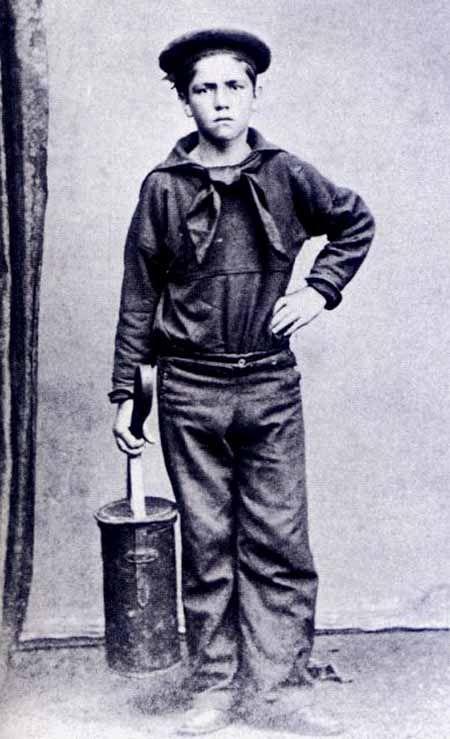
Figure 1.--The American Civil War has been called 'the boys' mwar because so many boys weree invbolded in the fighting. They are normally thoiught of in connectioin with the Army, beginmning with drummer boys. (Buggles required older boys with larger lung capacity.) OLder teens were actual combat soldierts. There were also young boys who joined the Navy. And here it was not just drummer boys. Small boys since cannons were first dragged aboard vessels--they served as powder monkeys. This ia Henry Message, a U.S, Mavy powder monkey. A powder monkey or powder boy helped man naval artillery as an important member of a warship's crew. This continued thgrough the Civikl War (1861-65). His duty bwas to bring gunpowder from the powder magazine dep the ship's hold to the actual artillery pieces. Here a biy;s small sdize was useful in naviagating the narrow passages and cramped quarters of a naval mbessle. Often the boys doing this were the yoiungest members of the crew, usually 12 to 14 years old.
The American Navy appered during the Revolutionary War. Although it could not begin to compete with the vast Royal Navy, it did help to raise the cost of the War to the British. It was also the only naval force able to gain victories against the British in individual naval combat, a record it repeated in the War of 1812. The American Navy disapeared after the Revolutionary War and was not revived again until the war with the Barbary pirates at the turn of the 19th century. America did not begin to build a professional force until the Naval Academy in Anapolis was founded (18??). The Navy played a role in the Mexican War and the opening of Japan. The Navy's primary accomplishment in the 19th century was its part in blocakading the Confederacy as part of the Federal Anaconda Plan during the Civil War. It was the American Navy that first deployed a modern iron vessel--the Monitor. American did not, however, begin building a modern navy until President Cleveland's Administration, a process subsequemtly furthered by President T. Roosevelt. After World War I, the British Royal Navy was no longer able to play its traditional role in controling the seas. With Pearl Harbor (1941), a new vastly expanded American Navy took on that role and played a major role in the defeat of Japanese militarism and European Fascism.
The British Royal Navy (16th -18th century)
The roots of the American Navy lay with the Royal Navy amd Engkland's maritime tradition. The Royal Navy was the strongest navy of the 18th centurym but not as dominate as it became after Trafalgar in the 19th century. What would become the Royal Navy was the Sea Dogs that raided Spanish Treasure fleets and finally defeated the Spanish Armadaa (1588). For more than a century the Royal Navy had the Dutcch, French, Portuguese, and Spanish to contend with. The Dutch were defeated in the Dutch Naval Wars (1652-74). The Portuguese provrd vto be more allies than enemies. Than the Spanish were defeated in the War of Jenken's Ear (1739-48) and the French in the Secen Years War referred to in its American phase as the French and Indian War (1754-63). These involved real fleet engagements, not raids on lightly armrf trasure ships, The British victories opened the way for the British to domimate India and seemingly left the British in control of North America, at least the French were pushed out. The British victories weree in large measure determined by the Royal Navy's ability to prevent the French and Spanish from prpjecting power beyond Europe. There were two matters that the British were uinaware of after their victory in nthe French and Indian War. First, their American collonies had been an important ally in their victory. And while the Colonials cinsidered themselves English, many in England did not and were not prepared to grant them the rights of Englishmen. This would create a rival mpower that would chhllrnge Vritish control of North Amereica. Second, sea farinh technology was not secret technology. The British merchant marine acquited all the nautical know-how developed by the Royal Navy. And the American merchant marine thus became just as skilled as the British. American ship construction wa somewhat more crude than the British, but they basically has the same technologhy. And the British provided American seamen (fishing and merchant vessels) by issing letters of marque for actions against enemy vessls--mostly enemy merchant vessels. In sharp contradt, the French had weakened their navy by massacring many iof rgeir finesr seanen-0-the Protestanbts (Hugenoughts).
American Merchant Marine
Britain's American colonies before the Revolutionary War had a very substantial merchant marine and ship building industry. It had one great advantage--an almost inexautable supply of timber from the great forrests of the still only minimally touched native forrests. This at a time that Europe, especially Britain was beginning o deplete its forrests. America lacked the ability to produce some important elements such as high-qualty sail and copper sheahing, but at the time of the Revolutionary War, the American colonies had a combined merchant marine lrger than almost all of the great European powers. Of course Britain had by far the largest merchant marines, but the American merchant marine was on a par with the other great European powers such as France and Spain. There were several thousand American merchantment, mosty small but sturdt vessels. American merchants chafed under rectrictions imposed by the British. Pamletteers like David Ramsey and Thomas Paine spread the idea that American merchants would benefit from being freed from the British Empire and free to trade with other countries. There was little recognition at the time as to the befnefits of access to British markets, especially the British Caribbean islands. Nor were the benefits of sailing under the British flag and protection of the Royal Navy fully understood. About two-thirds of American commerce was conducted with the British Caribbean colonies. Here the island economies were geard to produce sugar and other export products, not food. The islands imported food to feed the large slave populations. [Toll, p. 19.]
Continental Navy
The American Navy appered during the Revolutionary War. Although it could not begin to compete with the vast Royal Navy, in the sence of conducting fleet engagement. TheAmericans did carry the waetio sea. Masschusetts created a Naval mMilitia. Thev Continehtal Congress issued letters of marque, authorizing the taking of English merchantmem. This raised the cost of the War to the British which was important because the whole iIdea behind colonies was for trade and profit. The Continental Congress had mixed opinions about creating an actualy Navy. Some thought it was a mistake to divert scarce resources, but Congess after 5 months of deabate debate authorized the creation of a Navy and a seven-member naval committee (1775). One of its promient members was John Adams. The Continental Congress in terms of the funds available made very substantial investsments in a Continental Navy. Congress than proceeded to buy, rerrpfit and construct some 34 ships ranging in size from 8 to 30 guns. This was dwarfed by the Royal Navy with hundreds of ships, including ships of the line with over a hundred guns. This meant that the Americans could not win a major fleet action at sea. The most important Amrtican battle at sea was the vBalttle of Valcour Island. The Americans lost the battle, but sucessfully delayed an invasion from Canada. Those maintain that funds provided proved to be largely wasted. The Continental Navy proved not to be a professional force in the sence of the Continental Army, but largely a privateer force. But the privateers did have an impact. The basic problem for the Americans was that there was no secure naval base in the Colonies. The British Royal Navy had the force to attack any American oier at will. The Navy pleaded with Washington to protect its vessels in port. Washington understandably argued that the whole point of having a navy was to support the Continental Army, not visa versa. The Continental Navy, primarily theough privateers preyed on British shipping. Even the huge Riyal Navy could not protect Briitishbshipping on the uge ocean expoanses. The Continental Navy and oprivateers helped to raise the cost of the War to the British by raising insurance rates, an important accomplishment given the influence of merchants on the British Government. The Continental Navy was also the only naval force able to gain victories against the British in individual naval combat, something the French and Spanish rarely mastered. This was a matter of some embarassment to the British. Ironically the greatest successes came not in American waters, but in European waters. Here American ships could sally forth from protected French ports and attack British shipping and then return to French ports where harbor guns prevented Royal Navy ships from pursuing them. There were no such protected American ports. It was here that John Paul Jones made a name for himself sinking larger Royal Naval vessels. It was the entry of the French into the War (1778) that made a difference at sea, Followe by the Spanish, led to the costly seizure of many British merchantment. And nosr imprtantky, the French victory in the Battle of the Chesaapeake (also known as the Battle od the Capes) led to Lord Corwallis' surrender at Yorktown (1781). After the signing of the Treaty of Paris ending ther War (1783), Congress recalled the 7 bsurviving Continental Navy vessels and 323 privateers.
Articles of Confederation (1781-89)
The Continental Congress approved the Articles of Confederation (1777), although it was not ratified by all 13 states until 4 years later (1781). Thus after the the Revolutionary War, the Articles became the constitution of the independent United States. The Artticles created a weak association of essentially soverign states. There was no execurive or judiciary. The central givernment rested with Congress which was aind of legislatve committe with delagates from each state. A navy more than the army at the time was a costly undertaking. The Articles of Confederation gave the Congress the authority to create a navy, but no power to raise the needed funds through taxation. It could request money from the states, but could not compel payment. Under such a system, there was no way of financing an American Navy. Thus the navy was disbanded and the remaining vessels auctiioned off (1785). Thus for a decade after the Revolution there was no American navy. And without the protection of the Royal Navy, America's substantial merchant marine soon found itself vulnerable to all manner of foreign preditors.
Marine Commerce
British control of the sea during the Revolutionry War played havoc with American shippingr. The end of the War and American Independence did not immediately bring the benefits that the propnents of independence had anticipated. The British Government issued an Order in Council barred American ships from British Caribbean ports (1783). This had a devestating impact on American shippers and merchants. Prices of the products formely shipped to the Caribbean plunged. And ship sailings to the Caribbean sharply declined. And it was not long before it was noted that American ships no longer had the protection of the Royal Navy. The most notable problem here at first was in the Mediterranean where the Barbary Privates began to seize American ships and ransom the crews. Congress did not havevfinds to pay the ransime. American prisoners laguished in mediec=val Varbary proson. They were not the only group to prey on American shipping, but they were the first and lurid tales of the treatment of captive Americans, especially the women, began appearing in American newspapers. Economic conditions improved with the outbreak of the French Revolution (1789) and the outbreak of war in Europe. The demand for American exports began to increase and the American merchant marine began to expand once again. But also problems escalated for a neutral nation without a navy to protect its substantial merchant marine which sailed around the worldm invluding India and China.
The problems associated with the Aricles of Confederation resulting in a Constitutional Convention (1787). The Convention produced a new constitution with a far stronger national government. The prposed constitution was hotly debated. Americans split over what was to become future party lines. The group to be called Federalist led by Alexander Hamilton stroingly supported the Constitution. The future Republicans led by Jefferson were profoudly suspicious of a strong central government. There was, however, cosiderable flexibility. The stroingest figure in drafting the constitution and securing ratification was Jefferson's cloest political ally--James Madison. The strongest combination of Hamilton and Madison worked together to secure ratificatin after an rancerous national debate. The Constitution as ratified created a Federal Government that was able to create and fund a navy. And a navy was mentioned in the dicument, but not with any specificity. Article I included a provision giving Congress the authority to "povide and maintain a navy." Congress was also given the authority to "make rules for the Government and Regukation of the land and naval Forces". Article II made the president "Commander in Chief of tge Army and Navy of the United States". With such provisions it might have been expected that a navy would be created quickly after Congress convented. This did not prove to be the case and in fact the creation of a navy proved to be the most divisive issue faced by the early Congrress.
Foundation (1794)
The founding of the United States Navy occurred when President George Wasgington signed the Act to Provide Naval Armament (March 27, 1794). The justification was attacks in American shipping by the Barbary Pirates. Even so it was perhaps the most contentious issue considered by Congress during the Washington Administration and was an early issue upon which the emerging Federalist and Republican Parties split. The Federalists wanted a Navy to protect American merchant shipping, much of it operated from New England and to protect affonts to the hnor of the new nation. The Republicans saw a standing military as a threat to the Republic ahd were opposed to the very substantial outlays which they saw farmers havung to pat to finance the investments of wealthy merchants.
French Revolution (1790s)
The French Revolution overthrowing the French monarchy (1789) had a major impact on the new American Navy. The fighting at first led to land battles on the Continent. It eventually led to war berween Britain and France which meant naval warfare. This left American mercantmen in the middle. Ships headed to Britain were seized by the French and those heeaded to France were seized by the British. Both navakl vessls and privateers preyed on American shipping. The Jay Treaty reduced Revoutionary War antagonisms with Britain and established a solid base base upon which America could build a prosprous national economy (1794). The Jay Treatty reduced incidents with the British and thus French drepedtions on American shipping emerged as the major threat to American commerce. This further heightened the Federalist/Republican split because of ideological differences in the French Revolution.
After an extended debate, Congress authorized nearly $0.7 million to build or purchase six frigates. This was an enormous sum at the time for the basically babkrupt American Republic. Building and outfitting the shis was a huge undertaking and it would be 4 years before the first of the frigates were ready for service. At the time America was at peace, although being provoked at sea by both the French and British. The frigates were enormous tourist attractions in the United States with guards even charging admission which they apparently used to buy liquor. [Toll]
Refounding the American Navy (1798)
A tribute Treaty with Algiers temprarily reduced the immediate needs for the frigates. The Republicans as a result pressed to cancel the frigate project. President Adams championed the cause of the frigates and is thus seen as the father of the U.S. Navy. An compormise was reached to finish the first three. The incendiary XYZ Affair (1798) eventually convinced Congress to finish the remining three and outfit a number of smaller ships. Outfitting the frigates as well as the Quasi War with France was beyound the capabilities of the War Department which was composed primarily of men with varied backgrounds. As a result, President Adams moved to create the Navy Departmentn (1798). It would be the first new ministry and Benjamin Stoddert was selected as the first Secretary of the Navy. Stoddart was aevolutionary War veteran. The six frigates would go on to play an important role in the early history of the Republic. The ininital impetus was to deal with the Barbary Pirates, but they were first employed in the Quasi War with France, primarily in the Caribbean. Ironically although Republican leaders Jefferesin and Madison led the fight against the frigates, as presidents both they would make the greatest use of them.
The Quasi War (1798-1800)
The Quasi War was the independent American Republic's first military confrontation. It was fought with France, America's ally in the Revolutionary War. It was an undeclared naval war. The dates are a little ambiguous. While actual fighting began only after the U.S. Navy's frigates came on line (1798). The War actually began several years earlier. The United States even before the Constitution was ratified had signed an alliance with France (1788). While the American Republic had no navy, it did have a very substantial merchant marine and with the French Revolution (1789) and war in Europe, very substantial profits were to be had. The Royal Naby and the Frebch Navy began interdicting American trade. The issue of neutral rights soon bcame a major issue. The problems with Britain were temporarily resolved with the Jay Treary (1794). The Treaty while preventing a disasterous war with Britain was very controversial in America. While it was essentially a commercial treaty, the French took issue with the Treaty, seeing it as a violation of the 1788 Treaty and tatamount to an alliance with Britain and an act of betrayal given the aid that France had given to America during the Revolutionary War. French authorities began issuing letters of marque to French privateers who qlong with French naval vessels proceeded to take hundreds of American ships. Thus when President Adams assumed office, he inherited a very dangerus situation that could have easily led to war with France. The revelvations of the XYZ affair and the shipping losses changed many minds in America about the benefuts of a navy. The six frigates authorized by Congress were rushed to completion along with several smaller vessels. The War was fought entirely at sea, mostly in the Caribbean. The Quasi War proved to be a signal success for the fledgling U.S. Navy and its new frigates. The U.S. Navy captured numerous French privateers and defeated French warships, only losing one vessel. The Adams Administration pursued a policy of vigorosly wageing the underclared war while diplomatically seeking peace with France. The dating of the Wat to 1798 is rather amisnomer. The French began seizing large numbers of American ships (1794). There was no war at this time because there was no American Navy. The 1798 date is when the first of the six frigates began coming on line and the United States had a navy to respond to the French deoredations. The U.S. Navy was small, but it was much better trained and armed than the rag-tag Continental Navy. The Amricans had some 25 ships with more than 40 guns per ship. Of course the French weee in no positiin to concenbtrate its navy bin the Caribbean for the fight. Many Federalists influenced by Hamilton wanted an open war. The Republicans felt that the undeclared war made peace unobtainable. In the end, President Adams was proven correct. The new Navy effectively protected American shipping and helped to change minds in the French Government. The French were locked in a major war with the Royal Navy and were already outnumbered. Losing ships to the Americans was not helpful in the more important struggle with Britain. The French blost two frigates and sevedral dozen privateers. The Ameticans lost only one ship. In addittion, American merchant ships were needed to keep the French Caribbean islands supplied. The issues were resolved peacefully by the Treaty of Mortefontaine (1800).
The American Navy disapeared after the Revolutionary War and was not revived again until Washington built the six frigates. They were first tested with the Barbary pirates at the turn of the 19th century. The Barbary pirates began seizing American merchsant vessels after independence. After the Revolution, the Americans had lost the protection of the Royal Navy. The pasha and his emisaries aserted that the Holy Koran not only allowed, but made it the 'right and duty' of Muslims 'to make war" upon the infidels that 'they could find and to make slaves of all they could take as prisoners". Of course it helped that there were profits to be made in these attacks. All three early presidents were apauled by these attacks. President Washington was furious, and swore,"would to Heaven we had a navy to reform those enemies to mankind, or crush them into non-existence." [Oren] This was one reason Congress created the Navy so that it could protect merican merchants and missionaries. and it was President Jefferson who is often depicted as an idealist and pacifist that ordered the new Navy into the Mediterranen.
America at first without a navy had to handle the problem with diplomacy and tribute. As a result of these demands and than the Quasi War, America had a navy. And wgen the Bashaw of Tripoli mande outrageous demands followed up with attacks on American shipping, President Jefferson decided to use it..
War continued to fester in Europe with the Napoleonic Wars. Napoleon won a series of bloody military ebgagements taht militarty strategists still mdtudy. The Battle of Trafalgur (1805) meant that he would be unable to invade Britain, but he gained control over much of Europe. As a result a trade war developed with the French Orders in Council and the Royal Navy blockade. The United States had allpwed the Navy to decline after the Barbary War.
American shipping was caught between the two again. but with the British dominant at sea, it was mostly the Royal Navy that stipped American vessels. Desperate for crews to man the the huge dleet mnaintaining the blockade, the British increasingly impressed American seamen. In Britains defense, many Riyal Navt basilors were deseting and joining Amerrivan crews where wages were higher and living conditions nore palaitable. There were a range of causes of the War, but the impressment issue was the most incederary. The U.S. Navy during the War of 1812 began with 25 shios (10 frigatesv abd 24 small boats) aking with 500 privateers. They were not able to conduct fleet engagements with the massive Royal Navy whuich was nuch larger than the Revolitiinart War Royal Navy. The United States Navy reoeated its Revolutionary War experience of some successful individual engagements achu=ieved by USS Constitutioin, USS United States and USS Wasp. The Boyal Navy was central to the British war plan. The Duke of Wellington advised a three prong strategy in which British forces could rely on support from the Royal Navy. This time an American naval force blocked the northrrn prong, a invasion from Cabana, in the Battle of Lake Erie. The central prong suceeded iun burning Washingtom, but the failure to take Fort McHenry deniuned them a needed land base. The southern prong was to take New Orleans, This port was bital to all of America neyond the Apalalchins. Here American commerce depended ion the Mississippi River and the port of New Orleans. The Royal Navu klanded an amnphibious inbvasion, but it met with disaster as a result of a hastily orgabized defendeb by Gen Andrew Jackson. As it turned out, the vbattle was fought after the Treaty of Ghent was signed ending the War (1815).
Slavery was an issue that could not be resolved at the Constitution Convention (1787). There was agreement on a provision to end the slave trade. The new Constitution declared a provision to end the slave trade after a 20-year period. Congress did 20 years later passed the Slave Importation Act (1807). The Act prohibited the further importation of slaves. The British Parliament approve an even more restrictive act in the same year. At the time tens of thousands of slaves were being transported annually, many on British ships. These decesions did not end the slave trade. At the time the U,S. Navy was miniscule and President Jefferson saw no need to expand it. The Royal Navy for its part was fully engaged in the Napoleonic Wars. Nor was there any possibity of cooperation between Britain and America. The British were impressing America sailors, a practice that would eventually lead to the War of 1812. After the Napoleonic Wars, other countries also abolished the slave trade, including France, Spain, and Portugal. The slave continued because of the cintinued demand for slaves in the United States, the Caribbean, and Brazil and the high prices that could be obtained for slaves. The British deployed ships to patrol the African coast (1811). There was some support for the slave trade by sugar merchants, cotton mill ownwrs, Liverpool slavers, and some politicians, but the British public strongly supported the effort. [Vogel] Cooperation with the United States did not occur, even after the War of 1812. Many Americans believed that the British demand of the right of search was nothing more than a disguised effort to disrupt trade with Africa. This impaired cooperative efforts until the Civil War (1861-65). It was not much the cooperation of the fledgeling American Navy that was needed. It was the cooperation of port authorities in the United States, especially the souhern ports, that was needed. And support for slavery in the South was not declining, the profitability of cotton was creating an increased demand for slaves and political support for slavery.
Naval Build-up (1820s-40s)
Comngress as a result of the War of 1812 authortized a bavak build-up (1816). This included 9 ships to have at least 75 guns and 12 new 48 gun frigates. Congress only slowly actually allocated money for vessel construction. Yhe largest of these vessekls would be the . It was a three-decked ship of the line of the United States Navy, rated at 130 guns. She would be the largest United States sailing warship ever built--the equivalent of a first-rate Royal Navy ship of the kine. Although Authorized in 1816, she wsas not launched until 1837. She had a less than glorious, history, making only one cruise and spending the resdt of her servuice lije in Norfolk until destroyed during the Civil War.
Naval Academy (1845)
Today it is difficult to imagineb that a professioinal military wasa a controversial matterm but it was in the early republic. It was King George's orofessiinal army that almost won the Revolutiionary War. It was the colonial militias that first stood up to the British regulars. Thus the Demoatic-Republicans idealized the militia, you can see that in the second amedndment. It is no accident that the Second Amendment has pride of place only to the First Amenmdment guaranting free speech and freedom of religion in the Bill of Rights. Republican leaders like Jefferson were very suoiciiys oof a professioinal Army and Navy. Yet any even basic study of the Rebolution shows that it was the Continental Armny, not the militia that won the War. Prominnt soldiers and officials with the establishment of the Republic began lobbying for the establishment of a military accasemy. This included many prominent Revoltionary leaders, inv=vluding Washington, Knox, Hamilton, John Adams, amongothers. Thise who bseved in the Continental Army were especially adament. At the time, the United States was reliant on foreign expertise, especially engineers and artillerists. The logic of the argument forced even President Jefferson to concede the issue. The President signed legislation establishing the United States Military Academy (1802). He agreedonly after after ensuring himself that those attending the Academy would be representative of a democratic society. It was from the beginning situated at West Point on the Hudson, an imoprtant bfor during the Revolutiinary War. For several decades there was no comparable naval accademy, despite the fact that the Navy required even more technolgical training than the Army. A nautical school for officers was organized by Commodore Arthur Sinclair. He commanded the imprtant Norfolk Navy Yard. Sinclair opened the 'Nautical School' on board the frigate USS Guerriere (1821). Some 40 and 50 midshipmen were attached to the ship. The curriculum was diversified with Naval Tactics, Astronomy, Geography, French, History, English Grammar, and International Relations. The school operated until 1828, when Guerriere was ordered for Pacific duty. [Barnett, p. 553.] The Navy used a ship, the brihg USS Somers for a school at sea. After three of the students were hanged, it became obvious that a shore vbased scgool was more apprppriate. Secretary of the Navy George Bancroft organized the Naval School without Congressional funding (1845). It was opened at FortSevern, an Army post in Annapolis, Maryland. It bbegan nwith 50 midshipmen and 7 professors. The curriculum included mathematics and navigation, gunnery and steam, chemistry, English, natural philosophy, and French.
Tecnological Advances (1800-60)
The foundation of thev United States Navy coimicided withbthe Industrial Revolution. Major technological changes negan to affect marimtime transport and naval ehineeting in the early-19th century. Robert Fulton (1765 – 1815) was an American engineer and inventor who is credited with developing the first commercially successful steamboat--the North River Steamboat/Clermont). His boat traveled ip and down the Hudson River with passengers and cargo from New York City to Albany. a round trip of 300 miles (480 km) in a record 62 hours. The success of steam engine would transform fransport, both maritimne and land transport. The first American effoirt to adoptbnew tecnologies was the Demologos, an ungainly and unsucessful new ship. Steamboats became the main form of transport on American rivers driven by paddle wheels. This was particulkarly imprtant in America because oif the dtretch of navuigable rivers. The paddle wheel was, however, not ideal for oceanic transport and not suitavle for naval vessels as it was an obvious target for naval gunners. Swedish-born American naval engineer and inventor, John Ericsson (1803-89) solved this oroblem eith the screw propeller which pit the propulsion system safely belowe the waterline (1836). It took baval enginners some time to adopt these these advanves and the first such vessels were sail boays with auxillert stream engines. THis would be the case of many of the Federal Navy that implementedvthe Anacinda Plan and blockaded Cionfedweate ports. It was not until mwell after the Civil War (1861-65) that steam power ebtirely displaced sails.
Antebellum Missions (1800-60)
The United States was an expanding nation with a rapidly growing population and economy. With the Loiusiuana Purchace (1803), the United States became a contibental power which was tantalizingly close to reaching the Pacifgic Ocean. While the United States Navy was small, its' mission and respondibilities were not. After the skave trade was abolished (1807) it assiated the Royal Navy with anti-slavery patrols off West Africa. It assusted in actions agaimst Native Amerucan trubes upmthe various MNississppi tributaries. There were anti-piracy actions in the Caribbean, The country had a sizeable merchant marine that sailed around the world and needed dsome degree of protection. The famed China Clippers competed ducessfully with the Europeans in the China trade. There was also an active Pacufic whaling fleet. This was part of the readson that Comodoire Oerry and his black ships opened Japan. The Navy played a key role in the Mexican War (1846-48). The war began inland on the Mexican-Texas border. The opening battkes were foughtbin norther Mexico. President Polk decided to place the greatest effort in an infibious landing at Veracruz and then drive overland to Mexivo City. This invoobed the grratest naval oprayiomn in tyhe Navy's short history. MNexico did not have a substantial navy and the ciastal fortifications at Veracruz were easily oberwheakmed.
The U.S. Navy's primary accomplishment in the 19th century was its part in blocakading the Confederacy as part of the Federal Anaconda Plan during the Civil War. Secretary of the Navy Giddeon Wells played a key role in this effort. The U.S. Navy had only 90 ships when President Linmciln was elected and this inclided many decrepit hulls. Wells expanded this force toi 260 shiops vin thevfirst year of the War asc the blocjade was out into force (1861). Many more ships were needed, but it was a beginning. The Confedeeacy akso organized a navy and many naval officers joined the Confederate Navy. What the Condfedracy did not have was ships and the indusdtrail capacity to build them in large number. The Confederacy began the War with no warships President Lincoln on April 19, 1861 proclaimed a naval blockade of southern ports. It became known as the Anaconda Plan. Although not immedaitely emplemented by 1862 an expanding American Navy had virtualy cut the Confederacy off from foreign markets for its cotton and other agrcultural products and from foreign military supplies. This was critical because the South did not have the industrial capacity to match the North's manufacturing capacity. It also cut Briatain and France off from supplies of raw cotton.Condederate Secretary of the Navy Stephen Mallory plannd to build nlocvkade runners and irion clads in Cinfederate shipyards. Lack of capacity ;limited this effiort whichbwasc dwaefed by the Federal vessel cinstryctioin effort. The Condederacy also ordered warshios in Europe which preyeed on Federal maerchant shipping. The most famous of these was the CSA Alabama. Monry forced the Confederacy to operatye on credit in Europe which limited the mumber which could be built. Also U.S. diplomats attemoted to dusrupottheveffort. Both the Federal mand Confederate Navies rushed to deploy ironclads. It was the American Navy that first deployed a modern iron vessel--the Monitor. The CSA Virginia wasa less innovative casemate dedign. The Confederacy could bot cimpete woth the expanding industruial power of the North. The Federal Naby exoanded ti n700 ships and t=60 ironclads, giving them contol of the rivers and coasts of the South.
Decline (1865-70s)
The Imited States diring the Cibik War had built a massive fleet in only a few years, rivaling the Riyal Navy. There was not need afor a nacy of this size and it was raopidly reuiced in size. In just a few years the Navy was dien to it pre-Civil war size, about 50 shios and 30 ironclads. And the iron clads were allowed to deteriorate as they were expensice to maintain. The Virginious Affair (1873-75) cauusee mnany Americans tp rconsider allowing the Navy to detrriorate, especilly when a relatively modern Spoanish naval vessel showed up in New York harbor.
The Virginius was a fast American ship hire by Cuban revikutuinaries to run arns and supplies to Cuban recolutiinaries ib Spain. It was captured by the Soanisg Navy abd thge Soanisg=h basrer a prtfunctory trail befan shooting the crew, many if whom were American or British.
New Construction (1880s-90s)
The Unites States emerged in the late 19th century as a great industrial power, rapidy suroassing the undustrial capacity of the great European powees. Europe with the unifucation anmd rise of Gernmany began a costly arms race, bpth a naval and army arms race. The Unuted States had the financial and indudtrual caopacoity to build the largest army and navy in the world, but declined to do so. And while America did not participate in the army part of that arms race, the U.S. Navy insisted they needed to modernize, They got the money from Congress to upgrade some of the old ironclads and build five new battleships--the beginning if the modernAmerican Navy. The new ships were Amphitrite-class monitor. The Navy had been constantlky updating John Ericsons 1861 creation, the USS Monitor since 1861, but none of the mnany upgrades produced a truly ocean-going vessel. The Amphitrite-class monitor funally looked like a modern baval vesell and could make ocean voyages. The ptoblen for the Navy was that after Coingress was unerved by the Virginius affair, coincern quicklybdied dowbn and Congress proved eluctantb to fund actuall construction. So the Navy, incredably, did not get their hands on the new vessels until the 1890s. With thge exception of these five ships, the rest of the Navy continued to be obsolete wooden vessels. As a result, when South Amnerican countries began ordering modern warshios in Europe, President Arthur directed his Secretary of the Navy, William Hunt (1881-82) to begin nodernizing the Navy. Itwas duromg the Clebelamd Sdmomistration that real money began to be actually spent. This led to five protected )armored) cruisers and a ballleship. The USS Texas was the first American battlkesgio. The USS Maine was very similar, but designated and armored crusier.
Alfred Thater Mahan (1890s)
-Alfred Thayer Mahan (1840-1914) was an American naval officer and historian who was a exponent of sea power influencing both American naval strategy and polititival laeders. Mahan was the son of a professor at the United States Military Academy at West Point. He decided, however, tompursue a naval career. He graduated from the United States Naval Academy at Annapolis (1859), just before the oitbreak of the Civil War. Beginning with Cib=vil War duty, he would serve nearly 40 years of active duty. He fought in the American Civil War, later served on the staff of Adm. J.A.B. Dahlgren. He progressed steadily in rank. Stephen Luce, president of the newly established Naval War College at Newport, Rhode Island omvited him to lecture on naval history and tactics. He served as the College’s president (1886-89),He cthen poublished his Naval War College lectures in book form--The Influence of Sea Power upon History, 1660–1783 (1890). His thesis was the paramount importance of sea power in national strength. The 1890s was a tiume of great technological advancedmenbt in naval construction an armaments and an era of an arms race. His nooks had an impact on the great powers. Britain of course alreasy was committed to sea power, Mahan is believed to have influenced Admniral Tirpitz who cincinced Kaiser Wuklkhekm to build a highseas fleet. While Mahan was tight om hos historical analysis for America and Britain, it led Germany down the wrong path and this ccintribyred to its fefeat in two world wars. The Influence of Sea Power upon the French Revolution and Empire, 1793–1812 (1892) stressed the interdependence of the military and commercial control of the sea. He argued that control of seaborne commerce can determine the outcome of wars.
Spain lost its Latin American colonies in a series of revolutionary wars (early-19th century). They only retained their vhild on Cuba and Puerto Rico. Revolution flared in Cuba for several decades. American newspapers ran lurid articles about Spamish efforts to defeat the revolutiojaries. The Spanish-American War was set off by American journalists after the newly constructed >USS Maine blew up in Havana Harbor. The American papers blamed it on Spain. We now know it was an internal expoosion. President McKinnley yieldedvto the oubkic demand for War. The first combat test of America's new highseas fleet was combat with the Spanish Navy in the Spanish American War. The United States had a snall, but for the fitst time since the Civil War, some modern vessels. The Spanish fleet was composed of old obsollete vessels. The Spamish Atlamtic squadron was destoyed in Santiago, Cuba. The Spanish Pacific fleet was destroyed in Manila Bay. Both naval engagements cresulted in virtially no loss of American men and ships. Ground combat followed when the U.S. Army invaded Cuba and quickly secured the island.
Theodore Roosevelt (1898-1909)
Theodore Roosevelt first served as Assistant Secretary of the Navy in the McKinnely admimistration as Anerica moved towad War with Spain. He not only pushed the War, but resigned to form a regiment that fought in Cuba as the Rough Riders. His exploits in Cuba propelled him to be chosen as President McKinnely's vice president. (Many Repiblican stalwarts wanted him out of New York where he had been elected govenor.) And then unexpectedly after President McKinnely was suddenly presidenct. As president he was a strong proponent of naval power. No presidebt has more to do with American naval power than President Roosevelt. He took two huge steps. First was a massive naval contruction program. Second was contruction of the Pamama Canal. Naval power was probably the effort of his administratiion most important to Roosevelt. This may explain why the President made such frequent changes in his Secretaries of the Navy--he had six in all during his two terms of office, a presidential record. [O'Gara] Roosevelt ininiated the construction of a major high seas fleet. This was done through a series of annual naval building programs which advanced the U.S. Navy at breathtaking speed. This time Comgressional authorization resulted in immediate vconstruction. The President Initially pushed through authorixarion for two first-class battleships (USS Connecticut and USS Louisiana), two armored cruisers (USS Tennessee and USS Washington), and two gunboats (USS Dubuque and USS Paducah) (1902). Congress authorized an even greater naval construction program (1903). It provided for no less than five firstclass battleships of 16,000 tons displacement each. This was the equal of any fighting ships afloat in any navy, inckuding the British Royal aand German Imperperial Navies. Congress approved another firstclass battleship and three fast cruisers (1904). Congress approved the construction of two more first class battleships (1905). After 1905 began to study recommendations more closely and debates ensued on the further exapnsion of the fleet, both in the numbers of ships and fleet compsition. But by the end of the Roosevelt Administration, Presicdenr Roosevelt had propelled the United States from anaval nomn-entity to the second largest navy in the world (measured in battleship strength), second albeit a far second, only to the British Royal Navy. Not only was the U.S. Navy the secojd most poweerful, it was like the expanding German fleet, the most modern. It should be stressed that the battleship was considered the super weapon of the age. Thery were not only powerful, but very expensive. Thus the Roosevely naval construction progra, was a departure for the United States, a country which had up to that time been very parsimonious about naval spending.
Roosevelt was well aware of the strategic need for a shortcut between the Atlantic and Pacific Oceans. The construction of the Panama Canal helped with America's strategic need to build a two-ocean navy. France has began work on a canal (1881). The project was led by the famed manager of the Suez Canal--Ferdinand deLesseps. He was not an engineer and the project failed. The French abandobed the project asv a result of engineering problems and a high worker mortality rate due vto duseases like yellow fever. The United States with President Roosevelt's strong backing took over the project (1904). The Canal was one of the largest and most difficult engineering projects ever undertaken. American engineers mastered the technical challenges and American doctors dealt with the disease vissues. The Canal opened (August 15, 1914), a fewvdays after the outbrerakn of World War I in Europe. The Canal was a huge shortcut, greatly reducing the time for ships to travel between the Atlantic and Pacific Oceans. Shipping could now avoid the lengthy Cape Horn route around the southernmost tip of South America through the hazardous Drake Passage id the Strait of Magellan. This was not only a boon to maritime commerce, but meant that iun a time if crisis, it bmaen that the Navy could easily and quickly move it ships back and forth quickly.
President Roosevelt final naval action was personally ordering the Amerucan Navy on a global cruise around the world--showcasing America's naval power to the world (December 1907-February 1909). The American public began calling it the Great White Fleet as the ships were painted white for the display of naval power. It consisted of 16 mostly brand new battleships and escorts. It was a formidable dispaly of naval power. For whatever reason, the only stop in Europe was Spain. Looking back, a visit to Hamburg might have been efficacious. Notably the Fleet had to sail around the tip of South America as the Panama Canal was still under construction.
HMS Dreadnought (1909)
America's investment in naval power was not well times. The Royal Navy launched HMS Dreadnought (1909).
It was a revilution in naval engineering. Studying the batlle of Tushima where the Hapanese destroyed the Russian fleet, there was the one overwhealming conclusion. The only guns of imprtance on a battleship were the big guns.
Prior to Dreadnought, battleships bristtled with guns inclising many small caliber guns. Dereadnought armanent was all its big guns. Dreadnought was the brainchild of First Sea Lord admiral Sir John 'Jacky' Fisher. It had two revolutionary features. First was an all big-gun armament with heavy-calibre and few light and medium guns and a cehntralized fire support system. Second was a modern steam turbine propulsion system. The U.S. Navy was moving in that direction, but Dreadnought was the first such vessel actually launched. Dreadnought was fired with coal, but soon after the Royal Navy shifted to oil. The United States at thev time was the only important naval power that actually had domestic oil fields. In a single stroke, the British made every other battleship in the world obsolete. This was not exactly what the Royal Navy intended, because it also made mich of the Royal Navy's huge fleet of pre-Dreadnought battleships obsolete. This actually aided Germany in developing a competitive highseas fleet. And launched a massive naval arms race especially between Britain and Germany.
Naval Technology
The United States Navy immediately began work on its own Dreadnoughts. The firsrt were USS Deleware, USS Michigan, USS North Dakota, and USS South Carolina. But Dreadnoight was not the only decelopment in naval warfare. There were three revolutioinary new techlogies which led to while new ckasses of naval vessels..
First, two American bicyle mechanics, the Wright brothers, carried out the first bheavier thab air flight (1903). Militaries all over the world began assessinng the still fragil craft for miliitary uses. The U.M. Navy conducted the first flight trials off a ship (1910). It awarded the first contract for figuring out how to land planes (1911). This would lead to the modern carrier, but only after World War I.
Second, the subamrine was being developed as a whole new class of vessels. The U.S, Navy acquired it first reak sunmarine--the USS Holand (1900). Itbwould serve as the basis for the Plunger class sub and the first American sub fleet. It would, however, be the Germamns who would push the development of submarines. The subnmarine would significantly impact World War I and actually draw America into the War.
Third, the torpedo was invented in Britain, but was inaccurate (1866). It vwas not until much later that an effective torpedo was developed (1888). This mean that a small ship if it got close enough could sink a battleship which up to that time had been seen as the ultimate weapon. This not only gace the submarine a real bite, but led to anotherr new class of vessel--the destoyer. President Roosevely's naval condstruction program has focused on the battleship. The most important U.S. Navy contrinbution to World War I would prove to be its destroyers.
Naval Construction Act (1916)
As Europe exploded into war, the United States made little effort to expand its very small army. The Navy was an entirely different matter. The U.S. Navy was one of the world's most powerful navies and on the brink of becoming the first navy to challenge the Royal Navy's dominnce in more than a century. Naval analysts rank it third or fourth, behind Britain, France, and perhaps Germny--depending on the metriucs used. The Wilson Administration hoped to avoid war. The Administration backed plans to significantly expand the Navy. There were several reasons for this. America was now the world's industrial powers with extensive foreign trade. The British Royal Navy blockade of Germany restricted the rights of neutral shipping to which the United states objected. The German dinking of the Luisitania had shocked Americans. And the Japanrse declaration of 21 Points were a direct challenge to America's Open Door Policy. The U.S. Navy had 17 dreadnought and 23 pre-dreadnought battleships. The Naval Construction pAct of 1916 provided for a massive expansion of the Navy. It authorized the construction of 156 new ships. This included 16 capital ships (10 battleships and 6 battle cruisers). There were also to be numerous new cruisers. And 50 destroyers and 20 submarines. All of these new vessels were to be laid down (construction began) by mid-1919. The actual numbers are less significant than the fact that these would be modern vessels. This would have meant that by the early-1920s that the United States would have the most modern navy in the world. The British even if they won the War would nothave been able to afford such a massive building program. As the United States was still not involved in the War, American naval planning focused on a war in the Western Atlantic and Caribbean. All this planning was with the Navy. Mo real consideration was given to preparing an army to fight in France. The only step taken with the army was to change state militias to the National Guard. There was not effort to expand the army or to equip it with modern weapons.
America's entry into World war I was the deciding factor in the War. Here it was the American infantry that brike the dead lock on the Western Front. The Royal Navy and French blockade of Germany played a major role in undermining the German and Autrian economies and civilian morale. This was largely accomplished before America entered the War. America had the third largest navy in the world, second only to the British and German navies. The 300 warships of the American Navy only added to the effectiveness of the Allied blockade, but were primarily deployed in the North Atlantic to guard the sea lanes between America and the Britain and France. Especially important was guarding the troopships that delivered the American Expeditionary Force (AEF) to France. A few Navy vessels were deployed in the Mediterranean, but the bulk of the Navy was deploted in the North Atlantics. Only a few Navy vessels were sunk during the War. The cruiser San Diego sunk by mines set by a German U-boat off New York. Two Navy destroyers protecting convoys were sunk by U-boats.
It was German U-boats and the German decesion to resume unrestricted sunmarine warfare that brought America into the War. The German U-boat campaign proved unsuccessful because of the convoy system imnplemented by the Royal Navy and the invention of ASDAC (SONAR). The United States had a small sunmarine force of 30 ships. The U.S. Navy established its Submarine School at the main Submarine Base in New London, Connecticut (January 19, 1917). The American submarines would play little role in World War I, but the destroyer force would play a major role in World war II.
Command of the Sea
The naval arms race between Germany and Britain was a factor contributing to World War I. Germany swas not the only industrial power capable of contesting control of the seas in the early 20th century. The other was the United States. And the British were concerned about growing American power. There was a serious confrontation between America anfd Britain over Venezuela (1890s). America for its part retained a historic objection to British empire building. It is not impossible that condlict could have occurred between America and Britain in the 20th century. When World War I broke out in Europe there were disputes between Britain which established a blockade on Germany and the other Central Powers and America which insisted on the rights of neutral shipping. This was an issue that had developed between America and Britain from the very foundation of the Republic (1790s). President Wilson's closest advisor, Col. House, advised him not to challenge Britain on the issue. This was a factor in President Wilson's decesion to support a naval building peogram (1916). Incredibly recklass German policy with U-boats had the affect of overwealming disputes with the British. Afer the War, President Wilson wanted to raise the issue of neutral shipping rights at the Versailles Peace Conference. The British managed to persuade thenm not to. Wilson who was primarily focused on the League of Nations reluctabntky agreed. The Americans had not, however, forgotten about the issue. This led to a major decesion by Britain. Britain during the 19th and early 20th century was the the domibnant world naval power. World War I had brought Britain close to bankruptsy. The British could ill aford a naval building race with America. The United States not only had a larger industrial base, but it emerged from the War economically more prosperous than Britain. Thus the British had to decide whether to contest b=naval dominance with America are accept a rival naval power. This decession was addressed by the Committee of Naval Defence (winter 1920-21). Prime Minister Lloyd George later wrote that it was the most important and difficult that the Committee had ever considered. The conclusion tghey reached was difficult, but obvious, Britain no longer had the capability to control the seas. It could not outbuild the United States. This with little fanfare or publicity command of the seas began to shift from Britain to America. The British decided that rather than try to outbuild America, they would seek to negotiate arms control agreements.
The United States had anted to sponsor a general arms control agreement. The failire of the Senate to approve ratification of the Versailles Treaty, meant that France was left without American and British guarantees. The French Government thus made it clear that it would not support any limnitations on its army. The United States thus decided to focus on naval arms limitations. After World War I, the British Royal Navy was no longer able to play its traditional role in controling the seas. The German Navy was dismantled. The United States was concerned about the rising power of Japan, a World War I ally. American officials were especially concerned with Jpan's desiigns on China. As part of the World War I settlement, Japan received several Pacific Island territoiries, former German bases. To prevent a nabal arms race the United STates sponsored the Washington Naval Conference. The resulting treaties were strongly resented by Japanese nationalists and the military.
The U.S. Navy was affected by the end of World War I and the ovrall political and economic trends of the inter-War era. The American people turned away from the Democrats and Wilsonian Idealism. The vast majority of Americans not only wanred a return to peacetime pursuits, but were less interested in the progressive reform movement pf the early-20th century. There were a range of issues that America needed to address, almost all of which were domestic matters: adjusting to demobilization, farm problems, labor issues, immigration, prohibition, and arange of other issues. The eurphoria of the World War I victory soon sissolved into disillusionment and rejection of war. Many Americans came to regret participation in World War I. Many were objected to the treaty-making process that followed the War. There was not only a rejection of the War, but a growing feeling that industrilists (arms makers which began to be referred to as the 'merchahts of death') had drawn America into the War. The result was a rapid growth in isolationism with substantial pacifist overtones, Americans attempted to withdraw from international commitments. Wilson attempted to make the League of Nations the center piece of post-War policy. The U.S. Senate rejected the League and as a result the Treary of Versailles (March 1920). Americans wanted no part of the responsibilities associated with world leadership. Republican Senator Warren G. Harding and Republican presidential candidate encapsulated what was on the minds of most voter called for 'a return to normalcy'. It was not even a word, but most Americans liked the sound of it. It would only later become all too paarent that try as it might to isolate itself, the United STates would not be able to isolate itself from the world. The U.S. Navy like the Royal Navy decommisioned many vessels in the inter-War years as part of the Washington Naval Arms Limitation Treaties. Thus the U.S. Navy had the task of meeting its responsibilities with a much smaller force. In contrast to the Army, the Congress approved substantial appropriations for naval contruction, especially after Japan failed to accept continued limits on naval construction. Most naval strategists before the War believed that the backbone of the fleet was the big-gun battleships, but an increasing number of vissionary thinkers began to see air power as the future.
The British often talk about standing against Hitler alone for over a year (1940-41). While true, they were in fact not entirely alone. President Roosevelt was inagurated within weeks of Hitler becoming Chancelor and he was a sharp critic of the NAZIs from the beginning of his Administration. The primary interest of most Americans was to stay out of another European war. President Roosevelt understood that a NZI victory in Europe impreriledthe United States. Thus he pesued policies aimed at supporting the Allies (Britain and France) at the onset of the War and the British after the fall of France. America sold the British war material and when the British approached bankruptsy, he conceived Lend Lease to continue supplying them. The President turne over surplus World War I destroyers to help fight the griwing U-boat meanace. And finally the President committed the United States Navy to an undeclared war in the North Atlantic. This was domne with out Congressional approval and without the full knwledge of the American people. Historians can only speculate about his reasoning. Surely part of it was the straight military objective of protecting the convoys. But many historians believe that he was trying to spark a war. The strength of isolationist thinking made it impossible for the President to get a declaration of war from Congress and even if he had, America would have entered the war a severly divided country. The President may have thought he could goad Hitler into declarung war. (In fact this did actually come about.) Or he may have thought German attacks on American ships would cause a national outrage leading to war. In fact the public respmse to the sinking of American ships was muted, probably reflecting the desire to avoid war.
Isolationist sentiment in America disappeared over night when Japnese carrier-based aircraft struck the U.S. Pacific Fleet at Parl Harbor on December 7, 1941. The United States declared war against Japan in on December 8. FDR was not sure how to proceed against the NAZIs which he considered a greater danger. This dilema was solved by Hitler when on December 11 he declared war on the United States--incredibly the only country on which he ever bothered to formally declare war. The Japanese attack was a stunning tactical victory. It may have been the greatest strategic error in the history of warfare. With one stroke the Japanese had turned a deeply divided country into a unified nation with one purpose, to defeat Japan and her Axis partners. America had an industrial capacity that was not fully appreciate in either Tokyo or Berlin. America was now infused with a burning capacity to wage war to even the most remote spot on earth. Americans who had wanted a Fortress America were to be fighting in far away palces (including many that they had never even heard of) from flying the hump over the Himalaysa, tropical jungles like Guadacanal, frozen landscares like Attu and Kiska, the Sahara Desert, volcanic islands like Iwo Jima, as well as more familiar places like Italy and France. Isolationist Americans waged and won the most expansive conflict in the historty of warfare.
It was in World War II that the ballance of naval power shifted from the British Royal Navy to the United States Navy. The United States Navy, although severely weakened by the Japanese carrier strike on Pearl Harbor, played a decisoive role in the defeat of both Japanese militarism and European Fascism. The Pacific War was primarily a naval war. The battleships which naval planners thought would decide a Pacoific war played only a minor part in the War. It was carriers that began the war and would play the key role in the War. It was American carriers that woukd destroy the Imperial Fleet and help seize the islands that would bring the war home to the Japanese people. Unexpectedly. it was the American submarine force that would play another critical role. American carriers cut Japan off from the resources of the empire it had seized. It was America that conducted the only successful submarine campaign of the War. Not only was the Japanese war economy starved of raw material, but by the end of the War, the Japanese people were facing starvation. The war in Europe is often seen as primarily an air and ground war. The most important battle of the war the Battle of the Atlantic. The U.S. Navy entered this battle even before America entered the War. Without victory here, none of the other Allied land and air battles were possible. And all of Europe would have fallen to either Soviet of NAZI totalitarian rule.
The Navy League of the United States was founded as the Unites States was emerging on the world scene as a great industrial powerhouse and naval power (1902). President Theodore Roosevelt incourged the idea. The Navy League promoted the idea that the United States shold have a powerful navyfor national defense and to support its interests overseas. It spoke in favor of naval spending to Congresses reluctant to make military appropriations. The Navy League seems to have been more sucessful than groups promting the U.S. Army, but this was probably because the Navy in conjunction with two broad oceans was seen as a defensive force in the era before air power emerged as a major force and isolationist sentiment prevailed. The Navy League is the foremost citizens� organization supporting the various sea services � the U.S. Navy, U.S. Marine Corps, U.S. Coast Guard and U.S.-flag Merchant Marine, both these services and and their members. Not only does the Navy League operate as a lobby hroup, but it als conducts a range of educational programs which promote the idea that the United States is a maritime nation whose national economic and security interests require a committment to freedom of the seas. The three major missions of the Navy League is to: 1) promote the morale of active-duty personnel and their families; 2) inform Congress and the American public on the importance of strong sea services; and 3) support youth through programs such as the Naval Sea Cadet Corps, Junior ROTC and Young Marines that acquaint young people to the importance and values of our sea services.
Sources
Barnett, Lelia Montague. "Commodore Sinclair and The Nautical School," Daughters of the American Revolution Magazine. (October 1920) Vol. 54, No. 10.
O'Gara, Gordon Carpenter. Theodore Roosevelt and the Rise of the Modern Navy (Princeton University Press: 1943)
Oren, Michael B. Power, Faith, and Fantasy (2007).
Toll, Ian W. Six Frigates: The Epic History of the Founding of the U.S. Navy (Norton, 2006).
Vogel, Robert. Without Consent or Contract (New York: W.W. Norton, 1989).