**
war and social upheaval: specific 16th century conflicts
War and Social Upheaval: The Impact on Boy's Clothing--Specific 16th Century Conflicts
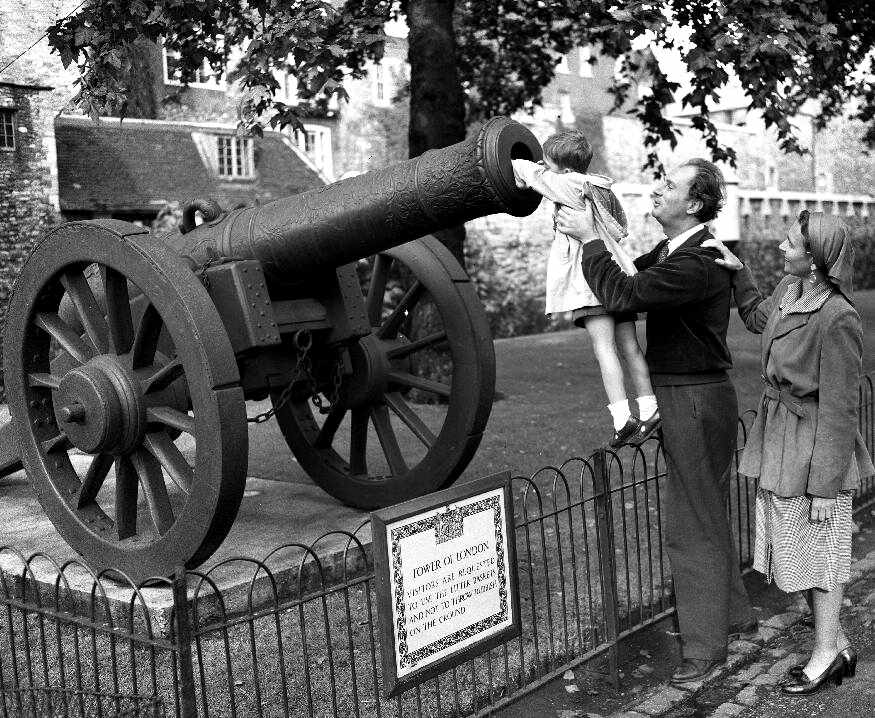
Figure 1.--Gunpowder like many important early inventions was a Chinese achievenment, probably before the 5th century AD), but never fully developed for major military weaponry. Gunpowder reached Europe (13th century), although early weapons were as dangerous to the gunners as the intendeded targets. Europeans did develop increasingly lethal weaponry which by the 16th century were having a huge impact and one not limited to military conflicts. Cannon ans muskets essentially ended the Feudal system. Canon could demolish the castles of feudal lords and a musket fired by a minimally trained musketter coukd defeat a highly trained and armored knight. Cannon helped dfeat the Arab naval forces that controlled the Arabian Sea, opening Euroipoean trade with the East. Cannon and muskets played an important role in the Soanish conquest of massive Native Americn aemies. And English mastery oi cannoery played a role in the defeat of the Spnish Armada and the foundation of global naval power. The failure of the Ottomans and Arabs to pursue modern secular movements, especially science, would mean that they unable to compete in the development of cannoins and other modern arms. Here little Martin Kubelicks sticks his hand into an eary cannon during a trip to the Tower of London (1951).
The 16th century in many ways can be seen as the beginning of the modern era. The Renaissance which had begun in Italy during the 14th century had reached most of Europe by the 16th century meaning that the new humanist outlook was now percolating throughout Europe. This meant the end of Feudalism and the Medieval era. And the science which accoimpanied it was having a major impact, in part throiugh increasingly effective weaponry such as muskets and cannons. These changes were amplified by the Protestant Reformation launched by Martin Luther (1517). The Reformation emphasized the individual responsibility and thus amplified the humanist outlook of the Renaissance. The European voyages of discovery begun in the 15th century result in major discoveries throught the 16th century. The Protestant Refornation and Catholic Counter Reformation would usher in a series of bloody religious wars that wouls conginue into the 17th century. Spanish Conquistadores wept through Mexico and Peru. The Spanish carved out a colonial Empire in the Americas and vast uantities of gold and silvr flowed into Spain. The bullion was what caught popular attention, but in the long run it was humble crops like potatos and corn that had an even greter long term impact. This helped make Spain the most powerful country in Europe. The Spanish use thos power to break Ottomon naval power. The Austrians stoped the advance of the Ottomons and Islm in Europe. The Spanish also attempted to use their power to supress the Reformation and Protestant states. The Spanish Inquisition successfully supressed questioining minds in Spain itself, but the Dutch Protestants held out in the Low Lands and the English defeated the Great Armada (1588). The Spanish defeat not only preserved the independence of England, but made possible the English settlment of North America.
Habsburg-Valois Italian Wars (1494-1559)
The Italian Wars are often referred to as the Habsburg-Valois Wars. Historians often refer to this as the beginning of modern history. As the time frame included the Reformation, this seems a reasonable assessment.
Italy was the major theater of operations. It was an on-again off-again series of conflicts between the the Austrian Hapsburgs and French Valois. The war widebned when he Hapsburgs inherited the Spanish crown under Charles V. Austria, France, and Spain were the major continental powers. And the instsability of Italy and many small principalities resulted in the Italian Pemimsula becoming the focus of competition between these powers. The wars involved most of the Italian states including the Papacy. King Charles VIII of France (1483–98) launched the conflict by invading Italy (1494). He capured Naples o the south (March 1495). The French artillery made a powerful impression, not only because of its effectiveness, but because of its mobility. Charles' invasion was also notable for the brutality, including several notable masacres of civilians.
The great European voyages of discovery of the 15th and 16th centuries were fundamentally economic enterprises. They were conducted by the European countries of the Atlantic coasts to establish direct trade contacts with China and the Spice Islands (Indonesia) that was being blocked by Byzantium/Venice and the Arabs. At the time, trade in silk, porcelin, and spices from the East carried over the Silk Road had to pass through Turkish, Arab, Byzantine, and Italian middleman, making them enormously expensive. The crusaders failed to break the Islamic wall separating still primitive Europe from the riches of the East. Circumventing the land Silk Road and the sea Spice Route would have profound economic consequences for Europe and the world. The ballance of power would shift from Eastern to Western Europe and eventualkly to northern Europe. Two nations led the early explorarions in the 15th century--Spain and Portugal. These two countries pioneered the sea routes that would lead Europeans to Asia and the Americas, but the Dutch, English, and French were to follow in the 16th century.
Portuguese-Arab Naval Wars (1498-1509)
The Portuguese rounding of the Cape of Good Hope was only the first step in initiating direct trade with the East. The mext step was overcoming Arab naval power. The Arabs had dominated the Indian Ocean and wider Indian Ocean since the Islamic outburst (8th century). This lead to the climatic battle of Diu (1509). Domination of the Arabian Sea meant that the Arabs controlled the lucrative commerce with the Orient. The battle was fought near the port of Diu, India. The Portuguese fought a combined fleet of the Mamlûk Burji Sultanate of Egypt, the Zamorin of Calicut and the Sultan of Gujarat. The Portuguese had technical maritime support from the Republic of Venice and the Republic of Ragusa (Dubrovnik). In some historical accounts, the battle is referred to as the Second Battle of Chaul. Diu was of great historical significance because it ended the Arab monopoly on the Indian Ocean. It was the beginning of European naval dominance in Asia. It also opened a new front in the centuries old struggle between Christian and Muslim powers. The new front was of emense strategic importance. Dominance of the Indian Ocean controlled trade with Asia, not only India, but the Spice Islands and China as well. The wealth resulting from this trade had for centuries strengrhened Muslim firces in conflict with Christian powers. Diu was the beginning of Portuguese domination of the Indian Ocean and made possible the development of the Portuguese Empire. The Portuguese victory was made possible by the increasing European technological advances and the failure of the Arabs and OIttomons to promote modern science and other secular thought unrestrained by religious orthodoxy.
English Scottish Wars
The centuries of military conflict between Scotland and England continued in the 16th century, primarily in the borderlands. The Scottish victory in the of Battle of Sark (1448) placed the Scotts in a more adfvatageous position than they held for decades. It also raised Clan Douglas to condiderable prominance. King Henry VIII declared war on France (1512). This was part of the larger War of the League of Cambrai. Scotland's King James IV was married to Henry's sister Matgaret--a matter of considerable future dynastic importabce. Even so, he honored a treaty of alliance with France. James impetuously followed preliminary border raids with an actual invasion of England. Scottish artillery reduced Norham and Wark. James was nothing if not chivalrous. He issued a challenge to the English army commanded by the Earl of Surrey and await him. The not so chivalrous Surrey manoeuvred his army around the Scottish rear and attacked. The result was one of the most disastrous engagements in Scottish military history--the Battle of Flodden Field. Not only was James IV killed, but also many of his nobles and gentry, often described as the "Flower of Scotland". Scootish King James V renewed the war with England (1541). Again border skirmishes were followed by another Scottish invasion. Poor Scottish leadership led to another led to another serious Scottish defeat-- Solway Moss (1542). The armies meet again at Pinkie Cleugh fought outside Musselburgh (east of Edinburgh (1547). The English army was led by Edward Seymour, Duke of Somerset, who aa regent sought to win a Scottish bride by force for his leige lord, the 9-year-old King Edward VI. The Scotts foiled his plan by by getting the young Queen Mary Stuart off the France, ruining English hopes of unifying the English and Scottish crowns--at least for several decades. Little noticed at the time was Mary's dynastic link to the English crown. Pinkie Cleugh is one of the lesser known English-Scottish battles, but military historians regard it as the first 'modern' battle in the British Isles. It features combined arms, sipporting actions among infantry, artillery and cavalry and even a naval bombardment. In addition to the more publicized wars, the English-cottish relationship was further complicated by The increasing Scottish settlement in north east Ulster. It began on a nall scale as early as the 14th cedntury, but intenified in the first half of the 16th century and by this time as aresult of the Reformation, the settlers were Protestants.
The Conquest of Mexico and Peru (1519-36)
The voyages of Columbus and the other European Voyages of Discovery had profound consequences for both Europe and the world. Following on Columbus' voyages, Spain rapidly beagan estalishing colonies. At first Columbus and the Spanish did not realize that they had chanced upon an entirely new continent--the Americas. They thought it ws India and thus called it the Indies and the Caribbean Islands have become known to us as the West Indies. Spanish colonization was at first in the Caribbean and extrodinarily brutal. The native Americans on the islands were for the most part exterminated. Next the Spanish looked to the mainland where rumors described natin American civilizations of vast wealth. This led to Diego Cortez's Conquest of Mexico. The Maya in the south proved more difficult to subdue, in part because there was no centralized empire. Balboa had earlier found the Pacific across the Istmus of Panama. This led to Francisco Pizarro's Conquest of Peru. The gold and silver flowing from the Americas made Spain a European super-power and financed the Great Armada. The most significantimpact of the conquests, however, may well have been the introduction of the humble potato to Europe fom Peru.
The Protestan Revolution was the religious struggle during the 16th and 17th century which began as an effort to reform the Catholic Church and ended with the splintering of the Western Christendom into the Catholic and Protestant churches. Combined with the Renaissance which preceeded it, the reformatuin marked the end of the Medieval world and the beginning of a modern world view. The French Revolution which followed the Reformation in the 18th century marked the beginning of our modern age. Conditions developing in Medieval Europe laid the groundwork for the Reformation. The Reformation began when a German monk, Martin Luthur nailed his 95 Thesis on the church door in Wittenburg (1517). Luthur was offended by the papal sale of indulgences by which the Renaissance popes were fiancing the splendid new church of St. Peters in Rome. Luthur's concern with indulgences were soon intertwined with a complex mix of doctrinal, political, economic, and cultural issues that would take European Church and temporal leaders nearly two centuries to partially resolve and lead to devestating wars, especially the Thirty Years War in Germany. Western Christendom would be left permanently split and even the Cathloic Church profoundly changed. Changes in man's view of himself and the Church were to also affect his view relative to the state and many in Europe began to question royal absolutism and divinreright monarchy, a process leading to the French Revolution.
Mogual Invasion of India (1522-26)
The Delhi Sultanate dominated most of Northern India. India was aland of fabulous riches. The and Turkic raiders strick into nothern India. but did not displase the Sultanate. Timur also known as Tamberlain sacked Delhi, effectiveled ending the Sultanate (1398). No powerful central authority replaced it. Timur died (1405). The Mongols lost control of northern India. Local Muslim leaders formed small states in northern India. Babur, a great-great-great-grandson of Timur and a military adventurer. He tried to seize Samarkand on the DSilkRod, but was defeted. He seized Kabul (1504). He decided to conquer the area Timur had raided in northern India (1504). His army had advanced gunpowder weapons and captured Delhi (1526). Babur founded the Mughal Empire-- Mughal is actually just an Indian spelling of Mongol, but by this time the old Mongol Empire founded by Genhis had declined and was divided into khanates. This was about the same timre that the Europeans had reached the Indian Oceana and began trading with India.
German Peasant Wars (1524-25)
The German Peasant War (Deutscher Bauernkrieg) was the rebellion of agrarian peasants including many serfs in the southern and central parts of the German states of the Holy Roman Empireagainst their aristocratic land owners. As the peasants marched on towns and cities, the urban poor often joined the revolution. The feudal system in Western Europevwas in decline. Theoretical the feudal was a system of mutual responsibility and benefits among the populaion from the monarchy down to the peasantry including the serfs. The kings and princes of the Holy Roman Empire were attempting to create nation states and independence from he Holy Roman Emperor. The aristocracy was attempting to gain nmore control over their estates which meant more forcibly binding the peasantry to the land and increasinf labor services (the coevée). The peasants were attempting to maintain some of their feudal protections, but to also increase their ability to tke advantages of the increasing economic opportunities made possible by the economic changes. The Reformation set in motion new ideas including resistance to authority. A substantial segment of the German peasantry was attracted to Luther's idea, but perhaps more for economic than theological reasons. If the authority of the established Roman Catholic Church could be questioned, the logical corollary was that established state power could also be questioned. Actual revolts occured in 1524. Luther was at first sympathetic urging the aristocratic and clerical landlords to meet the peasant demand for emancipation from feudal services. He soon turned against the peasants because he did want his theological issues mixed in with a radical call for social reform. He wrote a classic pamflet, 'Against the Murdering, Thieving Hordes of Peasants'. The peasants failed because of the aristocracy was better armed and more organized. Ultimately some 100,000-300,000 peasants were slaughtered as the rebellion was put down. The peasants were suppressed, in part by the same Imperial forces (1525).
Philip II of Spain proclaimed himself as the leader of the Counter Reformation. Philip was determined not only to rule their inherited territories, but to use the the power he inherited to turn back the Reformation. Philip used the powers of the Spanish state to enforce political absolutism and persue the Counter-Reformation. The gold and silvr from the America's along with the income from his realm gave Philip the wealth to aggressively pursue the Counter Reformation and the destruction of OProtestantism. Although Philip began his reign without a major European power oposing Spain, his policies involved Spain in wars throughout Europe in the Netherlands, Portugal, England, Italy, and France. In assessing these cnflicts its difficult to determine to what extent they were affected by the religious zeal of the Counter Reformation and that of Spanish national expansionism.
The English reconquest of Ireland began under King Henry VIII and continued by other Tudor monarchs, especially Elizabeth. At the onset of the reconquest, English control was limited to the Pale--a small area around Dublin. Silken Thomas, the Earl of Kildare, led a rebellion against King Henry (1530s). It failed, but Henry decided to punish the Irish. Henry had himself declared King of Ireland by the Parliament of Ireland. King Henrywas determined to restore English control which had gradually been lost after the Norman conquest. Henry's project was continued by his successors, including Catholic Queen Mary. Henry and his successors used both conciliation and repression. The English conquest was not just a military campaign. The Tudors unlike the Normans began to impose English law, language, and culture. And there was an effort to impose the English Church (Anglicanism) as the state religion. The Irish found themselves caught between their widespread support for the Catholic Church and Papacy the demands of the Tudor monarchy for loyalty. Religion oroved to be the only area in which the Irish succesfully reisted. The Irish received some foreign support. The Spanish Empire intervened during the Anglo-Spanish War which culminated with the Spanish Armada. Queen Mary atempted to make England Catholic again. And her edicts repealing anti-Catholic laws were well received in Ireland. But Mary did not treat her co-religionists any more kindly than her preecesors. She ordered an English army into the Pale and seized counties Laois and Offaly, just west west of Dublin (1556). This was not just and, grab, but an act of ethnic cleanings. She ordered the removal of the Irish population. The land was turned ivr to Catholic English settlers. The dispossed Irish fought back for some 50 years. Queen Elizabeth I came to the English throne (1558). Herreligious settlement finalized the character of the Church if England with many Protestant reforms. It was during Elizabeth's reign that the process of founding Englih colonies in North america begn, but with little success. Ireland seemed a more accessable territory to colonize. It was closer and had manyb similiar characteristics to England. The Irish Catholic aristocracy was unwilling to accept the sovereignty of Queen Elizabeth beyond the Pale. The O'Neills of Tyrone attacked, but were efeated (1561). Revolts by the FitzGeralds of Cork and Kerry were supressed (1575 and 1580). Queen Elizabeth took advantage of the defeat of the FitzGeralds in Cork and began what was called a plantation in Munster. Protestants settled in what had been FitzGerald land. The plantation proved successful, towns developed and the colony prospered (1587). The Irish struck back, destroying the colony (1598). Elizabeth died a few years later. By this time, however, the Tudor conquest was almost complete. All of Ireland came under control of James I (1603). The country was governed by a privy council at Dublin. The Tudors largely destroyed Gaelic Ireland as a political structure.
War of the Schmalkaldic League (1546-47)
The War of the Schmalkaldic League followed the spread of the Reformation in Germany. It pitted France against the German Protestant estates. It was a response to the threat of Holy Roman Emperor Charles V vowed to stamp out Protestantism in Germany (Lutheranism) (1530). The Schmalkaldic League was an alliance formed at the German city of Schmalkalden in respmse to Charle's threat (1531). It was forned by the Protestant princes and the representatives of free Protestan cities. The League was led by Philip of Hesse and John Frederick I of Saxony and grew rapidly. The protection in aforded Protestants permitted the Reformation to become well-established, especially in morthern Germany. The issues involved more than religion, but were part of a long-estanlished effort of German princes to create autonomous states within the Empire. Charles initiated what became known as the Schmalkaldic War to both countrr the clsims of autonomy/independemce and to restablish the unity of Western Christendom under the Roman Catholic Church. Charles' forces gained a major victory over the League at the battle of Mühlberg (1547). By this time, however, the Lutherns had become well estanlished in northern Germany.
Livonian War (1558-63)
The Livonian War was an extended military engagement between Tsarist of Russia and a coalitions of northern European states including Denmark, Grand Duchy of Lithuania, Kingdom of Poland (becoming the Polish-Lithuanian Commonwealth), and Sweden over control of Greater Livonia. (Livonia was what is modern Estonia and Latvia). The Reformation and Counter-Reformation had caused internal conflicts in the German Livonian Confederation just as it was in Germany itself. Livonia in the 16th century as a result of the Crusading Teutonic orders and the Hanseatic League was largely controlled by Germans. The Livonian Confederation was a loose alliance of feudal lords led by the Livonian Order of the Teutonic Knights. The Livonian War could be desribed as largely a frontier conflict between two cultural areas, Protestant Scandinavian and Orthodox Russian. The Baltic people not for the first or last time were caught in the middle as the fighting raged. What was at stake was not only about resorces, but also Russian access to the Baltic. After 5 years of war, most of Livonia was controlled by Catholic Poland-Lithuania. The exception was northern Estonia which Sweden seized. A cebtury and ahalf later Tsarist Russia would conquer the areaa in the Great Northern War.
Ottoman Challenge
The Ottomans were one of the great European empires. Like the Russians their empire straddled Europe and Asia. Christianity tied the Russians to Europe and the West. Islam tied the Ottomans to the East and Asia. It also insulated the Ottomans from both the effects if the Renaissance and Reformatiin which played such an important role in the making of the Western mind and modern Europe. Byzantium had been the major bulwark between the Ottomans and Europe. The Ottonans has penetrated into the Balkans (14th cenntury). It was not until they took Constantinople, however, that they could direct the full force of their armies north (1458). Soon Serbia and other Christian kingdoms in the Balkans fell and finally so did Hungary. The Austrians with the help of a Polish army held out in Vienna. The Ottomon failure to support scientific inquiry, however, meant that could not contunue to compete with the rising European states and their modrn weaoponry. The Spanish smashed Ottomon naval power in both the Indian Ocean and Mediterranean Sea. The key engagement was the Battle of Lepanto where the Spanish and Italians defeat the Ottoman navy (1571). Superior European cannonery was a major factor. This was the beginning of a long period of Ottoman decline.
Dano-Swedish War (1563-70)
Norway, Denmark, and Sweden were the three kingdoms of the Kalmar Union. Sweden objected to Denmark's continued use of the Trekronor coat of arms. Swedish claimed the large island of Gotland west of Sweden was still held by Denmrk, Efforts at negotiation failed. Swedish King Gustavus I. Vasa died (1560). He was suceed by his son Erik XIV who declared war on Denmark (1563). a Danish force took Älvsborg on the Jutland Peninsula which was Sweden's only North Sea stronghold (September 1563). A Danish fleet defeated a Swedish fleet in an engagement fought between between Øland and Gotland (May 1564). A small Sanish army defeated a Swedish army (1565). This was the last important engsgement of the War. King Erik XIV was deposed due to insanity (1568). The two countries signed a peace treaty (1571). The Danes returned Älvsborg to Sweden which paid 150,000 Dalers in compensation. Both countries had local allies. Denmark was allied with Lübeck (a Grman Hanseatic port) and with Poland. Sweden at the time was expanding along the southern Baltic coast. It seized trrotory in Estonia (1561). And while fighting Denmark were also contenting with the Poles over Livonia (part of modern Latvia) (1563-70). After King Erik XIV was deposed. his brother Johan relpaced him As he was married to a Polish princess, the war with Poland essentially was over. The major impact of the War was to interrupt the Baltic grain trade. Substantial shipments of grain were shipped from Danzig to the Netherlands which was not self sufficent in food poroduction. This resulted in a famine in the Netherlands. Denmark continued to control the Sound and trade routes between the North Sea and Baltic. This meant that the Danes controlled the Russia trade. Denmark's ability to control trade between the North Sea and Baltic mean that Sweden viewed the Danes as a potential threat.
Russo-Polish Wars: The First Northern War (1563-82)
The Reformation reached Livonia (a part of modern Latvia) and other areas in the Baltic during the 1520s. Livonia formally declared for the the Lutheran confession (1558). This undercut the authority of both the Livonian Order and the Livonian bishoprics. The Livonian Order had been declining for decades and by the 1560s no longer had the ability to defend the principality. Tsar Ivan IV (the Terrible) invased Livonia (1558), exposing the weakness of the Livonian Order. Livonia disintegrated. Parts of Livonia appealed for assistance from Poland- Lithuania. This brouht Poland-Lithuania into conflict with Russia. For a time a truce prevented opened warfare.
Ivan IV refused to extend the truce (1562). A Russian army appeared off Polock which was forced to surrender (February 15, 1563). A truce was negotited which lasted for several months (until December). Sweden signed an alliance with Russia, Poland sined an alliance with Denmark. The war is sometimes called the First Northern War. It was fought on three fronts. First, was along the the Dano-Swedish border. This fisghting it also referred to as the Dano-Swedish War (1563-70). Second, was in Livonia and refered tonas the Livonisan War (1558-82). Third, was fighting in Lithuania, often called the Russo-Polish War (1563-1570). A Lithuanian army commanded by Prince Nicholas Radziwill inflicted two winter defeats on the Russian forces (January and February 1564). Ivan's military commander in Lithuania Prince Andrey Kurbski defected to the Lithuanians. The Poles and Russians negotiated a peace (1570). Russia maintaned its hold on Polock. The Sejm decided that Pollock had to be retrived frim the Russians. Polish troops retook Polock (1579). Another peace treaty was negotiated (1582). Ivan IV. ceded all of Livonia and Polock. In exchage, Poland-Lithuania returned Smolensk which it had recently seized. The War shattered the balance of power in the eastern Baltic. The implosion of Livonia had created a power vacuume. This was exacerbated by the rise of Russia under a strong monarchy. A factor here was Englih deliveries of gunpowder through the port of Archangelsk. This exposed both Livonia and Lithuania to increasingly powerful Russian armies. Andisolated cities were less able to withsand major seiges. Neither Lithusanisa or Poland had a stroing standing army and mobilzing forces required time. A major result was the Union of Lublin which forged a stronger union between Poland and Lithuania. This left Poland in nominal control of much of the Baltics, including Lithuania and what is now Latvia (Courland, Riga and Livonia).
The French religious wars began with the First Huguenot War (1562-63). The percecution and religious intolerance on the part of many Cathloics resulted in reprisals from the the Protestants. The result was a civil war in France. Catholics under de Guise slew some 1,200 Huguenots at Vassy (1562). This ignited the the Wars of Religion which would last three decades and devestate the country. There were eight outbreaks of fighting separated by formal peace treaties. There was open war, attrocities. brutal acys, assainations, trachery and other acts during the civil war (1562-98). The Huguenot forces were led by Louis I de Boubon Prince de Condé and Admiral Gaspard de Coligny and later Henry de Navarre (Henry IV). The Catholic forces were led by Duc de Guise (Henry I de Lorraine) and Catherine de Médicis and later by Henry III. As in Germany, foreign troops were involved in the fighting. Soldiers from England, Germany, and Switzerland. The Catholics were supported by primarily by Spain. The treaties that end the various outbreaks granted the huguenots various levels of toleration. Afterwards the French royal Government attempted to repudiate or ignore these pledges resulting in renewerd hostilities. The essential problem was both the intolerance of the time and the conviction on the part of Catholic monarchs that Protestants would not be loyal, fully trusted subjects. The Wars were not finally ended until Henry of Navarre converted and finall was ceowned as Henry IV and subsequently issued the Edict of Nantes.
Spain and the northern provinces of the Netherlands negotiated a 12-year truce (1609-21). Spain was preparinfg a new offensive against the Dutch when the truce ended. The problem for Spain was how to support military operations in the low countries. The rise of a Dutch navy made it difficult to send troops and provisions by sea. Reach the Dutch by land was also difficult. France stood between Spain and the Netherlands. And the French were not about to permit Spanish troops to pass through their country. It suited French purposes at the time to have an independent Netherlands even though they were Protestant. Thus the Spanish would have to send their forces along a circuitous route from Spain to Italy by sea and then through the Alpine passes to the the Rhine River Valley. The Rhine than led to the Dutch. This was a very difficult march for any body of troops and needed equipment and supplies, especially given the nature of roads at the time. The key to the route was the Rhineland. This was a contested area. The Spanish hoped to acquire Alsace which Ferdinand had promissed for supporting his imperial candidacy.
Anglo-Spanish War (1585-1604)
The Anglo–Spanish War (1585–1604) was an intermittently waged conflict between the Spain and English kingdoms undr Philip II nd Elizabeth I. Relations between England and Spain began to deteriorate after the death of Queen Mary (1558) who Philip had married. The war which was never fully dclared was fought with a backdrop of the Spanish Main and treasure ships, the Sea Dogs, the Reformation and Counter Reformation, and the Dutch War for Independence across the Channel. The War persisted for three decades on land and sea with widely separated battles. The War began when Qyeen Elizabeth apprived a military expedition
commanded by the Earl of Leicester to support Dutch Protestant resistance to Habsburg rule and the imposition of Catholocism (1585). The English achieved important naval victories at Cádiz (1587) and the Spanish Armada (1588). The English then began to suffer defeats thenselves, beginning with defeat of the English Armada (1589) and the Drake–Hawkins and Essex–Raleigh expeditions (1595 and 1597). The Spanish dispatched two additional armadas (1596 and 1597), but achieved little because if adverse weather conditions. The war bogged down after the turn of the 17th century as a result of costly campaigns in Brittany and Ireland. The War ended with the Treaty of London (1604). New monarchs (Philip III and James I) saw no purpose in cintinuing the coitly wars. The English agreed to cease its military interventions in the Spanish Netherlands and the Spanish agreed to stop meddling in Ireland. The English also agreed to cease the high seas privateering that Elizabeth had found so profitable.
English audacity and technology at sea laid the groundwork for the Royal Navy and command of the seas. Sir Francis Drake, Sir John Hawkins ,
and the other "Sea Dogs" bedelved the Spanish treasure fleet with Queen Elizabeth as a secret partner. The English then formed overseas trading companies and very modest colonization attempts were made in the Caribbean and North America by Sir Humphrey Gilbert and Sir Walter Raleigh. The long conflict with Spain was rooted in an English hunger for Spanish treasure and a commercial and maritime rivalry, but Philip II's desire to destroy the Reformation in the Netherlands and England was also a very important factor. This struggle culminated in Philip's decession to build a Great Armada. Spain in the 16th century was the preminent international power. The Spain as a result of the Reconquista had buily a powerful military capability. Spain and Portugal at the time had colonized or claimed of the known world and huge quantities of gold and silver flowed into Spain from its American colonies. This enabled Spain to build a hugenavy to maintain its colonial dominions. Phillip was a devout Catholic and determined to destroy the Protestant Revolution in his domanins in the Netherlands and to do the same in England. The depredations of the Sea Dogs had convinced him that he must act against England. He built at great cost an "Invincible Armada" of 125 ships which would link up with the Duke of Parma's army already deployed in the Spanish Netherlands to destroy Protestantism. The Armada would then be used to ferry the Duke's army across the Channel to England where it would march on London and seize the Queen. England would then be brought back to the True Faith at the point of Spanish swords. The Armada was placed under the command of the Duke of Medina Sedonia, a nobelman of limited naval experience. The Armada sailed in late May 1588 and reached the Southwest coast of England on July 19. Limited engagements were fought by Lord Howard and Francis Drake who commanded the English fleet. The more manueverable English vessels harassed the Spanish, using superior cannonery tomdamage several vessels and actually capturing one vessel. The Armada anchored at Calais, but found that the Duke of Parma and his army was not yet there. The English set fire-ships at the Spanish (July 28). Little actual damage was done, but the Spanish scattered to avoid the preceived danger. The principal engagement occurred at Gravelines and in an 8-hour running engagement, many Spanish ships destroyed or damaged (July 29). The Commander of the Armada, the Duke of Medina Sedonia, fearing defeat decided not to invade and return to Spain. The prevailing winds forced him to take a northerly route into the North Sea anfd around Scotland and Ireland. The English pursued the Spanish for 3 days, but returned to port when they exhausted their ammunition. Much more damage, however, was done by storms in the North Sea andd floundered in the coasts of Scotland and Ireland. Only a small number of Spanish ships managed to reach Spanish ports. The destruction of Philip's Grreat Armada was a pivital turning point in history. Spanish naval power was ebbing despite the flow if gold and silver from the America. Britain was beginning its rise as a great naval power.
The Wars of the League (1589-98)
The War of the Three Henries (1585-89) was a struggle for the French crown. King Henry III succeeded Charles IX (1574). Henry III was childless, leaving his brother Francis, Duke of Alençon, as heir. When Francis died, Henry III was forced to recognize Henri of Navarra as his legitimate heir. Henri of Navarra was, however a protestant. Henri was able to draw the more moderate Catholics into his camp who were willing to accept the idea of a protestant king. The Catholic League was determined to resist and they were supported by Spain. Henri confronted the League militarily. He defeated the League forces commanded by the Duke of Mayenne at Arques (1589) and subsequently at the Battle of Ivry (1590). Henri gained control of Normandy, but the League controled Paris and control of the capital was vital for any French monarch. Henri was militarily dominant, but his force proved to small to breach the city's defenses. Henri laid siege to Paris. The people of Paris sufferred terribly and the city was near capitulation. Finally a Spanish force under the Duke of Parma, Alessandro Farnese, msarched on Paris from the Netherlands. he Spanish suceeded in breaking the seige. They brought in food and other supplies and stationed a garrison there. Parma conducted a second expedition toward Paris (1592). The League-dominated Estates General met in Paris to chose a Catholic candidate for the throne (1593). They ignored Henri's claim. Finally recognizing that he could not take the capital with the Spanish there, King Henri converted to Catholicism (1594). He is reported famously to have said, "Paris is worth a mass." The capital tired of war, seige, and the Spanish, through open ther gates of the city to him. the Spanish garrison departed. King Henri IV proved to be a wise leader. He was not revenful to his former opponents and drew many into his camp. Some resistance continued in the provinces. The most troubelsome area was in the north in the border regions with the Spanish-controlled Lowlands (modern Belgium and the the Netherlands) where they were able to obtain support from the Spanish. Royalis forces finally took Cambrai and Calais (1595-96). The League leader Mayenne surrendered (1596) and most of the lords of he League followed him. The Spanish suceeded in taking Amiens (1597). The Peace of Vervins signed by France and Spain finally brought the Wars of the League to an end (1598).
Japanese-Korean War (1592-99)
The Japanese attempted twice to conquer Korea at the end of the 16th century. Shogun Toyotomi Hideyoshi after unifying Japan and ending destructive fighting between feudal lords led the first Japanese invasion force (1592). The famed Shogun's unification of Japan has achieved some attention from Western historians. His invasion of Korea has been less well reported. The Shogun's gradiose goal lay far behond the Korean Peninsula and included building a vast Eastern Asia empire. This mean ultimately conquering China. Korea proved, however, to be a sturdy impediment. The Japanese invasions are also known as Hideyoshi's invasions of Korea, the Seven Year War, and the Imjin War. Most of the major battles occurred in the first years of the War. The Koreans suffered early defeats as the Japanese landed on the peninsula. Korean forces aided by irregular formations and an army sent by Ming China stoped the Japanese.
The war included one of the most remarkable victory against all odds--the Battle of Myeongnyang. Koream Admiral Yi Sun Shin, with a mere 13 ships attacked a Japanese fleet of 133 ships, a act of seemingly foolhardy bravery. Miraculously the Josen Navy destroyed the Japanese fleet. Yi as a result is sometimes called the Admiral Nelson of the East and is considered one of Korea's greatest national heroes. His statue dominates Gwanghwamun square in Seoul.
The land campaign was extremely brutal with extensive hand-to-hand combat and epic butchery. A single burial mound in Kyoto, Japan contains the sliced-off noses of 30,000 Korean and Chinese victims brought back to Japan as a voctory trophy. The second Japanese invasion was invasion had much more limited objectives (1594). It was essentially a retaliatory action. The Japanese effort, however, did not finally end until Hideyoshi's died (1598).
Tyrone's Rebellion in Ireland (1596-1603)
England's Queen Elizabeth I was cautious on religious matters, understanding the threats to the crown. King Philip II and Catholic Europe tatgeted her in an effortvto return England to the Catholic faith. She was moderate in her treatment of Catholics and suceeded in convincing most to join the Anglian confession of the reformed Church of England. Scotland to the north was even more Protestant. Ireland remained, however, staunchly Catholic. Trouble for Elizabeth was fomented by the Catholic Church and Philip in Ireland. Having failed in England, fomenting rebellion in Catholic Ireland seemed the weakest point to attack Elizabeth. A small Spanish expedition lent support to the Desmond Rebellion (1579-83). The Spanish Armada sought to land a huge Spanish army in England (1588). Elizabeth also seeing Ireland as her weak point sought to reduce the power of the Catholic Irish lords. Elizabeth established the first English Protestant settlements in Ireland at Monaghan (1591). This was a firect threat to the Catholic lords. Hugh O'Neill, Earl of Tyrone, decided to defy Elizabeth an ally himself with the Spanish, He also settled affairs with his long time rival, Robert O'Donnell. The two became the main Irish leaders in Tyrone's Rebellion (1594-1603). They achieved some early successes. They manage to overwealm seceral English castles. There most impotant victory was at Yellow Ford giving them control of Ulster in the north (1598). The Spanish landed a small force at Kinsale in Cork--the extreme south of Ireland (1601). The Spanish expedition was to support the rebellion. It is uncleared why they landed in the south. The Spanish could not advance inland because it faced a larger English force of 6,500 men commanded by Mountjoy. Hugh O'Neill led a rebel force of 12,000 men south to Cork in an effort to link up with the Spamish. O'Neill and Mounthoy's forced clashed at Kinsale (1601). The Spanish commanded by Don Juan del Aguila made no effort to support O'Neill. Mountjoy and the English emerged victorious and went on the offensice. They raided Ulster and established forts throughout Ulster. O'Neill accepted the Queen's pardon in return for laying down arms (1603). He thus permitted to hold his titles and lands. Elizabeth died soon after. King James I made peace with Spain. This meant the Irish no longer had a Spanish ally. James was aware that Catholic Ireland continued to represent a threat to the crown. He thus intensified the policy of Protestant settlement (Ulster Plantation).