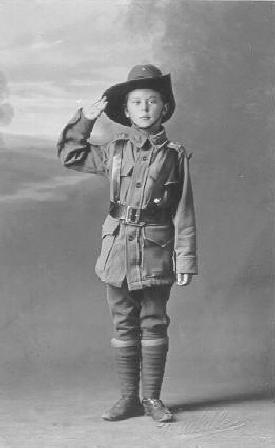
Figure 1.--This is a photo postcard showing a young Australian boy in full soldier's uniform and slouch hat, saluting for the camera. The back identifies him as Alfred Whiteman Hodges and "Leiutenant attached to the Staff of the 9th Battalion of the A.I.F., Enoggera, Queensland". I do not know if this is tounge in cheek, or whether he was a "mascot" for the battalion, but he obviouly was to young to join up. Photographer: Ruddles, Brisbane, Australia. The postcard is dated January 30, 1916.
World War I was the most costly war ever fought by Australia. Australia's population in 1914 was less than 5.0 million people, less than Belgium. Conscription proved to be highly controversial. Australians reacted to the outbreak of the War in Europe with a wave of enthusiam to support Britain. Over 0.4 million men enlisted. The Army set very demanding physical standards. The first Australian troops were deployed to Egypr to protect the Suez Cannal which was threaened after the Ottoman Empire joined the Central Powers. The Australians were rushed to Egypt with little military training. They were trained after arriving in Egypt. The Australians were used along with New Zealand, British, and French troops in the costly Gallipoli campaign (1915). After Gallipoli the Australian Imperial Force (AIF) was reorganised. Reinforcements arrive from Australia expanded the force from from two to five infantry divisions. The AIF was shifted to France, beginning in March 1916. There they participated in the bloody engagements on the Wstern Front. Caulties totaled 60,000 killed, four times that of Belgium where much of the War was fought. Another 156,000 men were wounded or captured.
Australia's modern history is largely an apendage of English history transplanted to Oceania. Australia was Europeanly settled in 1788. Britain established Australia as a penal colony. It developed in contrast to much of the rest of the Empire as a largely British populated colony. The level of immigration increased in the 19th century after the end of the Napoleonic Wars in Europe. Australia developed as several separate colonies. And as a result of the experience wuth the First Empire in North America, the British allowed Australia and the other developing Dominions to develop self government. Four colonies of Australia (New South Wales, Victoria, Tasmania, and South Australia) were self gioverning in domestic affairs (mid-19th century). Queensland was founded later, but was quickly self governing. Western Australia waa slower to develop self governing institutions, partially due to financial dependence on Britain. As aresultvitvwas the last of the Australian colonies to achieve self-government (1890). The colonies than moved to unite inti a single Dominion (1890s). This was achieved at the turn of the 20th century. The individual colonies were federated under the British Crown as the Commonwealth of Australia by the Commonwealth of Australia Constitution Act (1901). Australians than drafted the Constitution of Australia which was approved in a national referendum. Thus Australia was beginning to move toward independence, but the population still largely considered themselves to be British rather than Australians. Australia's population in 1914 was only about 5.0 million people, less than Belgium. It was thus thinly spread around the vast Australian sub-continent. The Germans as they contemplated war gave no weight to Australia and the other Dominions, let alone the United States. They considered cthecFrench and Russian Army and believed even the British woukd notvbe able to deply an expeditionary force before their armies had swept into Paris. While it woukd be up to the French to stop the Germans on the Marne, Australia and the other Dominions would play very important roles in both world wars. After World War I, however, more and more Australians would begin to think of themselves as Aussies rather than English.
Austria-Hungary was determined to punish Serbia for the assaination of Archduke Franz Ferdinand. When Austria-Hungary with German backing declared war on Serbia, Russia was committed to defend the Serbs--fellow Slavs. Kaiser Wilhelm and Tsar Nicholas exchanged telegrams, but ther personal relationship could not restrain the developing tragedy. The Tsar ordered a mobilization. France also began to mobilize its troops. Russia had the largest army in Europe and once moibilized posed a forbidable danger to Germany. Germany thus felt impelled to strike at France before Russia could mobilize. Germany declaring war on Russia (August 1) and France (August 3). The strike at France followed the Schlieffen Plan which meant invading Belgium. German armies crossed the Belgian birder (Aufudy 4). This brought Britain, which had treaty obligations to Belgium, into the War. Britain may have entered the War with out Germany invasion of Belgium, but the invasion provided both the causus bellum and popular support for war. Germany's decession to support Austria's desire to punish Serbia turned a Balkans crisis into a major European war. Germany probably would have prevailed in a war with France and Russia. The invasion of Belgium provided tactical advantages, but at the cost of brining Britain and the Empire with its immenense military and material resources into the War.
Declaration of War
As war clouds developed in Europe, opposition Leader Andrew Fisher (Australian Labour Party -- ALP) delivered a
an election speech at Colac in Victoria. He insisted that �should the worst happen, after everything has been done that honour will permit, Australians will stand beside the mother country to help and defend her to our last man and our last shilling� (July 31, 1914). Only a few days later, after Germany invaded Belgium, Britain declared war on Germany (August 4). The chain of events leading to the war was complex abd almost entirely European. Fisher or anyother Australian has any innkling of the War that the major powers rushed into. The Europeans had no idea so it would be diffucult to see hiw the Australians did. Australia would not fight to the last man and schling, but they would play an important part in the War and make major sacrifices to achieve the alied victory--the highest of any Imperial unit. The British Government at the time was responsible for the foreign policy of the empire, including declarations of war. As a result, when British Primeminister Herbert Asquith decided on war, there was no constitutional requirement that he consult any of the colonial governments, including the Dominions. The Australian Government�s role was only to decide the size of its military contribution to the Imperial forces. Australia�s constitutional independence from Britain was well understood and clearly establisged by law. The executive power of section 61 of the Australian Constitution is taken to include all the �prerogatives of the Crown under the English common law� including the power to make treaties with the governments of other countries and making war and peace. Even so, the Australian Government acceped the idea. That The British declaration of War automatically involved the entire Empire. And there was no opposition to this raised by the Australian Parliament at the time. [Curtis] The Australian Prime Minister at the time, Joseph Cook, declared, ""...when the Empire is at war, so also is Australia." One month later, Cook lost the cheduled election, but the War wa not the reason. The new Prime Minister Andrew Fisher reiterated that Australia would, "... stand beside the mother country to help and defend her to the last man and the last shilling."
Australian Interests
Several factors explain Australia's involvement. Many Australians still looked in Britain as 'Home" For many Australians it was if Australia itself had been attacked. Austrlia's security was based on Britain and the Royal Navy. The country did not have the capability if defending itself against a major power. Germany was no immediate threat to Australia, but to the extent that Britain was defeated or even weakened, Australia's security was affected. A Germany capable of invading a neutral Belgium was a lawless nation. The German Chancellor described treaties as mere scraps of paper. Having Germany emerge as the dominant world power was a potential security threat to British Empire countries like Australia. The Kaiser made no secret that he though Germany should have a larger Empire.
The Germans had colonies just north of Australia and they were building and expanding a High Sea Fleet. Australia's economy was based on trade with Britain. A German High Seas Fleet and U-boats were a threat to the sea lanes with Britain.
The major reason, however, was loyalty to the Mother Country. Involvement was, however, automatic as part of the Empire. There were few questions asked and actually there was a wave of popular support for Britain. Australia joined Britain again in 1939, but this time there was less enthusiasm as they knew what they were getting into. There was an act of Parliament .
The French success in stopping the Germans on the Marne was far more than a tacical victory (September 1914). It meant meant that the British and French would have time to marshall the ememse resources of their empires. This was especially true of the British. As a result, Australia and the other Domininions would play an important role in the War. And unlike the other Dominions, Canada was relatively close to Britain. Canadian would quickly join te British on the Western Front. As far as we can tell, this had not entered into the German calculation, to the extent they made a real calcultion beyond the immediate military campaign spelled out in the Schliffen Plan. The Germans were focused on a short, sharp victory as they achived in the Franco-Prussian War, and the y lmost suceeded. No real calculation was made to the consequences if they failed. While the Dominions had relatively small populations indvidually, when added together, the population was not inconsequential, they they commanded resources that gave the British economic power that the Germas could not match. And those resources were emense. While industrial development was still not substantial, although it had begin in Canada, manpower, financial, and agricultureal resources were substantial. And agriculture would prove a critical weakness in the German war effort. The Germans, confident of a quick victory, simply ignored the Empire--a mistake another generation would make again.
Public Opinion
Australians reacted to the outbreak of the War in Europe with a wave of enthusiam to support Britain. Over 0.4 million men enlisted. The Army at first set very demanding physical standards, turning down many volunteers. About 10�15% of the Australians who volunteered to serve overseas in 1914�18 had been born in Britain. Adding the number of volunteers who had one or two British parents, we probably have more than 50 percent. This give aood netric for the level of support for Britain..
The Pacific
An Australian Naval and Military Expeditionary Force landed on Neu Pommern (New Britain) which was part of German New Guinea (September 11, 1914).
Egypt
The first Australian troops were deployed to Egypr to protect the Suez Cannal which was threaened after the Ottoman Empire joined the Central Powers. The Australians were rushed Egypt with little military training. They were trained after arriving in Egypt.
Gallipoli (1915)
The Australians were used along with New Zealand, British, and French troops in the costly Gallipoli campaign (1915). The concept was to releave the Russians who at the time were ill equipped and suffering enormous losses. The Australians 4 1/2 months of training near Cairo, the Australians were transported by ship to Turkey. They were deploye on the Gallipoli peninsula, together with New Zealand units. The landings were made at ANZAC Cove (April 25, 1915). They gained the
steep slopes above the beach. Then the capaign became an Allied effort to break out and a Ottomon attemp to elinate the Allied beachhead.
The fighting turned into a costly stalemate continued throughout the remainder of 1915. Finally the Allies withdrew (December 19-20). The Allies might have done this earlier, but a withdrawing force was very vulnerable. The Allies executed a successful deception campaign and managd to evacuate with minimal casualties.
Austalian Imperial Force: The Western Front (1916-17)
After Gallipoli the Australian Imperial Force (AIF) was reorganised. Reinforcements arrive from Australia expanded the force from from two to five infantry divisions. The AIF was shifted to France, beginning in March 1916. The mounted (light horse) division remained in Egypt. The infantry noved to France participated in the bloody engagements on the Western Front. The Western Front had long bogged down into static, but costly trench warfare by the time the Australians arrived. The Australian infantry fought their first major engagement at Fromelles as part of the bloody British Somme offensive (July 1916). They took 5,533 casualties in 24 hours. By the end of 1916, the AIF suffered 42,270 casualties. The AIF in 1917 fought at Bullecourt, Messines and the four-month long campaign around Ypres (Passchendaele) suffering 76,836 casualties. These were enormous numbers for a country like Australia with a small population. Tthe Australian AIF troops (in addition to Gallipoli) were amongst the very best of the Allied soldiers on the Western Front. �Like the other Dominion divisions from Canada and New Zealand, the Australians were viewed as being among the best of the British forces in France." [Grey, p. 88.] This is why the British often used them to spearhead offensive operations. [Kuring, p. 89.]
Conscription
Australia entered the War as a Dominion as a result of British action and not by a domestic declaration of war. As in other countries, there was a first considerable patriotic enthusism for the war. The first Australian troops to enter the War were volunteers. Battlefield losses depleted Australian units. The Government as the war progressed had trouble enlisting adequate replacements to main Australian units at full strength. Prime Minister Hughes proposed conscription to raise the needed number of new recruits (1916). The existing Defence Act gave the Governmrnt the authority to to conscript men for military service. The Act, however, restricted the deployment of conscripts to Australia itself, not deployment overseas. A revision of the Act required a vote in parliament. Elements in the Labour Party were oposed to conscription. (The Australian Labour Party like the British Labour Policy was essentisally a Socialist party supporting by the working class abnd left-wing intelectuals.) Hughes calculated he had the votes within the Labor and Liberal parties to pass the amendments have a majority in the House of Representatives, but he did not have sufficent votes in the Senate. Hughes decided to stage a national vote, hoping that public opinion would swong the recalcitrant Senators. The result was an acrimonious campaign on conscription. Each side presented its case as the mopral high ground and vilified the oposition.in the end, Australian voters were closely divided, but conscription was rejected in a 5- to 49 percent vote. Historians do not fully agree on why conscription was rejected. Apparently many issues affected the vote besides just conscription. There was opposition to the War itself, economic issues, and other matters. There is a substantial Irish populatoin in Australia which was horrified at British actions in Ireland. Hughes by 1917 had a parlimentary majority in both houses. He hesitated, however, to enact a measure rejected by the public. As a result, he ordered another national vote. The campaign was again bitter and devisive and conscription was again narrowly defeated by a slightly greater margin. A very vocal opponent of conscription was a young socialist, John Curtin. He would would introduce a much stronger conscrition law when he became prime minister during World War II.
With the Russians knocked out of the War, the Germans moved forces west for their final war winning offensive. Their decession to resume unrestricted submarine warfare had brought America into the War (April 1917). They saw that it was critical to win the War before the immense resources of the United States could be fully mobilized and brought to bear on the Western Front. The Grmans drove deep into the Allied lines. The battles on the Western Front had been fought over veey limited areas along the lines of trenches established at the onset of the War (1914). The Germans drove 64 kilometres past the 1916 Somme battlefield. For a while it looked like they might split the British and French armies, but trengthen by American infantry, the Allied lines held. Suffering substantial losses, the Germans could not sustain their offensive and finally had to fall back to the Hindinburg Line.
Middle Eastern Campaign
The highly mobile campaign in the Middle East stood in sharp contrst the the static trench warfare on the Wesern Front. When the AIF was shifted to France, the mouted divisiuon (light horsemen) remained in Egyot. Conditions in the Middle East were very difficult, extreme heat, harsh terrain, and limited water. Despite the harsh conditions, casualties were a fraction of those on the Western Front. The Middle Eastern campaign was launched by the Ottomons. Muhammed V declared a jihad, but this had little affect on the Arabs. The Sherif of Mecca in fact used the War ti extert his independence. The initial Ottomon effort to drive across the Sinai and seize the Suez Canal failed. Australian troops helped defend Egypt and Suez and drove into the Sinai. Australian and other allied troops drive into Palestine, taking Gaza and Jerusalem. Then supported by Lawrence and the Arab Army, the Allies took Lebanon and Syria. The campaihn ended with the Allies moving north toward Anatolia. The Ottomons with their German allies near collapse, asked for an armistace (October 30, 1918).
The substantial losses sufferec by the Germans in their Spring offensive had substantially weakened them. While the French Army after Versun (1916) was no longer capable of offensive operaions, the British Army (strengthened with substantial Australian and Candian forces) and the new American Army were prepared for offensuve operations. As the German offensive weakened and fell back, the Allies began totake the initiative on the Western Front (April). The British had learned from the Somme and developed new infantry tactics, supported by artillery, tanks, and aircraft. The Australians using these tactics took Hamel spur (July 4, 1918). The major allied offensive was launched by the Canadian Corps at Amiens (August 8). Allied gains supported the Australian advances at Mont St Quentin and Peronne, and to the breaching of the Hindenburg Line. After months of hard fighting and substantial casualties, the British high command pulled the Australian divisions out of the frontline for needed rest and refitting
(early October).
The Allies refused to deal with the German Army. Following the outbreak of disorder in Berlin and other German cities, German political leaders declared a republic (November 9). Hindenberg informed the Kaiser that the Army could no longer protect him. He then fled to the Netherlands. The new Republican officials agreed to an Armistice. The document was signed in a railway car in the forest of Compi�gne. The War ended on the eleventh hour of the eleventh day of the eleventh month. At the time the Australians were preparing to move up to the front to participate in the final push into Germany
Individuals
We do not have much information on individual Australians involved in the War. We have learned about Jim Martin. He was the youngest soldier that fought at Galipoli. We were told he was the youngest Australian soldier that fought there. He served with the 21st Battalion Australian Infantry. Jim Martin was 14 when he volunteered to join the army. Jim, like so many others boys fibbed about their real age to join the military.
Cost
World War I was the most costly war ever fought by Australia. The country paid an enormous cost. Australia caulties totaled 60,000 killed. This was four times the casualties sufferd by Belgium, a country with a larger population and where much of the fighting on the Western Front occurred. An additional 156,000 Australians were wounded or captured.
National Consciouness
World War I was the first major military operation which Australia and New Zealand fought, often considered their "baptism of fire" as new states. Anzac Day is the most important national holiday in both countries.
Political Consequences
There had been great enthusiasm for coming to Britain's assistance when war broke out in Europe. Most Australians still saw Britain as the mother country. The fact that Britain declared war for Australia did not come into political focus until the conscription debate and even more so after the War. Australians as people in other countries began to see the War as a huge mistake. This provided great support for the Labour Party. Many Australians began to question Australia's constitutional status and ties with Britain. At the same time. Most Australians continued to see the British Royal Navy and a massive new naval base being built at Singpore as the conerstone of their security. But many wanted more say in their country's foreign policy. Britain officially controlled every aspect of Australia's foreign policy,along with that of Canada, New Zealand, and South Africa. This was finally changed with the Statute of Westminster (1931). Only as World war II approached a major Pacific threat appeared to Australia--the Japanese Imperial Navy. And to the shicknof all Australians, it soon became clear after the onset of World War II that the British Royal Navy would not be able to protect Australia. Fortunately for Austrialia, the American Pacific Fleet would be able to do so.
Australia joined Britain in fighting NAZI Germany after the German invasion of Poland (1939). As in World War I, the draft became a potent political issue. War with Italy followed after Mussolini declared war and invaded an already defeated France (June 1940). Australia's small army was deployed to Egypt and played a major role in the defense of the Suze Canal against Rommel's Afrika Korps. Other Australia units were deployed to the British bastion at Singapore. After the Japanese attacked Pearl Harbor, Singapore quickly fell. Perhaps the greatest dusaster to British arms in the War. The British and Australians taken in Singapore were bryrally treated by the Japanese. The fall of Singapore meant that Australia itself was largely defenseless, Its army was either in North Africa or captured along with the Singapore garrison. After seizing the Dutch East Indies and much of New Guinea. The Japanese bombing Darwin and other cities in northern Australia. The Japanese next targeted Port Moresby to complete their conquest of New Guinea in preparation for an eventual invasion of Australia. The country was vulnerable because the Australian Army was largely in North Africa fighting the Afrika Korps. The Australians had also been weakened by the surrender in Singapore. At the time the only meaningful force between Australia abd the Japanese were two American carriers Yorktown and Lexington. These carrers alerted by American code breakers and intercepted the Japanese in the Coral Sea (April 1942). Although Lexington was sunk and Yorktown badly damaged, the Japanese invasion force turned back. This gave the Australians time to train a new army and for American troops and supplies to arrive in Australia to build a creditable force. The Australians then turned back a Japanese effort to seize Port Moresby in an overland attack and played an important role in the reconquest of New Guinea.
Sources
Curtis, Jonathan. "To the last man��Australia�s entry to war in 1914," Research Branch, Australian Parliament. (July 31, 2014).
Grey, Jeffrey. A Military History of Australia 3rd ed. (Melbourne, Victoria: Cambridge University Press, 2008).
Kurig, Ian. Redcoats to Cams: A History of Australian Infantry 1788�2001 (Loftus, New South Wales: Australian Military History, 2004).