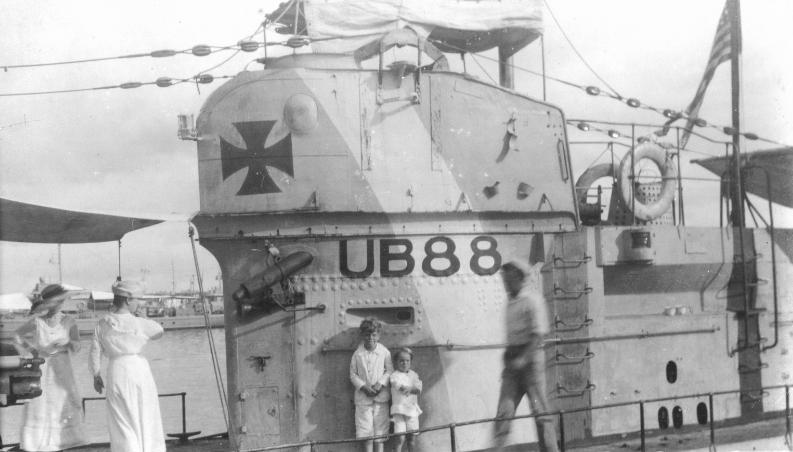
Figure 1.--The UB-88 was a Type-III U-boat, 182 ft in length, 19 ft in beam and displaced 510 tons. It served 10 months in the Imperial German Navy and sank 13-17 allied ships (accounts vary) on 5 combat patrols . It was commissioned on January 26, 1918. The UB-88 was one of six U-boats the Germans turned over to the Allies after the War and were subsequently assigned to the U.S. Navy. The UB-88 crossed the Atlantic (April 1919). Here it is being used for a coastal tour to promote the sales of war bonds.
The small U-boat fleet, however, proved a major challenge to the British. Early in the War, U-boats sank three British cruisers, astounding the public both in England and Germany. The Germans backed down from unconditional submarine warfare when America protested the sinking of the Lusitania (1915). There were 1,201 civilians, including 94 children killed. Among them were Americans and American public opinion was incensed. Although the British denied it, historians have since established that the Lusitania was carrying weapons and amunition. [Massie] The invasion of neurtal Belgium and the sinking of the Lusitania combined to create
the image of Germans in the American mind as modern day Huns. Making another effort to win the War, Germany in 1917 reimplemented unrestricted submarine warfare (March 1917). The Germans feared the entry of America into the War, but in the end concluded that they could force the British and French to seek terms before the American Expeditionary Force could be created and brought to France. It proved to be a huge miscalculation. As a result, America declared war on Germany (April 1917). The U-boat fleet succeeded in sinking 5,000 ships. That was an amazing 25 percent of the Allied merchant fleet. The Allies attempted to determine how to sink U-boats and developed the depth charge. It was, however, the introduction of the convoy system that defeated the U-boat. The World War I U-boat was really a surfacre vessel that could sumbmerge. Against esorted convoys, World war I era U-boats had little chance of success. In the end the German Navy only served to bring Britain and America into the War, ensuring Germany's defeat. An embittered German naval office, Karl Donnietz, confined in a British POW camp in 1918 was already planning Germany's strategy in the next war.
Naval Planning
Britain after Nelson's victory at Trafalgur (1805) dominated the seas. No other country during the 19th century challenged Britain's dominance. The Japanese victory at Tsushima (1905) in the Russo-Japanese War convinced naval planners that heavily armored big-gun battleships were the the ultimate in naval power. Ultol then battleships were built with a mix of guns. Tsushima demonstrated that thee smaller gunswere of little value. It was the big gunsthat woukld settle a fkeet engagement. Admiral Jackie Fisher sought to reform the Royal Navy in the years before World War I. The big-gun Dreadnaught rendered all existing ships obsolete. The Germans saw it differently as Dreadnaught rended the existing British fleet obsolete. The German naval planners calculated that this gave them the opportunity to challenge the Royal Navy. The Germans began building their own Dreadnaughts. The resulting naval arms race played a major role in shaping the Germans as an enemy in British eyes. This was a sea-change in British policy. Prussia had been a traditional ally against France. Ad the British for decadeds had been fighting the Great Game wuth the Russians. Kaiser Wilhelm's bombastic and confrontational foreign policy had disturbed many in the British establishment. The German naval building program fundamentaly changed British attitudes tioward the Germans. Britin was like Russia an enemy that the Germansdid not need to make, but the Kaiser was intent on a more aggressive foreign policy. Naval planners in both Britain and Germany in the years leading up to World War I believed that any naval war would be determined in an epic massive fleet action between heavily armoured big-gun dreadnaughts.
The Submarine
Few naval experts saw a significant role for the submarine. This was because panners failed to appreciated the potential impact that submarines could have on commerce or the possibility that a Europeans would conduct a protracted war of attrition. The submarine was conceived as a scout and potential challenge to capital ships in naval engagements. The idea of sinking merchant ships on a large scale and attempting to blockade Britain was not seriously consisered. The submarine was still a relatively new class of vessel. In addition, the virtually unanimous opinion of military experts was that a war, in the unlikely prospect that it came, would be a war of movement that would be quickly resolved. No one expected an extended war of attrition in which blockades would play an important role. And just as the German naval building building campaign would fundamentally change British attitudes toward Germany, German U-boats would play into developing public attitudes toward the Germans began at the outbreak of the War in Belgium and ultimately bring America into the War. This also did not have to happen. America had a very large German population fundamentally opposed to involvement in any European war.
Pre-war Navies
The Germany Navy as planned by Admiral Tripitz was designed to compete with the presitiogs German Army dominated by Prussian aristocrats. He wanted prestigious modern battleships and cruisers that could demonstrate Germany's industrial prowess. As a result, only limited expenditures were devoted to submarines. The Royal Navy likewise devoted only limited attention to submarines. Ironically, it was the French that were the most enthusuastic about sunmarines. Here the reason appears to be less tactical calculations, but a way for the left-leaning Republican government to dilute the power of conservative fleet admirals. Germany began the war with only 30 operational U-boats. They had limited ranges and carried only a few torpedos. There were no plans for a commerce war with the British.
Historical Background British Public Opinion
The only real challenge to Britain had for several centuries been that of France. At the same time, the British had close ties with the Germans, seeing France as Britain's mortal enemy. This view had been forged in the Hundred Years War and in the wars resisting Louis XIV's expansion. Britain had been severely threatened dutrung the Napolepnic wars. During the wars against Louis XIV and Napoleon, Britain had forged an alliance with the German states, especilly Prussia. This world view was still dominant in England in the mid-19th century. In addition the British royal family was of German (but not Prussian) origins. Ties with Germany which were strengthened when the young Princess Victoria chose a dashing German prince to marry--Albert. Many Britons were concerned about France under Napoleon III. The British view did not begin to shift until after the unification of Germany (1871). The change in the publuc mind was significantly affected when Kaisser Wilhelm II rose to the throne (1881). The belicose young kaiser soon dismissed Chancellor Bismarck who he believed to be too old and cautious. Wilhem II proceeded to pursue an expasionist foreign policy. The kaiser who had envied the Royal Navy as a boy, also decided to build a highseas navy. Britain was prepared to accept Germany as the dominant Euopean power. It was not prepared to accept German continental dominance along with naval dominance. Thus when Tripitz and Kaiser Wilhelm set out to build a modern highsea fleet to chanllenge Britain's dominance it significantly affected how Britain viewed the Germans, especially given the the Kaiser's belicouse behavior.
British and German Vulnerability
Both Britain and Germany were vulnerable to naval blockades. Both were highly industrialized countries which had to import both food and raw material. Britain as an island was the country most obviouly vulnerable. Britain was dependent on imports for about one-third of its food supply. The only major raw material Britain did not need to import was coal. Britain paid for these imports with the output of its factories. And to carry out the necessary trade, Britain had the world's largest merchant marine. And this was the target of the German U-boats and other commerce raiders. Germany as a land power was less obviously vulnerble, but it was vulnerable. Except for trade with Scandanavia which coulf be conducted in the Baltic, Germany had only a smll North Sea coast through which its foreign trade could flow. Here the major port was Hamburg. This made it relatively easy for the British with the powerful Royal Navy to effectively blockade Germany. Blockading the Channel was an easy matter. The North Sea was more complicated, but effectively executed with naval patrols and mine fields.
Early Attacks
The sibmarine was not developed to be used in a commerce war. Rather the submarine was seen as a means of delivering torpedoes in fleet engagements. The Germans first used them in an even more tactically aggressive mode. Contrary to all expectations, both among British and German plannets, the small German U-boat fleet, however, proved a major challenge to the British. Early in the War, a U-boat engaged the British 7th Cruiser Squadron off the Hook of Holland. The U-9 sank three British cruisers, astounding the public both in England and Germany. Helping to set the image of the U-boat as a dishonorable weapon, the captain of the U-9 sank the British cruiser Aboukir and then sank two other cruisers (Houge and Cressy) that were attempting to rescue the survivors. A British Admiral described the action as "Underhand, unfair, and damned un-English". [Parrish] The action also forever altered naval calculation. The U-boat was a small, relatively inexpensive ship, manned by a handful of men. The U-9 had a crew of 26 men. Yet it was capable of sinking major naval units. Major assetts would not be used to rescue survivors again. Years later, the crew of Bismrck in World War II would suffer the consequences.
Commerce War
After the British implemented a naval blockade of Germany, the Germans sought to blockade the British isles. As the War evolved in a protracted struggle, a war of attrition, these blockades began a major part of the conflict. Naval commerce with America and the Dominions played a major role in the British war economy. Here Germany employed both armed merchant raiders and U-boats, but the major threat was the U-boat. The Germans waged a guerre de course--a commerce war against Britain. The German U-boats at first stpped ships and followed internationally accepted Prize Rules. Neutral hips like American vessels were inspected. Allied ships were sunk, but the Germans allowed the crew and passangers to be evacuated before sinking it. This was often done by using the deck gun so as to save precious torpedos. To be effective, however, the World War I U-boat had to strike without warning. Stopping the merchant vessels put the U-boatsc at risk. Not only could the merchant vessel radio the location of the U-boat, but many surface vessels were armed and could fight it out with a surfaced U-boat. This issue came to a head when the U-20 sank the British luxury liner RMS Lusintania (1915). There were 1,201 civilians, including 94 children killed. (There are small differencdes in the varius accounts.) Among them were Americans and American public opinion was incensed. Although the British denied it, historians have since established that the Lusitania was carrying weapons and amunition. [Massie] Public opinion in America and Britain saw the German action little short of murder. The Germans backed down from unconditional submarine warfare when America prepared to sever relations. President Wilson was prepared to deploy the U.S. Navy to escort American shipping which would have inevitabled led to war.
American Public Opinion
The invasion of neurtal Belgium, attocities committed there, and the introduction of poison gas all blackened the image of German in America. Until World War I, Germany and Germans had a very positive image in America. The war changes this. And one of the most important German fotce that darkened the German image was the U-boat fleet. The U-boat was a new type of naval vessels first employed in World War I. And this was because it was not just used in naval engagements, but was primarily deployed against civilian vessels, mercant vessels to wage a commrce campaign. The Germans did not have suffient naval strenhth to enforce a surface blockade. The U-boat gave he Germans the posibilty of cutting the British sealanes to America, despite the Riyal Navy's superority. Commercewarfare was not new in naval warfare and as a result there were widely accepted rules -- the Cruiser Rules. The raider had to give cres the oppprtunity to get off a ship before it was sunk. German U-boats caused an internationa; uproar because it violated the commerce rules, but if they followed the rules, the U-boats became vulnerable. Theview of the Germans reached a crisus point with the sininking of the British luxury liner RMS Lusitania actually impacted Americans. The resulted was that the Germans began to be seen as modern day Huns. There were 139 U.S. citizens aboard Lusitania, 128 of whom were lost. The influntial American weekly, The Nation called it, "a deed for which a Hun would blush, a Turk be ashamed, and a Barbary pirate apologize." [Jones, p. 73.] America was divided on the War to a substantial degree along socio-economic and ethnic lines. President Wilson and a majority of Americans, however, wanted no part in the War. Wilson proclaimed that America was "to proud to fight". Former President Roosevelt called Wilson a coward and a substantial minority thought America should enter the War. .
While public opinion in America and most other countries saw U-boat attacks on civilain vessels as nothing short of barbaric, this was not the case in Germany. The Germans saw U-boat captains and their crews as brave heoes, much like fighter pilots. These two groups, aviators and U-boat men were see as different, removed from than the terrible grinding slaughter on the Western Front. The U-noat men were seen as taking on the mighty Royal Navy in small, flimsy boats. This made headlines with a single U-boat captain scored an unbeieveable success at the onset of the war. Kapitänleutnant Otto Weddigen on U-9 patrolling the Broad Fourteens (southern North Sea) attacked a squadron of three obsolescent British Cressy-class armoured cruisers (HMS Aboukir, HMS Hogue, and HMS Cressy), which were positioned to prevent German surface vessels from entering the eastern end of the English Channel (September 22, 1914). The U-9 became the most popular German naval vessel of the War. Boys with sailor caps wanted U-9 tallies. The popularity of U-boat commanders was in part because German propaganda emphasized attacks in Royal Navy vessels more than sinking merchant vessels and liners like Lusitania. Thus like the Red Baron and other fighter pilots, they were depicted as gallant warriors and that is how the German public perceived them..
The Western Approiaches
Britain like Germany was deeply dependent on imports of food to supply its industrialized cities. The Royal Navy easily blockaded Germany's North Sea ports where imports had entered before the War. And the Germans were hemmed in by the Russiuans in the East and British and French in the West. Britain was just as dependent on food, but not so easily blockaded. Unlike Germany, Britain had a life line. Food, munitions, metal ores, oil and everything else need to fight the War was available across the North Atlantic in America and Canada as well as the Empire which was spread all over the world. Latin American resources could also be accessed. The Royal Navy blockade denied all of this to Germany. All of these merchnt ships carrying supplies passed though the British called Western Approaches on the way to Liverpool, the Channel ports, and London. Look at the map, very little of England faces the Atlantic. It is the wesrrn coast of Ireland that faces the Atlntic. And it is Irish ports that can can best suopoort baval operations in the Westtern Approaches. The Battle of the Atlantic was primarily fought in the Western Passages because of the limited range of World War I German U-boats which unlike World War II did not have access to French Atlantic ports. The U-boats proved much more effective than the Royal Navy expected, especially when they began ignoring Cruiser Rules with the adootion of unrestructed submarine warfare. After the sinking of the Lusitania (May 1915), America almost entered the War. The Germans To prevent that the Kaiser ordered the Cruiser Rules be reinstituted. This significantly reduced the effectiveness of the U-boats. The Royal Navy's all importabt defense of the Western Approaches was based in Queenstown on the southern Irish coast. Here they conducted a long and arduous battle to keep the North Atlantic seaways open. This effort was overseen by Vice-Admiral Sir Lewis Bayly who commanded the Coast of Ireland Command, the original name for the Western Approaches. One author describes Bayley as a fierce disciplinarian with a mania for efficiency, and thought by some of his colleagues to be more than a little mad. Bayly's strategy was to take the fight to the Germans. [Dunn] He brought nto service boat or ship he could lay his hands on, including trawlers, tugs, yachts as well as the few naval craft that ciuld be spared from the Grand Fleet in the North Sea. He went on the hint for German U-boats. The command also swept for mines, a greater danger than often reported in World War I naval histories. They escorted merchantmen organized into convoys and all the time constanly faced the harsh conditions of the North Atlantic. Germany's best chganbceof winnning the War were dashed on Marne (September 1914). The Allies had a larger population and greater economic anhd financial resources.
The Germans by late-1916 realised that they were losing the War. They rejected American attempts to negotiate a diplomatic end to the War (November 1916). Rather they sought a military sillution. Part of that sollution was the reintroduction of unrestricted submarine warfare (January 1917). This changed the struggle in the Western Aporoaches, significantly increasing the sinking of the merchahnt men bringing supplies from America and Canada. For Britain the campaign in the Western Apporoaches was a fight for its very survival. The Germans also attempted to take advantage the anti-British attitudes of much of the Irish population and landed arms along the Irish coast for the nationalists. The Kaiser believed the advise of his army and naval commanders that they could achievce victory before America could effictevly intervene. And as President Wilson had warned the Kaiser in 1915, the United States declared war (April 1917). It took a year before the American Expeditionary Force could go into action in France. U.S. Navy Destroyer Squadron 8 sailed into Queenstown only one month after American declared War (May 1917). The American battle fleet played only a minor role in the North Sea. The American destroyers on the other hand played a major role in the Western Aporosches. This was not only the destroyers the United States had, but new destoyers than began to roll out of American shipyards. Bayly despite his leadership reputation, deftly integrated the American destroyers into a homogenous and effective allied fighting force.
The primary naval campaign od World War I due to massive superiority of the Royal Navy was a commerce campaign fought out in the Western Approaches to British ports. A much smaller and poorly reported campaign was conducted in the Mediterranean. It would have been much more important, but Italy switched when it joined the War. If Itlay had remained one of Central Powers, Britain would have had real tounble keeping the Mediterranean sea lanes open. And given the support provided by India and the Empire, this was imprtant to the Allied war effort. The ensuing campaign `was primarily fought by Austro-Hungarian and German Navies and the British Royal Navies. At the outbreak of World War I, with Italy's decision to remain neutral, the naval strength of the Central Powers was represented by the Kaiserliche und Königliche Kriegsmarine (KuK Navy). Not only was KuK Navy small, but the only access to the Mediterranean was through the straits of Otranto. And the KuK Navy could have no real impact unless it broke out to the Mediterranean. thr KuK had only seven U-boats at the ouset of the War. They hit a few French shlps in the Adriatic attempting to aid the Serbs, impairing Allied efforts to aid the beleagered Serbs. They had no impact, however, in the important Mediterranean sea lanes because they could not operate beyond the the Straits of Otranto.1915. German U-boats entered the Mediterranean campaign (April 1915). They were responding to the Allied Dardanelles campaign. The Germans had some success. The U-21—achieved sank two Royal Navy pre-dreadnought battleships that were unprepared for U-boats: HMS Triumph and Majestic (May 25 and 27). The Germans were less sucessful in the e Dardanelles area. Large numbers small craft and percautions such as anti-submarine netting and booms limited their movements. German U--boats at the time had limited ranges. Thus they sent U-boats in sections by rail, including UB and UC Type boats. They were assembled at the Austro-Hungaraian port of Pol on the Adriatic. They then sailed to Constantinople. While one was lost, the Germans established a squadron of seven U-boats at Constantinople, named the Mediterranean U-Boat Division. The Germans achieved some sucess raiding tghe Allid sea lanes (1915-16). With such a small force thevGermans could not cut the Mediterranean sea lanes, but they did sink a substantial numbr of shops. The Royal Navy introduced the convoy system (1917), significantly reducing shipping losses. The last action was the UB-50 sinking the battleship HMS Britannia a week before the end of the War near Gibraltar(November 9, 1918).
Russia (1917)
Russia honored its alliance with France and a Russian offense in the East preventing the Germans from concerntrating the full strtength of its army on the Western front. Had it been able to do so, the Germans would have won the War in in the early months of the conflict. The Russians suffered dreadfully on the Eastern front. Russian soldiers were not well equipped. Many soldiers did not even have riles and there were no gas masks for protection from gas attacks. A Revolution overthew the Tsar. The Germans seeing that the Russians were fattaly weakened increasingly believed that they could finally win in the West. And when the the Bolsheviks in the climax of the Russian Revolution overthrew the Provisional Goverment and sought terms with the Germans. This provided substantial forces that the Germans were convinced could be used to end the deadlock on the Western front.
German Gamble (1917)
Germany had practical strategic problems. The Allied blockade and the mounting attlefield losses were undermining the German war effort. German commanders increasingly began to think that war-weariness would force German to sue for peace. Commanders began to believe that their best chance of winning the War or at least achieving an advantageous peace would be to cut Britain off from America and the Dominions which were sustaning the British war effort. The German Highsea fleet was incapable of doing this. The only option was the U-boat fleet. The problem was the United States. President Wilson had kept America out of the War, but had made it clear that unrestricted submarine warfare could mean war. German commanders by 1917 were prepared to gamble that unrestricted submarine warfare would force Britain out of the War before an outraged America could recruit, train, and transportan army to France. German commanders even believed that their U-boats could prevent the U.S. Army from reaching France. The German Navy had chafed under the restrictions imposed on U-boat operations. Alfred von Tirpitz was an early advocate of unresticted submarin warfare. German Admiral Capelle, Secretary of State for the Navy, assured the German Parliament, "They will not even come because our sunmarimes will sink them. Thus America from a military point of view means nothing, again nothing, and for a third time notthing," [Keegan, p. 372.] At the time the American Army totaled only slightly more than a 100,000 men. Capelle would not be the last German official to under estimate the Americans. Admiral Henning von Holtzendorff, Chief of the GermannNaval Staff, argued that only unrestricted sunmarine warfare could impair British maritime commerce sufficently so the war in the West could be won before the British blockade crippled the German economy. [Keegan, p. 351] German naval intelligence estimated that unrestricted submarine warfare would enable the U-boats to sink 600,000 tons of shipping monthly. This was twice the tonnage sunk in cruiser' warfare. Another factor was the weather and war related bad harvests that Europe experienced in 1916. It had affected the Central Powers and the Germans believed that it left the British particularly vulnerable. Navy commanders calculated that
starvation would force Britain out of the War in 5 months.
Germant U-boat Fleet (1917)
German commanders by 1917 not only thought that they could win the War through unrestricted submarine warfare, but the Navy now had a more substantial U-boat fleet which could be used to wage a campaign in the North Atlantic. The Germans had a fleet of 46 large, modern U-boats capable of operating in oceanic waters. The Germans in addition had 23 smaller U-boats which could be deployed in coastal waters.
America
The major question concerning the resumption of unrestricted submarine warfare America was the United States. America was the one major power that had not declared War. America was neutral, but this did not mean that America dod nor affect the War. The Royal Navy control of the sea mean that Briitain hd access to American raw materials and industrial production. The Royal Navy blockade men that Germany was cut off from trade with America and other overseas countries. This was what unrestricted submarine warfare was designed to achieve, cut off Britain from America and the Dominuions. The threat of course was that not only would America's ebntry in the War give the Allies even more access to American oroduction, but that an American Army would be dispatched to France to bolser the Western Front. And given the population of the United states, it would be a huge army that a war-weakened Germany could probably not stop. Germans commandrs believed that with unrestricted submarine warfare that they could starve the British before America could effectively interbene. Military commanders. most with little knowledge of the United States, convinced themselves that America would not enter the War. Many saw American neutrality as an act of national cowrdice by a polygot nation and just assumed that such a nation would never dare war with Germany. They were also correctly aware that America did not have a substantial azrmy, futher confirming their assessment tht American would not enter the war against Germany. German politicans, especially the Socialists, were not at all sure about the Army's assessment. German Chancellor Bethmann Hollweg from an early point of the War had been concerned about America. Opinion in the Reichstag, however, had swung to support for unrestricted submarine warfare. The Germans were divided about the entry of America into the War, but in the end concluded that they could force the British and French to seek terms before any American Expeditionary Force could be created and brought to France. It proved to be a huge miscalculation. A calculation another generation of German leaders will repeat.
Bethmann-Hollweg attended a meeting at Pless (January 9, 1917). He found at the meeting that both the Army and Navy were insisting on unrestricted submarine warfare. And they had convinced the Kaiser. It was at this meeting that the Grmans decided to resume unrestricted submarine warfare. The German Navy launched the campaign that they thought would win the War (February 1).
America Temprorizes
The German invasion of neutral Belgium (1914) and the sinkling of the Lusitania along with effective British propaganda had created a dreadful image of Germany in the American mind. The German resumption of unrestricted submarine warfare did not bring about an immediate American declaration of war. President Wilson thought that the Germans could perhaps be convinced to rescind the orders has had been the case in 1915. The President broke off diplomatic relations with Germany (February 3). This was a clear warning that war was possible. The Germans did not flinch. The President ordered that American merchant ships be armed (March 9). German U-boats sank seven American merchant vessels (by March 21). Secretary of War Newton Baker activated the first National Guard troops (March 25).
Dismissing America
Britain and Germany from the onset of the War took very different approaches to America. The United States at the time of World War I had aarger population than every European state, but Russia. And it had the largest industrial and agricultural economy in the world. Britain;s policy from the beginning was to draw merica into the War. The Germans on the other hand were disnissive. They did not see Americawith its polygot population as aeal nation. And they saw that although an industrial power, the United States did not have an army of any importance. military power ishat impressed the Germans, and America did not have it. They believed that the War would be over before America couold build an army. And even if America did, it would take time to arm and train and the U-boats could interdict the troop transports. And even if an American army arrived in France, they question the fighting effectiveness of soldiers from a polyglot nation. Thus in dealing with America, the Germans pursued policies that would eventually bring America into the War, not recognizing the danger. It was a strategic blunder of immnse proprtions and the German would repeat the mistake a generation later. .
Wreckless bevavior
Sabotage
Zimmerman Telegram (March 1)
Once Germany resumed unrestricted submarine warfare and began sinkling American vessels, war was probably inevitable. It was at this time a starteling revelation appeared in American newspapers (March 1). British intelligence intercepted a message from German Foreign Minister Zimmerman to the German Embassy in Mexico (January 16, 1917). The message was sent a week after Germany decided to resume unrestricted submarine warfare. Zimmerman instructed the German Ambassador in Mexcico City to attemp to enduce Meico to enter the war. Zimmerman authoruzed the Ambassador to offer the return of the American southwest. The Zimmerman Telegram convinced many Americans still wavering that Germany was a threat to the United States. British agents intercepted the telegram earlier, but delayed the release so that a cover story could be concocted to protect British code breakers. The Zimmerman telegram infuriated Americans and it came just as the Germans ammounced the resumption of unrestricted sunmarine warfare.
The Constitution assigns the responsibility of declaring war with the Congress. As American Government evolved over time, formal Declarations of War were only passed at the request of the president. With the sinking of American ships, President Wilson finally decided that war could not be avoided. The President summoned a Special Session of Congress (April 2, 1917). President Wilson delivered a War Message asking Congress to declare war on Germany (April 6). Congress overwhelmingly passed the President's War Resolution. The vote was 373 to 50. A second War Resolution declaring war on Austria-Hungary followed (December 7, 1917). The German military was wrong that America would not enter the War. It remained to be seen if America could marshall its forces in time to save the Allies. The Allied public were surprised to find that a large country like the United States did not have a substantial standing army that could be immediately dispsatched to France.
Allied Counter Measures
The British were slow in developing effective measures to counter the U-boat threat. Only gradualy were needed counter-measures developed. Some of those measures included: mine barrages, Q-ships, zig-zag manuvers, Huff-Duff directional finders, ASDIC/SONAR, and depth charges. It was the mine barriers that roved most deadly to the U-boats. The primary Allied U-boat counter measurs included: mine barriers (48 u-boats), escort depth charges (30), rammings (19), and British submarines (17). It was, however, the introduction of the convoy system with escorts that defeated the U-boat. The admiralty had long oppsed convoys seeing the large numbers of ships to be protected as beyond the capability of the Royal Navy. Only the U-boat toll in 1917 after the resumption of unresticted submarine warfare forced the Admiralty to adopt the convoy system. The World War I U-boat was really a surfacre vessel that could sumbmerge. It could only sumerge for short periods and once sumerged was very slow. Against escorted convoys, World War I era U-boats had little chance of success.
Mine barges
The British planted a formidable barrier in the North Sea, a massive mine fields. Unlike World war II, Germany controlled neither France or Norway. The only way out into the North Atlantic was through the heavily mined anhd patrolled North Sea. Passage throiugh the English Channel was virtually impossible. World War I submarines had lmited range. Having to sail through the North Sea before reaching the Atlatic convoy routes, significantly impeded U-boat operations as well as reduced the time theu could remain on-station. The mine fields also cost the Germans almost 50 U0boats.
Q-ships
Zig-zag maneuers
Huff-Duff directional finders
ASDIC/SONAR
Because of the sinking of the RMS Titanic just before the War, an American scientist started to explore ways of detecting icebergs under water (1912). Reginald Fessenden invented the Fessenden oscillator. It was an electro-acoustic transducer. Fessenden began working on it at the Submarine Signal Company of Boston. It proved to be the first ASDIC/SONAR device. It has been likened to a dynamic voice coil loudspeaker. It was an early version of a transducer and could both create underwater sounds and of receive the echoes. While the Titanic disastrer wa thec primary motivatig factor there was a ocean shipping grew a need ti detect not only icebergs, various obstacles, and other ships. There were many limitations to these eaky devices, many rekated to the relatively low operating frequency.
Only after the outbreak of the War and the Germany deployment of U-boats did potential military uses come to the fore.
The crude Fessenden oscillator was then improved on by British scientists to support AWS naval moperations. American scientists alsobworked on the problems as U-boats began targeting American shipping. ies after the outbreak of the War. .
Fessenden for his part went on to invent AM radio which after the Wat=r created the basius for an entire new industry. The success of Workd War I ASW opoeratiions, especially ASDIC/SONAR, led many naval planners to believe that the U-boat would not be a threat in any future War.
Escort depth charges
Convoy system
Results
Germany commission 365 U-boats during the war and lost 178. This was about half of the force--a terrible loss rate. The Germany Navy during the War achieved substatial results. They sank 4,837 Allied merchant ships, mostly British. This exceeded 11 million tons of shipping. U-boats were responsible for most of the sinkings and primarily in 1917-18 after the resumption of unrestriced submarine warfare. That was an amazing 25 percent of the Allied merchant fleet. Most of the vessels sunk were ships sailing individually and not part ofconvoys.
Rationing
Impact of the Germany Navy
In the end the German Navy only served to bring Britain and America into the War, ensuring Germany's defeat. An embittered German naval office, Karl Donnietz, confined in a British POW camp in 1918 was already planning Germany's strategy in the next war.
Sources
Dunn, Steph R. Bayly's War: The Battle for the Western Approaches in the First World War (2018).
Jones, Howard. Crucible of Power: A History of U.S. Foreign Relations Since 1897 (Rowman & Littlefield: 2001). The Nation is the oldest continuously published weekly magazine in the United States> It is today the most widely read weekly journal of liberal/progressive political and cultural news, opinion, and analysis. It was founded in 1865, as a successor to William Lloyd Garrison's The Liberator.
Keegan, John. The First World War (Knopf, 1999), 475p.
Massie, Robert K. Castles of Sea: Britain, Germany, and the Winning of the Great War at Sea (Random House, 2003), 865p.
Parrish, Thomas. The Submarine: A History (Viking, 2004), 576p.