War and Social Upheaval: World War I--Trench Warfare
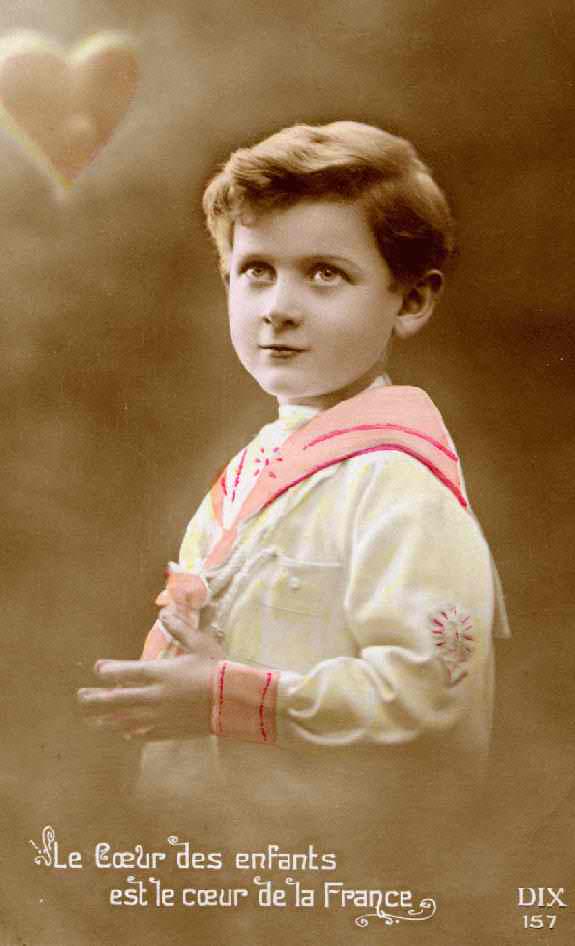
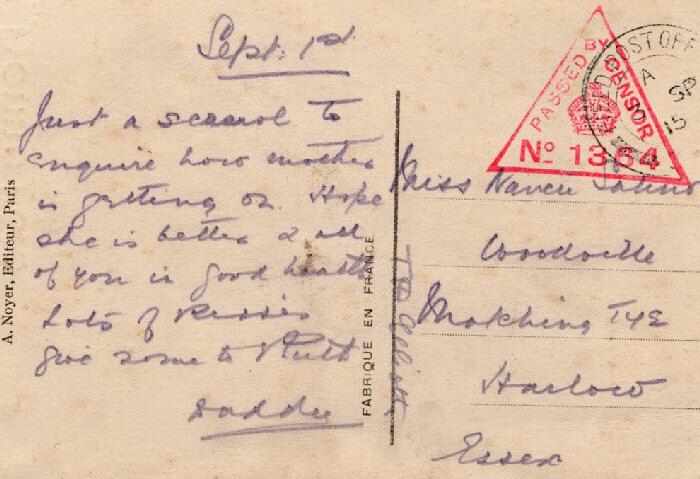
Figure 1.--This postcard was sent home by a British soldier in the trenches of the Western front during 1915. The card reads, "Le coeur des enfants est le coeur de la France." That means, "The heart of children is the heart of France. The sentimentality of the cards speaks of what was on the mens' minds. Click on the image to see the message on the back of the card. Image courtesy of the MD collection.
|
|
World War I resulted in a revolution in infantry tactics which fundamentally altered how wars were fought. The armies which clashed in August 1914 operated on essentially 19th century doctrines, large units of riflemen were screened by cavalry and
supported by artillery. Commanders expecting a decisive engagements to settle the war rapidly. The British, French, Germans, and Russians that marches off the war in August 1914 all assumed that the War would be over in a few months if not weeks. No one anticipated a struggle that would endure over 4 years. Sweeping manuevers exposed the calvary and infanntry to the killing power of modern weapons. Modern weapons, especially artillery and machine guns as well as accurate rapid-fire rifles proved devestating, especially when used against the tactics field commanders employed in the initial phases of the War. Field operations by 1916 had, after the loss of millions, been fundamentally changed. The professional armies of 1914 were devestated and were replaced by conscripted replacenments. What began as a rapid war of movement soon settled down to static trench warfare and became a brutal war of attrition. Both the Germans and French and British began digging trenches to stay alive. Eventually parallel trench systems streached from the Swiss border to the English Channel. There were about 40,000 kilometers of trenches on the Western Front alone. Living conditions in the trenches were dreadfull, but they did offer protection. [Bull] The British developed the tank which helped to breach the German trench lines, but it would be the Germans in World War II that would put this weapon to effective use in their spectacular offenses early in the War.
19th Century Tactics
World War I resulted in a revolution in infantry tactics which fundamentally altered how wars were fought. The armies which clashed in August 1914 operated on essentially 19th century doctrines, large units of riflemen were screened by cavalry and supported by artillery. Commanders expecting a decisive engagements to settle the war rapidly.
Anticipated Short War
The British, French, Germans, and Russians that marches off the war in August 1914 all assumed that the War would be over in a few months if nor weeks. No one anticipated a struggle that would endure over 4 years.
20th Century War
Sweeping manuevers of 19th century war exposed the calvary and infanntry to the killing power of modern weapons. Modern weapons, especially artillery and machine guns as well as accurate rapid-fire rifles proved devestating, especially when used against the tactics field commanders employed in the initial phases of the War. Field operations by 1916 had, after the loss of millions, been fundamentally changed. New weapons like poison gas, air palmes, and tanks were introduced.
Miracle on the Marne (September 1914)
World War began as a sweeping war of movement. The German right wing swept through neutral Belgium in August 1914. The gallant Belgian Army under King Albert I managed to slow the Germans, but the combined forces of Belgium and France along with the small British Expoditiary Force (BEF) that had manged to reach Belgium seemed unable to prevent the Germans from taking Paris. The Germans were so confidebnt of victory that they hd begun moving units east to strengthen the Eastern Front against the Russians. [Wells, p. 901.] Then on September 3, General Gallieni saw that the powerful German right wing had exposed its flank. French Commander General Joffre ordered an immediate counter attack with all available forces to stop the Germans at the Marne. Every thing was staked on this thrust. Paris taxis cabs were used to bring available French reserves to the front. The attacked succeeded, friving the Germans back accross the Marne and saving Paris.
Casualties
The German invasion of Belgium launched a war of mocement. The Schliffen Plan was a vast sweeoping movement around the French border defenes. Several million men were sent in moption, both the German invaders abd first the Belgian dfenders joined by the British and French. The German as attackers in Belgium were out in the open without fixed defense. The French Armies that attacked German positions were in the same position. The British who moved into Belgium to stop the Germans also were in the oopen, attemting to build make-shift defensive positions. Given the lethality of modern weapons like machine guns and rapid-fire artillery like the French 75, casualties were enormous. More than a million men perished in the initial fighting and this does not count the casualties (August 1914-January 1915). Most hostorians describe the trench wafare which followed as hideous and deadly. In fact, the combatant forces decended into the trenches to save their lives. [Beatty]
Construction Begins
The German commander, General Erich von Falkenhayn, after being stopped at the Battle of the Marne was forced to retreat to the River Aisne. German exhaution and British reinforcements dictated a defensive posture. He was ordered to hold the parts of France and Belgium that Germany had seized. Falkenhayn ordered his men to begin digging trenches to protect them from the French and British troops that were counter attacking. The Allies after enormous losses realised that they could not break through the deffensive trenches that the Germans were erecting. The Germans then attempted to seize Dhannel ports to cut the French off from the British. [Wells, p. 901.] The Allies then began to dig their own trenches. In only a few months trenches had been errected from the Belgian North Sea coast to the Swiss border.
Opposing Trenches
Both the Germans and Allies dug trenches for protection from the murderous fire and stay alive. It was the Germans, stopped in their initial offensive, that first began to build the trenches. They of course did not just build them where their front lines were. Instead they chose the best defensible terraine to build them--usually the high ground in any sector. The selection of the site and possession of the high ground not was an emense advantage to the Germans. It gave them an important tactical advantage. In addition, the Allies were at a considerable disadvantage. This also affected living conditions. In many areas, the Allied trenches were only about a meter above sea level. Water-logged trenches were a constant problem for Allied soldiers in Belgian and French trenches along the Western Front. Eventually parallel trench systems streached from the Swiss border to the English Channel. There were about 40,000 kilometers of trenches on the Western Front alone. Living conditions in the trenches were dreadfull, but they did offer protection. [Bull]
Construction
The defensive lines on both the Allied and German side consisted of a series of trenches to ensure that any offensive penetrating the frontline could be stopped by defensive trenches in the rear. Basically behind the front line trenches were a network support and reserve trenches. This meant that it was very difficukt for either side with comparable forces and arms to break out. A major problem was that once an army launched an attack, commanders would lose contact with the lead elements thus the attack continued with out command and control. There were no walky-talkies at the time. The defending dorces in the rear area trenches reatined command and control and could thus mobilize forces to contain and stop the eney attack.
Frontline trenches
A typical frontline trench was a little over 2 metwrs deep and 2 meters wide. This allowed most men to stand up in the trench without being hit. The front facing the enemy was called the parapet. The top parapet of the trench up to about a meter as well as parados (back of the trench) was built up with sandbags above ground level to protect the men from any bullets or shrapnell. This mean that the men could not see over the top of the sand bags. As a result, a ledge called a "fire-step" was built into the trench. Trenches were never dug in straight lines. They were not infrequently breached. A straight trench would have allowed the attacker to shoot straight down the trench and potentially killing large numbers of defenders. The trenches were constructed in a zig-zag pattern with alternate fire-bays and traverses. There were also platforms called 'duck-boards' along the bottom of the trench in an effort to keep the soldier's feet dry. Fungus infections became known as "trench foot". As artillery fire exploding over the trenches could also kill, the soldiers built "dugouts" and 'funk holes' branching out from the trenches for further protection. The soldiers would string barbed wire in front of their trenches. This would slow down an infantry attack giving machine-gun nests time effectively sweep the field. The area between the opposing trenches was called 'Non-Man's line'. Each side dug short trenches called 'saps' from the frontline trenches into No-Man's Land. They ended at the 'sap-head', normally about 30 meters in front of the main trench. These were very dangerous places. This is the origin of the modern slang word 'sap', meaning a foolish or foohardy person,. These sap-heads were listening posts for the frontline trench.
Support trenches
Reserve trenches
In the rear of the front-line trenches were support and reserve trenches. Normally there were three rows of trenches extending about 200 and 500 meters. Communication trenches, were dug from these rear trenches to the frontline trench. This allowed the movement of men, amunition, equipment and food without exposing soldiers to enemy fire.
Military Problem
Once the trenchs appeared, neither had the military force with the armaments ot tactics needed to break through the opposing trenches. The Germans had an advantage in the first 2-years of the Wars because they had greater numbers of heavy artillery and siege guns. They also having the advantage (August and September 1914) managed to gain the high ground over much of the front and thus had better had the more advantageous and drier trenches. They also were more innovative, introducing flame throwers and poison gas. It was the British that had the key to breaking through the trenches--but the Army High Command failed to understand its importance until late in the War. [Wells, p. 902] British tanks and the American infantry finally cracked the German lines, weakened by 4 years of fighting, wide open in the Hundred Day Campaign (August-November 1918).
Poison gas was first used in World War I. Poison gas was first been developed by a German Jewish scientist working for the German Army. Gas was widely used on the both the Western and Eastern Front during the War. Losses were especially severe on the Eastern Front where the Russians were not equipped to take the needed counter measures and were unable to reply with gas weapons of their own. The Germans first used poison gas at Ypres (April 1915) with devestating effect. The British and French followed suit. I don't think the Americans and Russians used it, but I think the Austrians did. Gas because of its stealth and horendous effects was perhaps, the most terror-inspiring of all the World War I weapons. Poison gas caused only a small fraction of total battlefield deaths, less than 0.1 million, but more than 1.3 million men received terrible wounds--many never fully recovered. Countermeasures were, however, rapidly developed which reduced gas to primarily a means of harassing the opposing forces. One estimate suggests that by the end of the War in 1918, about 25 percent of all artillery shells fired contained chemical weapons.
The trenches provided protection from the terrible fire power arranged on both sides of the opposing lines. Trench life had, however, tirtures of it own, the constat artillery fire, snipingmixed with boredom , terible food, mud, and unsanitary conditins. Hre in many cases the Grmans grabbed the high ground. Thus it was the Allies who ad the greatest prblem with mud and standing water. Conditions varies depending on which line of trenches the indvidual was stationed. The most primitive conditions were in the fornt-line trenches. World War I trenches were constructed so they could sustain enemy attacks. Even if the enemy attack penetrated the front line treches, the area trench would stop the advance and potential break out. And indeed break out never came despite the expenditure of hundreds of thousands of young lives until the Anglo-American Hundred Day Campaign racked open the German lines, ending the War (August-November 1918). Behind the front-line trenches lay support and reserve trenhes. Because of the stress on the men in the front-line trences,the standard practice was to ritate the men to limit time at thefront. Conditions were considerably better in the rear area trenches. Units were also allowed to spend short intervals in rest areas. Sime individuas wer granted home leaves. Unlike World War II, the distances from home (except the colonial forces and the Americans when they arrived, were not long and men could often be home in a mattr of hours. This varies among the different belligerant countries. The French in particular were reluctant to grant home leaves out of fear the men would not return. The amount of time spent in the front lines could vary by sector. In the areas of intense activity or during offensives, more time might be spent at the front and as a result less time in rest areas. And timeat the front asio increased as the War progressed. Trench life varied somewhat among the different natioanl armies, but there was considrable similarity. A rare degree of civility that was often observed was a breakfast truce.
Shell Shock
Many new words entered the English lnguage during the War. One was "shellshock". Many World War I soldiers suffered from shellshock caused by the intense artillery barages to which soldiers in the trenches were subjected. Surprisingly shellshock was not a major complaint during World War II. One author postulates that the difference was the peculiar nature of trench warfare. Confined to their trenches, suffering massive casualties to gain only meters of territory caused a sence of futility that magnified the horror of battle. Soldiers in World War II engaged in a war of movement with much greter issues at stake better understood the need for their sacrifice. [Hoffman]
The German war plan, the Scliffen Plan, was designed to win the War quickly in a massive Western OIffensive before he Rusians could mobilize. The Russians mobilized fster than expected and thd French held on the Marne. Thus the war that the Germans launched turned into a deadly war of attrition. The professional armies of 1914 were devestated in the early fighting before commnders began to adjust tactics to the deadly new wepons. The professionals had to be replced with youthful conscripts. Even Britain had to eventually begin conscription. It was more of a controversy in the Dominions. The Germans having failed to win the War at th onset, decided to breal the French Army at Verdun knowing that the French would fight and not retreat. The Germans failed to break the French Army, but did destroy it as an offensive force. And the Germans also paid a terrible price. What began as a rapid war of movement soon settled down to static trench warfare and became a brutal war of attrition. While the Germans had the advantage at the beginning of the War, a long war of attrition was not to their advantage. The German Army was designed for aggressive, offensive campaigning. The German Empire was well suited to wage an exyended ar of attrition. Germany had the single largest industrial base in Europe, but lacked the access to raw materials and agricultural production available to the Allies. The Royal Navy's command of the seas was to proive a decisive advantage. This meant that the British and French with a larger combined industrial base nd who could obtain militry supplies, raw material, and food from the British overseas dominions and neutral countries like America had an advantage. German industrial and agricultural production fell as more and more men were drawn into the military. The drafting of agricultural workers would undermine the war economy of Germany and Austria as food shortage developed and becme increasingly severe. The neutral United States with its vast industrial capacity and agricultural production was especially important and gave the Allies with their command of the seas a virtually inexautible source of war materials and food. To redress this inbalance the Germans turned to their U-boats in an effort to cut Britain's sea lifelines. In the end, the Germans would not only fail to cut Allied supply lines, but disastrously bring America into the War on the Allied side. The Germans at enormous cost knocked Russia out of the War and crippled the French Army. The Kaiser then threw away these dearly won achievements abd drew American into the War the only country with the manpower and resources capable of redressing the war of attrition that had stalematted the Western Front for 4 years. It was a action of stunning incomptence, only exceed by the next German war leader.
Tunnels
One of the least told stories is that of the tunnels under no man's land to the opposing trenches. The ground between the opposing trenches was so deadly that each side developed plans to attack through underground tunnels. Here both sides called on miners.
Impact on Society
The huge casulaties of World War scarred Europe for a century. Europeand died by the millions in the trenches both along the Western an Eastern fronts. They died in the trenches and in trying to cross No-Man's life to attack the opposing forces. It was not only the millins of deaths, millions more were injured and mained by shells and poison gas. Those that survived were also affected by the horrors of War and trench life. And the horrrors did not stop with the end of the War. A civil war followed in Russia visiting furthe horrors on the Russia people who suffered more than in any other country during the War. There were displaced people all over Europe and of course children suffered more than anyone else. Political caos, inflation, and economic crisis folloed the War in Germany. There was wide-spread hunger including deaths from starbation. The impact was to undermine all the certainties of pre-War Europe. People questioned the established order that had brought the horrors of war upon them. One of the impacts after the War was fashion, which is often influenced by wider social movements. Surely the War must have been a major reason for the sharp change in styles and fashion conventions following the War in the 1920s.
The letters and cards that the men who manned the World War I trenches are heart breaking. As HBC focuses heavily on photography and other visual images, we are especially struck by both the postcards selected by the British Tommies and the messages on the back. We note that the British Tommies in France and Belgium selected sentinental French post cards to send home. Some of the cards were of inniocent children with sentimental messages. They surely myst have reminded them of their children back home in England. Some of the cards had t pass through the censors. We do not know at this time how this affected the messages penned.
Break Out
The British developed the tank which helped to breach the German trench lines. The Germans never succeeded developed an effective tank. The key factors in the German defeatwas, however, were the exhaustion of German soldiers, the Allied blockade restricting the German economy, and the fresh American infantry which by 1918 had arrived in France.
World War II
It would be the Germans in World War II that would put the new weapons of World War I (airplanes and tanks) to effective use in their spectacular Blitzkrieg offenses early in the War in Poland (1939), France (1940), and the Soviet Union (1941). Only over Britain (1940) did the Germans fail to effectively deploy their new weapons. Blitzkrieg effectively returned mobility to the battlefield. The two major efforts to build entrenched defensive lines (the French Maginot Line and the German Atlantic Wall) proved dismal failures.
Sources
Beatty, Jack. The lost History of 1914: Reconsuderingvthe Year the Great War Began (2011).
Bull, Stephen. World War I Trench Warfare two volumes (Osprey Publishing Co., June 2002).
Hoffman, Eva. After Such Knowledge: Memory, History, and the Legacy of the Holocaust (Public Affairs, 2004), 301p.
Wells, H.G. The Outline of History: The Whole Story of Man (Doubleday & co.: New York, 1971), 1103p.
CIH

Navigate the CIH World War I Pages :
[Return to Main World War I page]
[Return to Main military style page]
[Aftermath]
[Alliances]
[Animals]
[Armistace]
[Causes]
[Campaigns]
[Casualties]
[Children]
[Countries]
[Declaration of war]
[Deciding factors]
-------[Diplomacy]
[Economics]
-------[Geo-political crisis]
[Home front]
[Intelligence]
[Military forces]
[Neutrality]
[Pacifism]
[People]
[Peace treaties]
[Propaganda]
[POWs]
[Russian Revolution]
[Signals and intelligence]
[Terrorism]
[Trench warfare]
------[Technology]
------[Weaponry]
[Bibliographies]
[Contributions]
[FAQs]
[Images]
[Links]
[Registration]
[Tools]
[Return to Main World War I page]
[Return to Main war essay page]
Created: January 16, 2003
Last updated: 5:38 PM 7/20/2014
<