**
World War II : Japan Chemical gas biological germ weapons WMDs
World War II: Japanese Weapons of Mass Destruction
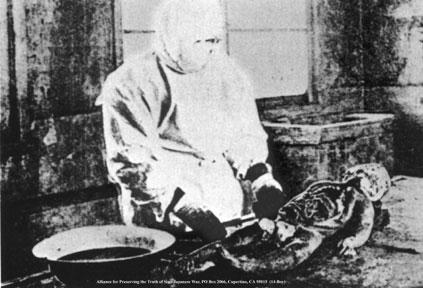
Figure 1.--The Japanese developed biological weapons at Unit 731, a sorawling research favility at Harbin in Manchuko--Japanese occupied Mnchuria. The work included experimentation on live subjects. The numbers killed are not known with any precision, but may have totaled as many as 0.2 million civilians and military POWs. Most of the individuals used for the experiments wrre Chinese and Korean nationals, primarily because they were the people most accessable. People selected for these experiments included children. Some Pacific Islanders as well as Allied POWs were also used for the experiments. Here is a child used in the experiments, probably a Chinese or Korean child. The Japanese experimenters first infected the child with a biological pathogen and then disected him or here alive to determine the effect on organs.
The World War II combatant countries all had stock piles of poison gas in World War II, but unlike World War I did not use them. The only exception was the Japanese who extensively used both poison gas and biological weapons in China. There is no precise data on the extent of usage because the Japanese tried to cover it up after the War. Assessments of the Japanese WMD program suggests that vuctims amounted to some 0.2 million people, mostly Chinese, including soldiers, POWs and civilans. The Japanese also used Pows and Chinese civilians to test these weapons. They did not use them against the Americans in the Pacific. The difference presumably is that the Chinese did not have chemical and biolgical weapons or developing them. The Americans did as well as a far greater capacity to use them. The Japanese were also working on atomic weapons, but accounts differ as to just how much progress they made.
Chemical Weapons
Only limited information is available on the Japanse use of poison gas during World war II. One Japanese source reports that between fiscal 1937 and 1941 a total of 839,956 chemical shells were shipped overseas. Of these, 571,946 were sent to China and the remaining 268,010 went to Southeast Asia. Even larger quantities may have been shipped in 1942 and 43, but records are not available. [Tsuneishi] The Japanese appeared to have used poison gas extensively in China. The Japanese Imperial Army used poison gas in battles against Chinese troops. Reports from the Nanking Masacre indicate that this was one of the ways prioners were killed after the fall of the city (1937). The Japanese murdered all of the Chinese prisoners they took, except those who went over to the Japanese side. The Japanese killed POWs in a variety of ways such as beheading, live burials, bayoneting, shooting, dirowding, and other ways. We have no data on the mumbers killed with poion gas. The Japanese used in developing more lethal gases. A former member of Unit 731 who insisted on anonymity said he was taken on a 'field trip' to the Unit's 'proving ground' to watch a poison gas experiment. [Kristof] Recent historical research suggests that in 1945 the United States was preparing for the introduction of chemical weapons ro support Operation Olympic, the planned invasion of Japan. [Allen and Polmer] The weapons, however, were never employed. At the time the United States was fire bombing Japanese cities causing massive civiloan casualties. Atomic bombs were dropped on Hiroshima and Nagasaki (August 1945) finally causing Japan to surrender (September 1945). After the War, the Imperial Japanese Army usually buried chemical weapons stockpiles when they evacuated China and Korea.
Japanese medical units in Manchuria experimented with biological warfare. The Japanese work was conducted at Unit 731. This was a spraling secret 6 kilometer-square complex on the outskirts of Harbin--the capital of the rich agricultural and coal region of Hailongjiang Province in what was known as Manchuko at the time (Japanese occupied Manchuria). The commander of the Unit was Shiro Ishii. The Unit focused on developing biological weapons, but was not limited to this area. There were tests on other weapons systems as well as work on how injured Japanese soldiers could best be treated. The Japanese researchersc at Unit 731 are believed to have killed large numbers of individuals they used for their experimentation. The numbers killed are not known with any percission, but may have totaled as many as 0.2 million civilians and military POWs. [HBC note: The 0.2 million figure may include both chemical and biological agents. Acailavke assessments are conusing on this.] Most of the individuals used for the experiments wrre Chinese and Korean nationals, primarily because they were the people most accessable. People selected for these experiments included children. Some Pacific Islanders as well as Allied POWs were used in the experiments. Most of those inflected for the experiments died or were killed. Some 0.1 million people may have survived. One historian writes, �These scientists had a weird sense of humor. They referred to their victims as �matures�, which, loosely translated, is logs, and that�s how they thought about them, as pieces of wood, not as humans. They could cut them up; they could burn them in a fireplace� If they ran short of candidates, the secret police would just literally sweep the streets of the city and pick up enough candidates for the lab.� [Harris] The experiments included amputations, germ warfare tests, explosive weapons testing, and other horrors to advance the Japanese war effort. Subjects at the Unit were subjected to vivisection--disected allive without anesthetic. Apparently the Japanese army doctors believed that this method produced the highest quality organs. There were also reports of cremations of live subjects after the experiments were completed. More than 400 villagers died of bubonic plague in China's eastern Zhejiang province during September 1942. Japanese planes with bombs prepared by medical Unit 731 dropped germ bombs. Unit 731 was active until the Soviet Union entered the war by invading Japanese-occupied Manchuria (August 1945). The Unit is known to have introduced typhus into the water supply flowing into Manchuria. Unit commander Ishii and most of his staff escaped back to Japan when the Soviets invaded. Ishii was apparently protected by Americam military officials in exchange for the data he collected. (This was a secret arrangement and it unclear how much the officers masking the deal knew about Unit 731 or how high up the chain of command the decession went. The Chinese and Soviets managed to arrest and try about a dozen members of he staff each. China has turned the buildings into a museum as a memorial to the people killed there.
There are many unanswered questions about the German atomic bomb program. Even less is known about the Japanese program. The Japanese were also interested in nuclear weapons. Japan had nuclear scientists who learned about the German expeiments and were aware of the weapons potential. Both the Japanese Army and Navy has small atomic weapons program. There is considerable controversy concening the progress made. The Japanese began mining uranium at Konan, North Korea. The mine an research facility was seized by the Soviets after they declared war on Japan (August 1945). Konan is now the source of the uranium for North Korea's atomic bombs. Unlike the Anglo-American relationship, there sees to have been relatively limited scientific cooperation between Germsany and Japan. What did occur was primarily German technology delivered to Japan. The Germans at first wanted to be paid. And they were concerned about the future relationship between the two countries. As the War went against Germany, the Germans were more willing to transfer technology. The problem was how to transfer it. Mine laying submarines were converted to carry cargos. We know that shipments took place, because of German accounts and the fact that German submarine crews were found in Japan after the War. And more importantly, one of the submarines, the U-234, surrended to the U.S. Navy after the NAZIs surrenderd (May 1945). It contained enriched uranium as part of the cargo. Just what cargos got through to Japan earlier is not known with any surity. The U-234 incident clearly shows that uranium was a priority concern of the Japanese by the end of the War.
Post-War Discussions
After the War, Japanese officals have generally attempted to limit public discussiion of the use of poison gas and biological weapons as well as other Japanese attrocities during the War. Some Japanese educators believe that there should be a fuller discussion. Prime Minister Kozume as well as Chinese and Japanese courts are currently wrestling with this issue. The Chinese are demanding that Japan compensate Chinese for injuries sustained because if these weapons and not only pay for the destruction of weapons found, but also assist Chinese authorities to locate other sites where the weapons were buried and pay for their disposal. [Tsuneishi]
Emperor Hirohito's Knowledge
Thw question arose after the War of Emperor Hirohito's knowledge and support for Japanese attrocities and war crimes. The Japanese were able to destroy emense amounts of domunentation before the American occuption forces arrived. Also the generals refused to give evidence against him. There is no doubt that the mperor was fully complicit in Hapann's planning and execurion of aggressive war. It is not known that the E,peror gavehi approval for all majorgovernmental actions. It may be true that out of fear for his persona;l safety and the imperil system that until the atomic bombs were dropped, he hesitated to challenge the military That said, it was his responsibility as emperor to rue and act in the vest interest of the Japanese people. The next question is how much he knew about Japanese attrocities and war crimes and to what extent he authorized such actions. This is impossible to answer becuse if the destruction of documentation and the refusal of Japanese generals, including convicted war criminals, to give evidence against the Emperor. We do not know the extent of the Emperor's knowlege of attrocitis and war crimes, but we do know that he had sone detailed informtion. We know this because his brother, Prince Mikasa, provided him extensive information including personal observations from his service in China as well as film's concerning the infamous Unit 731. [Bix]
Sources
Allen, T.B. and N. Polmar, "Poisonous invasion prelude," Pittsburgh Post-Gazette (August 4, 1995). [New York Times special features].)
Bix, Herbert. Hirohito and the Making of Modern Japan (New York: Harper and Collins, 2000).
Harris, Sheldon H. Factories of Death: Japanese Biological Warfare, 1932-1945, and the American Cover-up (New York and London: Routledge, 2002), 385p. Harris is a noted expert on Section 731.
Kristof, Nicholas D. "Unmasking Horror -- A special report. Japan confronting gruesome war atrocity," New york Times (March 17, 1995).
Tsuneishi, Keiichi. "Disposing of Japan's World War II Poison Gas in China" Asahi Shimbun (November 10, 2003).