|
The United States along with Britain and France Japan oversaw an occupation with changed the nature of West German society. Most Germans readily admitted their country's responsibility for the War and ther honredous acts of the NAZI regime. The Allies instituted a thorough going denazification process, a process which continues to this day in Germany. The Allies also attacked the militarism of the old Prussian junker class which the united German state was built around in 1870. The Allies completely dismantled the NAZI regime and during military occupation reconstructed an entirely new political structure. In some ways the process was simplified by the NAZIs who although opposed to democracy had gone a great way toward the breaking down of class barriers and weakening the power of the Prussian junkers. The Germans were not without a tradition of democracy and parlimentary politics. Given the NAZIs success in dominating the German people and the thorouness of that domination, it seems perhaps surprising how readily the Germans adopted democracy. Perhaps the totality of the NAZI defeat and the spector of Soviet totalitarianism looming accross the border were major factors. What ever the reasons, the German took to political democracy and free-market economics. A relationship with America was forged in the Berlin Airlift (1948) and four decades of resistance to the Soviers and Warsaw pact. The results by all practical measures have been an overwealming success. Germany today is one of the most prosperous and democratic societies in the world. Germany unlike Japan was also occupied by the Soviet Union. The Soviet occupation policies in eastern Germany were very different than those persued in the wetern occupation zone. Austria was separated from Germany after the War and occupied by the Soviets and Western Allies.
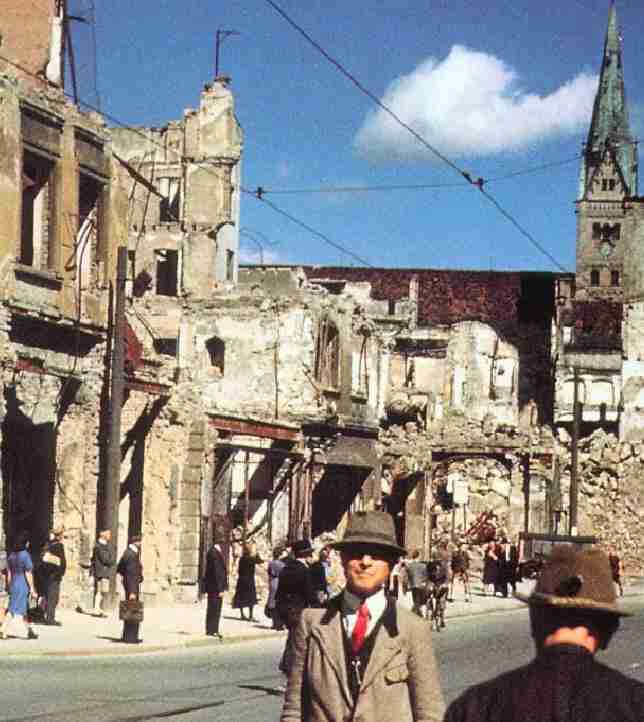
Germany was in ruins at the end of World War II. The scene here is what most German cities looked like. The American bombing campaign was based on daylight "precession" bombing based on the Norden bombsight. There was, however, no such thing as percession bombing in World War II. The weaponery that now allows pression targeting did not exist at the time. Most of the bombs dropped in the War did not hit the intended target. German factories were mostly located in cities. The cities with important industrial factories were thus devetated. And towns and cities with rail marsheling yards were also targetted. A German reader tells us, for example, "The photograph you show here is of course not the
Messerschmitt plant but the area around the Augsburgian Abbey located at some distance from the plant." The British made little pretense ar precision bombing. RAF Bomber Command bombing at night could not even begin to target specific plants. The British adopted a strategy of area bombing, essentially disrupting the German economy by destroying German cities. It was the German Luftwaffe which began the targetting of civilian populations and the use of terror bombing. Once America entered the war, the Allies were able to amass air armadas that wreaked destruction on Germany beyound what the Luftwaffe was ever cabable. The Allied strategic bombing campaign after the War has been questioned. Few Europeans sympathized with the Germans in 1945 after what thy had done. What ever the readers assessment of this debate, it is clear that the German civilian popuaion, including women and children, suffred horibly in the bombig and German cities and industry was in ruins.
Most Germans readily admitted their country's responsibility for the War and ther honredous acts of the NAZI regime. The primary crime was waging aggressive war. But many countries in the past had done this. What set the NAZIs apart historically were what horrendous crimes they committed once they occupied a country. Accounts from German concentration camps defy belief. The Holocaust perpetrated against Jews and other groups targeted by the NAZIs is perhaps the best known NAZI crime. Less well known were the crimes against other groups such as the Slavs and the apocalitic NAZI vision in the East, a vision that they began to implement in Poland. There was also the NAZI slave labor program as well as the mistreatement of POWs, especially Polish and Soviet POWS. Almost unknown today is the Lebernsorn program of kidnapping children for Germinization. It should not be thought that the NAZI horrors were only perpetrated against non-Germans. Many of the horrors perpetrated in the captive nations were outgrowth of programs in Germany associated with eugenics that involved sterilizing mentally or handicapped children.
Soldiers from five different countries smashed into the Reich to finally destroy the Third Reich. All had very negative attitudes about the Germans. Most had lost buddies and comrads as they fought their way across Europe from different directiins toward the Reich. The Red Army soldiers moving west found trerrible attrocities commited against civilians even before they reached German labor and concentration camps. They were thus primed with a smoldering hatred of the Germans well before they crossed the boundaries of the Reich. This was less true of the Western Allies moving east. But the occasional attriocities in France became more pronounced in Belgium during the Bulfe offensive. And then after crossing the RHine, American, British, Canadian, and French soldiers began liberaring concentration camps with terrible scenes. There was this little sympathy for the Germans as the occupation began. In the Soviet occupation zone this dioes not change. The barbarity of the NAZI oocupation and the massive death toll was ot something that could be soon forgotten. Stalin permitted several days during whivh the Red Army soldiers were unleased on the German people. Men were shot for virtually no reason or forced to watch their wives and daughtwrs be raped. Many men and women cimmitted suiside. And even after this outburst of violience, very strict rules about fratenization prevented any bonds of friendship from developing. Soldiers from the Western Allies behavec differently. That is not to say there was no rapes or stealing, but it was at a much lower level and not officially santioned. The French having endured 4 years of German occupation wre the mkost severe with the Germans. The Americans were the least severe. American GIs had no need to forcibly rape women, they had foodm chocolates, cigarettes, anf nylons to buy the affections of hungary Frauleins. The Americans also had rules against fraternization. But without draconian Soviet-style enforcement, it was impossible to keep hrathly GIs and lonely, hungary German women apart. A real kicker here. The German kids quickly worked out that no only did they not have to fear the Americans, but there was chewing gum and chocolate to be had. And unlike the adults for which many GIs harbored ill feelings, the kids were hard to resist. Thus slowly the American GIs and German peopke began to slowly weave a friendship, and one which was solidified during the Berlin Air Lift and would prove to be the primary block to Soviet Agression as the Cold War developed. The Cold War begn and ended in Berlin. And Stalin essentially lost it by the brutal policies he adopted in the Soviet occupation zone. The policies were not substantoally different than elsewhre in the Soviet Empire, but in Germany the Western Allies occupied half the country. Of course matter pf policy were made at high levels, but the personal relationships forced at the infiovidual evels sgould not be ignored.
It is not altogether clear what the German people thought about the NAZI Government immediately after the War. Losing the War is not the same as thinking your country was wrong. The Ameruican South after the Civil War is the best example of this. We think it is fair to say that most Germans believed that Hitler had been a disaster. The stark evidence of massively destroyed cities was mute evidence all around them. But this is not the same to say that the Germans believed that the NAZIs were wrong or even criminal. Many if not most Germans certainly believed that Hitler had made mistakes. Generlly that was going to War or invading the Soviet Union and declaring war on the United States. Most Germans did not believe, however, that the NAZIs had been criminal. We note for example what a Major Philipp von Boeselager told his wife after the War. (Major Boeselager on Field Marshal Gunther von Kluge's staff was one of the few surviving members of the 1944 plot to kill Hitler. He supplied the explosives used.) After the War he did not speak out about his role. He and the other bomb plotters were not seen as heroes. The reason was as he explained it, "For a long time, it was not believeable to normal Germans that their government was criminal. And as soon as one thought they had pushed that out of the way, then people just didn't want to know." [Associted Press] There are several reasons why Germans after the War did not see the NAZIs as criminal.
A whole other issue was the future. The Germans were now occupied by two different groups--the Soviet Union and the Western Allies (who at first had separate occupation zones) who had aklmost nothing in common other than a desire to defeat NAZI Germany. Unlike NAZI Germany, neither the Soviets or the Western Allies were intent on genocide. Thus after the shock of defeat had passed, the Germans began to realise that they would have to throw their lot in with either the Soviets or Western Allies--esentially the Americans. This is not the simple choice it may seem today. The Communists were ann important Party before Hitler seized control of Germany. And their was suppot for Marxist udeas among the Socialists who were the pricipal party in Weimar Germany. Socialt thouught was particularly pronounced among German workers. German loyalties could have gone either way especially because it was not yet clear that America would not withdraw from Europe as it had done after World War I.
Many Germans bridle at the depiction of Germans in movies, especially Hollywood films. Probably no other country has had so many films made about it by foreign film makers as Germany. Given the importance of Hollywood, popular images of Germans are in large measure influenced by these foreign depictions. This is perhaps difficult for Americans to understans as almost all important American images come from American-made
television and movie programing. Many of those film focus on the NAZI and World War II film. HBC is struck by the lack of realism in these films. Many films, especially films made before the end of the War did not begin to display the true horror of what went on in Germany or the occupied countries. Many of the depictions of Germans in these films are
perhaps understandably unflatering charactures. Relatively few films have sought to show German characters as real people. HBC has wondered how Germans viewing World War II films view the scenes of American and British tanks entering German towns and villages. Most Germans would today at least intelectually say that they were liberated from the NAZI tyrany as much as the occupied countries. (The experience was different in the areas occupied by the Red Army.) We are curious, however, if the emotional reaction is perhaps not different from the intelectual reaction.
The Volksdeutsche are German people who emmigrated to East and South Europe, but kept their language and customs. German minorities used to live throughout Eastern Europe and Russia. They were incouraged to emmigrate by Austrian emperors to help secure their control over lands liberated from the Ottoman Turks. Some Russian Tsars incouraged German German immigration to help develop and modernize their vast country. Catherine the Great (herself a German) played a major role here and thus German populations have existed in Russia for several centuries. These German minorities lived in these countries for centuries, but many did not assimilate or drop the German language. Often they even mainatin separate schools. While the Austrian-Hungarian Empire existed many lived in the political structure of a German-speaking Austrian monarchy, but this changed in 1918-19 with the collapse of the Austrian Empire as well as the loss of German territory. Many Germans found themselves under the control of newly independent countries. When the NAZIs
came to power in 1933, the Volksdeutsche proved a useful political issue and a way of justifying German territorial claims. The history and situation of the Volksdeutsche varied idely from country to country. Some like the Sudeten Germans or the Germans in Silesia were indestinguishable from actual Germans. Others like the Volksdeutsch in Russia had developed a desinctive culture. The fate of the Volksdeutche is one of the many depressing stories of World War II. They are referred to today in Germany as " Vertriebenen " (expelled ones). Nearly all lived in countries invaded and occupied by NAZI Germany. Many but not all participated in NAZI genocidal or explotive programs to colomie the occupied East. As a result, both the Russian Army and partisans targetted them as the Wehrmacht was forced to retreat. Many wisely fled with the Wehrmacht.
Others were reluctant to leave the farms and towns where their families had lived for generations. After the Wehrmacht withdrew and after the end of the War, millions of these ethnic Germans were murdered, deported or otherwise ethnically cleansed. Many first hand accounts describe the violence directed at those of German ancestry. A great deal of documentation was gathered by the German Wehrmacht War Crimes Bureau. (Yes, the Wehrmacht was collecting evidence of war crimes.) There are many incidents of unimagined savegery. There were women crucified in Nemmersdorf and the wholesale murder of children.
German children through the Hitler Youth played an active part in World War II. The Hitler Youth movement was in fact a major support for the German war effort, both on the home front, supporting the anti-aircraft defense against the Allied bombing campaign, and actual combat roles with the Wehermacht and Volkstrum. After the war, however, there
were large numbers of displaced children in Germany as well as the countries that the Germans had occupied. The displaced children were the orphans resulting from battlefield deaths of partents as well as deaths from the Allied bombing campaign and the fighting in the final months in Germany. Many more oprphans were created in the caotic
poupulation transfers from the German populations that had lived in East Prusia, Silesia, the Sudetenland, and other areas in the east. Many Germans relaized that because of the NAZI atrocities, Germans could no longer live in Poland, Czecheslovakia, and other easter European countries. Many who did not understand this lost their lives in bloody reprisals or were forcibly transported after the War. There was also the problem of the foreign
children brought to Germany under the Lebensborn program.
The suffering of the Germans during and after World War II is a largely neglected topic. Compare for examle the huge body of British literature on the Blitz and the
evacuation of British children from London and the industrial cities with the very linited literature on the plight of German civilians during the Allied air assault and the
evacuatioin of German children. This is especially surprising given the fact that even more Germans were killed (about 0.8 million people) than Britains during the Blitz. The handicapped German children killed and sterilized by the NAZIs and the huge number of refugess from the east who died add to the astonishing tragedy of the German people. Much of this is not well known. This is in part because give the emensity of NAZI crimes committed in the name of the German people, that many Germans did not feel that they had a right to compalin. Only a few German authors have addressed this toopic. The best known novelist is G�nter Grass, noted for Tin Drum. His latest novel addresses the plight of the East Prussians fleeing west and the tragedy of the Wilhelm Gustloff.Only at the turn of the 21st century, after half a century, have German authors began to deal seriously with the suffering of the German people.
Germany began World War II as the most heavily industrilized country in Eyrope. Britain and France combined had a greater industrial output, but only the United States had a greater industrial base. (Soviet industrial capcity is more difficult to assess, but was probably comprable to German production.) Germany's industrial infrastructure was not just severely damaged by the Allied strategic bombing campaign, it was virtually obliterated. The damage in the cities, especially the large industrial cities, was devestating. During the battle of Britain, a German raid of medium bombers was notable. For the Allies by 1944, raids with 1,000 heavy bombers was not unusual. Most German cities were left vast mounds of rubble. Germany's industry at the time was located in the cities, in part because the workers had to live near the factories. Cars in Germany, and the rest of Europe, were beyond worker's incomes. The bombers primarily targeted industry and specialized targets like the synthetic fuel plants which were not located in the cities. World War II began at a time that that air force commanders had still not worked out how best to employ their assetts. The Germans worked out tactical mrthods. It took longer for bomber commanders to work out the best use of their assetts. Allied commsanders noy only grasped the Germam Achieles heel--petroleum, but had a huge bomber force to hit virtuslly any target in force. Thus the synthetic plants along with the transportation netweork became priority targets. The introduction of the long-range P-51 escorts not only allowed the Allies to escalate the bombing, but the fighters on the way home went down to the ground and began hitting smaller targets, especially the transportation network outside the cities. Much of the destruction took place fairly late in the war, especially after the D-Day breakout when General Eisenhower relinquished control of the American and British bomber forces. The German war ecoinomy proved resiliant throughout most of the war, but finally befgan to collapse under the weight oif the bombing and loss of occupied countries to plunder (November 1944). Some damage was caused by the fighting as Allied ground forces closed in on the Reich. Excepot for Berlin, however, this was limited compared go the descrution resulting from the strategic bombing campign. Hitler at the end of the War ordered that the infrastructure that survived the bombing to be destroyed as the Allied forces approached, the same burnt earth strategy persued by the Soviets. Speer and some other NAZI officials tried to prevent the implementation of this order or ignored orders from Berlin. After the NAZI surrender, some NAZI diehards planned a campaign of sabatoge. This did not occur, but in fact there was not a lot left to sabotge. And in the Soviet occupation zone, much of what survived the bombing, was loaded on rail cars and shipped east as war reparations. The Soviet zone was the least indistrialized area of Germany and the reparations would contribute to East Germany's inability to compete with West Germany. As a result, Germany's industrial infrastructure would have to be essentially rebuilt from scratch. Most observers at the time thought that it would take more than a generation.
Many believe that after the NAZIs surrendered (May 1945) that all German resistance suddenly ceased. This was not the case. There were NAZI attempts as resistance and the Allies had to take measures to deal with the resistance from various German groups. The NAZIs in the closing months of the War organizated operations like the "Werewolves" to disrupt the occupation. Most of the Werewolves were Hitler Youth boys. There were incidents of Allied soldiers ambushed by Werewolf boys and incidents between Werewolf partisans and Allied forces in the closing days of the War. American soldiers leaflets detailing plans on how to undermine the occupation through sabotage and other measures. The NAZI resistance efforts proved ineffective. Given the level of support that the NAZIs built up, this seem rather surprising. The NAZI resistance effort failed for a variety of resons. One, the destruction as a result of the War changed the mind-set of many Germans. Two, relevations of NAZI war crimes also had a major impact on German thinking. Three, Germany was so devestated that the Germans were dependant on American food aid. Four, the nature of the Western Allied occupation did not generate resistance nd ill will. Five, the nature of Soviet behavior had the result of making the Americans look more like protectors than occupiers.
The Allied occupation of Germany proceeded differently in the Soviet and Western occupation zones. In the Soviet or Eastern Zone there were numerous rapes of German women in the first days of occupation. This was rape on a massive scale and included children and elderly women. Large numbers of pregnacies must have occurred. I am not sure if the women involved sought abortions or how they viewed the resulting children. After the first days of occupation Red Army brought their soldiers under control. Looting continued for some time. The Government persued a policy of reparations which included shipping whole factories to Russia. Soviet occupation forces were not supplied like the Western forces and there was much more living off the land. [Dulles] The Western Allies initially has separate occupation zones. Initially the were to be a British and an American zone, but plans were changes to accomodate a French zone. Ther were some differences in the three Western zones, but faced with Soviet pressure the Western Allies eventually combined their zones. The most immediate problem was food. About 60 the population of Germany were in the French, British, and American zones. Before the War, only about 40 percent of the food was produced in the west and the War damage had significantly impaired food production.
The Allies instituted a thorough going denazification process. The process was handed over to the Germans in 1948. The Allies also attacked the militarism of the old Prussian junker class which the united German state was built around in 1870. A substantial number of NAZIs and war criminals were arrested, but realtively few actually procecuted. The German Government continues anti-NAZI policies to this day in Germany. The denazification process was not particularly successful in convicting NAZIs and war criminals, but in a larger sence in succeeded in helping to convert Germany into a democratic nation.
About half the top leadership of the SS managed to survive or disaapear. This included Eichmann's deputies and the commanders of the Einsatzgruppen. The principle that membership in these and other convicted organizations was prima facie evidence of guilt was not sustainable after the immediate post-war years. The crimes of the NAZIs, including the Holocaust were of such magnitude and involved so many Germans and colaborators throughout Europe that normal juridical mechanisms could not possibly cope. Many high-profile defendants were judged at the Nuremberg Trials. Some of the most vicious pepertrators of attrocities were never tried or sentenced. These included Obergruppenf�hrer Karl Wolff (considered as a possible successor to Heydrich), Hinrich Lohse (Rosenberg's commissioner of the Ostland). Even of those found guilty, the United States set up a clemency board which reduced numerous sentences. Most of the guilty simply blended into the German population after the War. The results of the post-War trials are revealing. There were about 3.5 million Germans charged before the denazification courts established by the Allies. Less than 1 million were actually brought to trial and of those brought to trial only 9,600 (including Schacht, Papaen, and Fritzshe) were ever encarcerated. And the courts by 1949 had freed all but 300. [Conot, p. 518.]
After the Anschliss, indepedent Austria became part of the Reich--Ostmark (1938). The Allies after the War separated from Germany and occupied by the Soviets and Western Allies. Like Germany itself and Berlin, there were four occupation zones, although the Western Allies eventually unified their three zones. Many Austrians claimed that they were one of the oppressed occupied nations and should be treated differently than Germany. Many view Austria as a not onlt a willing collaborator, but an enthusiastic suppoter of Hitler and the NAZIs. The same de-Nazification process was conducted in Austria as in Germany. The Austrians agreed ot to unify with Germany or allow the Hapsburgs to return. There were also protections for ethnic minorities. Austria's neutral status and a provision prohibiting foreign military bases were incorporated in the Austrian Constitution (October 1955). Soviet troops withdrew from Austria (September 1955) and a smaller number of Western troops (October 1955). There is in Vienna a large monument honoring the Red Army. It is located on the grounds of a public building in Vienna. The Soviets conditioned their withdrawal from Austria in part by requiring that this memorial not be removed or altered in any way. The Austrians had the last say, however, by constructing an enormous fountain whose spray of water effectively overshadows the Soviet monument!
The Allies decided to try NAZI war criminals in Nuremberg. This was in part a symbolic gesture because Nuremberg was the heart of NAZI Germany, but the palace of justice in Nureberg was on of the few facilities left standing in Germany large enough to accomodate the proceedings. Nuremberg was location of the annual NAZI Party Congresses. The chilling film, Triumph of the Will depicted one of these congresses. There were other reasons for holding the trials in Nuremberg, one in particular was that it wa in the Western zone. The first trial of the NAZI leadership was held from November 20, 1945 to October 1, 1946. The International Military Tribunal (IMT) convened in the principal courtroom for criminal cases (room No. 600) in the Nuremberg Palace of Justice. It was the scene of many NAZI show trials. Allied leaders during the War had agreed to pprosecute those responsible for war-crimes. President Harry S. Truman designated Supreme Court Justice Robert H. Jackson as the U.S. representative and chief counsel. He planned and organized the trial procedure and served as Chief Prosecutor for the United States. It was Jackson who recommended Nuremberg as the site for the trials. The Soviets wanted the trials held in Berlin. A compromise was reached. Berlin was to be the permanent seat of the IMT and that furture IMT trials could be held in Berlin. There were no further IMT trials, however, because of the Cold War. There were further trials, but none cinducted by the Soviets and Western Allies jointly. Each of the four Great Powers (England, France, the Soviet Ynion, and the United States)provided one judge and an alternate as well as the prosecutors. The first session of the International Military Tribunal was opened on October 18, 1945, in the Supreme Court Building in Berlin, which had become the seat of the Allied Control Council. Soviet judge, Iola T. Nikitschenko presided over the opening session. The prosecution
presented indictments against 24 "major war criminals" and against 6 "criminal organizations": Hitler's Cabinet, the leadership corps of the Nazi party, the SS (party police) and SD (security police), the Gestapo, the SA and the General Staff and High Command of the Wehrmacht.
The German economy supported the NAZI war effort until the fall of 1944 when as a result of the Allied Strategic bombing campaign and because the advance of Allied armies meant that the NAZIs could no longer plunder the resources of the occupied countries By the time that Admiral Karl D�nitz surrendered the Reich, the country's economy had virtually ceased to function (May 1945). The land, homes, and property of the German people lay in ruin. Germany had begun the War with bombing cities and creating hordes of displaced civilian refugees. Industrial Germany was destroyed. The Allied Stratehic bombing campaign had left German cities piles of rubble and the cities of course was where the factories (which had been the targets) were located.
Germany was devestated by the War. German cities were piles of rubble Millions of husbands and fathers were dead or in POW camps. (Few of thise in Soviet POW cams would ever return.) Hundreds of thosands of civilians killed and women raped. The numbers were lower than in the countries they pillages, but they were still very substantial. At the end if the war it was German civilans clogging the roads as refugees. And ethnic Germans being driven out of neigboring countries where they have lived for centuries. Millions were forced to flee from the East abandoing homes and farms with nothing but the clothes on their backs.
And if all that was not bad enough, poor harvests and the breakdown of the transportation network threatened famine and starvation in the cities. The Germans had used similar circumstances in the occupied countries as part of their Hynger Plan.
The Soviets in their occupation zone began carting off the factories that survived as war reparations. This meant that not only was Germany no longer producing industrial products, but there were no longer jobs for German workers. The country side was less damaged, but the Allies had also targeted the transportation system, espeially the rail network. This meant that there was no way of transporting food from the countryside to the cities. And even in the countryside food productin plummeted because there were so few men acailable to run the farms. (During the War the NAZIs used POWs and slave labor from the occupied countries to maintain farm production.) Transporting coal was also a problem and most Germans used coal to heat their homes--if they still had a home. The first 3 years of the occupation were thus a time of poverty and a difficult struggle meerly to obtain the most meager amount of basic food to keep alive. Only American food shipments precented starvation. Tens of millions did not have enough to eat or to wear. Inflation raged. The German currency plummted in value. Germany beecame essentially a barter economy. Items like American Camel cigarettes, Hershey chocolate bars, Parker pens, nylon stockings, and other consumer goods became the preferred currency. The best use of money were cigarettes. (From the end of the war to the new DM exchange, the cigarettes would bring $100 per carton on the black market.) One assessment at the time estimates that the average German worker would be able to purchase a plate every 5 years, a pair of shoes every 12 years, and a suit every 50 years.
The German and Austrian World War I effort was undermined by the failure to ensure that food production was maintained. Conscription depleted farm labor and harbests declined. Hitler was determined that this mistake woulod not be repeated. Thus he used POWs and foreign slave labor to maintain farm production. German farms of any size had foreign workers. Frencvh POWs were extensively used fir farm labor. When Allied armies entered the Reich, these foreign workerswere liberated and immediately left the farms. Those from the West wereabkle to make their way home. Those cfrom the East were carted for in DP camps. At any rate tghey were off the farm. And they were not replaced by Germans. Many German men were killed or injured in the War or in Allied POW camps. Thus after April 1945, there was a substantial shortage of farm labor both to plant the crop and to harvest it. The result was a very serious food shortahe in Germany suring the winter of 1945-46. The allies did not do this to punish the Germans. You could hardly expect the Allies not to liberate POWs and slave laborers. The sane situation existed in 1946, although not as seriously as in 1945. Only in 1947 as the POWs were released by the Western allies and returned home did German good production begin to recover.
The German economic collapse only began to change amist a complex mix of the German industriouness and technological capabilities, Ludwig Erhard's vision, enligtened American administration, the Marshall Plan, currency reform, and the Berlin Airlift. The Soviets had a very simple plan to deal with this-=reparations. Whole factories which survived the bombing were shipped back to the Soviet Union o help replced the factories destroyed in the War. The Western Allies had, however, no set policy. There was talk of de-industrialing Germany--the Morgenthau Plan. This was, however, never instituted. The Western Allies and the democratic politicans that they returned to power were first primarily focused on preventing starvation in the war-ravaged country. Meanwhile offivials debated about the future. Economists estimated that it would take a generation, perhaps longer to rebuild the country. Food and good coninued to be rationed. Different economic models were debated. Germany under the NAZIs had developed a highly regulated econmy with extensive government restrictions and regulations. Two alterntive paths devloped as part of these dudscussions regulations. The best nd brigtest minds in Germany worked with American and other Western occupation authorities. One approach was tgo ciontinue heavy NAZI regulatgion policies. This was the approach favored by Socialist politicans and labor unions which were allowed to reorgznize. It involved government regulations and controls and a soft currency. The other suggested path was a free market approach with reduced government restrictions as well as a hard monetary policy which required currency reform. Currency reform thus becameame a central feature of the debate. The Soviets in particular opposed the currency reform. Ludwig Erhard plyed a key role in developing the German Economic Miracle and became Chancellor Konrad Adenauer's Minisy\ter of Economics. He was stronf\gly influenced by the work of Wilhelm Roepke, an important economist who devedloped a theory of Soziologischer Liberalismus. A key factor was that Germany was bankrupt And unable to borrow money. Thus massive stimulus was not an option and could not be used in ssence to buy votes as occurred later by European socialists. Rather the Germans had to fall back on themselves and hard work. The factories were smashed, but vast technological expertise and a trained work forse existed. The financing provided by the Marshall Plan resulted in the jump starting of the economy that we today know at least in West Germany as the Wirtschaftswunder--the German Economic Miracle.
An American GI at the time tells us, "At that time clothing was practically unavailable and German boys wore shorts all the time. I estimate 80 to 90 percent of the boys to the age 18 years plus wore short Pants. Even in the coldest climate I saw many boys wearing shorts and some had long wool stockings that they were able to cover their legs. In Bavaria almost all boys wore lederhosen. I remained in Europe until 1948 and after the Marshal Plan was implemented is when you saw a change in their economy whereby boys were able to get new clothing."
The occupation of Germany was signoficantly impacted by advent of the Cold War. Suddently Americans began thinking more about the advantages of a strong Wst German partner than punishing NAZIs. The United States and its allies following World War II fought a 45-year struggle war with the Soviet Union and China. The War pitted the ideals of Western democracy and free enterprise against totalitarian states with command economies. At stake was the future social order of mankind. Germany's defeat left Stalin in control of the countries of Eastern Europe. President Harry Truman when he became president in April 1945 began taking a stronger approach to the Soviets, disturbed by Soviet actions in Poland. Stalin proceeded to install People's Republics in these states which meant Stalinist police states subservient to the Soviet Union. American and European democracies sharply criticised the Soviet actions. Winston Churchill warned in 1946 that an "iron curtain" was descending through the middle of Europe. Joseph Stalin who had virtually allied himself with Hitler in 1939 to launch World War II, blamed the War on "capitalist imperialism" and threatened Western Europe. President Truman decided to support Western Europe economically (the Marshall Plan) and militarily (NATO). The Cold War was a period of intense East-West competition, tension, and conflict, but always short of full-scale war. The first major episode was the Soviet blockade of Berlin in 1948. Berlin was during much of the Cold War a focal point of the conflict. The Soviets brutally suppressed attempts by Eastern Europeans to overthrow Soviet imposed governments: East Germany (1953), Poland (1956), Hungary (1956), and Czechoslovakia (1978). There were proxy wars and competition for influence in developing countries, many of which introduced Soviet command economics. There was also an arms race between the two super powers. After Stalin died in 1953, the Cold War became more unbalanced. There were periods of relaxation followed by resumed confrontation. The most dangerous point of the Cold War was the Cuban Missile Crisis (1962). There were efforts to pursue detente during the 1970s. Unlike the other major conflicts in world history, in the end the Cold War was not settled by force of arms. It was the example of the West, especially the success of free market economics and political democracy that defeated Communism. Not all historians agree that the Cold War was necessary and that the foundation of Western democracy was at stake.
The Allies completely dismantled the NAZI regime and during military occupation reconstructed an entirely new political structure. In some ways the process was simplified by the NAZIs who although opposed to democracy had gone a great way toward the breaking down of class barriers and weakening the power of the Prussian junkers. The Germans were not without a tradition of democracy and parlimentary politics. Given the NAZIs success in dominating the German people and the thorouness of that domination, it seems perhaps surprising how readily the Germans adopted democracy. Perhaps the totality of the NAZI defeat and the spector of Soviet totalitarianism looming accross the border were major factors. What ever the reasons, the German took to political democracy and free-market economics.
Germany unlike Japan was also occupied by the Soviet Union. The Soviet occupation policies in eastern Germany were very different than those persued in the Wetern occupation zone. There were in 1945 large numbers of people who believed fervently in Socialism. This was true on both sides of the developing Iron Cyrtain as well as throughout the developing world. The division of Germany by accident provided an easily observable test of the relative merits of capitalism and socialism. The Soviet Union had been successful before the War in preventing informtion about living conditions and economic trends from becoming known in the West. In German this was much more difficult, especially among the Germans themselves. The East Germans would eventually build a wall to isolate theur people, but most East Germans could receive West German and West Berlin radio and television. And despite endless state propaganda, the East Germnns wanted what they saw on West German television and judged their own country on that basis. East Germany was ironically the most prosperous country in the East Bloc, but they were up against West Germany, the economic dynamo of Western Europe. The difference shocked Communists, not only in East Germny, but in the Soviet Unioin as well. They had been convinced that Socialism would lead to an economic prosperity that cpitalism could not possibly match.
Europe is a Continent with a history dating back centuries. And that includes national antagoinisms deeply rooted in history. The French-German antagonisms emerged from the Medieval era. The antagonism with Germany was of more recent origins. Germany had not history of antagonism with America. In fact, huge numbers of Americans were if German ancestry. Americans in the 19th century admired the Germans and unlike an historical antagonism with Britain, there was no such ill will with the Germans. Germany strongly influenced American education. President Roosevelt even briuefly attended a Gernan primary school when his brother did university studies in Germany. World war I was the first real internatiinal conflict between Germany and America of any consequence. After the War, the Gernans while holding considerable animosity toward Britain and France, did not look in the sane way on America. During World war II, Germans were well aware that America had joined Britain in the strategic bombing campaign. And because large numbers of German workets had left-wing orientations, Germany was up for grabs in the developing Cold War. It was Stalin's brutality that determined the future of Germany from an early point. Red Army soldiers went on a orgy of rape and looting when they ebntered German cities. This alone cemented the image of the Soviet Union and Commubism in German minds. The more restrained occupation regime of the Western Allies began to create a new post-War relationship. This relstionship and utimtely the future of Europe was settled only a few years after the War. The cuurency reform in the West along with the Marshall Plan set the German Economic Miralcle in motion (1948). This interun led to Stlin's effort to force the Western Allies out of Berlin.
The German relationship with America was forged in the resulting Berlin Airlift (1948). America and Germany would be united in four decades of resistance to the Soviers and Warsaw pact.
The results by all practical measures have been an overwealming success. Germany today is one of the most prosperous and democratic societies in the world.
A new generation of Germans as well as others in Western Europe have begun to reevaluate their relationship with America. Since President Roosevelt and Primeminister Churchill met on board the Prince of Wales in 1941 to enunciate the Atlantic Charter, the United States and Europe have been united in a common shared vision of democratic socities. First under threat from the NAZIs and then Soviet Communism, America and Europe were united by a common threat. There was never total unity, but the great majority of people on both sides of the Atlantic were united in a common effort. The disolution of the Soviet Union and the end of the Cold War have changed the dynamic of the American-European relationship. Without a common threat the differing world views of Europe and America are
becoming increasiungly apparent. It is not that Europe feels threatened by America, bur rather many Europeans have come to renounce a world outlook which renounces force as an instrument of national policy and look to multilateral cooperation and negotiaion to resolve differences. Americans while reluctant to use force, are continue to see military force as sometimes necessary. The mass demonstrations in Europe during early 2003
illustrated the dimensions of the split with the United States. This has resulted in differing views on how to approach the problem of Iraq's weapn's of mass
destruction, but this this may be only the first of many major disagreements to come.
Young Germans are reeamining their past. They do not accept the previous reluctance to avoid a discussion of how Germans suffered in World War II. This is in part due to a lack of familarity with the totality of NAZI crimes. It is also due to the vert real fact that the Germans also suffered greviously in World War II. One German reader writes to us, " "Well, wars do just happen. But the same way crimes and accidents do just happen and everything is done to prevent or at least to keep them at a low number, everything should be done to prevent wars, too. Furthermore, wars are always man-made, so man should be able to prevent them. It is just a simple black and white creation. Strange, that this could work over centuries so very well, and now still works. World War II brought democracy to us, but at a high price. Towns were bombed, many of them being no military targets. And two nuclear bombs were thrown on Japan. Not to mention the thousands of people died on all sides. I think the price is too high." We suspect that many young Germans feel the same. To a large degree this opinion seems to be a rejection of war as an instrument of national policy. This opinion is widely shared by young people througout Western Europe. It is a major issue that separates America and many Europeans today.
Associated Press, ""Philipp von Boeselager, 90; took part in the plot to kill Hitler," Washington Post (May 3, 2000), p. B6.
Conot, Robert E. Justice at Nuremberg (Carroll & Graf: New York, 1986), 593p.
Dickinson, William. "Bremen, Vienna, Budapest get fierce mass air raid, " British United Press (September 5, 1942).
Dulles, Allen W. "That was then: Allen W. Dulles on the occupation of Germany" Foreign Affairs (November/December 2003).
Lucas, James. Kommando: German Special Forces of World War Two.

Navigate the CIH Worl War II Pages:
[Return to Main World War II aftermath page]
[Return to Main military style page]
[About Us]
[Biographies]
[Campaigns]
[Children]
[Countries]
[Deciding factors]
[Diplomacy]
[Geo-political crisis]
[Economics]
[Home front]
[Intelligence]
[Resistance]
[Race]
[Refugees]
[Technology]
[Bibliographies]
[Contributions]
[FAQs]
[Images]
[Links]
[Registration]
[Tools]
[Return to Main World War II page]
[Return to Main war essay page]