|
The people of London and other British cities paid a terrible price for defying Hitler. The first Luftwaffe attack on London killed 430 citizens and severely wounded another 1,600 people (September 7). The primry target had been the London docks which became the British target most heavily bombed by the Germans. Worker housing was located close to the docks and thus heavily hit in the attacks. The Luftwaffe struck London for the next 57 concecutive days. Many but not all of the children were evacuated again. Most of the adults had to stick it out. Air raid shelters had not been prepared for the entire population. The Government made materials available at low cost to build Anderson shelters in back gardens (backyards). Others had to find what ever shelter was available. Many left their homes in the evening and and took shelter in warehouse basements. Others sought shelter in the Tube (underground/subway) stations. The Government at first discouraged this. The people slept on makeshift beds amid primitive conditions with no privacy and poor sanitation facilities. The Luftwaffe returbed the following day and another 412 perople were killed (September 8). The Luftwaffe overall conducted 127 important raids on British cities from September 1940 to May 1941. Over half of these raids or 71 raids were on London. The Luftwaffe extended attacks to other British cities: Belfast, Birmingham, Bristol, Cardiff, Coventry, Glasgow, Hull, Liverpool (the main port where American and Dominion supplies were arriving),
Manchester, Newcastle, Nottingham, Plymouth, Portsmouth, Sheffield, and Southampton. The Germans suceeded in destroying 60 percent of the homes in London. Overall they destroyed 2.0 million homes, about 0.4 million in London. With so many homeless, ways had to be found to meet their needs. Casualties totaled 60,000 killed and 87,000 badly injured. More than half of the preople killed were Londoners. The population of central London was reduced 25 percent. In the ininital phase of the War, the German killed more women and children than British soldiers and sailors.
When London had not been targeted, many Londoners responding to appeals from their children brought them home. There was, as a result, large numbers of children in London and the other big cities. With the German Western Offensive (May 10), it soon became clear that London and other British cities would soon be within range of Luftwaffe bombers. As a result, plans were made for another major evacuation effort. Unlike the first one, it was not done all at one time, but more spread out as conditions unfolded in France. Again it was voluntary based on parental judgement. This time, however, there was an added complication. The children in 1939 had dutifully marched off as told not really knowing whst was in store. For many it was a lark, a great adventure. They had no idea they would be separated from their parents for an extended period. Now they were really in danger, but most of them knew just what to expect and many did not want to go through that again. Many children put up quite a howl and convinced their prents to let them stay. Any parents know just how difficult is is to deal with a teary child. The Goverrment organized evacuations after Dunkirk (June 13-18). This was well before the Blitz, the bombing of London. About 0.1 million children were evacuated. Others followed. And parents could seek to evacuate their children even after the major evacuations. In most cases they were revacuated. The number was smaller than in 1939 because many children had not returned from the first evscuation and other children had convinced their parents to let them stay. Other vulnerable people were evacuated like the elderly. There were also efforts to remove people from ther coastal Channel ports that fronted Germzn occupied France. Another 0.1 million children were evacuated later in June. Most of the adults had little choice but to stick it out unless they had relatives willing to take them in for a time. Further evacuations occurred when the Germans actually launched the air assault on Britain. (July). Many worked for the Government or were involved in war industries and expected to stay. This time it was not just air attack, but the Germans were preoaring an actual invasion. Some coastal towns in Kent and East Anglia deemed to be particularly vulnerable evacuated over 40 percent of the population. The British military assumed the exprcted invasion would come in Kent as it was the country closest to the German controlled Channel ports. The number of official evacues peaked at 1.4 million (February 1941). The Blitz ebnded as the Luftwaffe shifted east to prepare for Barbarossa (May 1941).
Frustated at the Luftwaffe's inability to destroy the RAF and Bomber Command's raid on London, Hitler decided to teach the British a lesson. He ordered Göring to target London. Londpn had been off limits.
The attacking Luftwaffe force included 300 bombers and 600 escorts. The RAF was unprepared for the change in target and most of the attacking force reached London without RAF being engaged by RAF fighters. The first Luftwaffe attack killed 430 Londoners and severely wounded another 1,600 people (September 7). The Luftwaffe returned the following day and another 412 perople were killed (September 8).
The primry target had been the London docks which became the British target most heavily bombed by the Germans. Worker housing was located close to the docks and thus heavily hit in the attacks. This would again be the aiming point when the V-1 and V-2 attacks began later in the War.
The Luftwaffe struck London for the next 57 concecutive days. The day times raids proved costly so the Luftwaffe shifted to night raids. It was hard for the RAF to find the bombers at night. Later in the War the Luftwaffe would develop night fighters to target British bombers, byt at this stage of the War, this capability did not exist. It was also hard for the Luftwaffe to find targets. London was, however, so large that it could not be hit.
The Luftwaffe had not yet learned that the greatest amount of damage could be done by causing fires. Thus they dropped large quantities of high explosive bombs. They also dropped incendiaries, but not as many as they might hasve dropped. Also the damage from bombs was not always caused by direct hits. The vibrations caused by exploding bombs were big enough to cause whole streets of terraced houses to collapse in the East End of London.
The British evacuation program was voluntary. Parents were not required to send their children away. Many parents could not bring to part with them. And the children after the 1939 experience knew more about what was happening. It was a terribly gut wrenching decision for the parents. The result was that there were still children in the cities even after the evacuations. There were also areas outside the inner city. These were areas not heavily targeted by the Luftwaffe but where bomb did fall. This left parents in more of a quandry. And at first the Germans did not target the cities except for the Channel ports. But this changed with a vengence when Hitler ordered the Luftwaffe to target London -- this was the beginning of the Bltiz (September 7). It meant that city children were in real danger while in school. The schools had been drilling the children even before the War began how to react when the sireens sounded. The safest places in the school was identified. And the children learned how to quickly move to these places in an orderly way. And the teachers learned ways to occupy the chidren so the time was not totally lost and to get the children's minds off the danger. The daylight phase of the Blitz did not last long. The Luftwaffe had to come further north to bomb London and the indutrial Midlands. This reduced the level of fighter escort protection. And the RAF blasted the poorly protected bombers out of the skies during day time. Losses were so high that the Luftwaffe quickly shifted to nightime bombing. This reduced their losses, but it also meant that they could not effitevly bomb priority targets. It also meant that the childen were not in danger at school. Now they were in danger at home at night. Here the home bomb shelters became important. Other families moved to public shelters or took their chances at home.
The British Government had made extensive preparations for an air war and German bombardment. These did not include the construction of reinforced underground shelters for London and other cities. Nor did the Government preceive the potential use of the Underground (London subway Tube) stations. The Government's assessment was that the great bulk of the population (87 percentg or more) of the population could effectively use the material provided to build secure areas in homes (under stairs etc or other strong points) or back garden family shelters. The most common of the back garden shelters were Anderson shelters. The Government made materials available at low cost to build Anderson shelters in back gardens (backyards). Others had to find what ever shelter was available. The Government estimasted that a mere 4 percent of the population would need to use the Underground stations. Air raid shelters were not built or prepared for the entire population. When the Germans started bombing London, many left their homes in the evening and and took shelter in warehouse basements or substantial buildings like churches. Others sought shelter in the Tube Underground stations. The Government at first discouraged this. But even strong buildings and Anderson shelters could not withstand a direct hit. Thus people sought security in the Tube stations. People in the stations had no beds and very primitive conditions with no privacy and poor sanitation facilities.
The Tube stations, however, provided a level of security not offerd by home strong points, Anderson shelters, or inreinforced buildings. Each night underground stations played host to thousands of families in London grateful for the protection they afforded. The Government and the individuals involved began preparing the stations for the long nightly ordeals. Makeshift beds were set up.
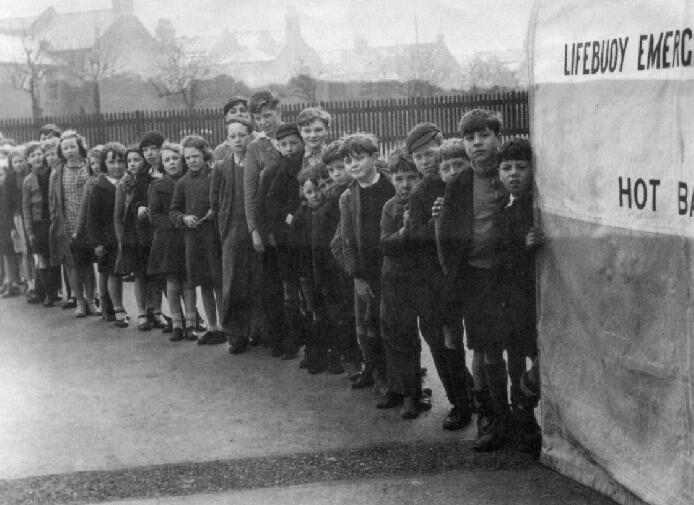
After the attacks on the docks in the East End, the Luftwaffe campaign became largely a matter of destroying London which mean using its limited resources to level a vast city. The initial raids were a terror campaign. But as soon as the British had adjusted to the new German tactic and provided shelters, actual casualties were limited, must smaller than what had been anticipated before the War. Bombing at night, the Luftwaffe could only hit London, not specufic targets within the city. The result was the destruction of large numbers of houses. London was, however, a vast city and the small bomb loads of the Germn bombers limited the damage, especially because they continued carry mostly high-explosive bombs rather than incendiaries. Large numbers of Londoners were bombed out of their homes. Overall the Germans destroyed aboyt 2 million British homes. Many were in London. The British responded with a well organized effort to meet the neededs of those affected. Needs varied. Some had relatives they could deprnd on. Others needed emergency food, clothes, help finding housing, new cupon books, and a range of other services. There were even mobile Lifebuoy Emergency hot baths.Thus the basic needs of those bombed out were met.
One of the most stunning developments of World War II is how British morale held up during the Blitz and actually seems to have intensified Britain's commitment to win the war and destroy NAZI Germany. This is stunning because of the strength of Pacifist thought in the Inter-War Era and only a few months earlier, Britons were determined to avoiding another war at virtually any cost. And Britain had suffered military defeats of staggering proportions, especially the fall of France. Historians tend to credit Prime-Minister Winston Churchill with this and he certainly played a role. Oddly enough, the primary reason was the policies of former Prime-Minister Neville Chamberlain. While his Appeasement Policy was a failure, the British people entered World War I convinced that their government had done everything humanly possible to avoid another war. And while Churchill commanded a military woefully prepared for the NAZI challenge, he had the backing of a united nation which was made all the more determined by the NAZI Blitz. An estimated 43,000 people were killed in the Blitz and 1.1 million homes destroyed, but it had no impact on the British war effort or engender any desire for a British Vichy. There were two primary reasons that British morale did bot crack. First, The British were convinced that they were fighting an evil, malignant force. and if you are fighting evil, people are prepared to suffer dire consequences. Second in contrast to most other countries, British cities were built out, not up, and covered much wider areas than other cities--especially London. And the German Luftwaffe was a tactical, not a tactical force. It was not capable of waging a successful strategic bombing campaign. This was especially the case against Britain which had the most modern air defense system--the Chain Home Network and modern high-performance fighters. The result was not only were there no real achievement, but British war production actually increased, the British people were highly motivated to strike back, and the Luftwaffe was substantially weakened for the upcoming campaign in the Soviet Union. In addition, Government programs like home shelter construction, opening public bomb shelters, a fair if severe rationing system, evacuation of children, and care for bombed-out families generated wide spread belief that the Government was doing all it could to care for its people. One interesting phenomenon is that Prime Minister Churchill and the King and Queen regularly toured hard hit areas to share the populations pain and suffering. This is something that Hitler never did. Unlike previous wars, data from the Mass Observation movement (MO) provides actual data that scholars have undertaken to study British morale. 【Beaven and Griffiths】 One author writes, "... dire predictions of mass air-raid neurosis failed to materialize. In the event, civilians proved more resilient than planners had predicted, largely because they had underestimated their adaptability and resourcefulness, and because the lengthy conflict had involved so many in constructive participant roles. 【Jones】 A range of authors have tried to dismantle the idea of the Blitz Spirit steadfastly caring Britain through the War. Of course the British like any other people nor without slackers, profiteers, cheaters,and other who did not adhere to ideal behavior, but this was in fact only a small minority. Government policies helped to maintain morale and a patriotic national sentiment was a vital factor in the British war effort. 【Mackay】
Beaven, B. and J. Griffiths. "The Blitz, civilian morale and the city: mass-observation and working-class culture in Britain, 1940-41," Urban History Vol. 26, No. 1 (1999), pp. 71-88.
Jones, Edgar, Robin Woolven, Bill Durodié, and Simon Wessely. "Civilian morale during the Second World War: Responses to air raids re-examine," Social History of Medicine Nol. 17, Is. 3 (December 2004), pp. 463-79.
Mackay, Robert. Half the Battle: Civilian Morale in Britain During the Second World War (Manchester University Press: 2002, 282p.

Navigate the CIH World War II Section:
[Return to Main Battle of Britain London Blitz phase page]
[Return to Main Battle of Britain Regional Blitz phase page]
[Return to Main World War II page]
[About Us]
[Biographies]
[Campaigns]
[Children]
[Countries]
[Deciding factors]
[Diplomacy]
[Geo-political crisis]
[Economics]
[Home front]
[Intelligence]
[POWs]
[Resistance]
[Race]
[Refugees]
[Technology]
[Totalitarian powers]
[Bibliographies]
[Contributions]
[FAQs]
[Images]
[Links]
[Registration]
[Tools]
[Return to Main World War II page]
[Return to Main war essay page]
[Return to CIH Home page]