***
war and social upheaval: World War II air campaign -- British evacuation of children evacuation process 1939
British World War II Evacuation of Children: The Evacuation (September 1939)
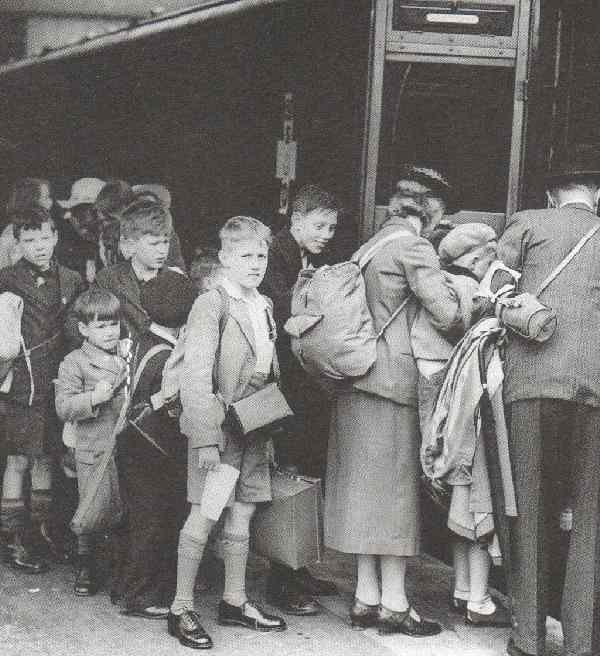
Figure 1.--These British children are boarding a train during the initial 1939 evacuation. I'm not sure where. The man is probably their teacher. The woman is probably one of the mothers with small children. Notice the little boy being carried in front is wearing a beret. Popperfoto.
England was not prepared for war, but the idea of aerial bombardment had so terrorized the public, that plans were ready to protect children. The children living in London and other major cities were immediately tagged liked parcels and shipped out by special evacuation trains. The evacuations were mostly conducted through the schools with the children accopanied by their teachers. I am not precisely sure how this worked. I think married men teachers may have been accompanied by their wives. Many women teachers were unmarried. Many of the men were eventually called up, but the ones that were not I believed stay in the country communities to help supervise the children and work in the local schools. Despite the imense number of children involved, the actual evacuation went fairly smoothly, despite the caos in the stations as tearful mums waived good-bye to their nippers. The children sang songs like "The Lambert Walk" and "Wish Me Luck as You Wave Goodbye". There was also a song about the "Bogy Man" that the children liked. Other children said good-bye to their mums at their schools. Often schools marched en masse to the stations with their teachers. While the actual evacuation from the cities was ordely and well managed, the same can not be said of the reception points in the country side. The evacuation plan had left responsibility here to local authorities. Some had prepared properly. Many had not. Caos ensued at many reception points as train loads of children began arriving in the country side. Host families had signed up to care for the children, but there was enough. The Government had organized the evacuation, but it was left up to each local community to process the children. At many locations trains arrived with new loads of children even before the first group had been processed.
England was not prepared for war, but the idea of aerial bombardment had so terrorized the public, that plans were ready to protect children. The Government gave the evacuation order August 31, 1939, a day before the German Panzers crossed the Polish frontier.
The Government planned to evaccuate 3 million, but only 1.5 million were actually evavuated. It was up to the parents and parents decided to keep about half of the children. In the end about 1.5 million were evacuated. About 0.6 million were evacuted from London alone. Another source reports 0.4 million school children were evacuated from London. War historians often docus on London, but even more children were evscuated from provincial cities. One report estimates that 0.8 million school children were evscuated from provincial cities. I'm nor sure as to the descrepancy, it could be due to date differences or who was counted. These numbers may just be for England. Also there were more evacuees than just school childrem.In addition to London, school children were also evacuated from Clydeside, Tyneside, Merseyside, the Midlands, Portsmouth, and Southampton. The evacuess came primarily from the central city area. The suburbs were for the most part not evacuated. There were also 0.2 million Scottish school children evacuated to the Lowlands. Plymouth, Bristol, and Cardiff were not evacuated. We are not sure at this time why these cities were not evacuated.
The children evacuated were mostly school children. The evacuations were organized through the schools this alone meant that the children would primarily school age. This meant children 6-uears old and up. We are not sure if there were ctual age limitations. The images mostly show school-age children. At the time mamy British children did not attend secondary school. Working-class children geberally left school at 13-14 years of age. WE arenot sure how teenagers out of school were handled/ Many had jobs. We are also not sure if younger children were permitted. Perhaps some younger brothers and sisters, but we do not see any really young children. They stayed at home with their parents. They required more care tha schoo-age children. And parents would have been more hesitant to part with the little ones. Letting go of the older children was difficult enough. . This may have changed with the subsequent evacutions when the bombs actually egan falling. And because if the carnage there were orphans of all ages. This of course was not the case in h 1939 evacuation. We are looking for actual regulations, but have not yet been able to find them. Hopefully our readers will know more.
The children living in London and other major cities were immediately tagged liked parcels and shipped out by special evacuation trains. The evacuations were mostly conducted through the schools with the children accopanied by their teachers. I am not precisely sure how this worked. I think married men teachers may have been accompanied by their wives. Many women teachers were unmarried. Many of the men were eventually called up, but the ones that were not I believed stay in the country communities to help supervise the children and work in the local schools. Despite the imense number of children involved, the actual evacuation went fairly smoothly, despite the chaos in the stations as tearful mums waived good-bye to their nippers. The children sang songs like "The Lambert Walk" and "Wish Me Luck as You Wave Goodbye". There was also a song about the "Bogy Man" that the children liked. Other children said good-bye to their mums at their schools. Often schools marched en masse to the stations with their teachers. Many movies such as "Hope and Glory" show parents bring their children to the train station. This appears to be a misrepresentation. Of course such representations do not affect historians--they do affect the public image.
Given the enormity of the task, moving some 3 million children in such a few days, the evacuation was amazingly successful. There were 0.6 million from London along. This is really unimaginable as parents with one child getting him or her off to school in the morning will understand. There was no panics or unmanageable crowds and virtually no lost children. (This is why the children had tags.) There were some problems on the reception side, but the exodus from the cities was brilliantly executed. And the reception problem were worked up. This was largely because the whole process was managed through the schools. And thus teachers wee involved who helped manage and care for the children. And we see some mothers with small children. This also helped with imagining the children. One aspect that is very notable is however the older children helped with the younger children. Because school groups were moved, we generally see groups of children of similar ages, but often mixed in are some younger children, teachers, and mothers. In some cases mothers with small children (figure 1). We also see older children with their younger siblings. Parents often did not want their children separated. They wanted the older siblings to look after the younger ones. Nor did the children want to be separated. The photographic record shows children patient moving in organized queues. We see concern on their faces, but not fear. It was all wonderfully planned out and executed. And the children themselves were part of thesuccess. They did what they were told and behaved tthioughfully toward the younger children. . Something like this had never been done before. The only thing like it we have ever seen was what a few months later at Dunkirk. We see orderly queues of soldiers on the beaches even while being bombed and shelled as the NAZI Panzers closed in on them. There was no break down in command. Of course Dunkirk and Victoria Station are two very different enviroents, but for younger children leaving the safety and security of their home into the unknown it was a traumatic experience.
Reception
While the actual evacuation from the cities was ordely and well managed, the same can not be said of the reception points in the country side. The evacuation plan had left responsibility here to local authorities. Some had prepared properly. Many had not. Caos ensued at many reception points as train loads of children began arriving in the country side. Host families had signed up to care for the children, but there was enough. The Government had organized the evacuation, but it was left up to each local community to process the children. At many locations trains arrived with new loads of children even before the first group had been processed.
Regional Variations
The planners had anticipated evacuating about 80 percent of th school children in the cities. Only about 50 percent showed up for evacuation. This was due to a comination of factors. Many children did not want to go and parents did not want to be separated from their children. One factor tht the planners had not anticipated was the regional differences as to how the evacuation was viewed. Londoners believed that they would be a target and partipated heavily in the evacution. About 60 percent of the school children in Manchester and Liverpool, important industrial cities were evacuated. Liverpool was also a major port where supplies from America and Canada were arriving. Other areas were less covinced about the idea of evacuation. Cities and towns in Yorkshire evacuated less than 15 percent of their school children.