**
war and social upheaval: World War II air campaign -- British evacuation of children return home 1939
World War II Air Campaign: British Evacuation of Children--Return Home (Winter 1939)
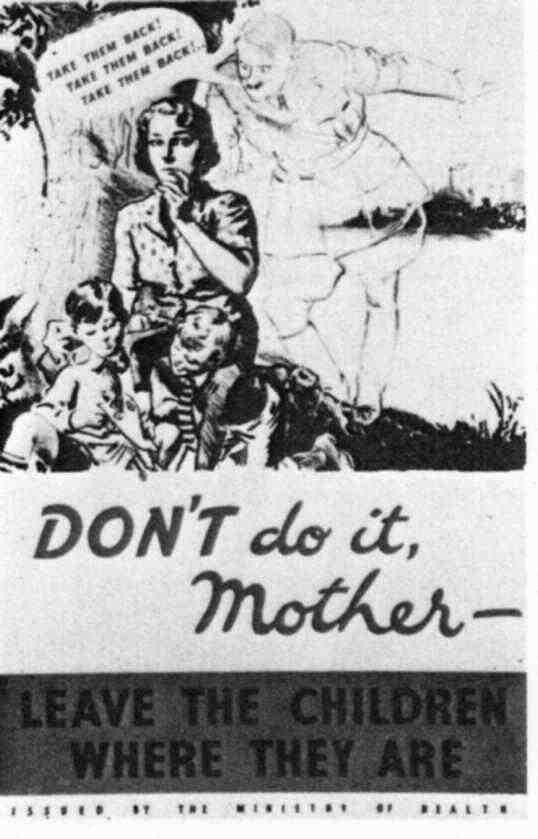
Figure 1.--British children were evacuated to the countryside in early September 1939. The children were not happy and wrote letters pleaing to be brought home. Some mothers joined the children in the countryside. When German bomber raids did not materialize, parents began bringing their children home. Here a Ministry of Health poster urges mothers to keep the children safe in the countryside.
Following the declaration of war, the Germans did not launch Luftwaffe raids on British cities. In fact, the Luftwaffe was a tactical force and did not have the capability for any extesive air campaign against Britain from German bases. The fighting was largely restricted to Poland. The Allies made no real effort to suppot Poland besides declaring war and instituting a naval blockade of Germany. The fighting in Poland was over by early October. There was little fighting on the Western front. The press took to calling the war "The Phony War". There were no important German bombing raids on Britain. The children for the most part were understandably unhappy and wanted to come home. And the Government began requiring that parents make a small monetary contribution. As a result, many parents began bringing their children home. There was of course a great desire on the part of the children by Christmas 1939 to come home. Some children stayed put, but parents brought most of them home. Many children, about 75 percent, had returned home by January 1940. The Government launched a campaign to persuade parents to leave the children where it was safe. The poster here is an example (appendix 1). Thgey also made cheap railroad day fairs available to parents so they could visit their children. The Phony War, however did not last, The Germans finally launched their long anticipaed Western Offensive. And after the fall of France, the German bombers would come. The children had to be evacuated again.
England was not prepared for war, but the idea of aerial bombardment had so terrorized the public, that plans were ready to protect children. The Government planned to evaccuate 3 million, but only 1.5 million were evavuated. It was up to the parents and parents decided to keep about half of the children. In the end about 1.5 million were evacuated. The children living in London and other major cities were immediately tagged liked parcels and shipped out by special evacuation trains. The evacuations were mostly conducted through the schools. Despite the imense number of children involved, the actual evacuation went fairly smoothly despite the caos in the stations as tearful mums waived good-bye to their nippers. The children sang songs like "The Lambert Walk" and "Wish Me Luck as You Wave Goodbye". There was also a song about the "Bogy Man" that the children liked. Other children said good-bye to their mums at their schools. Often schools marched en masse to the stations with their teachers. Caos ensued as train loads of children began arriving in the country side. Host families had signed up to care for the children, but there was enough. The Government had organized the evacuation, but it was left up to each local community to process the children. At many locations trains arrived with new loads of children even before the first group had been processed.
Evacuee Children
The children for the most part were understandably unhappy and wanted to come home. The younger children were unhappy to be away from their prents for the first time. Many had not uunderstood what the evacuation was. They saw it as ak in the ciountryside rather than an extended separation from their families. Within days, most were ready to come home. The older children had a better appreciation of the situation, but even most of them wanted to come home.
Monetary Contributions
The Government began requiring that parents make a small monetary contribution. This encouraged some parents to bring their children home.
Following the declaration of war, the Germans did not launch Luftwaffe raids on British cities. In fact, the Luftwaffe was a tactical force and did not have the capability for any extesive air campaign against Britain from German bases. The fighting was largely restricted to Poland. The Allies made no real effort to suppot Poland besides declaring war and instituting a naval blockade of Germany. The fighting in Poland was over by early October. There was little fighting on the Western front. The press took to calling the war "The Phony War". There were no important German bombing raids on Britain.
Children Begin Returing Home
The combination of events resulted in parents changing their minds about the evavuation.
There were no German bombing raids. Nor was there much action on the Western front. The fighting had mostly been in distant Poland. And Britain and France made no effort to relieve Poland. In the West this was the start of what became known as the Phoney War. The French remined safefly beginf the Maginot Line. And the British Expeditionary Force deployed along the Belgian border, ready to advance into Belgium if the Germans attacked Belgium as anticipated. But as the Lufwaffe did not attack, parents began to change their minds. And the children now knew it was not a holiday lark and wanted to come home. Parents understanably missed the kids. The children began sending letters pleading to be brought back. As a result, many parents began bringing their children home. Some children stayed put in the country side. But as time progressed more and more parents began brining their children hime. The evacuee children in the countryside became a minority.
Government Campaign
The Government launched a campaign to persuade parents to leave the children where it was safe. The poster here is an example (appendix 1). Thgey also made cheap railroad day fairs available to parents so they could visit their children. But the visits often resulted in more children being brought home. he poster here appealing to Mothers to evacuate their children (figure 1) and the appeal for women to volunteer for evacuatiom work reflects the fact that the men were called up fir military service. And thus Mums being the main target of goverment propaganda to evacuate.
There was of course a great desire on the part of the children by Christmas 1939 to come home. All the childtrn wanted to be home for Christmas. And the thought of a Christmas without the kids was to much for most parents to bear. As Christmas approached few parents coud not resist the tearful letters fron their children. And most children got their wishes and were back home for Christmas. he evcution after all had been voluntary and all up to the parents. Estimates suggest that about 75 percent of the evacuated children were back home by January 1940. As a result, the children returned to their London and other city schools. After Chrustmas parents began registering the children ikn their former schools for the Winter Term. This was not easy to arrange because so many teachers had been evacuated with th chidren to the countryside. For several months the Phony War continued. The German in reality did not have the rnge to bomb Britain. It had been designed as short range tactical air force. The Allies could hve bombed Germany, especilly when the Luftwaffe was fully committed to the Polish campign (Septenber 1939). The French refused to authorize bombing from French airfilds bout of feat of German raids in their cities. Thus the British public began to think thar their pre-War fears of bomning cities was exagerted and hpe tht perhaps a peace could be arranged. The only action was at sea where the U-boats proved to be more of a threat than the Royal Navy had anticipated. But that was beyond the view of British families. It felt safe at home. There were no Zeppelin and Gotha bomber raids. The BEF and French Army still stood betweem thm and the Germans as had been the case in World War I.
The Phony War, however did not last, The Germans finally launched their long anticipated Western Offensive (May 10, 1940). The Germmns in surprose move strucj hriugh the Ardennes, wooded area in wastern Belgium. Within a little over a week the Germanm Panzers reached the Channel (May20). French Army units were shattered. The British Expeditionry Force and the French First Army was cut off in Belgium. Th Royal Navy mnaged to evcuate the BEF nd French Units ant Dunkirk. Then the Germand turned south. The might French rmy which had been the bckbone of the Allied firce in World War II proved incaole of dealing with the German Blitzkrieg. Paris fell (June 14). France capitulated and signed and armistice with the Germans (June 22). After the fall of France (June 1940), the Lufwaffe bombers now were within range of British cities. And Britain was on its own. The Germans moved into French air force bases and began to build new bases closer to the Channel. Within weeks the Luftwaffe launched the initial stage of the Battle of Britain.
After the French capitulation, the Luftwaffe quickly established bases in France and by July 10 launched preliminary strikes in what has come to be called the Battle of Britain. The Luftwaffe while better trained and outnumbering the RAF was ill prepared for the campaign. They did not appreciate the ctitical importance of the British home chain radar network. They also had no straegic bomber fleet. The air offensive was to be conducted with two engine bombers that proved highly effective in short range tactical operations, but were not well suited for kinger-range strategic bombing. The Battle of Brirain began in ernest on August 13 with Luftwaffe raids on British airfields and aircraft factories. Hitler had assumed that the Luftwaffe could force the British to capitualte. He saw world politics in racial terms and in relatity wanted the British as allies or at least neutrals in his planned invasion of the Sovie Union. This isresumably why he stopped the panzers before Dunkirk. Unlike his strategy against the Poles, Dutch, and Belgians, there were no German terror bombing of London and other British cities. The Luftwaffe im its August campaign seriously weakened the RAF and Fighter Command was having increasing difficulty maintaining its forward air bases in Kent. Then off-course German bombers accidentally bomb London on August 23-24. RAF Bomber Command on August 25-26 mounted a small reprisal raid against Berlin. Hitler is furious and orders an immediate change in Luftwaffe tactics. Rather than completing its offensive against the RAF infrastructure, Hitler ordered a "blitz" on British cities which began in earnest on September 7. The Luftwaffe wreaked havoc on civilians in London and major English cities. Thousands of civilians were killed. Edward R. Murrow broadcasting from London ("London calling ...") described Britain's valiant resistance to rapt American radio audiences, greatly affecting American attitides toward the Hitler and the NAZIs. White British cities burned, the RAF was given a respite, allowing its forward air bases to recover from the damage done in August. As a result the RAF was able to mount increasingly costly attacks on the German bomber fleets. The Lutwaffe eventually is forced to shift to nightime raids and eventually end the major offensive against the British as the German military in 1941 began preparing for Opperation Barbarosa, Hitler's long awaited dream of invading the Soviet Union which at the time was a virtual German ally.
The German bombers initally targeted the RAF fighter bases in the southeast. They achieved a degree of success in degrading Fighter Command XI Group. Hitler unhappy with the rate of progress and eraged at a British bomber raid on Berlin ordered the focus of the Luftwaffe campaign to be to be changed to London. A British reader writes, "One reason there were so many children in London during the Blitz was that many of the evacuees came home when nothing much happened whgen the War began. Then France fell and Hitler turned his attention in our direction. It was a time of terrible uncertainty. My mother and her brother got shuttled all over the country at different times during the war."
A British reader tells us, " A British reader tells us, "You can see in the last poster that many boys wanted to stay in the cities and help the war effort, but according to my relatives, they were often a 'bloody nuisance'. Parents after the Blitz began wanted them back safe and sound in the countryside! It seems odd that I often played on a real bombsite as a boy - left over from the war 20 years before and the worst I got was grazed knees and a nail through my foot once. Mum could soon patch that up (and issue dire warnings about not playing in 'dangerous' places) but how different it must have been when the bombs were actually falling and the worrries of Mums back then."
The children had to be evacuated again after the fall of France (June 1940). The Germn quickly began to move into French air bases and building many new ones along the Channel Coast. This time tere would be no Phonny War. The first great air battle of the War was shapeing up and Briish citirs were now in range of Luftwaffe bombers. nd this tgime it would not be just pin prick raids as in World War I. For the first time in history an air war would be cranged to fefeat a country solely by air. And the Luftwaffe, although not designed dor staryehic bombardment, proved caoable of destroying whole cities. The RAF exacted a greviius toll on German bombers. This firced the Germans to bomb by night meaning that they were unavke ti targer Britush war industries. In effect the Germans were exprding valuable combat powe to jbock diown British houses ans kill civilans--hardly a way to win a war. One result of the Battle of Britain was that the Luftwaffe would be weakened in the coming invasiin of the Soviet Uinion. Anothr result was that the Brtish woukd foicus theur war effort on the strategic bombardment of Germany. And like the Blitz, it would be a no hold barred campaign of total war. After the Blitz there woukd be further ecacuations as a result of the German V-weapns.