|
The Pacific War was fought on the largest battlefield in history. This would make the range of aircraft to be an imprtant factor. The air war in the Pacific began as in the European theater with mastery of the skies by the Japanese. The Chinese air force was vitually non-existant. The Japanese conducted terror bombing raid, first on Shanghai and then on other Chinese cities. Japanese aircraft, especially the Mitusubishi A6M Zero, were so effective that they were able to achieve air superority during land and sea battles against Britain and the United States beginning with the attack on Pearl Harbor. The Zero was fast and maneuverable and had an impressive range. This continued throughout much of 1942 and only with the arrival of new American 56L Hellcat in large numbers did the Allies begin to gain the upperhand in the sky. The gradual attrition of skilled Japanese pilots was another factor. New American aircraft brgan reaching the fleet (January 1943). The Gruman 56L Hellcat would be the mainstay of the U.S Navt during the Pacific War. Gradually American flyers had planes with capababilities well beyond those of the Zero. The seizure of the Marianas and the deployment of of the new long range B-29 bombers brought the Japanese homeland within range of strategic bombardment. The initial raids were inclonclusive. General Curtis LeMay devised a strategy of fire bombing which caused massive destruction in Japanese citis crammed with highly flameable wooden structures. When Japan refused to surender after the Yalta Conference, President Truman ordered the use of tha Atomic Bomb in August 1945. The Japanese surendered in September.
Looking at the Pacific War from the perspective of time, it seems virtual insanity for Japan to have attacked the United States and launch the Pacific War. The Pacific War begun and won in the War. And any assessment of the aviation industries that would provide the planes to wage the War would show the Japanese had an aviation industry with only a fraction of the capability to build aircraft. The United States had the world's largest aviation industry. And this was before the United States significantly expanded its aviation industry after Pearl Harbor. Neither side, however, fully preceived the importance of aviation. Both America and Japan believed that it was naval forces that would decided the outcome of the War. But here the naval construction industries also favored the United States. The Japanese militarists that took the country to war were largely army officers who were aware of this imbalance, although probably not fully aware of the disparity. The decesion they reached was that three other factors that would negate America's significant industrial power. First, that the United States would have to focus most of its military power in Europe to battle the Germans who were about to defeat Soviet Russia. Second, that Japan with its military build up could seize the Southern Resource Zone (SRZ) it coveted before America could shift its industry to armament production. Three, decadent Americans would not have the will to fight a major war and would make peace as Russia had done in 1905.
The air war in the Pacific was primarily fought by the United States and Japan. British and Chinese forces were also involvedin a marginal way and the Siviet Red AirForce in the final days of the War. The air war proved to be a mismatch because of the huge industrial and technological capability of the United States. This was not the case in the first year of the War. The Japanese calculation was that they could over come the American superority in manpower, resources, and industry, by building a powerful military force, including a modern airforce before the United States coverted its industry to war production. Japanese naval planners in particular as part of their preparation devised a long, through training program. And as a result at the beginning of the War had the best trained pilots in the world, although because of the rigorous training program, a relatively small cadre of pilots. And they were equipped with the best carrier fighter in the world in 1941-42, the Mitsubishi A6N Zero. The Japanese calculation that these pilots and the Zero and other aircraft would provide the margin of victory in a climatic naval battle at an early point of what they believed would be a short war. When the Imperial Fleet failed to force a conclusion to the war in the first year, America's industrial capacity very quickly reversed the advantage the Japanese had in the air during the first year of the War. The basic organization of air forces was similar at the beggining of the War. There was no unified air force, but both army and navy air forces. During the War, U.S. Army Air Forces moved increasingly toward an independent force. The Japanese army air force never did. The huge industrial capacity of the United States converted the relatively Army Air Corps into the large air force in the world, far exceeding the combined air forces of the Axis countries. The United States produced a wide variety of new aircraft types so that the planes in use at the time of Pearl Harbor were a forgotten memory. The B-29s that destroyed Japanese cities was beyond the comprehension of the Japasnese militarists that launched the War. The Japanese on the otherhand were still using the same aircraft with which they began the War and were reduced to suiside tactics. The untested aspect of the air war was the secret Japanese airforce assembled to repel the anticipated American invasion.
Japan began to use its air power in China several years before actually invading China proper. Japan used air power as it swept through Manchuria, establishing the puppet state of Mannchuko (1931). Chang undersyanding that he did not have the militaryfoirces capable of stopping the Japanese decided not to oppose the Japanese action. Chinese public opinion was, however, outraged at the Japanese aggression. This led to protest demonstrations throughout China and attacks on Japanese diplomats and businessmen. The situation was especially volitile in Shanghai. The Imperial Japanese Army (IJA) used these attacks and other instances of resistance to justify a military action in Shanghai. The Japanese attacked Shanghai in what they called the Shanghai Incident (January 1932). the Japanese air force bombed Shanghai to quell the disturbances. They claimed that Japanese residents were endangered. The city had no air defense or bomb shelters. There was no effort to hit military targets. This was the first of many Japanese terror bombings of civilian populations. The Japanese when they attacked Shanghai, avoided hitting the International Settlement. Chinese fleeing the fighting attempted to get into the International sector. It had to closed off as supplies did not exist to provide for the refugees. Groups in America provided some relief aid. Press reports and wire photos of the devastated city and civilians appeared in newspapers around the world. This profoundly affected the Japanese image both in Europe and more importantly the United States. The International Settlement in the 1930s found itself in the middle of the bloody battle between the Nationalists and the Japanese. The Nationalists were out gunned by the Japanese who were supported by Japanese naval vessels in the harbor. They put up a fight for the city. Only the SIS remained untouched. Eventually a ceasefire was negotiated. This resulted in the demilitarization of Shanghai. The Chinese KMT were prohibited from deploying troops in the city, but could have a police force. The Japanese were allowed a small force of Marines. This helped form the opinion among the Japanese military that they could bomb China and later other adversaries with impunity without endangering the Home Islands. The Chinese had virtually no airvfirce or air defenses. And the emense expanse of the Pacific Islands protected the Japanse from the Americans.
Chinese and Japanese troops exchanged fire around Lugou near the Marco Polo Bridge (July 7, 1937). This was beyond the boundaries of Manchuria and a strategic access route to Beijing. The fighting was confused, with sporadic skirmishing. Such incidents had occurred before. This time the Japanese decided to teach the Chinese a lesson and attacked in force leading to a full-scale battle, seizing Beijing, the old imperial capital. and its port city of Tianjin. This is generally seen as the beginning of the Second Sino-Japanese War. The Japanese would have stopped there, at least for a time. Chaing after the Marco Polo Bridge incident, however, decided he could no longer ignore Japanese aggression. The KMT Government mobilized the country's Army and smal Air Force. They attacked Japanese Marines in Shanghai (August 13, 1937). This lead to another major battle--the Battle of Shanghai. The Japanese used air power to defend its position in the city. The Imperial Japanese Navy (IJN) attacked with sorties of the then-advanced long-ranged G3M medium-heavy land-based bombers and assorted carrier-based aircraft (August 14-16). The expectation was that they would easily and quickly destroy the small Chinese Air Force. The Chinese using their Hawk III and P-26/281 Peashooter fighter squadrons put up effective resistance. The attacking Japanese bomber squadrons suffered heavy losses, in some cases up to 50 percent. This rare Chinese success in the Air war led to the KMT designating August 14 as China's Air Force Day. The sky over Shanhhai became a testing zone for the advanced biplane and new monoplane aircraft types. The Japanese intriduced the advanced A5M "Claude" fighters into the Shanghai-Nanking area (September 18). This quickly enable the Japanese to establish air superiority until the final year of the Pacific War. The few experienced Chinese pilots managed to stay in the air even with their obsolete aircraft and helped the Chinese firces put up a stroing defense of the city. Eventually the Imperial Japanese Army (IJA) had to commit over 0.2 million men backed by naval vessels and aircraft to ultimtely cpture Shanghai. The Japanse took 3 months to capyture Shanghai and suffered far greater casualties than they had expected.
American involvement in China did not begin with the Japanese invasion and the Roosevelt Administration. American naval vessels began cruises on the Yangtze River in 1854. The mission of these early cruises was to show the flag and support American consular officers. The naval mission grew ever more complex as the authority of the Imperial Government deteriorated in the late 19th century and became an important instrument of American foreign policy. Operations included putting landing parties ashore on occassion to protect U.S. interests. The U.S. Navy after the turn of the 20th century began to conduct the patrols in a more organized fashion. The Navy deployed purpose-built gunboats and began coordinting operations with the Britidsh Royal Navy. The U.S. Navy was also deployed in anti-piracy patrols off the Chinese coast. Japnese forces were moving up the Yangtze River toward the Chinese capital which had been evacuated from Peeking to Nanking. Two U.S. Navy gunboats were at Nanking, the U.S.S. Luzon and the U.S.S. Panay. Chinese officials notified the American Embassy on November 27, 1937 that it must evacuate. The Ambassador and most of the Embasy personnel departed the net day on the U.S.S. Luzon. The rest of the Embassy staff remained another week. Ambassador Grew notified the Japanese government on December 1 that the U.S.S. Panay would be departing. Panay took on Embassy officials and some civilians and began upriver. It escortied three Standard Oil barges. Two Royal Navy gunboats and some other British boats followed. A Japanese artillery position commanded by a Colonel Hashimoto fired on the ships, hoping that it might precipatate a war with America and end civilian influence in the Japanese Government--finalizing the "Showa Restoration." Panay flew an American flag as well as had Americn flags painted on the awnings and topsides. December 12 was a clear, sunny day with perfect visability. At about 1330, three Japanese Navy bombmers attacked Panay followed by 12 more planes that dive-bombed and 9 fighters that strafed. The attack was deliberate lasting over 20 minutes. As Panay began sinking, the Japanese sraffed the lifeboats and river bank. Two sailors and civilian were killed. there were 11 sailors seriously wounded. passenger died of their wounds; eleven officers and men were seriously wounded. [Morrison, pp. 16-18] There was no outcry in America for war. The Japanese Government which had not ordered the attack, promtly appolgized and offered compensation. The attack was, however, coordinated by military officers. Both the American public and the Roosevelt Administration were releaved that war could be overted. [Freidel, pp. 290-291.] The Japanese when they arrived in Nanking proceeded to conduct one of the greatest attrocities in their campaign in China--known to history as the Rape of Nanking". The Panay was also involved in intelligence collection. The Admistration for a while considered economic sanctions against the Japanese. The Navy gunboats missions continued through 1941 until the Japanese attack on Pearl Harbor. The Japanese carfully avoided any further incidents. The Japanese officers responsible, however, got what they so ardently desired nearly 4 years later.
Notably the Germans, despite the Axis alliance, made no effort to supply the Japanese with any of their advanced aircraft technology. In the early stages of the War the NAZIs thought that they had essentially won the War and saw no need to share military secrets with a potential future ally. This was in sharp contrast to Allied cooperation even before America entered the War. I have no details on talks between the Japanese and Germans on technical cooperation, but as far as I know, through 1943 there was no serious technical cooperation between these two Axis partners.
There has always been a strong isolationist strak in American political life. Americans separated by two great oceans have since the Revolution seen ourselves as different and apart from the rest of the World. From the beginning of the Republic, President Washington warned of entagling foreign alliances. For much of our history, Britain was seen as the great enemy of American democracy and Manifest Destiny. World War I was America's first involvement in a European War and the United States played a critical role in winning that War. Had the Germany not insisted on unrestricted sunmarine warfare, in effect an attack on American shipping, it is unlikely that America woukd have entered the War.
Many Americans in the 1920s came to feel that America's entry into the War was a mistake. There was considerable talk of war profiteering. Many were detrmined that America should avoid war at any cost. This feeling was intensified with the Depression of the 1930s and the focus on domestic issues. With the growing military might of a a rearmed Germany, others such as Charles Lindburg, thought that America could not win another war. Many not only opposed American envolvement, but even military expenditures. Aginst this backdrop, President Roosevelt who did see the dangers from the NAZIs
and Japanese militaists, with great skill and political courage managed to not only support Britain in its hour of maximum peril, but with considerable political skill managed to push through Congress measures that would lay the ground work for turning American into the Arsenal of Democracy, producing a tidal wave of equipment and supplies not only for the American military, but for our Allies as well in quantities that no one especially the AXIS believed possible.
The Japanese in 1941 had 13 aircraft carriers to 3 American carriers in the Pacific. At the time the carrier was still not preceived as the most powerful instrument in naval warfare. Thus the extnt of the Japanese superiority had not yet been fully perceived. The Japanese also had the best fighter in the Pacific--the Mitusishi A6M Zero. Navy planners believed that the Japanese were preparing a strike, but more likely in East Asia or perhaps the Philippines. There were several reasons for this, but one was that carrier aircraft were nelieved to be inferior to land-based planes. Thus it was considered suisidal for Japanese carriers to approach Pearl which was well defended with Army Air Corps bases. The first wave of Japanese planes focused on the air bases, where most of the American planes were destroyed on the ground. This left the Japanese free to attack the battleships and carriers at Pearl. The Japanese found the battleships there, but to their surprise the carriers were not there.
Japanese aircraft, especially the Mitusubishi Zero, were so effective that they were able to achieve air superority during land and sea battles against Britain and the United States. They destroyed substantial numbers of the aircraft on the ground, especially in the Philippines. Then land and sea offensives overran airbases. Another factor was the superb training of the Japanese aviators and their fast, manueverable Zeros.
Any look at a map tells you that the Japanese would have to attack the Philippines. Their primary interest was obtaining access to oil, especially after the United States embargoed oil exports. This meant tht they needed the Dutch East Indies (DEI) with its important oil resource. But the Philippones stood beyween the Japanese Home Island and the DEI. Thus after the U.S.Pacific Fleet was destroyed at Pearl Harbor, the Philippines would have to be seized. General Douglas MacArthur preparations for defending the Philippines were premesed on holding off the Japanese until releaved by the Pacigic Fleet sorteeing out frpm Pearl. An important part of the Islands defenses were Army Air Corps instalations. General Douglas MacArthur was immediately informed of the Japanese attack on Pearl. No preparations were taken for a Japanese air attack. The Japanese struck 9 hours later with land based bombers from Formosa (Taiwan). MacArthur did not think this was possible. American air power in the Philippines was destoyed on the ground. This forced the limited naval forces in the Philippines to withdraw. It meant that MacArthur could nit oppose the Japanese landings and the American and Philipino forces had no air support. MacArthure decided to withdraw to the Batan Peninsula abd conduct the defense of the Philippines from Correidor. He thought he could hold out until rleaved by the Pacific Fleet, not understanding the extent of the Japanese success at Pearl. While he managed to get most of his men to Batan, he failed to get adquate supplies there needed to suustain them.
The first important Allied effort to stop the Japanese sweep through the Pacific occurred in the Coral Sea. The Japanese planned to seize Port Moreseby, completing their conquest of New Guinea and a smaller operation in the Solomons at Tulagi. Port Moresby would have provided a launching pad for an invasion of Australia itself. (At the time, most of the Australian Army was in North Afric fighting Rommel's Afrika Korps.) The Japanese landing force was escorted by the front-line carriers Shokaku and Zuikaku. The Japanese naval task force en route to seize Port Moresby was intercepted by an American carrier force, alerted by American code breakers. It was the first carrirer to carrier engagement in history. The Japanese launched an attack on the Americans, but found only a destroyer and oiler. In the meantime the Americans sank the Japanese light carrier Shoho (May 7). The next day the two carrier forces fought a major engagement. The Japanese succeeded in sinking Lexington and heavily damaging Yorktown (May 8). The Americans heavily damaged Shokaku and devestated the air crew of Zuikaku. The substantial Japanese pilot casualties was very signigicant. Despite the American losses, the Japanese invasion force turned back, the first major Japanese reversal of the War. The Japanese assessment of the battle was that not only was Lexington sunk, but that Yorktown was either sunk or so badly damaged that it could no longer be deployed. This affected planning for the Miday operation. The engagement appears to have convinced Japanese naval planners that the American carriers were no mach for the Japanese carriers. The Japanese failed to preceive that the American carriers effectively fought the battle or that the surprise appearance of the American carrier in the Coral Sea to oppose the invasion of Port Moresby resulted from American code breaking. It also meant that they had lost a carrier, and large numbers of planes and pilots. This effectively removed two front line carriers from the Japanese order of battle. This reduced the available carriers for the Midway operation. Combined with the British damage to the First Air Fleet in the Indian Ocean, Admiral Yamamoto had allowed their carrier forces to be significantlseriously weakened in operations of marginal importance. This was critical because if Japan was to win the War it had to be done in 1942 when they had overwealming superiority in the Pacific. If the War developed into a war of attrition, the far greater indusstrial resources of the United States would prevail.
The news from the Pacific was an unrelenting series of disasters. America needed a victory. The only intact offensive force in the Pacific was Americais carriers. Army Air Corps pilot with B-25s trained for carrier take offs. The B-25 was a medium bomber never intended for carrier use. Carrier commander Afm. "Bull" Halsey led a taskforce made up of Hornet and Enterprise. It was a risky operation as it committed half of the Pacific fleet's carrier force to a very dangerous operation. The B-25s took off from Hornet. It was the first blow to the Japanese home islands. The raid was led by Lt. Col. Jimmy Doolittle. The physical damage was inconsequential, but the psychological impact was immense. Most of the Amrican aviators crash landed in China and were helped to reach saftey by Chinese Nationalist guerillas. The Japanese reprisals were savage. A estimated 0.5-0.7 million Chinese civilians were murdered. The Japanese Navy was so embarassed that they rushed forward Admiral Yamaoto's plans to bring the desimated American Pacific Fleet to battle at Midway Island.
Midway proved to be the turning point of the Pacific War. It is notable because it was the only major Allied victory in whivh the opposing forces were superior. Admiral Yamamoto was determined to bring the American Pacific fleet to battle before America's industrial might could redress the strategic ballance. Yamamoto reasoned that Midway was an assett of such importance that Nimitz would have to commit his remaining assettscto defend it. The Japanese had many advantages. Unknon to them, however, surprise was not one of the advantages. The same American code breaking operation that had learned of the Port Moresby operatioin also warned Admiral Nimitz that the next target was Midway. Admiral Yamamoto was convinced that the remaining American carriers could be brought to battle and destroyed at Midway. The Japanese plans were based on achieving an element of curprise and on the fact that two American carriers had been destoyed in the Coral Sea, in fact the Yorktown, although heavily damaged had not been sunk. American code breakers had alerted the Ameicans to the Jaspanese plans. Admiral Nimitz positioned Enterprise and Hornet, along with the hastily patched up Yorktown northwest of Midway to ambush he Japanese. The American carrier victory at Midway dealt a crippling blow to the Imperial Navy. The Americans sank four first-line Japnese carriers, killing most of the well-trained crews. The weakness of the Japanese in fire saftey and fire supression was notable. While the Imperial Navy still held an advantage, it was no longer an overwealming one. Meanwhile American shipyards were turning out the new Essex class carriers that would engage the weakened Imperial Navy in 1943. The stunning American carrier victory at Midway, significantly reduced the strike capability of the Imperial Navy.
General MacArthur was ordered from Corregidor shortly before the Japanese who had already taken Batan. He managed to get out through the Japanese naval patrols by PT-boat reaching airbases in the southern Philippines that had not yet been taken. Upon reaching Australia hhe pledged to the people of the Philippines in his first public statement pledged, "I shall return." (In typical MacArthur style it was "I" not "We".) Japanese airpower had played a major role in their victory in the Philippines. One of the erly actions MacArthur took after receiving the command of American and Austrlian forces was to establish a Technical Air Intelligence (TAI) group to compile information on Japanese planes. There was no alternative as America had no inteligence gatering operation in Japan. There was great confusion about the Japanese planes and an almost total lack of knowledge about their technical capavilities. The first TAI group was set up on a shoe stringin Hanger 7 near Brisbane in northern Australia. TAI teams were sent into the jungles of New Zealand to try to retrieve the remnants of crashed Japanese planes . It proved to be a daunting task. Luckily a PBY in the Aleutians found an almost undamaged Zero (July 1942). Asca result of this effort, the United States had detailed information on Japanese plane types by the late 1942. This was important in both developing new air craft types as well as developing tatics to be used in engaging the Japanese.
The Japanese conducted their wirlwind offensive after striking Pearl Harbor from well prepared and supplied bases. They faced mostly poorly trained and armed colonial police forces. (The Philippines was different, but Japanese naval power made it impossible to supply the Amnerican and Filiipino forces.) The first serious opposition the Japanese faced was in the South Pacific. While they easily seized the northern area (Northern New Guinea and New Britain--Rabaul). The Southgern aea proved a much more difficult problem. American carriers stopped an amphibious opoeration in the Coral Sea (May 1942) and then cut the heart out if the First Air Fleet at Midway (June 1942). They then faced well equipped Australian infantry (New Guinae) and American Marines (Guadalcanal) ant the extreme limits of their weak supply lines. The American supply lines were much longer, but America had the needed merchantmen--the Japanese did mot. Japan sent their soldiers into battle expecting them to live off the land. That worked at first when they scored quick victories. But when the quick victories did not come, tge soldiers began to starve. And the inadequate maru fleet became an increasing factor. Japan's only chance to win the Pacific War was in 1942. The Japanese had a huge advantah=ge with the Zero, especially its long range, but this advnatage was negated by the extrene distance iof Rabaul from the battlefoield. Once they were stopped, the fight became a war of attrition--a war that Japan could not win. Huge numbers of American aircraft including new advance types gave the United states command of the air. America's huge industrial might had kicked in and by 1943 the war sitution had totally changed.
The first American offensive of World War II occurred at Guadacanal in the southern Solomons. American air reconisance aircraft detected a new air base the Japanese began building on the island. An airbase there could help cut the sea lanes to Australia and New Zealand where America was buildung up its forces. The American invasion force initially encountered only weak Japanese resistance. The Japanese did not think the Americans were capable yet of an offensive counterstroke. They had not garisoned the island strongly. And the closest air base was at Rabaul. Here Japanese aircraft could reach Guadacanal, but were on the outer limit of their effective range. Japanese aircraft struck the small Marine beachhead and threatening the transports. The Japanese naval victory in the nighttime Battle of Savo Island forced the transports to withdraw. Meanwhile the Americans seized the airfield and rushed it to completion using Japanese contruction equipment. Within 2 weeks it was operational. They named in Henderson Field in honor of a Marine pilot killed at Midway. The small marine air force which operated there played a key role in the defense of the Marines on Guadacanal. It became known as the Cactus Air Force. (The America code name for Guadacanal was Cactus.) The Marines flew in Grunman 4F Wildcat fighters and Dauntless dive bombers. They faced a much larger Japanese force at Rabaul which targeted Henderson field. The Marine Wildcats came into service in 1937 and by 1942 were largely obsolete by 1942, but it was all the Navy and Marines had. They were not as fast as the Zero and were not as manuerable, but they were armored and had greater fire power, Henderson field was essentially a carrier and the Cactus Air Force made it very costly for the Japanese to supply the substantial troop strength they were building on the island. The Cactus AirvFirce targeted Japanese naval ships and the Tokyo Express. Evebntually it became just too costly for the Japanese to continue contesting possession of Guadacanal. With Guadcanal secured, the Americahns began moving up "The Slot" to secure more island air bases as part of a strategy of building "Rings atound Rabaul".
Rabaul was the main Japanese base in the South Pacific. Quickly after Pearl Harbor, the Japanese seized Ranaul on New Britain and began building a major base there. The Japanese effort to retake Guadalcanal was launched from Rabaul. And during and after the failed effort to retalke Guadalcanal the Japanese steadily expanded the base. It consisted of a network of airfields, naval instaltions, and a garrison of more than 100,000 men. Syrviving airmen from the Midway battle were assigned to Rabaul air crews. This meant that an extremely valuable cadre would not be available as Japan rebuilt its carrier force. Rabaul became the major Allied objective in the South Pacific as the Allies began to retake the norther coast of New Guinea and move up the Solomon chain. Rabaul was impregnable as long as it was protected by the Imperial Fleet, but after Midway and the heavy naval losses in the Guadalcnal campaign, the Japanese decided to withdraw its fleet from the South Pacific. Initually MacArthur wanted to storm Rabul as part of Operation Cartwheel, but experience convinced him that it would be preferable to isolate the Japanese forces there. And thus opertions became a series of Marine and Army invasions, assisted by NAZUS forces, to secure air bases surrounding Rabaul cutting the Japanese bastion off and launching a unrelebting air campaign. The Americans after securing Guadalcanal began moving up the Slot. This brought Rabaul into range of land-based bombers and fighters. The new 5th Air Force commander, George C. Kenney, recommended a comprehensive air campaign to neuter Rabaul through a daylight strategic campaign. [Gamble] Like most of the Pacific campaigns, it was small by European standards, but would be the central battle in the South Pacific. Until Okinawa, this would be the larget garrion America engaged in the Pacific War. Most of Japann;s Army was in China and the country lcked the merchant marine to trnsfer and supply large forces to the Pacific. A range of planes wer used in the campaign. The P-38 Lightings and the B-24 liberators played key roles because of their long range. The B-24s could not take the punishment that B-17s could. But as more surronding islands fell, distance became less of a problem. And the Japanese air defences became degraded. Attacks from different directions at different time of the day becme garderand harder to defend against. This is a struggle not well covered in World war II historie. The casul reader will be aware of the contribution of Marine airmen including Pappy Boington's Black Street Squadron. The new Essex Carriers and new Hellcats joined the assault (November 11, 1943). The carrier assault destroyed 20 Japanese planes and a destroyer. The Japanese retailiated with a strike on the carriers and lost 35 more planes. This subsantially reduced the air capability of Rabaul. It was a bitterly fought campaign and the Japanese were both skilled and detemined, but lacked the resources of the Americans. As with other Pacific garisons, the High Command in Tokyo ordered 'self suffiency'. Thi wasca face saving way of saying that you have to starve. The Japanese removed the remaining air forces (early-1944). Without a protective roof, the Americans relentlessy pounded Rabaul. This potent base was never assaulted directly, but it was surounded and cut off becoming useless to the Japanese. Rabaul was never a milk run and being shot down meant torture and death if taken by the Japanese. Japanese treatment of POWs was one of a long litny of war crimes for which the Japanese never fully answered. The air campaign was the only campaign won by air power alone. Rabaul did not surrender until after the Emperor surrendered. By the time the Allies took control, the Japanese garrison was starving.
American planners were surprised that Japan would dare attack because of the massive industrial potential of the United States. No where was the American polential prove to be so important than in the air war. Japan introduced the Zero in China (1940). Five years later it was still their main-line fighter. The U.S. Navy at the time of Pearl Harbor was using the Gruman F45 Wildcat. It was slower and less maneuverable than the Zero. It had a limited range of only 770 miles. Its only real asset was it was heavier armored and more durable than the Zero. The inadequate performance and the greater numbers of he Zero enable the Japanese to dominate the skies of the South Pacific during 1942. American aviators developed tactivs to oppose the Zeros, but they wre only partially successful. Even before Pearl Harbor, Gruman wa working on a new fighter--the F6F Hellcat (June 1941). After the attack on Pearl Harbor, the Navy and Gruman rushed development of the Hellcat. The first protype was flown (June 1942). `It was to be the primary American carrier plane of the Pacific campaign. The Hellcat by the end of the War was being replaced by the even more capable Corsair. The U.S. Air Forces also deployed the Lockeed P-38 Lighting and later the North American P51 Mustang. The Air Force also deployed a range of bombers. It was the B-15 Mitchells that first struck Tokyo. The B-19 Flying Fotresses and the B-24 Liberators played important roles, especially the B-24s with their longer range. It was the B-29 Superforts that would eventually win the War. These planes had capabilities far beyond those of the comparable Japanese planes and were more rugged. And they were produced in numbers that dwarfed Japanese production.
Admiral Isoroku Yamamoto was an early proponent of naval aviation. As commander of the Japanese Combined Fleet, he mastermined the Pearl Harbor attack. His pursuit of naval aviation was his primary contribution to the Japanese war effort. Actual military campaigns were poorly executed. He flittered away valuable time by sending the First Air Fleet into the Indian Ocean instead of tracking down the American carriers. His Midway battle plan led to a disater and even Pearl Harbor was deeply flawed, missing the principal objectice--the American carriers. Fleet Radio Unit Pacific Fleet decoded an intercepted Japanese Navy transmission. They learned that Yamamoto was preparing to inspect three front-line bases near Bougainville Island. The Americans after securing Guadacanal was moving up the Slot toward Rabaul. Yamamoto hoped that they could be stopped on Bougainville. The intercepted message included precise details as to when the Admiral would becarriving and departing each base and the planes that would be used for both transport and fighter cover. Admiral Nimitz after receiving White House authorization ordered that an effort be made to shoot down Yamamoto. Nimitz's decesion was made on the basis of Yamamoto's capability as well as revenge for the Pearl Harbor attack. Nimitz also decided it would adversely affect Japanese morale. The operaion was ordered by Admiral Halsey who had taken over command of the Solomon's campaign. A squadron of 18 Army P-38 Lightnings got the assignment. This was the only American fighter with the needed range, although added fuel tanks were needed. The Americans received added incentive when they leaened that the Japanese beheaded three of the Doolitle flyers. The squadron took off from Henderson Field (Guadalcanal) (April 18). Yamamoto was noted for his pubtuality which gave the American squadron some hope of success, even so it was a longshot given the vageries of weather and other factors. The operaion came off precisely as planned. The P-38s encountered the Nakajima G4M2 "Betty" bombers and six Zero fighters escort. The P-38s shot down the Admiral's plane which crashed into the jungle. A Japanese Army search party found the Admiral's remains the following day. The Japanese government delayed announcing the Admiral's death (May 21). The Americans came up with a cover story involving civlian coast watchers to protect the secret that the Japanese code had been broken. Yamamoto's ashes were returned to Tokyo aboard the giant battleship Musashi--the Admiral's last flagship. He was given a state funeral (June 3). He was promoted to Fleet Admiral and awarded the Order of the Chrysanthemum, First Class. Thousands of mourners came to Nagaoka City so they could pay their respects. At the time of his death, Japan had lost Guadacanal, but the Imperial Navy was still a poweful force. The crushing American naval victories, incliuding the destriction of the Navy Air Arm would not come until 1944.
The gradual attrition of skilled Japanese pilots was another factor in the decline of Japan as a major air power. The First Air Fleet began its campaign with the carrier attack on Pearl Harbor (December 1941). It was the primary, but not only instrument by whuch the Japanese establish naval doninance in the Western Pacific. Japan began the War with a cadre of extensively trained pilots. They were some of the finest pilots of the War and with the superb A6M Zero provided air superiority for Japanese operations in the South Pacific and Southeast Asian for more than a year. Their training program was, however, seriously flawed. While thge trainingbprogram produced superb pilots, it did not produce large numbers of them. The very intensive training program was no practical for waging an extended war against a major power. The Japanese produced enough meticulously trained pilots to fully man four of their six mainline carriers (Akagi, Hiryū, Kaga, and Soryu). The plots of the newer Shōkaku and Zuikaku were well trained, but less experienced. The Japanese had limits on how many carriers they could build because of their limited industrial base. There were, however, no limits on the number of pilots they could train. For apprently reasons of economy, they did not train significantly more pilots than demanded by their carriers. They began the War with little margin for error as regards their pilot reserves. For the first 6 moths of the War, it looked like the trained pilot force would do fine. They lost only 29 pilots at Pear Harbor and for 6 months that ws their most serious loss. The Japanese lost very few pilots. This began to change, first in the Coral Sea (May 1942) and the more decisively at Midway (June 1942). The Japanese not only lost four mainline carroers at Midway, but large numbets of their best trained pilots. Japanese naval aviation never recovered. Japan never organized a training program to create large numbers of skilled new pilots. The American pilot training program did not produce the masterful aviators with which Japan began the Pacific War, but it produced competent airmen in large numbers. In addition, pilots were expected to fly until they were killed. Particularly skilled pilots were thus gradually lost and with them their invaluable skills. Thius was the case for Army pilots as well, but was especially the cse for carrier pilots because of the skills meeded to take off and land on moving carrier decks. The United States would bring back paticularly skilled pilots to help train new pilots.
One estimate sugests that The Japanese Army and Navy had lost about 10,000 pilots by the end of 1943, and for much of that period, they enjoyed the advantage of fghting obsolete American aircraft. American Lt. Gen. George C. Kenney, chief air commader in the Pacific at the time, reported to Washington, “Japan’s originally highly trained crews were superb but they are dead.” Japan by 1943 was not only facing improved American plane types, but the replacement pilots flying the ageing Zeros were often poorly trained and unprepared to deal with the increasingly skilled American pilots and their more powerful new aircraft. The result would disater for Japanese naval aviation--be the Great Marianas Turkey Shoot and the destruction of Japanese naval aviation (June 1944).
Japan decided on war in part to secure the raw materials needed by its industry and military. One of the key resources was the oil of the Dutch East Indies. The American sunmarine campaign which targeted the Japanese merchantmrine (maru) fleet was beginning to become effective (mid-1943). The Japanese aircraft industry came up with some novel approaches. One was the Pheonix aie tanker. Air freighting oil over long distnces in quantity was not feasible, but the tankers showed the potential of the Japanese aircraft industry. The Kyaba Engineering Corporation developed an advanced auto-gyro/helicopter, the KA-1, for artillery spotting and ant-submarine warfare (ASW). This program was derailed when an American sunmarine (USS Queenfish) sank the Japanese Army carrier Akitsu which had many of the Japanese KA-1 force. The carrier had been assigned to help supply isolated Japanese Pacific garrisons. American naval intelligence was completely unaware of the KA-1. Both of these efforts proved unsuccessful, but are examples of an advanced aviation industry.
After Pearl Harbor the American fleet that would win the war had to be built. Operations in 1942 suceeded in stoping the Japanese advances and securing Australia where the Army under General MacArthur could begin a land campaign in New Guinea. The Navy victory at Midway (June 1942) had cost the Imperial Fleet four of their first line carries. After Midway the Japanese still had the most powerful navy, but it was no longer so powerful that it could overwealm Allied positions. This gave America the time to build the new Essex fast carriers and the new Hellcat fighters. The Hellcats began reaching the fleet (January 1943). The Japanese after losses in 1942 also began a buildup. Confrontations between the two fleets were limited in 1943. The desivie naval battles of the Pacific War were fought in 1944 and naval aviation, especially the Hellcat would play the decisive role. A entire factory was devoted to theHellcat and it tuned out 20 planes a day. The Hellcat with its 2,000 horsepower engine had the capabilities that the Wildcat lacked. It also had the range needed for the extensive Pacific battlefield. The Essex carriers that the Bavy began deploying in 1943 had a complement of 36 dive bombers, 18 torpedo planes, and 36 fighters.
Japanese air superority continued throughout much of 1942 and only did the arrival of new American aircraft and Essex class carriers in large numbers did the Allies begin to gain the upperhand in the sky. Wake Island after stiff resistance was seized by the Japanese in the opening weeks of the Pacific campaign. The Americans struck back (October 5, 1943). This was the first use of the new Hellcat fighters and the results showed that the Zero was now outclassed. The Hellcat had about the same range of the Zero, but outclassed it in climbing potential, speed, maneuverability, armour protection, and durability.
The U.S. Navy began its Central Pacific Campaign in the Gilberts. The Gilberts consisted of 16 tiny atolls near the equator. They were stepping stones to the next target--the Marshalls. The heavily fortified island of Betio in the Tarawa Atoll was the first objective. The American taskforce began a naval and air bombardment (November 20). Tarawa would be proportionally the most heavily fortified atoll America would invade during the entire Pacific Campaign. Japanese commander Admiral Keiji Shibasaki (1894-1943) believed that he could hold the island and bragged that the United States couldn’t take Tarawa with a million men in 100 years. Tht was hyberbole, but he was nearly right that 18,000 U.S. Marines could not. The american lon the other hnd were confident that the Marine could secure tiny Betio in hours. After the American invasion of Guadacanal, the Japanese responded forcefully from Rabaul. The American pounding of Rabaul had so reduced the capabilities of the Japanese base that they were unablre to come to the aid of the garison on Tarawa. The actual Tarawa invasion of a bloody affair that showed the Marines just what they would face in their drive across the Central Pacific. Therewas no Japanese aerial opposition, but the American erial support proved lacking. A pre-invasion air raid was delayed, but most importantly, a system of forward air controllers need for close air support was not yet perfected. Thus the air support and naval artillery did not identify many of the more than 100 pill boxes. Not were needed combat oprations worked out for how to destroy the Japanese emplacements. The Marines paid a heavy price for these failures.
The Japanese had received the Caroline Islands in the World War I peace settlement. They set about building a major naval base at Truck. By the time of World War II it was a major fleet bastion. The Japanese thought it was impregnable and referred to it as the Gibralter of the Pacific. The Truck Atol was protected by a barrier reef. It had a important air defenses. The U.S. Navy launched a 2-day carrier strike (Debruary 26-27, 1944). The first day was a fighrt sweep. A six carrier task force launched 72 Hellcats which destroyed much of the Japanese air defenses. This was followed on the second day by a desvestating attack by the dive bombers. This and subsequent strikes reduced Truck to a useless surround base for the Japanese.
The Marianas was the key target of the U.S. Navy's Central Pacific campaign. The seizure of the Marianas and the deployment of of the new long range B-29 bombers which would bring the Japanese homeland within range of strategic bombardment. The Japanese knew this. They had hoped that the heavily defended bastions in Central Pacific (The Gilberts, and Marshals and especially Truk, which they considered the Gibraltar of the Pacific would stop the Americans. The Imperial Navy did not contest the American nslaught and the islands fell one after antoher. Even Truk was devestated, although it was not invaded. With the Marianas the Imperial Navy would finally deploy its carrietrs to stop the Americans. The Air Force had planned to conduct the strategic bombing of Japan from China. A Japanese offensive in China and the seizure of the Marianas chaznged that calculation.
The Pacifc War was fought over an the emense expanse of the Pacific Ocean. Fo aviators, this meant that a shoot down or mechanical ilure would mean death. If if tey survided the shoot down, the chances of ever beng found an rescued were not good. Only about one-third of the aviators who managed to bail out or survived a crash landing would ever be found. [Keeney] The U.S. Navy did what it could. There were long range air patrols. Lifeguard Submarine patols were set up. Reports from the survivors prvide accunbts of the harrowing obstcl that hd to be overcome. One very fortunate survivor writes, "My chute opened at about 300 feet before I hit the water. I failed to see where my P-38 crashed, for a Tony was circling down on me and and I kept my eye on him. When about 50 feet from water, he made a strafing pass on me but shot below .... I hd my chute traps unbuckled so I immediately fell from the chute .... When I came up again he hadn't passed over me but saw me come up, so he pushed his nose down and tried to get another hit. He came too low and his prop hit the water and he went in, blowing up." [Keeney] But the huge areas involved mitigated against many succesful rescues. Of course injuries were a factor, but the major problem was just the enormous areas that had to be covered to find a doened airmen, an incredibly small target to find. And even if aviatrs wnt down near islands, survival was impossible.., They were flyig over mostly Japanese held islands. And the Japanese murdered virtually all the airmen who fell into their hands. The fate that waited the airmen were beatings and torture and eventually death. There are many reports of canibalism, but we are unsure how common this was. Japanese aviators were even less likely to be resuced, especially after Midway. But the extent of Japanese aviation declined ubstantially. The Imperial Fleet withdrew from the Central and South Pacific and the remaining aviation assetts were primrily involkved in protecting island bases. Of course in the final year of the war, the Kanakazee pilots were not expected to survive.
The NAZIs had highly developed weapons systms that would have been of enormous aid to the Japanese, such as radar. The Japanese were very interested in obtaining access to that technology. We do not hve details on efforts by the Japanese to obtain access to this technology. Clearly NAZI battlefield revrses in Russia and North Africa convinced the Germans that they had no choice but to provide the Japanese some of their most closely guarded secrets. The NAZIs finally provided technical details and actual examples of several weapons systems (mid-1944). We do not have informastion on the full extent of the material involved, but we know that it included jet and rocket aircraft. Two Japanese submarines (Satsuki and Matsu) depart kiel cramed with NAZI military secrets (Mid-Summer 1944). Allied code breakers knew of the effort to ship military technology, but not just what was on the sunmarines. The Allies managed to sink Satsuki. The Matsu reached Singapore (July 1944). The Japanese were working on jet proppulsion. but the German plans, parts, and other material helped the Japanese engineers solve major problems. The Japanese thius began to produce a number of weapon systems that American TAI was completely unaware.
Kamikaze means Divine Wind. It refers to the Mongol invasion of 1281. The Mongol Emperor of China was Kublan Kahn introduced to the West by Marco Polo. China at the time wa the most poweful country in the world Mongul armies had conquered China and then swept all opponents and pushed into the Middle East and Eastern Europe. When the Japanese Shogun refused to pay homage to the Mongol Emperor, Kubla Khan launced a massice invassion in 1281. The invasion fleet was made up of 4,200 ships and 142,000 men--larger than the D-Day invasion at Normandy. It was, however, destroyed by a typhoon which the Japanese came to call the divine wind. This became the foundation of a holy myth, buttressed in the next century by a Samari General Kusunoke who launched the hopeless battle of Minegawa at the order of theJapanese Emperor. As a result, his obedience and sacrifice came to be lionized in Japan and a holy natianal myth was built around him. His life was seen as the basis for the Kamikaze campaign. And inded the letters, diaries, and poemsof the Kamikaze pilots wre filled with references to him. Interestingly, the Kamikaze was not conceived by the Japanese General Staff. Rather it was a tactic demanded by junior officers who saw that they could not match the rising power of American air and naval power. Only reluctantly did the Generl Staff adopt the tactic. Junior naval officers wrote to the General Staff in thei own bolld demanding hat Kamakazi units and operations be employed. Admiral Onishi, anaval aviator, wa the driving force behind the Kamikaze pilot attacks. Kamakazi attacks had resulted from individual acts of Japanese pilots. After the loss of the Philippines, however, it was adopt as a major defense policy. It was central to the Japanese plan to defend Okinawa.
The United States to adress the limitations of its two heavy bombers (the B-17 and B-24), built the B-29. It had a longer range, carried a heavier load, and was presurized so it could operate at jigher altitudes. It was the single most complicated weapons system of the War. By the time it arrived in Europe the 8th Air Force and Bomber Command had obliterated almost all important targets in Germany. Thus the B-29 was primarily in the Pacific where its long range was needed to strike the Japanese Home Islands. Japan was within range of air fields in China. Operating from Chinese air fiekds required a huge logislical effort because all supplies had to be flow over "the Hump"--the towering Himilayas from bases in India. The Army Air Corps began the strategic bombing campaign in November 1944. The initial bombing raids were inclonclusive. The air crews had very limited impact, in part because the Jet Stream had high altitudes affected nomber operations.
The American conquest of the Marianahas Islands provided new bases from which the B-29s could reach the Japanese Home Islands. General Curtis LeMay who played an important role with the 8th Air Force in Europe devised new tactics. He took out the persurizing equipment amd most of the guns. The crews were ordered to bomb at low levels, thus avoiding the Jet Stream. The bombers were also armed with incendiaries. The result was massive destruction in Japanese cities crammed with highly flameable wooden structures. Major cities like Tokyo were devestated. The resulting fire storms caused thousands of civilian deaths nd significantly disrupted the Japanese war economy.
Operation Downfall was the Allied plan to invade the Japanese Home Islands and end the Pacifuc War. Downfall involved two stages: Operation Olympic and Operation Coronet. Operation Olympic was the first stage (October 1945). The objective was to invade and capture the southern third of the southernmost main Japanese island -- Kyūshū. Okinawa now in Allied hands could be used as a staging area and for air support. The second stage was Operation Coronet (Spring 1946). This was invade Honshū and capture the Kantō Plain, near Tokyo. Airbases on Kyūshū captured in Operation Olympic would provide air support for Coronet. The Japanese could easily anticipate Amerucan objectives becausec if the importance of air support. They thus could plan their defense -- Operation Ketsugō. This was to throw their remaining resources into the defense Kyūshū. Casualty assessments varied. Some Allied planners began to talk about 0.5-1.0 million casualties. [Frank, p. 340.] It was unclear to what extent the civilian population would resist as planned in Ketsugō. For the Japanese they were immaterial as shown on Okinawa, but the numbers involved would have been catestrophic. The Japanese defense of Okinawa was just a dress rehersal for what the Japanese planned for the Home Islands. American commanders planning the invasion began to reassess the casualty figures. Admiral Nimitz in particular began to doubt the advisability of invading the Home Islands given the possible casualties. Thus for the Americans the Japanese strategy of bleeding the Americans led directly to the decesion to drop the bomb. And the Japanese were determined to make any American invasion as costly as possible. They knew the landings would be staged in southern Japan within air range of Okinawa. Civilians including school children were being trained to fight the Americans. Troops were moved from China to southern Japan. And a huge secret airforce was being assembled for devestating Kamakaze attacks on the invasion force.
The Japanese secret airforce is much more than an trivial historical footnote. An appreciation of the existence of the force is important in fully understand the ending of the War. Japan is often described as a defeated country in 1945. This represents a failure to reasonably appreciate the strategic situation. Japan even after the fall of Okinawa still had a sizeable airforce. American intelligence at the time did not fully appreciate the strength of the Japanese air force. Japan is a very mountanous country. After it became clear that the Americans planned to initiate a strategic bombing campaign, the Japanese military began to move its aircraft production facilities into caves, abandoned mines, and railwat tunnels where they could not be hit by American bombers. Using these fcilities Japan managed to amass a secret airforce of 12,000 combat planes that were to be used against an AZmerican invasion fleet. American intelligence had no idea of the dimensions of the force being prepared to oppose the landings. Noit only was a large force being prepared, but the Japanese aided by NAZI technology were building planes that were mre advanced than anything in the American arsenal. Some of these planes include the Japanese Army's Kario (Fire Draggon) which was based on the Luftwaffe ME-262 jet fighter. The Japanese used plans for the jet engine to be used for the Henkel He-162 Volksyager (People's Fighter). It was a simplified engine that was quicker and easier to mass produce. The Japanese version was the NE-20. It was ot just a copy, but an improved version. The Japanese avy also developed a jet fighter, the Kika (Mandrin Orange Blosom). The Navy began flying an operatioinal version (August 7, 1945). The Japanese also produced a fighter to target the B-29 bombers that were vesestating Japanese cities. The plane was the Suswi and was an improved version of the Luftwaffe ME-163 Komet. The Japanese Navy began operational flights (July 1945). There was also the Oka rocket suiside bomber. It was of limited use in Okinawa because it had to be brought into range by slow mombers, but might have proven effective in the defense of the Home Islands. TheJapanese also developed the R2Y (Beautiful Cloud) jet bomber. A prototype was flown (April 1945), but with propellar engines as the engines were not yet ready. Many of these aircraft were very complicated and thus a challenge for the Japanese to produce in numbers. They were not ready in August 1945. Some of them, however, would have been available by Spring 1946 when the American invasion was schheduled. Combined with the hug number of conventional aircraft that had been built, the American invasion could have been a very costly undertaking.
|
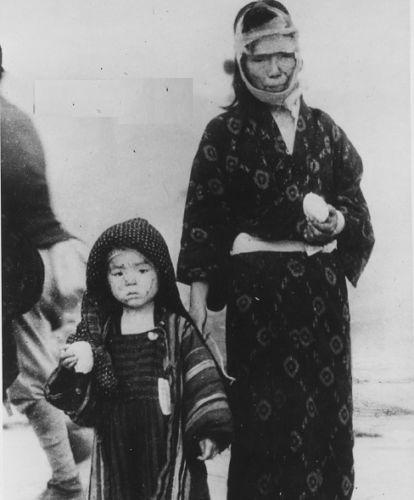
The American Manhattan Program was initiated by President Roosevelt when work done by German physicists led to concern that the NAZIs might build an atomic bomb. Jewish and oher refugees fleeing the NAZIs made a major contribution to the success of the Manhattan Program. The first bomb was successflly tested at Alamagordo, New Mexico on July ??, 1945. The Allies met in a Berlin suburb after the NAZI surrender to make dcisions about the occupation of Germany and defeating Japan. The Allied powers 2 weeks after the bomb was tested demanded on July 27, 1945 that Japan surrender unconditionally, or warned of "prompt or utter destruction". This became known as the Potsdam Declaration. The Japanese military was prepared to fight on rather than surender. The Japanese Government responded to the Potsdam Declaration with "utter contemp". The Japanese military continued feverish pland to repel the Ameican invasion of the Home Islands. Many Whermacht generals at the end of the War were anxious to surrnder to the Amreicans. One German General commanding forces westof Berlin after the War said, "We wondered why they didn't come." This was not the attitude of the Japanese military. I know of know memoir written by an important Japanese military officer expresing similar sntiments. Truman was not anxious to use the atomic bomb. He was anxious to end the War and limit Ameican casulties. For Truman the Japanese response to the Potsdam Declaration made up his mind. There have been many books and aticles published in both Japan and America about the atomic bomb. Japanese scholars have reserched the decission making process that led to the dropping of the atomic bombs. Almost always the focus is on Truman and Ameican military leasers. Rarely do Japanese authors address the role of Japanese political and military leaders. The United States dropped two atomic bombs on Hiroshima and Nagasaki on August 6 and 9, and the Soviet Union entered the war against Japan on August 8.
Most Americans believe that the Japanese surrendered because of the American development and use of the atmonic bomb. The bomb was certainly a factor, but not the only factor. The decesion to surender is far more complex and impossible to know with any surity. The American Pacific Island invasions, naval power, and in particular the Soviet declareation of war and starteling sucess of the their invasion of Manchuria all played major roles. The success of the Soviet Army convinced even Imperial Army officers and the Ministry of war that defeat was inevitable. Emperor Hirohito on August 14 decided to surrender unconditionally. Even after the atomic bombs and the debacle in Manchuria, there were hardliners that were opposed to surrender. A group calling themselves the Young Tigers seized the Imperial Palace grounds and tried to prevent the Emperor's surrender broadcast. The attempted coup almost succeded. On what has become called "Japan's Longest Day" the attempted coup, bombing raid blackout, intrigues, killings, and sepukus determined fate of millions of Japanese people. It iwas a complicated series of events involving both great heroism and treason by officers convinced that they were behaving honorably. The Commander of the Eastern Army, however, remained loyal to the Emperor, dooming the coup. [PWRS] The formal surrender was held underneath the guns of the battleship USS Missouri in Tokyo Bay. Not knowing just what the Japanese were planning, the American carriers were standing at sea off Japan.
A Japanese reader, Fujioka Keisuke, has kindly provided HBC some of his boyhood memories, both before and after the War. We note large number of Japanese readers visiting HBC and we hope some of those readers will provide us additional accounts.
Frank, Richard B. Downfall: The End of the Imperial Japanese Empire (New York: Random House, 1999).
Gamble, Bruce. Target: Rabaul--The Allied Seige of Japan's Most Infamous Stronghold, March 1943-August 1945 (2013).
Keeney, L. Douglas. Lost in the Pacific: Epic Firsthand Accounts of WWII urvival Against Impossible Odds (2014), 216p.

Navigate the CIH World War II Section:
[Return to Main Asian air war page]
[Return to Main World War II Pacific campaign page]
[Return to Main World War II air campaign page]
[Biographies]
[Campaigns]
[Children]
[Countries]
[Deciding factors]
[Diplomacy]
[Geo-political crisis]
[Economics]
[Home front]
[Intelligence]
[POWs]
[Resistance]
[Race]
[Refugees]
[Technology]
[Bibliographies]
[Contributions]
[FAQs]
[Images]
[Links]
[Registration]
[Tools]
[Return to Main World War II page]
[Return to Main war essay page]