|
The American Manhattan Program was initiated by President Roosevelt when work done by German physicists led to concern that the NAZIs might build an atomic bomb. Jewish and oher refugees fleeing the NAZIs made a major contribution to the success of the Manhattan Program. The first bomb was successflly tested at Alamagordo, New Mexico on July ??, 1945. The Allies met in a Berlin suburb after the NAZI surrender to make dcisions about the occupation of Germany and defeating Japan. The Allied powers 2 weeks after the bomb was tested demanded on July 27, 1945 that Japan surrender unconditionally, or warned of "prompt or utter destruction". This became known as the Potsdam Declaration. The Japanese military was prepared to fight on rather than surender. The Japanese Government responded to the Potsdam Declaration with "utter contemp". The Japanese military continued feverish pland to repel the Ameican invasion of the Home Islands. Many Whermacht generals at the end of the War were anxious to surrnder to the Amreicans. One German General commanding forces westof Berlin after the War said, "We wondered why they didn't come." This was not the attitude of the Japanese military. I know of know memoir written by an important Japanese military officer expresing similar sntiments. Truman was not anxious to use the atomic bomb. He was anxious to end the War and limit Ameican casulties. For Truman the Japanese response to the Potsdam Declaration made up his mind. There have been many books and aticles published in both Japan and America about the atomic bomb. Japanese scholars have reserched the decission making process that led to the dropping of the atomic bombs. Almost always the focus is on Truman and Ameican military leasers. Rarely do Japanese authors address the role of Japanese political and military leaders. The United States dropped two atomic bombs on Hiroshima and Nagasaki on August 6 and 9, and the Soviet Union entered the war against Japan on August 8.
The American Manhattan Program was the largest weapons development program in history. It was initiated by President Roosevelt when work done by German physicists led to concern that the NAZIs might build an atomic bomb. Important scientists in 1939 concluded that German scienbtists had begun to develop an atomic bomb for the NAZIs. These scientists enduced President Roosevelt to launch an American atomic bomb project. The project was, however, given serious attention only after the Japanese attack on Pearl Harbor bringing America into the war. General Leslie R. Groves (1896-1970), Deputy Chief of Construction of the U.S. Army Corps of Engineers, was assigned to oversee the project. The Manhattan Project us named after the New York borough where the first office headquarters was located and began June 1942. Groves had just completed another rush project, the construction of the Pentagon. He considered himself an astute judge of men and chose Robert J. Oppenheimer (1904-1967)to lead the scientific team. Oppenhimer was a respected, but reatively unknown theoretical physicist. Enrico Fermi and ?? Salard working in a converted squash court beneath the University of Chicago's carried out the first controlled nuclear reaction occurred confirming that nuclear fission could unleash huge amounts of energy. The major difficulty in building an atomic bomb was in obtaining the rquired quanity of fissionable material. A huge facility was built an Oak Ridge, Tennessee to separated the U-235 isotope needed for the bomb from the more common U-238 isotope. The Hanford Engineer Works was built in washington to produce plutonium. Groves chose Los Alamos, New Mexico as a location to acually develop and assemble the bomb or "gadget" a it was called. This ioslated town had by March 1943 been turned into a high-technology boomtown. The Y-12 Plant at Oak Ridge provided the bomb-grade U-235 used for the Little Boy bomb. The Harford plant provided the Plutonium used in the Fat Man bomb.
Jewish and oher refugees fleeing the NAZIs made a major contribution to the success of the Manhattan Program. The NAZI campaign against the Jews began almost as soon as Hitler seized power in Germany. Even respected sientists were quickly dismissed from positions at universites and research institutes. Many of these individuals were able to emmigrte and take of their carrers Americ, France, and Britain. This significantly increased the pool of talented sientists available tothe American atomic bomb program. Some of the vest known were Hans Bethe (Alsatian-German Jew), Albert Einstein (German Jew), Enrico Fermi (Italian with Jewish wife), Leo Szilard (Hungarian Jew working in Germany), Edward Teller (Hungarian Jew working in Germany), and Eugene Wigner (Hungarian Jew working in Germany). Many like Bethe did not look on themselves as Jews. Some authors believe that the dismissal of competent scientists and appointment of Party hacks was a major reason in the failure of the German bomb program. [Walker] Many of these nuclear scientists emmigrated early in the NAZI era when the NAZIs were primarily concerned with dismissing Jews from universities and other official positions. Fremi came much later and managed to escape with his wife when he was allowed to go to Sweden to accept a Nobel Prize.
The American conquest of the Marianaas Islands in the Pacific brought the Japanese Home Islands within the range of the new American B-29 Superfortress bombers. Initinally the campaign was to be launched from China. The conquest of the Marinasa, however, provided even bettr bases. The Army Air Corps began the strategic bombing campaign in November 1944. The initial bombing raids were inconclusive. General Curtis LeMay devised a new strategy of lower level raids and the use of incendiaries. The resulting fire bombing which caused massive destruction in Japanese cities crammed with highly flameable wooden structures. Major cities like Tokyo and Kyoto were devestated. The resulting fire storms not only destroyed Japan's industrial economy and war industries, but it caused hundreds of thousands of civilian deaths. The casualties were far greater than resulted from the two atomic bombs. Interestingly, even though the number of casualties were far higher, LeMay's fire bombing campasign has not attracted the controversy of the two atomic bombs.
The invasion of Okinawa was the first American attack on Japanese territitory. Okinawa, in the Ryukyu Island chain was strategically located between Kyushu, the southernmost Japanese island and Taiwan (called Formosa by the Japanese). American strategists saw Okinawa as a necessary base from which an American invasion of the Japanese home islands could be staged. Okinawa had several air bases and the only two important harbors between Formosa and Kyushu. The American invasion was code named Operation Iceberg. The greatest naval force in histoy was assembled for the invasion. Admiral Raymond A. Spruance's 5th fleet included more than 40 aircraft carriers, 18 battleships, 200 destroyers and hundreds of support ships. Over 182,000 troops participated in the invasion. The American invasion forced was surprised when the beach landings were unopposed. Okinawa was defendened by the 32nd Japanese Army and a garrison of about
110,000 men. The Japanes had drawn back from the onvssion beaches. The Japanese strategy was to bring as many ships as possible in close to the island to support the invasion. it was then that a major Kamakazi attack was unleased on the invasion fleet. The Japanese on April 6-7 employed the first massed formations of hundreds of kamikaze aircraft. The Japanese during the Okinawan campaign flew 1,465 kamikaze flights from Kyushu. They succeedd in sinking 30 American ships and damaged 164 others. Other ships were attacked nearer Kyushu and Formosa. The Army Air Corps had rejected a request to havily bomb these air fields
as it was seen as a diversion from the strategic bombing campaign. One third of the invasion force was killed or wounded. Over half of the 16,000 Americans killed were sailors on the ships attacked by the Kamakazis. Virtually the entire Japanese garison died in the Okinawa campaign. Few Japanese soldiers surendered even after defeat was certain. Large number of civilans were also killed. The Jaoanese military reserved available food and supplies for its use and in many cases forced civilians to commit suicide. The American military saw Okinawa as a dress rehersal for an invasion of the Japanese Home Islands and anticipated even fiercer resistance. The extent of the casualties was a major factor in the American decission to use the atomic bombs.
In the waining months of the NAZI state, German technology was disptched to Japan in U-boats. Included in these shipments was enriched uranium. Germany overrun from east and west finally surrendered to the Allies (May 8, 1945). This meant that Japan faced the combined Allied strength alone. The NAZI zsurrender any further U-boat shipments. The U-boat with enriched uranium decided to surrender to the Americans rather than making a dangerous run to Japan. The impetus for the Manhattan Project was the concern of European refugees that NAZI Germany was building an atomic bomb. The American bomb was built primarily as a deterent against a NAZI bomb. Few of the scientists involved at the time thought that the bomb would ever be used once the NAZIs surrendered. Most of the scientists had not been thinking about Japan as they worked on the bomb. When the NAZIs surrendered and it was soon determined that German work on an atomic bomb had not progressed very far, the initial rationel for the American atomic bomb no longer existed. Even so, only one scientist, Joseph Rockblatt, resigned from the project. He was quickly hustled out of Los Alamos by General Groves. [Cornwell]
The American and Germans were not the only countries with nuclear programs. The Brirish of course supported the American Manhattan Project. The Japanese also had a small program. It was conducted at Osaka University. It made only minor progress. The Japanese Army, however, developed a dirty bomb project. Here I do not know to what extent the Japanese developed this project or it was suggested to them by the Germans. We do know that the Japanese selected of all German war material and technology to have the Germans ship Uranium oxide to them by U-boat just before the NAZIs surrendered. The U-234 was dispacted (april 1945) with 50 lead cannisters with uranium oxide. Presumably this was accompanied with technical documentation. If so it was dicarded at sea by the U-boat captain along with two Japanese officers. Apparently the Japanses were planning to use the uranium oxide for a dirty bomb that was to be delivered by Japan's huge sunmarines that could actually launch aircraft. The suns had early stealth technology--rubber coated hulls. The attack was to hit San Francisco and was scheduled for August 17, 1945. Although the U-234 surrendered to the Americans, it was not known how many U-boats the NAZIs dispatched and how many got through with what cargos.
The first bomb was successflly tested at Alamagordo, New Mexico (July 16, 1945). The yield was about 20 kilotons, the greatestv man-made expolsion in history, but a fractiion of the fusion weapons to come. The test was carried out at the Alamogordo Test Range, located on the Jornada del Muerto (Journey of Death) Desert. The test was code named Trinity. The first test was a uranium bomb based on the implosion weapon design that had been built at Los Alamos. The test device was called Gadget. Given the new technology, it could not be evaluated without an actual test. The gun-type uranium bomb was not seen as requiring a test. The sciebntists concluded that at least one test should be conducted and monitored to test the many theoretical conclusions they had reached. The scientis were fairly confident of the outcome. Even before the test, a second bomb was secretly shipped to the NMarians to prepare for an attack on Hiroshima which had already been selrcted as the first target. The Trinity blast created a flash of light described as brighter than a dozen suns. The flash was seen over the entire state of New Mexico and in some areas of Arizona, Texas, and Mexico. The characteristic mushroom cloud rose to over 38,000 feet into the upper levels of the atmoshphere within only minutes. The heat of the explosion was measured at 10,000 times hotter than the surface of the sun. And even at 10 miles away, the heat was described as facing into a roaring fireplace. The explosing extunguished every life within a mile of the test tower. A fleet of 2,000 B-29, Superfortresses would be needed to deliver an equivalent payload of conventiinal explosives.
The victorious Allies met in a Berlin suburb after the NAZI surrender to make dcisions about the occupation of Germany and defeating Japan. The news of the successful test was cabeled to President Truman who was at tghe Potsdam Confwerence, meeting with Churchill and Stalin. He received a brief secret notification that the atomic bomb test had 'exceeded expectations'. Truman when he informed Stalin about the atomic bomb thought it odd that Stalin was not surprises. The reason of course is that Soviet spies had already provided the Soviets a great deal of information abvout the bomb. The Allied powers 2 weeks after the bomb was tested demanded on July 27, 1945 that Japan surrender unconditionally, or warned of "prompt or utter destruction". This became known as the Potsdam Declaration.
The Allies demanded 'unconditiinal surrender'. Many authors have criticised President Roosevelt and President Truman for this demand from both the NAZIs and Japanese militarists. This was a policy enunciated by President Roosevelt and Primeminister Churchill at the Casablanca Conference (January 1943). Actually Roosevelt came up with the idea without getting Churchill'a agreement. The post-World War I peace was on Roosevelt's mind. He was determined to make sure to leave no doubt in Germans minds this time that they had been defeated. Uncondition surrender was a term ringing in American minds since U.S. Grant abd the Civil War. Churchill had some reservations, but went along in the name of Allied unity. Some historians claimed it steeled Axis resistance. Perhaps, but Germanhy and Japan would have probably fought on wih or without the demand for unconditional surrender. Just what could be offered to the NAZIs. Some Japanese wee beginning to think about ending the War, but surrender, especially unconditional surrebnder was not an option. Anyone even suggesting that woukd have been arrested or assasinated by the miklitary, including Primeminister Suzuki. Japan's cities were being reduced to ashses by the strategic bombing campign, but the military was still against surrender which was widely seen as dishonorable. The sufferingb if the civiliann population seems to have had little impact on the military's thinking.
They believed that thaey could badly damage any invasion fleet appriaching Japan and strongly resist any invasion force. In addition, they still were in control of large areas of China and Southeast Asia with substanyial undefeated military formations in the field.
The Imperial Government and even the most militant Japanese military commander by 1945 realised that Japan had lost the War. There was no longer any hope of winning the War. Japanese leaders realised that there would have to be a negotiated peace. The question was just what the ternms would be. There was the question of Japanesse possessions, just had to be given up. Japan even after the strategic bombing campaign began, refused to accept the Allied demand for unconditional surrender. The two developments that the Japanese in particular refused to accept was first an end to the monarchy and second the occuopation of the Home Island. Japan no longer had the military capscity to defeat the Allies. The military was forced to adopt the strategy of majing the Allied advance as costly as possible. Commanders on Iwo Jima and Okinawa adopted tactics to kill as many Americans as possible. Thus as bad as the earlier campaigns had been, both of these two campaigns were worse. There were 6,000 casualties at Iwo and 70,000 on Okinawa. The Kamikaze campaign ubleased on the U.S. Navy at Okinawa made it clear what the Japanese were preparing for the invasion of the Home Islands. And not only was the military preparing, but the civilian population, including children were being prepared to resist an American invasion.
The Japanese military was prepared to fight on rather than surender. The Japanese Government responded to the Potsdam Declaration with "utter contemp". The Japanese military continued feverish pland to repel the Ameican invasion of the Home Islands. Many Whermacht generals at the end of the War were anxious to surrender to the Amreicans. One German General commanding forces west of Berlin after the War said, "We wondered why they didn't come." This was not the attitude of the Japanese military. I know of know memoir written by an important Japanese military officer expresing similar sentiments. Truman was not anxious to use the atomic bomb. He was anxious to end the War and limit Ameican casulties. A HBC reader writes, "As a World War II veteran, I would like to make a comment about the use of the atomic bomb on Japan. The estimated U.S. military casualties if we invaded Japan was approximately one million GI's. Iwo Jima an island that was three miles long and one mile wide at it widest had 6,000 marines killed and a casualty count of 25,000. My brother was wounded landing on Iwo Jima and still carries some shrapnel in his leg. Then remember Saipan and Okinawa where where we had huge losses of our GI's. Therefore, if we had to invade Japan how many of our Unted States population would never been born? In addition, Japan was using Kamikaze planes to destroy American aircraft carriers. Their military tradition was to die to the last man. President Truman made the right decision." And to do just that, Japan was amassing a secret airforce.
One factor which must be consdered had America not dropped the bomb is the extent of Japanese casulaties, both military and civilian, had America invaded. Japanese readers writing to HBC suggest that Japan was defeated and there would not have been significant resistance. As far as we can tell, this appears to be the widespead Japanese public opinion on the issue rather than an assessment founded on historical research by recognized scholars. HBC would be interested in any Japanese or Western research substantiating the aseetion that Japanese resistance to an invasion of the home islands would have been inefectual. There is evidence that the Japanese military had stockpiled more than 5,000 aircraft for Kamakazi attacks when the invasion fleet came into range. The planes were well hidden from aerial attack in caves and other locations. The military was also feverously working on jets and other weapons with techhnology supplied by the NAZIs. There was also work on nuclear weapons and while Japan was far behind the Manhattan Project, they were fully capable of building a dirty bomb. One German U-boat with canisters of Uranium bound for Japan surendered to the Americans. American planners had no way of knowing if other U-boats got through. Another factor is the potential civilian casualties. Most of the War was fought in locations without important Japanese civilian populations. The exception was Saipan and to a much larger extent Okinawa. The Japanese military on both islands expected the civilians to resist the Americans and incouraged them to commit suiside rather than surrender. Had the Japanese military done the same on the Home Islands, the civilian casialties would have been enormous, dwarfing the libe lost at Hiroshima and Nagasaki.
For Truman the Japanese response to the Potsdam Declaration made up his mind. There have been many books and aticles published in both Japan and America about the atomic bomb. Japanese scholars have reserched the decission making process that led to the dropping of the atomic bombs. Almost always the focus is on Truman and Ameican military leaders. Many Japanese writers insist that Japan was a defeated country and would have surendered without the use of the bomb. Little real evidence is presented to substantiate the claim that Japan would have surendred. Rarely do Japanese authors address the role of Japanese political and military leaders. One American presidential adviser reports that Japanese reserchers and journlists have interviewed him a number of times during visits to Tokyo. They ask about when the decission was made to drop the bomb. He replied that it was the Japanese leaders who made the decission when they rejected the Potsdam Declaration. He says that this response is never included in either published articles or broadcasted television interviews. [Elsey] President Truman made the decession after a meeting with one of his most influential advisers, South Carolina Govenor Jimmy Byrnes (June 1). Byrnes told him that if he did not use the bomb that he would have to explain at his impeachment why he did not use a weapon that would have ended the War and saved tens if not hundreds of thousands of American lives. President Truman has never explained in detail why he decided to use te bomb. Certainly the military estimates of potential casualties from an invasion was a primary factor. Japanese resistance on Okinawa and Iwo Jima was strong evidence that American casualties would have been very substantial. Japanese brutality toward American POWs and civilians must have influenced the President, but to what degree it is difficult to tell. The possibility of the Soviet Union entering the War and claiming an occupation zone may have also been a factor. Dealing with Stalin was very much on Truman's mind at the time. It was at the Potsdam Conference that Truman told Stalin about the bomb. [Beschloss, p.66.] We are not sure just what intelligence briefings Truman received. One factor which would have been of concern was the Uranium shipments from Germany via U-boat. The only possible reason for such shipments was a Japanese nuclear project. One factor that does not seem to have influenced the President was limiting Japanese civilian casualties, but as horrible as the two bombs were, ending the War without an invasion probably save hundreds of thousands of Japanese lives, if not millions.
The major decision coincerning the use of the atmoic bombs was what cities to target. The Air Force chose several cities as both primary and alternative targets. The alternatives were needed as various problems could have made the primary target difficult to hit. A simple look at the map shows why Hiroshima and Nagasaki were on the list. Hiromshima was a major naval base and the primary port through which the Japanese were shifting forces from China to defend Kyushu. Nagasaki was on Kyushu. Actually Nagasaki was not the primary target. The primary target was Kokura. This was a city on the Straits of Shimonoseki between Honshu and Kyushu. It was a major point through which forces on the other Home Islands were being shifted south to Kyushu. And it would a supply route to support the defending forces on Kyushu resistinhg the American invasion.
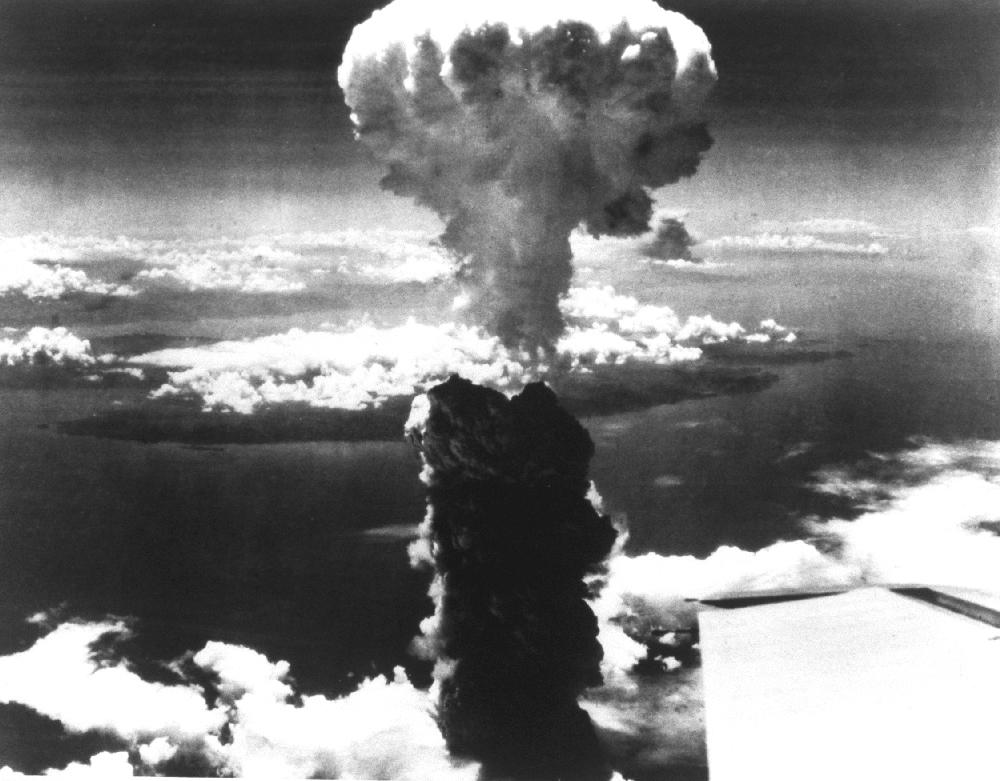
The United States using the hard-won bases in the Marianas and the new long-range B-29 Flying Fortresses dropped two atomic bombs on Japan (August 6 and 9, 1945). First came Hiroshima. It was not unusual for single B-29s to appear over Jaopnese cities. Single planes were not sent on bombing missions. City residents in Hiroshima noting the planes in the clear summer sky thought they were weather planes or other single planes on some kind of special non-threatening mission. The 'Enola Gay' dropped the Little Boy uranium bomb on Hiroshima (August 6). The Japanese were totally unprepared and at first had no idea what had ocurred. Except for a hanhdfull of nuclear scientists and Soviet spies, no one in Japan or America had any idea what an atomic bomb was. The War Party in the War Council denied the reports tht the blast was atomic despite the reports that it was a sinle bomb an an enitre city had been destroyed. Japan had its own atomic program which had cinckuded that while an atomic bomb was feasible, it could not be built within the time frame of the War. The primary limiting fctor was producing the needed fissile material. The War Party insisted on dipatching Japan's primier nuclear physicist, Yoshio Nishina, to investigate. Nishina headed a team of scientists to confirm whether or not Hiroshima had been destroyed by an atomic bomb. After taking physical measurements, he cabeled Tokyo confirmed the articles appearing in American newspapers (August 8). [L'Annunziata, p. 235.] Army commanders assured the Emperor, however, that the process of producing fissile mateial was so difficult that even the Americans could not possibly have another bomb to drop. The Americans dropped a second bomb the following day. 'Box Car' dropped the Fat Man plutonium bomb on Nagasaki (August 9). The Nakasaki bomb not only destroyed Nagasaki to what was left of the creditability of ther War Party with the Emperor. There was now no reason for the Japanese after the Nagasaki bombing to think thst the Allies did not possess any more atomic bombs. It is true, as Groves puts it, "Actually there were no more bombs ready to go, but more could have been assembled in relatively short order as the fissionable material was available." Gen. Groves later wrote, "Our entire organization both at Los Alamos and at Tinian was maintained in a state of complete readiness to prepare additional bombs." In the process, the world entered the nuclear age. The results were catrosrophic. Both cities were instantly devastated--because of topgraphy, Hiroshima anf Nagasaki. What had taken thousands of planes and million of bombs and at great cost over several years in Europe was accomplished by two planes in an instant--the destruction of entire cities. Two cities were largely leveled and countless souls simply incinerated. In some cases all that was left was a shadow burned into concrete. Many of the survivirs were badly burned.
The human tragedies are heart rending. There are many factual accounts. Many fiction writers have also addressed the cataclism. One particularly moving fiction account was about Emikio Amai age 6. "One morning toward the end of the summer they burned away my face. my little brother and I were playing on the bank of the river." [Bock]
The Soviet Union, 2 days after the first atomic bomb was dropped, entered the war against Japan on August 8. Soviet armies rapidly swept through Manchuria, destroying the Japanese armies there. Some authors believe that the success of the Soviets in Manchuria and the inability of the Japanese army to resist them, had more of an impact on the Japanese military than the two atomic bombs. One factor that we are not yet sure about is why Japanese resistance in Manchuria colapsed so quickly and why the Japanese military commanders were willing to surrender to the Soviets, but unwilling to surrender to the Americans in Okinawa or the Philippines. The Japanese that surrendered to the Soviets spent years in the Gullag. They were used for years in construction projects in Siberia and Central Asia. [Solzhenitsyn, p. 84.] Only about half survived and ever returned to Japan.
The first two bombs were dropped as a result of the momentum that had been built up in the effort to create nuclear weapons and end the war. And if they had not been dropped, there would be a firestorm of outrage over the caualties involved in an invasion of Japan. The third bomb was more of an open question. It would soon be ready and could have been dropped. The second bomb ws needed to convince the Japanese that the United States had the capability to produce the bombs in large numbers. (After Hitoshima, the Army told the Emperor that it would be months before the americans had another bomb.) The third bomb was more of a question. After the fire bombings and two atomic bombs, it was reasonable to ask if the Japanese would ever surrender. And President Truman was bothered about the civilian casualties. The President raised tis issue the day after the Nagasaki bombing. He commented to the cabinet, "The thought of wiping out another 100,000 people was too horrible (August 10)." He didn't like the idea of killing "all those kids." [Bernstein, p. 257.] The President ordered the military to hold off in dropping a third bomb.
There is no question that the atomic bomb was a horific weapon. And it is easy to criticize it and condemn the men who used it. But essentially the same can be said about any bomb or for that matter any weapon. The Civil War Minnine ball caused or artillety cannister round caused untoild carnage, but both played a role in fleeing the slaves. Should they have not been used? And while untold pages have been written describing the horrors of the atmomic bomb--all of which are absolutely correct. But what you do not see in these comments is what alternative could have ended the War with less loss of life. And here we are talking about both American and Japanese lives. It is easy to crirticise America, much more difficuklt to offer a more humane alternative that faced President Trumana nd his advisers. Any real assessment of the bombs has to consider what the alternatives were. There were four major alternatives: 1) Accept a peace with the Japanese militarists left in power, 2) Semonstration drop, 3) Invade Japan and defeat the Japanese military on the Home Islands, and 4) Continue blockading the Home Islands and starve the Japanese into submission. We can consider these and assess if any of these otions were better for America and the oeople of Asia or for that matter the Japanese people. We welcome reader input here as to any other possible alternatives.
The success of the Soviet Army convinced even many hard-line military officers that defeat was inevitable. Even so there were still hard liners that were determined to hold out. The military defense plan included using civilians to fight the Americans. This included wpmen and children. Children drilled with bamboo spears. A HBC reader as a little boy in primary scool remembers the bamboo speers. Some children were going to have explossive charges strapped on them. If this had been put into effect, the number of civilian cassualties would have been incalcuable. It is not clear wprecisely just when Emperor Hirohito decided that Japan must surrender. It seems that he came to this conclusion before the atom bombs were dropped, but did not know how to cinfront the military. The bombs and perhaps the success of the Soviets in Manchurchias, gave him the means of driving a wedge between the hard-liners and the rest of the militry high command. Even so, after it was learned that the Emperor planned to announce hi decission to surrender on the radio, die hards stormed the Imperial Palace in Tokyo, but were arrested by the palace guard who remained loyal. Emperor Hirohito on August 14 decided to surrender unconditionally. The formal surrender was held underneath the guns of the battleship USS Missouri in Tokyo Bay.
The United States after World War II oversaw an occupation which fundamentally changed the nature of both German and Japanese society. The American occupation in Japan rooted out Japanese militarism and fomenting the development of a democratic political regime and social structures. Women were enfranchized and labor unions allowed to organize. The results by all practical measures have been an overwealming success. Japan today is one of the most prosperous and democratic societies in the world. There were, however, major differences in the occupation policies pursued in Germany. The Imperial Government was not dismantled. Emperor Hirahito was allowed to remain on the Crysanthumum Throne. Details on his involvement in the War suggest a participation that was far more extensive than admitted at the time, although he certainly acted with considerable courage to end the War. Japan did not and does not today admit the full extent of its responsibility for launching World War II. Many Japanese attempt to hide the extent of their country's war crimes. Here the list is long, led by the launching of aggerssive war first against China (1937) and then the United States and Britain (1941). Specific examples include the terror bombing of undefended Chinese cities (Shanghai); masacres of Chinese civilians (the Rape of Nanking), use of biologcal and chenical weapons, mistreatment and massacres of Allied POWs (the Batan Death March), abuse of civilain internees, use of slave labor, conscription of civilian women for prostitution (Korean comfort women). Many Japanese today attempt to portray Japn in the role of a victim of the War as a result of the atomic bomb. Right wing groups in Japan today are promoting a new curriculum about the War.
At the time of the War there was not a great deal of criticism over Truman's decision to use the atomic bomb. Some of the Manhattan OProject scientists objected, largely because many had committed to working on the bomb because of the danger that Hitler and the NAZIs might build a bomb. They never intended to build a bomb for use against the Japanese. Some in the American military also objected. The great bulk of Americans and other in the Allied camp heartily approved, especially the GIs would were preparing to invade Japan. It was widely believed that it would it would be a very costly military operation, based upon Japanese resistance in other Pacific island campaigns. The Japanese still hoped to avoild occupation through a policy of bleeding the Americans. The Japanese knew that the invasion was coming in the southern island of Kyishu and were massing forces there. They had also ammased a Secret Airforce for massive Kamikazze attacks on the Allied invasiion fleet. Civilians were being trained as part of Ketsugo. The Bomb is commonly depicted as killing countless Japanese. In fact about 200,000 Japanese were killed, a terrible number, but a small fraction of the millions of people who died at the hands of the Japanese. And in fact the bomb gave tge Emoeror the excuse he needed to surrender despite a wide spread determination of the Japanese military to commit national suiside. Not often The bomb was justified by saving the lives of Allied soldiers. Often ignored are the thousands of military and civilian internees who were near death from staebation and the Japanese Army had decided to murder. And usually ignored in the debate was the millions of Japanese lives which were saved. This includes both the casualties from an invasion as well as a famine which was developing because of food shortages and poor harvesrs. Since the War, the Japanese have used the bomb to portray themselves as a victim of the War rather than the perpetrator. We note incesant demands on the internet that America should appologize. Among the mindless chatter, we note some pertinent comments. One came from China. The Chinese who suffered terribly at Japanese hands are less willing to forgive. "As a Chinese, I strongly against the idea of apology, Japan does not deserve any apology as a evil invader who set out the fire WWII and cause so much pain to Asians especially China. The bomb drop hasten the end of WWII, it is certainly justice. How ridiculous for Japan to pretend to be a victim in WWII?" [Junting] One very thoughtful American writes, "Sure. Japan has become a friend, and friends apologize for their actions in past conflicts. However I would also say that this does not mean the USA was necessarily wrong in their decision. Nor is it our place to second-guess those who made that terrible choice. Similarly, the actions of Japan as an aggressor are in the past. They too should apologies to those nations once harmed, but such an apology does not mean that they owe reparations beyond those decided on at the end of the war. It's past, it's over. If we are going to re-fight all the injustices of history we must resign ourselves to endless war until we are all eaten up. As this is senseless perhaps we should all say to one another "I'm sorry that my ancestors did yours harm, regardless of the reasons" and then let it be. Moving on from past conflict is part of friendship. It's called making peace. But it seems to me that most calls for apologies and reparations I see happening between nations are an attempt to turn historical grievances into diplomatic coin or a sense of obligation and/or moral superiority. That's not peacemaking, it's passive aggression. And this strikes me as a shoddy and cynical way to seek advantage. An attempt to exploit the misfortunes of ones own ancestry is hardly something which inspires me to see those demanding such apologies as deserving of any such thing." [Moorer]
Beschloss, Michael. The Conqueroes (Simon & Schuster: New York, 2002), 377p.
Bernstein, Barton J. "Understanding the Atomic Bomb and the Japanese Surrender: Missed Opportunities, Little-Known Near Disasters, and Modern Memory," Diplomatic History Vol. 19, No. 2 (Spring 1995).
Bock, Dennis. The Ash Garden (Knopf, 2001), 281p.
Corwell, John. Hitler's Scientists: Science, War and the Devil's Pact.
Elsey, George. Panel discussion, Book-TV C-Span, November 14, 2002.
L'Annunziata, Michael F. Radioactivity: Introduction and History, From the Quantum to Quarks.
Moorer, Anderson. Quorum discussion (July 14, 2013).
Junting, Paco li. Quorum discussion (July 14,2013).
Solzhenitsyn, Aleksandr I. The Gulag Archipelago, 1918-56: An Experiment in Literary Investigation (Harper & Row: New York, 1974), 660p.

Navigate the CIH World War II Pages:
[Return to Main World War II Pacific campaign page]
[Return to Main World War II air campaign page]
[Return to Main military style page]
[Biographies]
[Campaigns]
[Children]
[Countries]
[Deciding factors]
[Diplomacy]
[Geo-political crisis]
[Economics]
[Home front]
[Intelligence]
[POWs]
[Resistance]
[Race]
[Refugees]
[Technology]
[Bibliographies]
[Contributions]
[FAQs]
[Images]
[Links]
[Registration]
[Tools]
[Return to Main World War II page]
[Return to Main war essay page]