
World War II: Vichy France--Economic Collaboration/NAZI Exploitation
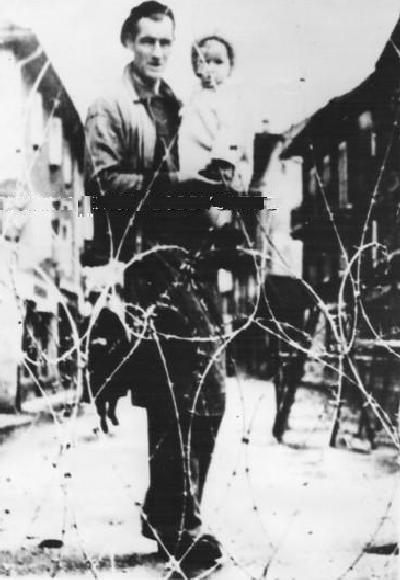
Figure 1.--This International News Photos wire service photograoph was published in American mewspapers April 4, 1943. The caption read, 'Inside looking out but not for long. This dramatic picture portrays the opresent struggle and the hopes of a free future for this Frenchman and he stands in front of barbed-wire fence that stands between him and those he loves and freedom. Ther mass deportations of French youths to Germay to work in sorely needed occupatons has driven the French patriots to the Alpine destricts where this picture was made. They still dream of a free world and a free France.' The caption is a little confusing because the details of German actions in occupied Europe were still not knowm. The man here has not been conscripted for war work because he has a baby. Only able bodied workers were brought to the Reich and they did not bring their famiky with them. And he has not fled to the countryside because again he would not have taken a baby with him.
|
|
One subject that we have not yet been able to properly assess is the extent to which Vichy France economically supported the NAZI war effort. We know that Vichy supported the German war-effort. We do not know just how effective that support was. Pétain on October 24, 1940 met with Hitler at Montoire. At that meeting Pétain and Laval discussed Franco-German cooperation. They were unable, however, to get any commitment from Hitler on key issues such as the post-War border of France and the return of the French POWs. Hitler had not yet made up his mind on these issues. The fact was that Hitler had little respect for France or the potential benefits of a French ally. He had convinced himself that the War was already won. The ally he really wanted was Britain. Vichy did make an important economic contribution to the German war effort, but it seems limited in terms of the potential economic potential of France. Of course the issue of economic collaboration merges into the subject of NAZI exploitation.
Information Needed
One subject that we have not yet been able to properly assess is the extent to which Vichy France economically supported the NAZI war effort. We know that Vichy supported the German war-effort. We do not know how effective that support was.
After Dunkirk, the Germans turned the Panzers south. It is soon apparent that the French Army is broken and will not be able to hold. Refugeees flow out of Paris to the south. The French declared Paris an open city. The Germans entered Paris (June 14). Prime Minister Reynaud asked the British Government to release France from its commitment not to make a separate peace with Germany (June 16). Churchill offered a union of France and Britain. The French Government rejected the offer. [Freidel, p. 337.] French Prime Minister Reynaud resigned (June 16). He was replaced by Marshall Pétain, the hero of Verdun in World War I. The French ask to be released from the commitment to Britain not to make a separate peace. Pétain immediately asked for an armistace (June 17). France capitulated (June 22). Hitler had found the railroad car in which the Germans had signed the World War I Armistace (1918). The armistace was signed at Compiègne. France was thus out of the War and Britain now faced the Germans alone. The terms of the Armistice were dictated by the Germans. They were harsh, but not as harsh as some had anticipated. The Germans treat France vert ifferently than Poland.The terms of the June 1940 armistace between Germany and France divided France into an occupied and unoccupied zone, with a rigid demarcation or boundary line between the two. The unoccupied zone becoes known as Vichy as aew capital is established there. The French had to agree to hand over anyone the Germans wanted. Former Primeminister Reynaud was among those detained. And they had to pay heavy reparations for starting the War.
Official Meetings
Pétain met with Hitler at Montoire (October 24, 1940). Hitler wanted Péetain to join the anti-Bolshevik crusade that he was planning in the East. Pétain adamntally refused. France woukd not reenter the War.
At that meeting Pétain and Laval discussed Franco-German cooperation. They were unable, however, to get any commitment from Hitler on key issues such as the post-War border of France and the return of the French POWs. Hitler had not yet made up his mind on these issues. Vichy did make an important economic contribution to the German war effort, but it seems limited in terms of the potential economic potential of France.
NAZI View
The fact was that Hitler had little respect for France or the potential benefits of a French ally. He had convinced himself that the War was already won. The ally Hitler really wanted was Britain. The NAZI use of the French economy for the wr effort was affected by the fact that the Germans in June 1940 thought they had essentially won the War. Even German industry was not fully mobilized for the War-effort. German policy was in part influenced by a desire to ensure that France would never again threaten Germany militarily rather than a desire to expand French armaments production.
Manufacturing
France was a major European industrial power. On the Continent, only Germany and the Soviet Union had a larger industrial capacity. The French coal and steel industry, aircraft and motor vehicle manufacture all had important potential for the German war-effort. The Germans made use of the French economy and industry, but it seems to us that they did not use it very effectively to support the war effort. This is just an initial impression. We need to persue this assessment in more detail. One factor here may be that ynlike the Czech lands which were to be repopulated with Germans, there wee no such plans in Frane. Apparently the NAZIs were more interested in reducing France's arms industry than in using it.
French industrial capacity
France was a major European industrial power. On the Continent, only Germany and the Soviet Union had a larger industrial capacity. The French coal and steel industry, aircraft and motor vehicle manufacture all had important potential for the German war-effort. There was very little damage to French industry as a result of the War. The fighting in 1940 was in the north and French cities were not bombed in the Luftwaffe. Thus the Germans seized a France largely undamaged by war.
French industrial companies
French industrial firms confronted grim alternatives after the armistice. Many faced bankruptsy or seizure by the German authorities. Others faced the prospect of competing wih favored German companies. French industrials for the most part saw little alterntive to cooperating with the Germans. Many persued cooperation with the Germans reluctantly, but saw no real alternative. Others had no quams to dealing with the Germans, attracted by the potential profits. Here we have nit yet been able to find much information. Or prelominasry assessment is that the Germans did not use the French industrial capacity to produce arms (aircraft, tanls, artollery, ect) in large numbers. We are nit sure just what occured at these plants. We believe that the badsic German policy was to demilitarize France and to make sure there would never again be a threat to Germany from the West. The Germans did utilize other non-military sectors of French industry that had military uses. Renault for example which had built French tanks before the Germann invasion. The Germans seized the Renault factories. One source reports that bLouis Renault refused to produce tanks for the Germans. We are not sure to bwhat extent vthe Germans pushed him to do this, we suspect not very hard. Perhaps French readers may know more. He did produce large numbers of trucks which the Germans used to support the Wehrmacht campaign in the East. Growing Allied Air power and the withdrawl of Luftwaffe units back to the Reich to defendc German cities, meant that any important French factories supporting the German war effort was exposed to Allied attacks (1943).
The Allies bombed the Renault factory in Billancourt at Île Seguin (1943). After Liberation, the French Provisional Government accused him of collaborating with Germans and arrested him (1944). Renault was held at Fresnes prison where he died under poorly explained circumstances while awaiting trial.
German contracts
Many French concerns benfitted from German contracts during the first 2 years of the German occupation. Many firms reported increased output and profits as a result of contracts with the Germans. [Hirschfeld, p.9.] The important French photographic company Photomaton in 1941 contacted German authorities with an offer to produced identity photographs for Jews in concentration camps.
French workers
One author estimates that about 8-9 million French workers in France were employed directly by the Germans on roads, military defences, aircraft, armaments and food production. [Pryce-Jones] (THis does not include the French workers conscripted for war work in the Reich.) Most of the construction of the Alantic Wall was also done by conscriped French workers. With the POWs held in the Reich, and conscription both for war work in France and and in the Reich, there was a shortage of labor in France. Some plants were operated with the help of the women and older men.
French arms industry
We know that Czech industry such as the Skoda arms plant played a major role in German arms production. We are less sure about the role of French heavy industry. For example, France manufactured artillery and tanks. Some of the French tanks were effective, but not well used by the French military. We do not know how the Germany integrated this manufacturing capability into their war effort. We have not read about the Germans manufacturing arms or planes in France, but our information is very limited. We know that old Belgian and French artillery was used in the Atlantic wall. Surely the Atlantic Wall could have been stregthened by manufacturing artillery in France. If the Germans did not manufacture weapons in France, it means that they were not fully utilizing the French economy in the war effort. We are not sure why the Germans did not do this. Perhaps it was a desire to demilitarize France to make sure it would never again threaten Germany. We believe that some munitions were manufactured in France. A French reader tells us, "Our war industries durng the occupation were dismanteled and shipped to Germany." We have no details on this, either the extent to which it was done or how effectively the Germans used the equipment to build new plants.
Food
France has some of the richest agricltural lands in Europe. And combined with the warm economy made France the most productive agricultural producer in Western Europe. The more southerly location of France and milder garment meant that the all important wheat yields were higher than in he British Isles, Low Countrie, Germany, and Scandnavia. The reason that France as such an important country in medieveal and pre-industrial Europe was the richness of its agricultural base. The German victory in the west, gave the NAZIs access to French agricultural bounty. This was vital to the NAZI war economy as Germany was not self-sufficent in food production and dependent on imported food. Stalin as part of the NAZI-Soviet Non-Aggression pact ships huge quantities of food to the Reich. After Hitler invaded the Soviet Union these shipments ceased. Hitler had expected the invasion to yield a vast agricultural bounty of food. It did not. The food seized fed the invading Wehrmacht, but there was no surplus available to ship home to the Reich. What fed the Reich was the agriculture of the captive countries in the West and France was by far the most important. The Germans after their stunning victory, as they did in other contries, moved to appropriate substantial quantities of France's food production. Decrees required farmers to sell animals and existing food stores. Horses were requisitioned for military purpses as they were needed for the coming Barbarossa campaign. The Germans demanded a percentage of the annual crop as part of the armistice terms. As the War continued, German seizures became both more random as well as escalating the share. The primary German exploitation tool became setting and extrodinarily low exchange rate (1 reichmark to 20 francs). The Germans ha, however, abasic problem. The more they exploited French farmers by not paying them a reasonable price for their produce, the more the farmers simply withdrew into self suffiency. They just produced what they need and thus there was less for the Germans to exploit. The NAZIs experienced this problem with their own farmers, but to a much larger extent in France and other countries in the West. It was a serious problem because in the West agriculture was based on the prodution of large numbers of small-scale farmers. Thus any kind of enfrcement would have required a massive enforcement effort. One historian describes a little girl named Emilia Olivier who lived on the family farm. Her family's experinces are described in eetail. They ate well, producing all they needed and simply waited out the Germans as the War swirled round them. [Collingham, p 163.] The German control system caught farmer trying to transport food for sale on the black market. It did not catch farmers who simply reduced production and stayed on their farms.
The Germans also impaired French harvestsin other ways. The French POWs intened in Grmany included many agricultural and industrial workers. The German conscription of workers took more men away from the farms. One estimate suggests tht some 0.4 million agricultural workers were missing because of German policies. [Collingham, p. 170] Other inputs such as hoeses, tractors, fuel, fertilier, pesticides, and agricultural equipment were virtually impossible to obtain. Milk and meat wre especially difficult to obtain. And while prouction fell, the Germans incresed their demands. German policy was to eporthunger to the occupied people. Reich Marshal Göring who headed the Four-Year Plan demands reached 15-20 percent of French productio by 1942. Even German ocupation authorities resisted, fearng it would result in further reductions in French production. One assessment suggests that French rations had fallen to starvation levels about 1,050 callories (1944). Urban families had to resort to the black market to live. Families wre spending 70 percent of their income on food. Malnutrtion increased as well as diseases ssociated with malnutrition (rickets, tuburculosis, and others). French school boys averaged 7 cm shorter and girl 11 cm shorter than pre-war llevels. [Collingham, p. 172.] In the end, the expolitative German policies hurt both the Germans ad French. The Germans only got 49,000 tons of butter from France (1940-43). In comparison they got 200,000 tons from Denmark, a country with a much smaller agricultural sector. The differece was themuch more lenient poliie pursued in Denmark. [Nissen, p. 185.]
Consumer Goods
French manufactured consumer goods were shipped to Germany. Clothing was an important product. Part of this was to fufill war reprations demanded by the Germans as part of the armistice. In effect France had to pay for the goods shipped to Germany, We have little actual information on these shipments at this time. The French public was aware of these shipments and they contributed to domestic shortages. A French joke at the time was a definition of collaboration: You give the Germans your watch and they give you the time. These clothing shipments may have had an impact on German fashions. We note, for excample German boys wearing French-styled rompers in the early 1940s. French reader writes, "Food, clothes, cloth, and shoes became very difficult to obtasin during the German occupation. A friend tells me that she couldn't go to school every day because there was only one decent pair of shoes for both her and her brother. So one day her brother went to the school and other day
she went. All old clothes, especially wool garments, were used to make new clothes. Despite the work of social organisations, one found more and more
poor families with children ho found it increasingly difficult. Food was more of a problem in the cities than the country. Clothes were especially difficult to obtain in the country."
Slave Labor
Germany's horific racial policies squamdered the potential resources of labor in the occupied east. The Jews were murdered in the Holocaust. Large numbers of Poles and Russians died because of mistreatment. The NAZIs in 1940-41, expecting quick victory, saw no need for these largely Slavic people. The Germans by 1942 were running out of workers as abled bodied Germans were drafted into the military. The failure of the Wehrmacht to defeat Russia in 1941 meant that German arms production would have to be increased. This was especially true because Hitler after Pearl Harbor also declared war on the world industrial giant, the United States (December 1941). Dedicated NAZI Fritz Sauckel was responsible for obtaining needed labor for Germany.
This was in part necessary because Hitler refused to authorize th mobilization of German women, other than unmarried young women. There was not Rosey the Reviters in Germay. The British mobilized women even more than America. The Germans, however turned to slave labor from occupied countries.
The Germans opened enlistment offices of the Office de Placement Allemande (German Placement Office -- OPA). This began as a voluntary effort. The iniitial purpose was to convince understandably reluctant French workers pf the 'benefits' in enlisting for employment in the German war industries in the Reich. They promised higher wages and better working conditions. (The manipulated exchange rate meant that wages paid in Reichmarks did buy a lot of Francs.) The newspapers published letters from French workers in the reich extoling their new conditions. Glossy publications were distrubyed describing the wonderful working conditions in the Reich.
They had little success. The success of the Soviet offensive before Moscow (December 1941) meant that the war in the East would be a portacted struggle. And with German workers being mobilized by the military, the NAZIs needed labor. Sauckel thus begsan to drawn on workers in Western European counties occupied by Germany. The numbers at first were small. The NAZIs ordered Vichy (May 1942) to supply 250,000 French workers for work in Germany by July. Vichy authorities, willing to cooperate in other areas were not anxious to transport French workers to Germany. Both Pétain and Laval realised the inevitable impact that conscripting labor for transport to Germany would have on the popularity of the regime. Pétain's popularity was based on the fact that Vichy had taken France out of the war and thus limited the impact on France. Laval devised a scheme called la relève. This provided for the repatriation of one French POW for every three workers who volunteered for war work in Germany. Vichy authorities, however, were unable to voluntarily recruit the number of workers demanded by the Germans.
As a result, Laval issued a conscription order (September 1942). A British newspaper reported that the new Vichy law "conxcripts all men between the ages of 18 and 50 and unmarried women between 21 and 35 for 'work necessary in the national interest'. British and other foreign residents also are affected. The Daily Telegraph (London newspaper) correspondent on the French frontier says the law is the most drastic ever passed in France and is the result of German failure to induce French workers to go to German war factories." [French workers ...] To enforce the conscription, Vichy authorities thus had to introduce conscription, le Service du travail obligatoire (Obligatory Work Service--STO) (February 1943). The OPA became the organization and sorting facility for the STO. The storefront signs, however, were not changed as they sounded less oppresive. The NAZIs using their Vichy regime began deporting French workers (February 1943). [Ryan, p. 178.] This more than any other single matter, began to change the attitide of the French people toward Pétain and his Vichy regime. In adition the War news now suggested that the NAZIs were not going to win the War. There was a substantial increase in the numbers of réfractaires. These were men that refused to report for conscription. Some simply hid. Others joined the Resistance. Some sought jobs in occupations exempted from the STO such as mining. France would make an important contribution to the German work force. Eventually about 650,000 Frenchmen and 44,000 Frenchwomen were deported to Germany for forced labor. France became the second most important contributor of unskilled labor to the German war effort. Only Poland provided larger numbers of workers. France was the leading supplier of skilled labor. [Atkin, p.174.]
Looting
NAZI looting played an important part in financing the German war effort. One estimate suggests that 40 percent of the wealth Germany acquired from the occupied territories came from France. Vichy in 1940 authorized the transfer of the Beligian gold reserves which were held in France to the Germans. Vichy in 1940 also authorized the transfer to theGermans of the French shares to the Bohr copper mine in Yugoslavia. Art works and antiques looted from Jews were sent to Germany.
German Seizures of French Assetts
he Germans introduced the essentially wrkless 'Invasion Mark'. his inflated the French France, essentially devaluing it. As the occupation continued, German agents bought up non-portable assets such as farms, real estate, mines, factories and corporations. Given the act that the Invasion Mark was baically worthless and the Germans had the coersive power to force sales, these sales were actually thinly desguised seizures. The Vichy Bank of France was forced to underwrite and finance German industrial schemes, insurance transactions, gold and foreign exchange transfers etc.
Sources
Atkin, N. Pétain (London & New York: Longman, 1998).
Collingham, Lizzie. The Taste of War: World War II and the Battle for Food (Penguin Books: New York, 1962), 634p.
Hirschfeld, G. "Collaboration in Nazi-occupied France: Some Introductory Remarks' in G. Hirschfeld & P. Marsh (eds), Collaboration in France: Politics and Culture during the Nazi Occupation 1940-1944 (Oxford: Berg, 1989), pp. 1-14.
Nissen, Morgens R. "Danisgh food productionin the German war economy," in Frank Trentmann and Flemming Just, eds. Food and Conflictin Europe in the Age of the Two World wars (Palgrave Mcmillan, Basingstoke, 2006)., pp. 172-91.
Pryce-Jones, David. "Paris during the German Occupation" in G. Hirschfeld & P. Marsh (eds), Collaboration in France: Politics and Culture during the Nazi Occupation 1940-1944 (Oxford: Berg, 1989), pp. 15-31.
Ryan, Donna F. The Hollocaust & the Jews of Marseille: The Enforcement of Anti-Semitic Policies in Vichy France (University of Illinois Press: 1996), 307p.
'French workers for Germany: Laval's conscription order," The Mercury Hobart, Tasmania (September 15, 1942), p. 1.
CIH -- WW II

Navigate the CIH World War II Section:
[Return to Main Vichy page]
[About Us]
[Biographies]
[Campaigns]
[Children]
[Countries]
[Deciding factors]
[Diplomacy]
[Geo-political crisis]
[Economics]
[Home front]
[Intelligence]
[POWs]
[Resistance]
[Race]
[Refugees]
[Technology]
[Totalitarian powers]
[Bibliographies]
[Contributions]
[FAQs]
[Images]
[Links]
[Registration]
[Tools]
[Return to Main World War II page]
[Return to Main war essay page]
[Return to CIH Home page]
Created: December 5, 2003
Last updated: 7:20 AM 3/14/2017