
World War II: Denmark and Norway (April, 1940)
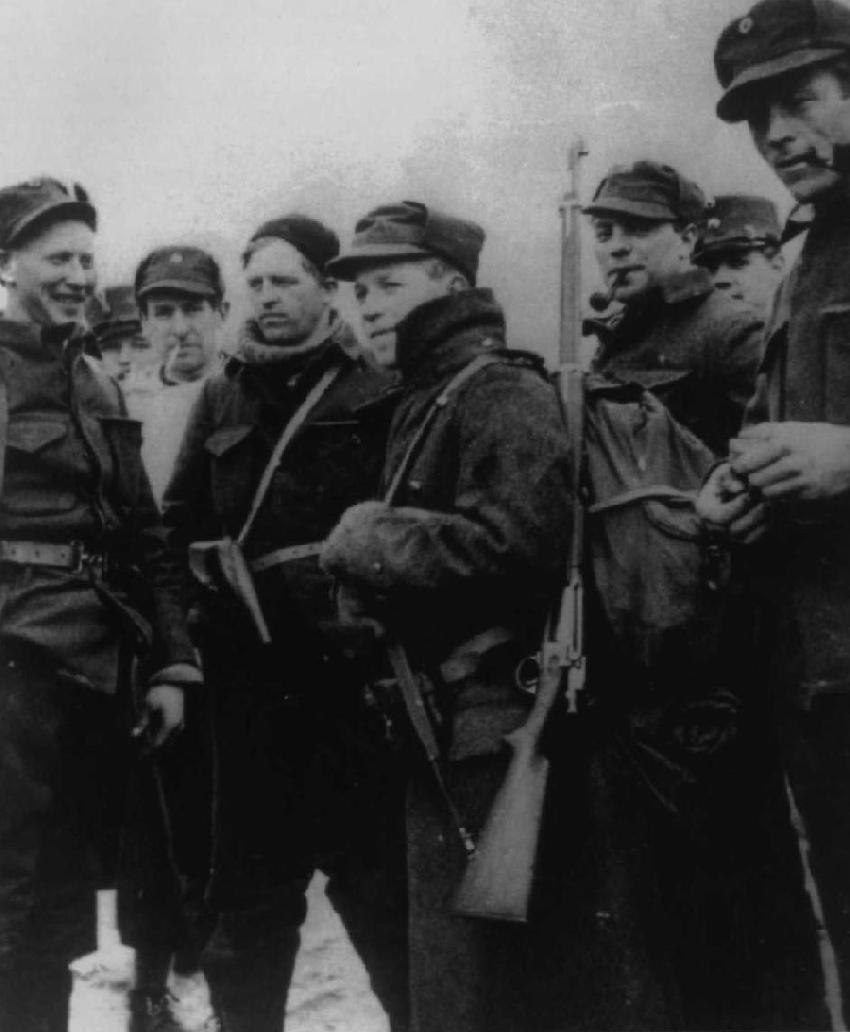
Figure 1.--unlike Denmark, Norway could have effectively resisted the German invasion as it required a naval and air assault. The Norwegian Army was totally unprepared. It was very small and lacked modern weapons. The Government naively believed that as in World War I, the Germans would honor their neutrality. Here Norwegian soldiers are pictured at Kongsvinter near Oslo where they were able to resist the Germans for a time. Source: Imperial War Museum.
|
|
Seven months after World War II began in Poland, the Phoney War came to an end in Scandanavia. The one Allied offensive in the first year of the War was planned to secure Norway. This would have tightened the North Sea blockade and at seasonally blocked the delivery of Swedish iron ore vitally needed by the German war economy. The Germans responded with a premtive offensive north invading Denmark and Norway (April 9). It was a rapidly organized invasion to counter a planned British attempt to move into Norway. The Danes did not resist. The Norwegians were caught totally unpreoared. The German Krriegsmarine suffered severe losses, especilly of its small, but modern destroyer fleet. The British fought on in northern Norway for 3 weeks, but the superiority of the Luftwaffe and the long-awaited German offensive in the West finally forced them to withdraw. The loss of Norway not only provided the Germans secure access to raw material, but meant that the U-boats could not br bottled up as they were in World war I. This however proved of minor importance when the German success in France gave Admiral Dönitz access to French Atlantic ports. It also meant later in the War that supplying Russia would be very difficult.
Norway's Strategic Importance
Norway's stastegic location attracted British and German interest in both World Wars. Norway in World War I managed to remain neutral. The country was not so lucky in World War II.
British efforts to bottle up German U-boats and surface units was premised on command of the North sea. The British had effectively done this in World war I and it severely hampered U-boat operations. German Admiral Wegener during World War I wrote about Norway's geo-strtegic importance. After the War the importance of German naval bases in Norway was stressed. Bases in Norway, especially air bases would greatly faciltate Allied operations in the North Sea. In addition Norway was an important producer of iron ore. Swedish iron ore was also important and when the Baltic ports froze over in Winter, shipments were routed by rail through the ice-free Noregian port of Narvik. Both the British and Germans imported Scandinavian iron ore.
NAZI Racial Theories
There were not just the strategic location and the raw materials that drew Hitler'a attention to Scandinavia. NAZI racial theories saw Scandinavians as a repository of Nordic blood that Hitler and the NAZIs so prized. Many historians tend to view the NAZI racial mania as a side show whereas in reality it was cental ton Hitler's thinking.
Studie Nord
Hitler at the onset of the War had not considered invading Norway. Hitler's initial planned to to keep Norway neutral. Only after Poland had been digested and he began to give increasing thought to his Western offensive did he begin to think more about Norway.
Hitler ordered a study of the possibility of invading Norway (December 13, 1939). The resulting assessment "Studie Nord" recommended a preemptive operation (January 10, 1940).
One of the strongest proponents was Admiral Raeder. Many on his staff considered Allied violation of Norwegian neutrality unlikely. Raeder ordered further assessments. The initial planning by the Kriegsmarine called primarily for naval operations. Planners concluded that weather conditions would inhibit Luftwaffe operations. [Claasen] OKW concluded, however, from a early point that the Ludtwaffe would play a major role in any Norwegian operation. Generalmajor Alfred Jodl, at the time head of the OKW's operations section, conferred with Luftwaffe staff concerning Norway. Hitler's ordered the creation of a small group to study the occupation of Norway (December 13). Jodl met with Hauptmann von Sternurg, a Luftwaffe staff officer (December 13) and Hans Jeschonnek, the Luftwaffe's chief of staff (December 18).
These consultations let to Jodl and Generaloberst Wilhelm Keitel, OKW's chief of staff, discussing the deploying of X Fliegerkorps elements and the Luftwaffe's Strategic Air Reconnaissance Group "Rowehl" in reconnaissance operations over Norway. One of the recommendations of Studie Nord was to appoint a Luftwaffe commander to oversee a planning staff and then command the actual operation. Generaloberst Erhard Milch, the Air Ministry's state secretary and the Luftwaffe's armaments chief, was given the assignment to oversee the planning staff which became known as Auster (Oyster). Auster met (January 14, 1940. After this meeting, Hitler had second thoughts about Studie Nord. He dissolved Auster and assigned OKW to plan the Norwegian operaion. [Claasen]
British Planning
With the outbreak of War, Winston Churchill, was recalled to the Admiralty. At the time as a result of the NAZI-Soviet Non-Aggression Pact were virtual allies. When the Soviet's invaded Finland in the Witer War (1939), Britiain and France conidered how to help the Finns. One idea was set up bases in Norway and ship men and supplies across Sweden to the Finns. This had the advantage od cutting off Norwegin and Swedish iron ore to the Germans. [Osborn] It would of course been disastrous as it would have meant war with the Soviet Union.
German Intelligence
German intelligence learned of Allied plans for Norway. We are not sure just how they suceeded. Hitler received reports that Britain would not respect Norwegian neutrality. German naval intelligence broke the British naval codes. B-Dienst, created in the early 1930s, had broken the most widely used British naval code (1935). At the time of the War, B-Dienst crytoligits ad broken enough British naval codes that the Germans knew the positions of all British warships. They had further success in the early stages of the war as the British were slow to change their codes. The Germans as a result, the Germans were partly aware of the Allied planning having intercepted radio traffic showing that Allied transport groups were being readied. This reportedly provided important information about Allied activities and plans. The intercepts indicated that the Allies were preparing for operations against Norway. The Germans notice British submarine activity in the southern North Sea. Other reports such intercepted statments by former-Prime Minister and then Defense Minister Daldier Édouard Daladier revealed that Allied action was eminent. In addition, iformation leaked out from the Btitish War Cabinet. Both the Swedish iron ore shipments through Norway and the desire to assist Finland were issues for the Allies. As the War progressed, the German intelligence scored few additional intleigence coups. The primary excption being cracking the British merchant codes during critical phases of the the Battle of the Atlantic.
Altmark Affair (February 16, 1940)
A Royal Navy destroyer entered Norwegian waters to attack the German ship Altmark which was tranporting British POWs to a BBalktic port. The Norwegian government protested the violation of its neutrality.
Allied Actions
The one Allied offensive in the first year of the War was planned to secure Norway. The French and British mined Norwegian waters to stop the passage of German ships (April 8).
German Response
The Germans learned of the Allied plans. We are not yet sure just how the Germans learned of the Allied plans. The Germans responded with an offensive north on April 9, invading both Denmark and Norway. It was a rapidly organized invasion.
Denmark (April 9)
As German air and sea forces moved toward Norway, the Wehrmact moved accross the unmilitarized Danish frontier (April 9). Denmark had no creditable military force. The Danes realistically understood that they could not effectively oppose a German invasion. They hoped that the Germans would respect their neutrality as they did during Wirld War I. This was, however, a very different Germny. It was an almost bloodless invasion. It was notable for the first combat parachute landing in history. The Danish Army offered no real resistance to the Germans and the country was effectively occupied within hours.
German sea and airborne units while their comrads rolled into Denmark, launched their invasion of Norway (April 9). The Germans in a single day launched muktiple seaborn ar airborn attacks to the complete surprize of the completely unprepared Norwegians. [Greene and Massignani] The Germans targeted Oslo, Bergen, Trondheim, Stavanger, and Narvik. The Norwegians were stunned by the German invasion, but managed to organize some resistance. Three German cruisers and four troopships were sunk. The Allies land an expeditionary force landed in southern Norway (April 16–19), but are eventually forced to withdraw (May 3). The Narvik operation was especially daring as it was located in the far north of the country and involved a naval operation against the far superior Allied naval forces. It was accomplished by a German destroyer squadron moving ground forces all the way to Narvik. This German force succeeded in holding the town even after the the British sank the destroyers (April 13). The Germans steadily reinforce their foothold. After the Allies with drew from the south, the Norwegians have no real hope of resisting the Germans on their own. When the Germans took thev key rail center of Dombas, organized Norwegian resistance rapidly ceased. A British ground force retook Narvik (May 28), but was eventually withdrawn. The superiority of the Luftwaffe and developments in France were the deciding factors (June 10). The NAZIs placed a Reich-commissar in charge of Norway which took over the legal administration of the country. The Reich-commissar dissolved all Norwegian political parties except the pro-NAZI Nasjonal-Samling (September 25). The occupation regime was run administered by 13 commissars.
Vidkun Quisling (1887-1945)
Vidkun was the son of noted Lutheran minister and genealogist Jon Lauritz Quisling. Both parents came from distinguished families in the northern town of Telemark. Their son was notable as the country's highest scoring war academy cadet. He upon graduation). He helped save lives in Russia, working with Fridtjof Nansen, to help alieviate cthe famone following the Revolution and Civil War. He also reached the rank of major in the Norwegian Army, but served as defense minister in the agrarian government (1931-33). Despite is Christian upbringing, Quisling was very impressed with Hitler and the rise of the NAZIs in Germany. His experiences in Russia had made him intensely anti-Bolshevik, but thisxdoes not explain his anti-democratic orientation. Quisling and state attorney Johan Bernhard Hjort formed the Nasjonal Samling (National Unity--NS) Party (May 17, 1933). This was Constitution Day in Norway. The NS was the Norwegian National Socialist (NAZI) party. Nasjonal Samling was in all respects a Norwegian clone of the NAZI Party. The NS was anti-democratic and this was reflected in the Party structure which was based on the NAZI Führerprinzip.
The party at first had some modest success It polled nearly 30,000 votes (1933). This was a respectable showing in a country with a very small electorate, but this was before Norwegians understood just what Quisling represented.
Quisling was supported by the religiously rooted Norwegian Farmer's Aid Association which he had worked with during his gime in government. As the NS developed, however, support dwindled. Quisling closely followed Hitler and NAZI policies in Germany. The NS shifted from aparty with religious roots to a clearly pro-NAZI party with hard core anti-Semitic beliefs rejecting democracy and with little in the way of Christian foundation. As a result, support from the Church dwincled. Still the NS received about 50,000 votes (1936). After this support rapidly declined as Norwegians read more about developments in Germany. Hitler met with Quizling after the War began (December 1939). Hitler was apparently impressed with Quisling. It was at this time Hitler began to consider a possible Norwegian campaign.
At the time of the German invasion, the NS had avout 2,000 members. Quisling was ready for the invasion. He became the first person in history to announce a coup on a news broadcast. He announced the formation of a new government withb himself as prime-minmister. Because of his links to Hiller, he hoped tht the Germans would recognize his government. Hitler while personally impressed with Quisling, had aracgical side and realized thst Quisling had virtually no support in the country.
Results
The German Krriegsmarine suffered severe losses, especially of destroyers. The loss of Norway not only provided access to raw material, but meant that the U-boats could not be bottled up as they had been in World War I. It also meant later in the War that supplying Russia would be very difficult and Allied convoys to Archangel and Murmansk suffered dreadful losses. The occupation of Norway like the later occupation of the Balkans and opperations in North Africa all served to weaken the offensive power of the Wehrmacht and Luftwaffe when Germany invaded the Soviet Union (June 1941). Hitler boasted in 1942 that his success during 1940 in Norway would prove to be one of the two decisive actions of the War. He compared his decissive action with the failure of Germany's World War I leadership act decisively. [Claasen]
Sources
Claasen, Adam R. A. Hitler's Northern War: The Luftwaffe's Ill-Fated Campaign, 1940-1945 (Lawrence: University Press of Kansas, 2001), 338p.
Greene, Jack and Allesandro Massignani. Hitler Strikes North: The Nazi Invasionn of Norway and Denmark, April 1940 (2013), 352p.
Osborn, Patrick R. Operation Pike.
CIH

Navigate the CIH World War II Pages:
[Return to Main Danish World War II page]
[Return to Main Norwegian World War II page]
[Return to Main World War II campaign page--first phase]
[Return to Main World War II campaign page]
[Return to the Main World War II page]
[Biographies]
[Campaigns]
[Children]
[Countries]
[Deciding factors]
[Diplomacy]
[Geo-political crisis]
[Economics]
[Home front]
[Intelligence]
[POWs]
[Resistance]
[Race]
[Refugees]
[Technology]
[Bibliographies]
[Contributions]
[FAQs]
[Images]
[Links]
[Registration]
[Tools]
[Return to Main World War II page]
[Return to Main war essay page]
Created: 3:45 AM 1/9/2005
Last updated: 3:19 PM 12/24/2017