
World War II: Case Blue--Stalingrad (1942-43)
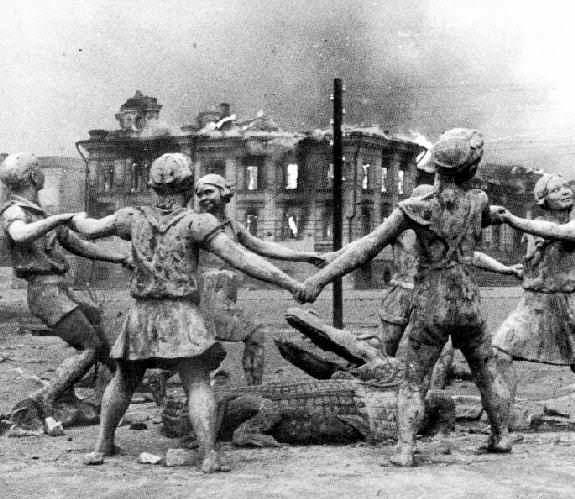
Figure 1.--Some of the fierest fighting in World War II took palce around this sculpture of Russian children in the middle of Stalingrad. Not one of the mounumental Soviet sculptures, but one of the most famous. The children are wearing their Young Pioneer uniforms.
|
|
"... the speed with which our soldiers have now traversed territory is gigantic. Also what was traversed this year is vast and historically unique. .... I did not want to attack in the center, not only because Mr. Stalin probably believed I would, but because I didn't care about it any more at all. But I wanted to come to the Volga, to a definite place, to a definite city. It accidentally bears the name of Stalin himself, but do not think that I went after it on that account. Indeed, it could have an altogether different name. But only because it is an important point .... A gigantic terminal was there; I wanted to take it. And do you know, we're modest: that is, we have it; there are only a couple of very small places left there.
-- Adolf Hitler. Speech on the 19th Anniversary of the Beer Hall Putsch (November 8, 1942) only days before the Red Army struck.
The battle of Stalingrad is generally seen as the turning point in the Second World War. The German summer 1942 offendive fouced on the south, including the Ukraine, the Causeses, and reaching the Volga at Stalingrad. The massive winter losses had significantly reduced the capabilities of the Wehrmacht. They simply were unable to accomplish the assigned objectives. The Wehrmacht no longer had the strength to launch a massive offensive all along the Eastern Front. They decided to strike in the south toward Stalingrand and the Caucuses where Hitler was especially interested in the oil resources. The powefull, well-equipped 6th Army was assigned the task. Initially they achieved startling successes. The shatered elements of the Red Army fell back accross the Don and were persued by the 6th Army. German inteligence, however, failed to appreciate the ability of the Russians to form and arm replcement armies. Hitler refused to even listen to estimates of Soviet strength. Hitler here made a deadly error. He dividing his forces, weakening 6th Army in an effort to seize the oil rich Caucusses. The Red Army withdrew accross the Volga when the 6th Army reached Stalingrad on August 19, but mainatined forces needed in the city to steadily bleed the Germans. Stalingrad was an important industrial city and a major transportation center for southern Russia. Hitler was also attracted by the name of the city. He felt seizing the city would be a propaganda blow to Stalin and his regime. By fighting in the city, however, the 6th Army's powerful mobil striking potential was negated by determined Red Army soldiers. The Soviet counter-offensive surrounding the 6th Army in Stalingd came as a complete suprise to the Germans. The result when Hitler refused to let the 6th Army break out was the complete loss of the Army, the most powerfull unit in the German order of battle (December 1942-January 1943).
Turning Point
The battle of Stalingrad is generally seen as the turning point of World War II. We suspect that the Red Army Counter Offensive before Moscow was even more important, but in the popular mind it was Stalingrad that was the turning point. his is probably because a German fiekd army surrendered to the Soviets. This was something that did not occur in the Red army Winter Counter Offenive, even hough the losses in men and equipment were enormous.
Hitler launched Opperation Barbarossa, the surprise invasion of the Soviet Union, on June 22, 1941. Massive Panzer encirclements destroyed whole Sovietvarmies. The losses were astonishing. The Soviet losses were so massive that Hitler and many Wehrmacht generals were convinced that Germany had won the War. The NAZIs had, however, failed to appreciate the dimensions of the Russian reserves. When finally stopped before Moscow, the Germans had seized many of the largest Russian cities, virtually destroyed the Soviet Air Force, and killed or captured about half the Red Army. . The Russian counter-offensive and bitter Russian Winter caused very substantial losses in men and material. This seriously reduced the strength of the Wehrmacht. Many front line German divisions had been reduced to a thirsd of their strength. Huge quantities of heavy weapons had been destoyed or abandoned. One Wehrmact estimate in early 1942 indicated that of 162 German divisions, only 8 were fully combat ready. Thus the German offensise in 1942 had to be much more limited than Barbarossa in 1941.
Stalin
Stalin had by 1928 established his dominance over the Soviet Union. He had an almost incaluably suspious, vindictive mind. Under Stalin the aparatus of the Soviet state was extended into every facet of Russian life. During the 1930s he oversaw an emense industrial exansion focusing on heavy industry and military production. He institude purges expanding labor camps to unpresendent proportions. Rivals were purhed, but arrests and executions were carried out of unbelievable proprtions designing to terrify the average Soviet citizen into unquestioning obedience. In 1937 that purge had reached the military. One of the reasons for the German successes in the early stages of Barbarossa during 1941 was the degree to which the Red Army cadre of professional officers had been weakened. The role of the Comisariat wand secret police in the army was expanded, further weakening morale. Many of Red Army dissasters in 1941 were the result of Stalin's refusal to allow restreat. Although Stalin had been silent during the initail stage of the German invasion, he proceeded to enforce a ruthless policy of shootig officers who retreated or failed to perform successfully.
The City
Stalingrad was a huge industrial city with T-34 tanks and other arms pouring out of the massive industrial comolexes. It also controlled the rail and waterway communications of southern Russia. Once Stalingrad was in Gerrman hands, the resources of the Caucuses, especially the oil, woukd be caught off from the Soviet war economy and combined with thev German drive into the Caucauses make a major contribution to the Geman war effort. in German hands. Stalingrad was in a very real way, Stalin's city. It was not just named after him. He had defended the city during the Russian Civil War (1918-21). And it was his Five Year Plans that turned it into a major industrial city. Stalingrad was thus the Soviet jewel on the Volga of Stalin's Five Year Plans and the industrialization of the Soviet Union. It was a city built expressly for the workers with apartment blocks near the industrial areas and spacious parks for recreation. The Germanns needed Stalingrad or at least a neutralized Stalingrad to secure the left flank of the drive into the Caucauses. As the battle developed the possession of Stalingrad took on a life of itself. Stalin ordered that it should be held at all costs. One historian has claimed that he saw Stalingrad 'as the symbol of his own authority'. And if Stalingrad was taken, the way would be open for Moscow to be enveloped from the south and west in the next year of the campaign. And for much the same reason, Hitler whi at first was after the oil in the Caucausesgradually shifted his focus to Stalin's name sake city.
Soviet Offensive (Spring 1942)
The Wehrmacht had seized Kharkov in October 1941. The Russians buoyed by their suucessful Winter in Spring 1942 offensive launched an offemsive to retake the strategic city. Marshall Timoshenko in Spring 1942 attacked toward Kharkov and encountered the main German striking force. The Soviets had assumed that the NAZIs would resume the offensive toward Moscow and had not anticipated forces of the strength in the south. The Soviet offensive proved to be a disaster. The Soviet forces were shatered. The Germans launched a counter offensive. The Germans launched a counter offensive on May 12. German Panzers cut off several Soviets armiesand began the systematic reduction of the Kharkov pocket which they achieved by the end of May. More than 70,000 Red Army soldiers were killed and 200,000 men taken prisoner. There were also huge losses of equipment. The entire southern wing of the Russian line had been shatered. The Red Army in the South by May 1942 had exhausted its offensive capability. The Wehrmacht was, however, not fully aware of the waekness of the Soviet position. The Germans seized the Crimea after valliant fighting in Sevastrpol. Thec Donets industrial basin was virtually undefended. The Germans advanced into the Caususes, threatening the Soviet Union's most important source of oil. Army Group A took Rostov (July 23). Now the Sixth and Fourth Panzer armies struk out east for Stalingrad.
Soviet Strategy
Stalin was in early 1942 prinmarily concerned with Moscow, understandable given how close the Wehrmacht had come to taking it during 1941. Moscow was a prize of emense sreategic importance. Not only was the capital, but in the Soviet system of centalized rule it was the vital nerve center of the Soviet Union, for the erconomy, the government, and the military. Thus Stalin concetrated the bulk of the Red Army around Moscow, convinced that the Wehrmacht would again strike in the north at the capital. The southern wing of the Russian defense line was the weakest, especially along the Don Steppe and the Caucasus. This seem an area od secondary importance.
Hitler's Strategic Thinking
It was in the South that Hitler decided to attack, lured primarily by economic consideration and the the resources--especially the oil resources of the Caucasus. Hitler in the early military campaigns including the early phase of Barbarossa had allowed the Wehrmacht generals to conduct the campaigns without undue interfearence. The military successes increased his prestige to the extent that he gave less and less credence to the professional Wehrmacht commanders and relied increasingly on his own personal judgements, lacking no moral compunctions and often colored by vicious racial hatred. The Wehrmacht failure to take Moscow in 1941 was largely due to his interfearence in the campaign. Failing to apprecaite this, he made himself Commander in Chief of the Wehrmacht in 1942, convince that his personal direction could at last achieve the ultimate victory in the East before the weight of American industrial production could be felt. He proceeded to interfere in operations, often ibvolving himseklf in minute detaiols. He fired many competent officers who resiisted his orders. He ignored or abused others. Those around him did not even attempt to interceed once they knew what he wanted, especially Keitel.
German Strategy
The Germans having failed in their objectives for Barbarossa in 1941 could no longer lauch a massive offensive all along the front. Faced with the prospect of a longer war than he had inmagined, Hitler decided to focus on the south where the richest economic prizes could be found, what Germany needed for along war. He was especially interested in the grain of the Uktaine, the minerals of the Don Blass, and the oil of the Caucasus. He was convinced that Germany with possession of these resources could wage war indefinitely. As a result, equipment and replacements as well as actual units were shifted south from Army Groups North and Center to Army Group South.
Case Blue
The German summer 1942 offensive was code named Case (Operation) Blue. Blue aimed south at the Ukraine, the Caucasus, and reaching the Volga at Stalingrad. The Germans planned to anchor their southern line on Stalingrad while they completed the conquest of the Caucausses. Stalingrad was a first only a minor objective. The massive winter losses had significantly reduced the capabilities of the Wehrmacht. They simply were unable to accomplish the assigned objectives. The Wehrmacht no longer had the strength to launch a massive offensive all along the Eastern Front. They decided to strike in the south toward Stalingrad and the Caucusses where Hitler was especially interested in the oil resources. To achieve this, Hitler assessmbed 74 divisions. There were 59 German divisions (9 armored and 7 motorized). Despite the lessons of the successful Blitzkrieg operayions in 1939-41, the German armored units were not concentrated, but rather dispersed among the various German formations. Combining infantry and armour sttrngthed the German units, but it also serious slowed operations and limited mobility. There were 8 more German divisions being assembed in the rear. The rest were divisions of AXIS allies, much weaker formations supplied by Hungary, Italy, Romania, and Slovakia. There was also the Spanish Blue Division composed of volunteers. Half of the Luftwaffe strength in the East was assembled unfer the Fourth Air Fleet. They wre faced by 15 Soviet armies. (Soviet armies were organizationally smaller than Wehrmact armies, sometimes composed of as little as 2-3 divsions.) The Soviets were assembling 10 additional armies further west. The bulk of the Red Army, however, was further north still expecting an offensive aimed at Moscow.
Historians often describe the desperate German defensive forces as 'scraping the bottom of the barrel'. In fact after the huge losses before Moscow (1941-42), the Wehrmmact was already doing this in 1942. Operation Blue, the German Summer Offensive in 1942, had to be limited to one sector of the front. Offensives of the scale of Barbarossa were no longer possible. Hitler chose the south because of the resources the German war economy needed, especially oil. This surprised the Soviets who were expecting another assault on Moscow. The 1942 Summer Offensive was largely fought by rushing the current year class of 18-year old conscripts to the front. These inexperienced youths would comprise a major proprtion of the rebuilt Ostheer (Eastern Army). Compared to Barbarossa, Operation Blue was an offensive on a shoe-string. Even so, it was surely the most complex Wehrmacht operation of the War. And because of the limited resources and complexity, there was a narrow margin of victory. With America now in the War, 1942 would be Germany's final opportunity to win the War before the United Staytes could mobilize its resources and bring them to bear on Germany. One of the several weaknesses of Blue was the large number of young, inexperienced troops. Hitler was well aware of this, he told his generals, "The operation must begin with success; young troops mustn't suffer any setbacks. Young troops need special support. Thevoperation must proceed in such a way that our young divisions get used to the enemy." (March 28, 1942). [Hadler, p. 3:420.] The resulting disaster at Stalingrad (January 1943), further weakened the Wehrmnacht and creating a massive manpower shortage, not only because of the rebuilding Red Army, but because the growing Allied strength in the West.
Offensive Lunched (June 28, 1942)
The Wehrmacht launched Blue on June 28, 1942. Waves of Luftwaffe bombers ponded Soviet positions. Panzers sliced through Red army units weakened by the failed Kharkov offensive. The Russians wre unprepared for the strngth of the NAZI onsluught, having expected an attack further north ainmed at Moscow. The initial strike was east from Kursk toward Voronezh. These were followed in early July with additional units attacking further South. Other German units attacked south east toward the Don Bend. Other units attacked east toward the Caucasus. The Germans by July 5 had reached the Don. Initially the Germans achieved considerable success. The shatered elements of the Red Army fell back accross the Don and were persued by the 6th Army and 4th Panzer Army. The Wehrmacht failed, however, to achieve the massive encirclements that had characterized Barbarossa in 1941. The Germans concluded that this was because the Red Army had been fatally weakened. It was in fact because the Red Army was laerning how to fight a modern war. German inteligence failed to appreciate the extent of the Sovier reserves and the the ability of the Russians to form and arm replcement armies. Hitler refused to even listen to estimates of Soviet strength. He was, however, was delighted with the accomplishments of the campaign. When Speer Hitler at his Vinnista headquarters, he found an optimistic, if not enthusiastic man already planning the next campaign. He explained to Speer. "I have had everything prepared. As the next step, we are going to advance south of the Caucuses and help the rebels in Iran and Iraq against the English. Another thrust will be directed along the Caspian Sea toward Afghanistan and Ondia. Then the Englih will run out of oil. In two years we will be on the borders of India. Twenty to thirty elite German divisions will do. Then the British Empire will collpase. They've already lost Singapore to the Japanese. The English will have to look on impotently as their colonial empire falls to pieces." [Speer, p.50.]
The Wehrmacht split the expanded Army Group South into two elements, Army Group A and B. Hitler here made a deadly error. The central rule of military strategy is to concentrate forces on a vital objective or weak point in the enemy line. This was a key element of Blitzkrieg. The great German Victory in the West was achieved by this dictum as well as the great victories of Barbarossa. Here Hitler's avarice was so great that he split his forces to seize the many assetts he prized. Having learned nothing from the 1941 offensive, Hitler decided to seize not only the oil of the Caucasus, but also Stalingrad as well. Important Wehrmacht commanders including Jodl argued against dividing the limited German forces. In some cases Hitler shouted them down and refused to hear data undemining his decision. He thus divided the German forces, weakening Army Group B's powerful 6th Army, in an effort to move south and seize the oil rich Caucasus. The front had begun over a line of 500 miles, the objectives would mean expanding the front to over 2,500 miles. Instead of focusing his attack, Hitler was again dangerously dispersing his forces. [Fest, pp. 659-660.] Hitler dissatisfied with the progress Army Group A in the south was making toward the oil fields in Caucasus, decided to detach armour forces from Army Group B moving east through the Don Bend toward Stalingrad. This was a blunder of emense proprtions which his generals argued against. The Soviets had expected the Germans to strike in the north and renew the drive on Moscow. The Soviets were thus surprised at the German offensive in the South and as a result in July did not have the forces to mount a successful defense of Stalingrad. A focussed German attack at this time probably would have taken the city. In addition, the attack on the Don Bend and Stalingrad was over flat, open ground perfect for tank warfare and would have allowed the Wehrmacht to have employed its armour to maximum effect. In contrast the drive into the Caucasus was over terriane much less suited to tank warfare. Thus for much of the crucial battle for Stalingrad, major elements of Army Group South were diverted south into the Caucasus and not engaged with important Red Army units. In betwwen the prongs of the German attack barreling toward Stalingrad abd the Caucasus was a vast streach with virtualy no German forces. Not only were German forces in the south divided, but Hitler even ordered some units transferred north to join the attack on Lenningrad.
Donbas: Drive on Stalingrad (July)
East of Kharkov is the Donbas--the Donets Basin. It is a recognized historical, economic and cultural region of eastern Ukraine, although the boundaries are variously defined. The name of the region originates from the coal-field which began to be developed (late-19th century). They were named after the Donets River flowing through the region. The Germans rapidly afvanced into the Bonbas, but unlike earlier operations did not take large numbers od Soviet prisoners. The German stook Rostov on July 23, but failed to inflict major losses. Some Russian units executed a fighting retreat, but many men simply fled east in a disorganized surge to escape the Germans. The Germans in the Dobas smashed much of six Soviet armies (40th, 28th, 38th, 9th, 24th, and 57th Armies). Despite encircling these armies, German Army Group B simply did not have the needed infantry strength to actually capture the encircled Red Army soldiers. Most managed to escape east or i many cases simply hid from the Germans.
Order No. 227 (July 28, 1942)
After the disaster at Karkov, Red Army soldiers began an unorganized and desperate retreat east. Ironically this desperate attempt to escape the advancing Wehrmacht was successful in saving hindreds of thousands of Red Army soldiers. The Germans were powerful enough to smash any Red Army formations that stood and fought. Rounding up thousands of small bands of fleeing soldiers, however, was beyond their capacity. Stalin was furious at this. It was his decesion to not allow the Red Army units at Kahrkov to retreat that led ti the disaster. Of course hed would not acceot the responsibility. His response was Order 227 (July 28). He issued the Order in the capacity of People's Commissar of Defence. It ordered “Not a step back". After thec War, Stalin would be lionized for his masterful defensive strategy of buying time with land and luring the Whrmacht deep into Russia where it was destroyed. This in fact waas not Stalin's war strategy. He has positioned Red Army unit close to the border where major formations were destroyed in the opening weeks of Brbarpssa (June 1942). Order 227 was just one more example of Stalin's actual war leadership. MKVD units were positioned as blocking detachments. An estimated 10,000 men were shot. As many as 600,000 men are belieced to have been detained.
Only weak Red Army units defended the Caucasus. Major German formations in Army Group A crossed the lower Don and poured into the Caucusus. The Red Army did not seiously contest this offensive and fell back in good order. This mean that powerful German formations were diverted from the climatic battle of the War which ws to be fought in and around Stalingrad. Maikop, the one oil field north of the Caucuss Mountains, was so completely destroyed that it took a year to bring it back into production. The bulk of the Soviet oil fields were south of the Caucuss Mountains. This was a major barrier in which the Panzers were useless. German mountain units probed the few mountain passes and on August 21 planted the swastica flag on Mount Elbrus. The terraine, however, enabled small Red Army units to fight off superior German forces. The passes were easily defended and in October when the cold weather began were impassable. Thus Army Group B with its strong Panzer forces was uselessly deployed while the 6th Army and Fourth Panzer Army struggled for Stamingrad far to the north. In the end, the massive offensive into the Caucusses failed to net meaningful quantities of oil for the NAZIs and only served to weaken the drive on Stalingrad.
Great Bend of the Don (August)
After Karbov, Operation Blue unfolded with relatively little opposition from the Red Army. Army Groups A and B rapidly moved east toward the Don and south toward the Caucauses. Red Army soldiers surged east in a disorganized retreat, fleeing from the Whermacht. Stalin was furious and demanded the Red Army stand and fight. Obly in the Don Bend was the Red army finally able to organize effective resistance. The Don Bend is a huge U-shaped bend in the Don. The apex of the Bend points to the Volga and Stalingrad. Here the Red Army stood and fought, this time with considerable effectiveness. The 6th Army resumed its offensive in the Don Bend (late-July) and firece fighting was reported there (early-August). The Soviets suffered substantial losses, but this time they also inflicted sizeable losses on the Germans who were less able to replace the losses. As a result, many 6th Army units were weakened by the time they reached Stalingrad. Stavka began counteroffensive actions (late-July). Three tank armies were committed, many with sizeable numbers of T-34 tanks which were now rollikng off Soviet assembly lines in numbers. The 5th Tank Army was committed near Voronezh. The 1st and 4th Tank Armies were committed in the Don Bend. They failed to stop the advancing Germans, but in the intense fighting the German Second and Sixth Armies sustained substantial losses. The 6th Army resumed its offensive in the Don Bend (late-July) and firece fighting was reported there (early-August). The Germans had trouble eliminating Russian ressistance and the Red Army managed to hold on to pockets on the west bank of the northern Don Bend. Paulus's Sixth Army proved too weak to clear the Soviet forces from the Don Bend according to schedule (1-2 weeks). And there were no large encirclements. In fact it took several weeks of heavy fighting and substantial losses to reach the Don. The 6th Army finally crossed the Don at positions closet to the Volga (August 19-21) and prepared to drive on Stalingrad (August 19-21). The 16th Panzer Division on August 23 lunched a major offensive toward the Volga (August 23).
Marshall Zukov (late-August)
Marshall Georgi Zukov had helped save Lenningrad and planned the Counter-offensive before Moscow (1941). Stalin andcthe High Command had expected the Germans to renew the drive on Moscow. Thus defenses had been built up in the north. Opperation Blue focusing on the South surprised the Soviets. Stalin ordered Marshal Zukov to take over command of the southern armies (Late-August). Zukov was renowned for his toughness. He was also a meticulous planner. Gradually the basic comcept of Operation Uranus emerged and Zukov began planning for it. Enough forces woukd be thrown into the Stalingrd calderon to maintin a tie-hold in the city and occupy the Germn. Meanwhile, new forces arriving to the front would be deployed to the north and south, but be kept concealed. This was skill that the Red rmyb poved very dept at. German intelligence did not detect the masive Red Army build up. The Germans remained convince that the last Red army reserves were being commited to the defense of the city and were being destroyed.
Engagements Around Stalingrad (September-October)
The 18th Panzer Division was the first German unit to reach the Volga (August 23). They arrived at the Volga north of Stalingrad. Almost immediately Soviet forces attack from the north. The Germans attempt to cut off and encirle Red Army units just west of Stalingrad (August 29). The Red Army attacks from the north dorce the Paulus to commit the 16th Panzer Division and the weakened force is unable to execute the ebcirclement, The Red Army units are thus able to escapr toward Stalingrad. The Germans begin to close in on Stalingrad (ealy-September). The Germans were able to bring their artilery within range of the Volga River crossings supplying the city (mid-September). The Soviets continue to orgnize counterstrokes against the German forces ringing Staligrad northwest and south of the city.
The 6th Army Commander Frederich Paulus was both a strong supporter of Hiler and a careful planner. His elegant plant to seize Stalingrad by pinzers from north to south (XIV and XXXXVII Panzer Corps) unraveled because of the Soviet counterattacks. One of the most important was the attacks in the Kotluban' region northwest of the city. There were four-five major counterstrokes in that region (late-August through October). They were poorly organized and coordinated by Stavka and the units involved sustained substantial losses. But they diverted the XIV Panzer Corps from supporting the weakened 6th Army's drive into Stalingrad. [Glantz]
The 6th Army reached the suburbs of Stalingrad (September 13). The Red Army withdrew accross the Volga, but mainatined just enough forces in the city to steadily bleed the Germans. Small units of the Red ASrmy crossed the Volga under fire at night to reinforce the besiged garrison. Stalingrad was an important industrial city and a major transportation center for souther Russia. Hitler was also attracted by the name of the city. He felt seizing the city would be a propaganda blow to Stalin and his regime. By fighting in the city, however, the 6th Army's powerful mobil striking potential was negated by city terraine determined Red Army soldiers. Thus the Germans gave up much of their advantage. The battle for Stalingrad proper began in October. The struggle in Stalingrad was some of the fiercest and most brutal in World War II. Nor quarter was given. Prisoners were not taken. Without crossing the Volga, the Germans could not surround the city, an esential step in any seige. Even so, Hitler ordered the 6th Army to take the city. Fighting ensued for the Stalingradv 'kessel' raged from apartment to apartment and factory to factory. The Red Army's resistance was legendary. The city center had been reduced to rubble by the Luftwaffe, but the rubble offered invaluable cover for the defenders. The Germans met determined if not suicidal Russian ressistance. In the caulderon of Stalingrad all of the advantages of German mobility and superior tactics were lost. It was down to the tenacity and fighting spirit of indivudual soldiers. In the brutal house to house combat that ensued the courage and resourcefulness of the Red Army soldier proved to equal that of the NAZI supermen if not surpass them. The front lines was sometimes marked by an interior building wall or the floor of a building. The Whermacht which in 1941 might advance 50 kilometers in a day, now measured in gains in meters. At the end of September the 6th Army shifted its assaults from the southern and northern sections of Stalingrad to the northern sector where there were three emense concrete factories, including the famed Red October Plant producing tanks. At this huge tank factory, construction continued at one end even after the Germans had entered the other end. The 6th Army opened an offensive along a 3 mile front to finally seize the now largely destroyed city (October 3)
The Germans raised the swastika flag over the Univermag department store in the center of town. The Germans were reached the Volga in some sectors. The Russians held only a toe hold along the eastern bank of the river in other sectors and some industrial sectors (October 14). The Germans controled 90 percent of the city. To accomplish this, Paulus committed the last reserves of the 6th army. This left his flanks protected only by relatively weak Romanian divisions with no German support. Then the first frost set in and wiffs of snow begin to appear. Hitler announced to the German people that Stalingrad had been taken. "I wanted it and I now have it." Russian resistance, however, continued in scattered pockets as men and supplies were fed in nightly through the tiny bridgeheads under artillery fire.
North Africa
The only other active land camaign in 1942 was in North Africa. The number of men involved dwarfed the titantic struggle in the East, but was of considerable straegic importance. Rommel's Africa Korps had stunned the British by taking Tobruk on June 21. He was stopped by the 8th Army at El Alemein on June 26, 1942. Churchill gave command of the 8th Army to Montgomery. American supplies flow to the 8th Army Allied naval forces cut Rommel's supplies to a trickle. The superior industrial capacity and resources of the Allies began to impact battlefield results. Montgomery is thus able to strike Rommel with overwealming force at El Alemein October 24-November 4 smashing the Africa Korps. [Fest, p. 662.] Montgomery preceeded his attack with an artileru barage lasting 10 days. He then pursues s Rommel west. This is followed by surprise American and British landings in Morocco and Algeria--Opperation Torch on November 8-December 1. Hitler inexplicably at a major phase of the Battle for Stalingrad orders element of the German strategic reserve and large numbers of Luftwaffe transports used in a futile effort to save Tunisia.
Soviet Winter Offensive: Operation Uranus (November 19)
Zukov during October husbanded his resources, only commiting the minimal amount of men to Stalingrad to prevent a German victory and to continue bleeding them. He begins assembling about 1 million men, artillery, and tanks north and south of Stalingrad. This force was carefully concealed. The Red Army finally struck in mid-November. This time Marshall Zukov had engineered a massive encircling operation, clear evidence that the Russians had learned the basics of modern mechanized warfare that the Germans had introduced. Zukov struck the weak Romanian armies north and south of the city. The offensive was launched south of Stalingrad in a driving snow storm with a massive artillery barage, obliterating whole Romanian units (November 19). [Fest, p. 662.] The artillery could be heard by the Germans in Stalingrad. Then Zukov struck northwest of Stalingrad into the Don Valley Ismas again obliterating whole Romanian units (November 20). Available German units had been committed to the battle in Stalingrad and the flanks had been protected only by the lighly-armed Romanians. The Germans never euipped their Italian, Hungarian, Rimanian and other allies like their own men. The two wings of the Red Army forces after breaking through thr Romanian lines joined 3 days later, surrounding the 6th Army and units of the 4th Panzer Army the Stalingrad Kessel. The Red army now had nearly 300,000 men surrounded in Stalingrad and more importantly they were cut off miles from German lines which the Russians began attacking as well.
Break Out
Hitler refused to let the 6th Army break out which it probably could have imediately after the initial Soviet encirclement. Paulus asked for permission three times. Each time he was refused. Conferences were held to discuss the issue. Hitler's mindset was to not give up land once won. The idea of falling back to more defensible lines was constantly rejected until it was too late to fall bck in an orderly retreat. Keitel knew what Hitler wanted to to hear. He proclaimed, "Mein Führer, Stand at the Volga!" Goering pledged to supply the 6th Army by air. Jodl reccomendee waiting. The pleas from Paulus and other commanders were pushed aside. [Fest, p.664.] Hitler was determined to turn Stalingrad into a mighty fortress on the Volga. The need to supply that fortress and Germany's logistical capabilities somehow alluded him. His refusal to allow retreat may have saved the Germany army before Moscow (Winter 1941-42). At Stalingrad it was a huge mistake. [Davidson, p. 440.]
NAZI Germany began World War II with the most powerful airforce in the world. Much of Germasny's early success can be ttributed in part to its air superority. The NAZI's first failure, however, came in the Battle of Britain, a Luftwaffe operation. This affected Göring's prestige with the Führer. Lufwaffe Commander Field Marshall Goering, after the Red Army surprise offensive, promissed Hitler that the 6th Army cut off in Stalingrad could be supplied by air. This appears to have been bluster and not based on any real assessment. He wanted to regain loss prestiuge. He had no idea, however, of the 6th Army's requirements or the Luftwaffe's cargo lift capability. To make matters worse for the Luftwaffe, the Allies at the same time struck in North Africa. Hitler decided to maintain the Afrika Korps in Tunisia and the Luftwaffe would also have to supply it because so many of the Axis (mostly Italian) merchant cargo vessels were being sunk. The Luftwaffe would have had diffiulty accomplishing either goal. In the end they were unable to do either. Paulus estimated that the 6th Army would require 500 t of supplies a day. The Luftwaffe was able to deliver less than 100 t per day. The lack of supplies redered the 6th army increasingly less effective an inmobile as the siege went on. Goering's pledge to supply the 6th Army by air was a illusionary as his pledge that German cities would bever be bombed or that the RAF would be desimated. A HBC reader as a GI in Germany after the War met a youth named Hans who as a Hitler Youth boy flew a combat mission in the Luftwaffe Komet
rocket plane. His brother was killed flying supplies into Stalingrad where the 300,000 men of the 6th Army were trapped.
Fortress Stalingrad (December 1942-January 1943)
The Russian offensive came as a complete suprise to the 6th Arny and OKW. Hitler ordered Paulus to move his headquarters into the city and form a defensive perimeter. Speaking at the annual commemoration of the Beer Hall Putch, Hitler proclaimed, "There will no longer be any peace offerings coming from us." Contrasting the situation with Imperial Germany, he assured the German people that there stood at the head of the Reich a leader "who has always known nothing but struggle and with it only one principle: Strike, strike and strike again!" [Domarus, p. 1935.] It was to be one of his last public appearances.
The 6th Army in Stalingrad was left to fight it out with the Red Army beseiging them. This took 3 months to play out. It soon becme obvious that the Luftwaffe was incapable of supplying the 6th Army. Deliveries declined as the weather cut wirst and aesurgent Red air Firce began shooting down the transports and bombers attempting to deliver supplies. ilots pushed to the breaking point crashed. Then the 6th Army negan losing air strips. Rations had to be cut and then cut again.The German soldiers endured unbelieveble conditions. In addition to the brutal combat, they faced starvaton, frosbite, and disease. A German soldier writes, "The penetratng, previously itiful sounding 'Urrah!' was coming nearr. Our four MGs fired for so long that the barrels glowed. The Russians definitely had many dead and wounded, but nevrthele the grey horde was closer .... I loaded my flare pistol with a red star-shell round to request a barrage of fire from the divisional artillery. At that moment standing near my locomotive I aw in the light of battle a number of Russians crying 'Urrh!' and running from under the bridge towads the locomotive, firing long bursts from their machine pistols. Their commander who was running ahead of the mob, fired a burst at me, I felt only a heavy blow at my hip, stumbed to one side, which probablysaved me from being hit by the next burst, and also gave me a fraction of a secondt fire the star-shell at him rather than into the heavens." [Busch] Finally the amunition began to run out.
Wintergewitte (December 16, 1942)
Von Manstein assembled a Panzer force to relieve the Stalingrad pocket. This was Operation "Wintergewitter" (Winter storm). He assembled forces from XIV Panzer Corps and attempted to relieve the 6th Army from the southwest. Von Manstein's force was in dequate and complicated by Paulus' reluctance to abandon Stalingrad. Hitler gave Von Manstein the impression that his orders were to link up with the 6th Army that would try to break out of Stalingrad. Hitler never, however, issued orders to Paulis to attempt such a breakout. In fact he order Paulis to stay put and hold Stalingrad at all costs. In any case the 6th Army was increasing less able to execute even a breakout even if Hitler gave the order. The German equipment had deteriorated to the point and the fuel problem was so severe that much of the 6th Army would have had to attempt a retreat from Stalingrad on foot.
Von Manstein moved forward in the face of an intense blizzard. Gradually Red army resistance intensified and Von Manstein had increasing problems obtaining supplies. He was stopped by the weather and the Red Army about 80 kilometers from Salingrad (December 19). Mainstein realized that he did not have the forces need to break through. He hoped, however, that Paulus would disobey Hitler's orders and break out to meet him. He did not. Manstein's force held its position for 5 days under increasing Russian pressure and brutal weather conditions. Finally he turned back, in part to avoid being encircled himself.
Russian Offensives
Meanwhile another Russian offensive destroyed an Italian army, endangering the entire German possition in southern Russia. Manstein was forced to withdrawl. OKW ordered Army Group A to begin to withdraw from the Caucausses (December 24). The Soviets throughout January continued tp pressure the shrinking Stalingrad pocket. Another Russian offensive west of Stalingrad obliterated a Hungarian army (January 12, 1943). Thus elimated virtually all of the Axis satellite armies that had accompanied the Wehrmacht into the Soviet Union. Very few of the men ever returned home.
Stalingrad Pocket
Maistein's spearhead commanded by Hoth drove to within 48 km (30 miles) of the 6th Army's Stalingrad pocket (December 18). Paulis and the starving 6th Army made no attempt to break out and link up with Manstein's relief force. Some officers in Stalingrad pleaded with Paulus to defy Hitler's stand fast and orders and attempt to break out. Paulus refused. He later expressed a concerned about the Red Army attacks on the flank of Army Group Don and Army Group B. If the Red Army had seied Rostov-on-Don, Army Group A would have been trapped in th Caucasus. Another factor was that the 6th Army was no longer a highly mobile force. The 6th Army tanks only had fuel for a 30 km advance towards Hoth's spearhead. Communications with Army Group Don instructed Paulus. "Wait, implement Operation 'Thunderclap' only on explicit orders!" German efforts to relieve Stalingrad were abandoned (December 23). Manstein's forces were in dangerof being cut off themselves. As Zhukov after the War described the situation. "The military and political leadership of Nazi Germany sought not to relieve them, but to get them to fight on for as long possible so as to tie up the Soviet forces. The aim was to win as much time as possible to withdraw forces from the Caucasus and to rush troops from other Fronts to form a new front that would be able in some measure to check our counter-offensive." [Zukov, pp. 110-111.] With the failure of Winter Storm, the Soviets steadily ponded the Stlingrad pocket. Rtions were cut nd cut again. The men began to starve. Amunition rn low. The Soviets reduced the Stalingrad pocket to one-third of its original size and seized the last usable airfield, although by thi time only a trickle of supplies wee arriving (January 22). Red Army units broke through to the Stalingrad bridgehead along the Volga, cutting the 6th Army into two pockets (January 25). The end came 3 days after Berlin's gloomy celebration of the 10th anniversary of Hitler's rise to power.
Surrender (January 31/February 2, 1943)
Hitler promoted Paulis to Field Marshall (January 31). He assumed Paulis, one of his most loyal commnders, would shoot himself rather than surrender to the Soviets. Paulis understood just what the promotion meant. No other field marshall in German history had ever surrendered. Paulus after encouraging his commanders to do this, declined to do it himself. He meekly surendered the same day when Red Army soldiers reached his headquarters. The northern enclave fought on for 2 more days until also surrendering (February 2). Many German soldiers, many near starvation, fought on until their amunition was exhausted. The The American newspaprs reported that 'the flower of Adolf Hitler's army' had been destroyed. That was hyperbole, but the 6th Army hadbeen the most powerfull formation on the Wehrmacht. Moscow Radio reported that of the 300,000 men caught in the Stalingd pocket, some 91,000 troops, including a field marshal, twenty-three generals and, thousands of other officers survived to surrender. Actual losses in the fighting around Stalingrad raised the Axis loses to some 500,000 men.
The consequences of the Stalingrad battle were enormous. The result in the end was the complete loss of the entire 6th Army as well as assiciated units, the most powerfull formation in the German order of battle. There were 20 German divisions destroyed and more sevely damaged. War material equal to 6 months production of German war plants was lost or destroyed. These were losses that the Germans simply could not replace. One historian writes, "The Battle of Stalingrad ... tore the guts out of the Germany Army--destroyed it, wrecked it, devestated it--and yet it went on fighting for another two and a
half years. No other army in the world , then or now, could have done that, and yet Stalingrad was the turning point of the whole Second World War ... The real significance of Stalingrad lay in the reralization by both Germany and Russia that the Red Army not only would resist, but could resist, and that Russia was just to vast to be conquered without far more armoured and mobil units and far more men than even Germny could produce. There could not now be a swift victiory over the Soviet Union, or indeed anything other than a stalemate at best." [Corrigan]
Military historians debate just where the turning point of the War occurred. While there is no unanimity, many historians believe that the Russian offensive before Moscow (December 1941) ended any real hope of Germany winning the War. Not winning and losing a war or two very different outcomes. We believe that it was the Red Army offensive before Moscow and subsequent Winter offensive (December 1941-April 1942) that ended any possibility of the Germans defeating the Soviet Union. The loss of the 6th Arny at Stalingrad probably ensured the defeat of NAZI Germany now that America had entered the War. Even a stalemate for Hitler and the NAZIs were no longer possible. The surrender of the 6th Army was followed by not only a series of further Red Army offensives, but crituical devlopments in the West. The Germans were being beaten into a Tunisuan pocket. The Americans joined Britain in the Around te Clock strategic bombing campaign. And even more importantly, Ameruican Lend Lease began reaching the Soviet Uniin in substantial qantities. Especially important were the trucks. Possession of large numbers of trucks gave the Red Army a vastly increased mobility that the Germans could not match.
Home Front
The Russian Offensive and gradual reduction of the Stalingrad pocket took place during the Christmas celebration in Germany. It was a bitter Chriustmas for Germany. Most Germans haf fathers or sons serving on the Eastern Front. NAZI big wigs gave optimistic speeches, but combined with the Allied bombing, many Germans now realized that the War was not going well.
Letters
Varous sources claim that a German soldier wrote this letter home from the battle to his clergyman father. It is believed to be one of the last German letters out of the Stalingrad pocket.
"... In Stalingrad to question God means to deny Him. I must tell you that, dear Father, and I am doubly sorry for it. You brought me up, because, I had no mother, and you always kept God before my eyes and my soul. And I doubly regret my words, for they will be my last. After this I will be able to speak no others which
could compensate or reconcile. You are a clergyman, Father. In one's last letter one says only what is true or what he believes to be true. I have looked for God in every shell crater, in every destroyed house, in every corner, among all my comrades when I lay in my hole, and in the sky. God did not show Himself, when my heart cried out for Him. Houses were destroyed. My comrades were as brave or as cowardly as I. Hunger and murder were on the earth. Bombs and fire came from the heavens. But God was not there. No, Father, there is no God. I write it again, and know that it is terrible and that I cannot make amends for it. And if in spite of all there should be a God, then it will be only with you, in the hymnbooks and prayers, the pious sayings of priests and pastors, the ringing of chimes, and the smell of incense. But not in Stalingrad." [Vetter] One gets the impression that this German soldier expected God tom intervene on Germany's side. What we do not know is to what degree he participated in war crimes or was aware of them.
POWs
Only 90,000-110,000 German soldiers (accounts vary) in the 6th Army and 4th Panzer Army survived the Battle of Stalingrad to surender to the Red Army (January-February 1943). Hitler shed no tears to the men that had fought to the last ounce of their strength for him. Incredibly he compared them unfavorbly to suisidal rape victims. He told General Kurt Zeitzler, "True to form they surrendered themselves. Because otherwise, you gather yourself together, buikd an all-around defense, and shoot yourself with the last cartridge. If you can imagine that a women, after being insulted a few times, has so mmuch pride that she goes out, locks herself in, and shoots herself dead immediately--then I have no respect for a soldier who shrinks back from it and prfers to go into captivity." [Hitler, Führer Conference, February 1, 1943] Incredibly, these were the thoughts racing through the Führer's mind, not the fact that he had refused the men permision to break out while it was still possible. Long lines of famished German POWs were photographed stragling in snowy terraine to the east. Some were praded through the streets of Moscow. Goebbel's propganda claimed that the men of thec 6th Army died 'shoulder to shoulder to the last bullet'. Only slowly did the public, including the relatives of the men, learn that large numbers of men had been taken prisoner. Only 5,000-10,000 (accounts vary) of those German POWs would survived the POW camps and the Gulag and finally manage to return to Germany, aome many years fter the War. Only a fraction of the Soviets captured by the Germans survided the NAZI camps. One source says tht the Germans fied at even higher rates than the Russians. [Roberts, p. 343.] We know less about conditions in the Soviet camps. We suspect the death rate of the German POWs was in part affected by the fct that the men taken at Stalingrad were near starvation when they surrendered. The Soviet camps were not quite as deadly, but the German POWs would be held many more years. The Germans treated Soviet and Polish POWs differently than POWs from the Western Allies. Conditions for the western Allies wre harsh. For the Soviet and Polish POWs, conditions were genocidal. And the Wehrmacht not only the SS had been complicit in this. Now the men of the Whermacht would experience comparable treatment. The Soviets set up POW camps that were theoretically seperate from the Gulag. The POWs were culled for war criminals who were then sent to the Gulag. [Solzhenitsyn, p. p.84.] We do not know how that selection process was conducted. Apparently the assessments were for the most part cursory. A German air ace, for example was judged a war criniml because he could 'not have helped but kill women and children'. [Solzhenitsyn, pp. pp. 602-603.]
Impact on Hitler
Of course Hitler blamed everyone but himelf for the Stalingrad disaster. He railed against the generals who refused to carry out his orders. But we was still lucid and in his private thoughts he must have begun to question himself about the decision to invade the Soviet Union and the Stalingrad campaign. It is hard to know precisely what went through his mind. We know from a recorded tape of conversations with Finnish President Mannerheim when he admitted that the assessment of the Soviet capabilities were faulty. What we do know is that the Stalingrad disaster fundamentally altered Hitler's behavior. He retreated into vurtual solitude. The German people now rarely saw their leader. He spent most of his time brooding at the Wolf's Lair--the heavily guarded military compound near Rastenburg in East Prussia. He was no military genius, but he must have realized that the war was lost, although he may not have realized that the NAZI regime was doomed. He was embittered, believing that the generals had failed him. It was now clear that all his great plains detauled in Mein Kampf were now unachievanle. His war plan was to defeathis enemies in detail before they had the opportunity to prepare. And now they were not lonly orepared, but united against him. And if that was not bad enough, his health was failing, in part because he chose a quack doctor who plied him with injected cionoctions including drugs. It is not entirely clear what was wrong, but the smptoms included gas, migrains, insomnia, a nervous tremor in his left arm and leg. He was surrounded by a small cotiere made up of his doctor, military aides, and Bormann. Heydrich was gone, but there were occasional visits from Goebbels and Himmler. One casualty of Stalingrad was Göring. He failed in his assurance to Hitler that the Luftwaffe could supply the 6th Army by air. It permanently sepatated the two old Party comrads. Hitler lost all confidence in him and the Luftwaffe and the intensifying Allied strategic bombing campaign only widened the gulf. Hitler was obsessed with new military campaigns to reverse the terrible losses. This would eventually lead to Kursk. Amazingly for a man who seemed to be everywhere in Germany and dominate the airways, Hitler woukd emerge from isolation only four times after Stalingrad--two public appearances and two party funerals. Goebbels woukd to an extent replace the Führer as the face of NAZI Germany at major events. It would be left to Goebbels to comfort the people of bombed out cities. Another impact was that Hitler lost virtully all interest in public affairs which did not affect the war effort or the killing of Jews. This was a process that had begun earlier, but reched a climax after Stalingrad. As a result, the head of the Reich Chancellery, Martin Bormann, who controlled access to Hitler, came to dominate both the Party and the Government.
Stalin's vast industrial city was virtually leveled by Luftwaffe bombing, German artillery, and the ground fighting. Somewhere from 25,000-40,000 Soviet civilians died in Stalingrad and its suburbs during the first week of Luftwaffe bombing. And this was just the beginning of the terrible battle. The total number of civilians killed in Stalingrad and the surrounding area is unknown. Too often historians stress the damageand destruction done to German cities by the Allied strategic bombing campaign. Sometimes lost to history are the cities in the East destroyed by the Germans. Stalingrad is just the largest and best known of the cities, towns, and villages destroyed in the East. Not only were the building destroeyd, but the populations were desimated, killed or fled into the countryside. The Germans fed only those who were working for them. As the Stalingrad battle developed, civilians retreated into the rubble and cellars. Large numbers of cvilians, as the batttle developed, were trapped in the city. Stalin did not order an evacuation. Some civilans did escape the Stalingrad kessel, bur Stalin believed the garrison would fight harder if there were civilians to protect. Most accounts of the battle focus on military casualties. Much of the civilian population would perish. Stalingrad was also one of the battle when huge numbers of civiljians were killed or died of starvation or the cold. Little food was available. The Soviet supplies that trickeled into the city were for the soldiers, not for the surviving poopulation. Some civilians lived off the generosity of the Red Army soldiers. With gradual libeation of the city, the traumautized civilans who survived began coming out of the rubble.
Reader Comments
A German reader writres, "It is very good that we humans always remind each other of the great war tragedies. Especially Stalingrad was one of the heaviest and sadest ones. Although these short reports can hardly cover the whole tragedy they are important to be mentioned again and again - in order to remind everybody about what can happen once a war is waged. We should point the finger on those things and show them to our political leaders who
almost all have been born after World War II. Much more is needed in order to save us from the egoists who see no other goal of their life than becoming the biggest - which never will happen - and most cruel . They should study the cruel details of history - or do you thing the Sadam Hussain´s and Ladens and many other do not bother about their fellow people´s fate and pains? I think they do not." HBC agrees. There are men like Sadam who want to use War to impose their will, regardless of how his or other people are affected. There are also people like Hitler and Bin Laiden who see war as a possitive good and revell in it.
Sources
Busch, Reinhold. Survivors of Stalingrad: Eyewitness Accounts from the 6th Army, 1942-43 (2014), 256p.
Corrigan, Gordon. The Second World War: A Military History.
Davidson, The Unmaking of Adolf Hitler (The University of Missouri Press: Columbia, 1996), 519p.
Domarus, Max. Hitler: Reden: und Proklamationen 1932-1945 kommentiert von einem deutschen Zeitgwenossen, 2 vols, (Würzburg, 1962-63).
Fest, Joachim C. Hitler (Vintage Books: New York, 1973), 844p.
Schneider, franz, Charles Gullans, and S. L. Marshall. Last Letters from Stalingrad (Greenwood Publishing Group June, 1974).
Glantz, David. The Stalingrad Trilogy (University Press of Kansas).
Hadler, Franz. March 28 entry, Kriegstagebuck. Vol. III: Der Russlandfeldzug bis zum Marsch auf Stalingrad" (Stuttgart: W. Kohlhammer Verlag, 1964).
Hitler, Adolf. Führer Conference, February 1, 1943. Quoted in Heiber and Glantz. Hitler and the Generals, p. 59.
Roberts, Andrew. The Storm of War: A Ne History ofthe Second World War (Harper Collins: New York, 2011), 712p.
Solzhenitsyn, Aleksandr i. The Gulag Archipelago (Harper & Row: New York, 1974), 660p.
Speer, Albert. Spandau: The Secret Diaries (New York: 1977).
Uterm, Wilh. Jungen--eure Welt!: Das Jungenjahrbuch. Boys - Your World. (Zentralv., Franz E. Nachf., Gmbh.: Munich, 1943). 488p. This was the Year Book of the German Boy. This was Vol. VI of the series. Because of deteriorating conditions, an edition was not published in 1944. The book is a compilation of articles of interest to the German Youth in their teens. There are sections on current events, politics, the war, arts and crafts, games, sports, wildlife, and similar content.
Vetter, John F., translater, "Letter 17", Last Letters from Stalingrad. (Coronet Press, 1955). When originally published, Last Letters ws seen as the unvarished letters of the German soldiers trapped in the Stalingrad pocket. It now appers that they were edited to some extent by NAZI officials. Propaganda Minister Josef Goebbels decided, however, against publishing them. He decided that even the edited version did not convey the martial spirit he expected from the German soldier.
Zhukov, Georgy. Marshal of Victory, Volume II (Pen and Sword Books Ltd.: 1974).
"Russians liquidate last Stalingrad pocket: Nazi army beaten," New York Times (January 3, 1943), p. 1.
CIH -- WW II

Navigate the CIH World War II Section:
[Return to Main World War II Second Phase Campaigns page]
[Return to Main World War II campaign page]
[Return to the Main World War II page]
[About Us]
[Aftermath]
[Biographies]
[Campaigns]
[Children]
[Countries]
[Deciding factors]
[Diplomacy]
[Geo-political crisis]
[Economics]
[Home front]
[Intelligence]
[POWs]
[Resistance]
[Race]
[Refugees]
[Technology]
[Totalitarian powers]
[Bibliographies]
[Contributions]
[FAQs]
[Images]
[Links]
[Registration]
[Tools]
[Return to Main World War II page]
[Return to Main war essay page]
[Return to CIH Home page]
Created: January 6, 2003
Last updated: 11:28 AM 9/30/2017