|
Japan had long desired to expand in East Asia. Its primary historic target, reflecting the geogrphy of East Asia, was Korea. Japan's ambitions were, however, limited by the tremenous power of China which for most of history dominated Korea and influenced client States. This changed with the Meiji Restoration and the development of Japan as an industrial power. The First Sino-Japanese war (1894) opened up East Asia to Japanese imperialism. After the Russo-Japanese War (1904-05), the Japanese seized control of Korea. Pu Yi after being deposed and expelled from China began courting war lords and the Japanese (1924).
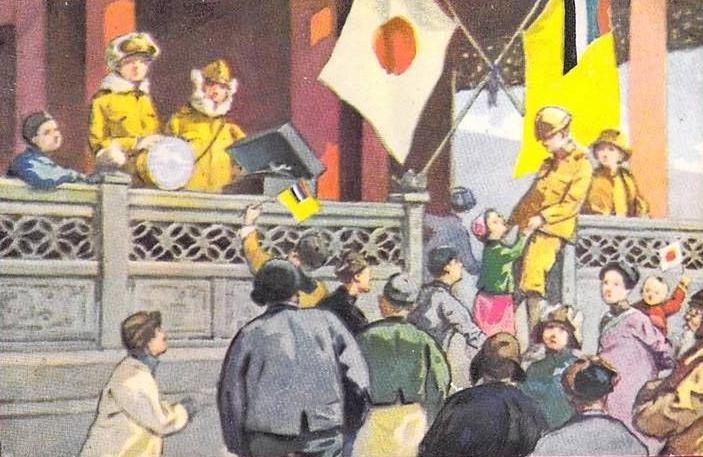
The Russians still had interests in Manchuria. Japan wanted the entire territory. The Japanese Kwantung Army invaded and occupied Manchuria, a Chinese province, using as a pretext a faked incident on the main railroad--the Mukden Incident (1931). Japan then decalared 'Manchukuo' an independent state, setting up Pu Yi, the last Manchu Emperor of China as a puppet Emperor (1932).The Jaoanese latched on to him to give Japanese control of Manchiria a Chinese facade. Anti-Japanese disturbances broke out in Shanghai. The Japanese bombed the unprotected city to quell the disturbances. There was no real effort to hit military targets. This was the first of many Japanese terror bombings of civilian populations. The League condemed the Japanese invasdion. Japan withdrew from the League as a resulted of the criticism of her military operations (1933). The Japanese popultion rapidly increased. Many were Japnese civil servnts and their fasmilies. The Japanese encouraged Japanese 'colonizers' to emmigrate to Manchukuo offerung them rhe best land. Relatively few responded to the propaganda films depicting an Asian paradise. For the Chinese in Manchukuo, life became increasingly difficult as second-class citizens. Access to Manchria was at first limited to the Liaodong Peninsula in the Yellow sea. The seizure of Korea (1909) and Japanese territorial expansion as a result of World Wwar I, more fully opened up Manchuria to Japanese expnsion. Access to Manchria wss at first limited to the Liaodong Peninsula in the Yellow Sea. The seizure of Korea (1909) and Japanese territorial expansion as a result of World Wwar I, more fully opened up Manchuria to Japanese expnsion. The Japanese Kwantung Army occupied Manchuria, a Chinese province, using as a pretext a faked incident on the main railroad (1931). Japan then decalared "Manchukuo" an independent state, setting up Pu Yi, the last Manchu Emperor of China as puppet Emperor (1932). Anti-Japanese disturbances broke out in Shanghai. The Japanese bombed the unprotected city to quell the disturbances. There was no effort to hit military targets. This was the first of many Japanese terror bombings of civilian populations. Japan withdrew from the League of Nations as a resulted of the criticism of her military operations in Manchuria and China (1933). The Japanese encouraged Japanese 'colonizers' to emmigrate to Manchukuo, but few responded to the propaganda films depicting an Asian paradise. For the Chinese in Manchukuo, life became increasingly difficult.
Manchuria is a region in East Asia, today essentially Northeast China, but historically beyond the Great Wall and the home of Steppe people who raided into China or were attacked by Chinese armies trying to pacify the area. Wanyan Aguda, the founder and first emperor of Jin dynasty established Jin's capital Shangjing (Upper Capital) Huining Fu in what is oday's Acheng District of Harbin--called Fuchiatien until the Chinese Revolution. After the fall of the Dynty, it was abandoned. The actual borders of Manchuria have varied over time. Most of Mancuria at its lerger extent on pow part of Chima, but some areas are part of the the Russian Far East. The Russian part id sometimes referred to as Outer Manchuria. Manchuria is the homeland of the Manchu people, a term introduced to describe the Jurchen people, Tungusic people which seized control of China -- laubching the Qing dynasty (17th century. The population increased greatly during the Qing (Manchu) Dynasty from about 1 million people (1750) to 14 million (1900), by the time Russia and Japan were vying for control of the area. The major reason for the population increase was the migration of Chinese farmers hungary for land. Manchuria by the late-19th century had become a cockpit for three great nations, a declining Chinese Empire and the expanding Japanese and Riussian Empires. A Treaty with Tsarist Russia gave the Russians control over the northern Manchuria -- the Beijing Treaty (1860). The Russians began building the Reans-Siberian Railway (1891). The Russians financed the construction of the Chinese Eastern Railway extending the Trans-Siberian Railway. This reduced the distance from China to Vladivostok and linking the new port city of Dalny (Dalian) and the Russian Naval Base Port Arthur (Lüshun). The Russians selected Harbin as the base of their administration over this railway and the Chinese Eastern Railway Zone. Japan after the Meiji Restoration (1868s) set out on both a program of industrialization and reforms including building a military modernization program. Within in only two decades this was accomanied by a program of aggressive trritorial exampion an imperialism. The primry targets were in East Asia (China, Korea, and Manchuria). Beginning with the First Sino-Japanese War (1894-95), Japan began to encroach on traditional Chinese client states and set up treaty ports. This led to rising levels of conflict between Russia and China over both Korea and Manchuria. This led to the Russo-Japanese War (1904-05). Russia with its rail connections used Harbin as a base for military operations. With the Japan victory, the Russian influenced declined and the Japanese influece stradily increased. Japan seized Korea (1909) and forced Russia out of the region. The Japanese expanded their influence north into Manchuria as well neighboria areas of northern China. World War I enabled them to seize German assetts in the area. Japan was attracted by Manchuria;s mineral resources and the vast expanses which offered densely populated Japan the possibility for emigration and colonization.
The Imperial Japanese Army (IJA) had one of the most rigid command structures of any World War II military. An anomaly here was the Kwantung Army (KA). This is of enormous importance because it was largely the actions of the KA that led Japan into first Manchuria (1931) and then China (1937). Many of these actions were initiated by the KA without even consulting the Japanese Government or evem the IJA. Both would, however, support the KA's unauthorized actions. They would even supportthe KA when they took on the soviet Red Army. And the the war with China which of course morphed into the Pacific War with the United States. The Liáodōng Peninsula, once referred to as Southeast Manchuria in the West, is one of the most importnt strategic prominances in the Yellow sea, situated at the conjunction of China, Manchuria, and Korea. It has been fought over since ancient times, including the war States Period. The Japanese began to move into the Liáodōng Peninsula during the First Sino-Japanese War (1894-95). The desire to control the Peninsula and Port Arthur (Lüshun) resulted in the Russo-Japanse War (1904-05). The Japanese victory opened up further intoads into Manchuria. The Japanese established a garison at Kwantung to guard the Southern Manchurian Railway from bandits, Chinese war lords, and rival countries. Kwantung was a coastal territory on the Liaodong Peninsula including the ports of Dalian and Lüshun. After World War I the Japanese had significant territorial ambitions in East Asia, including Mnchuria and Siberia. As part of this expanonist desires, the Japanese formed the KA from their alreasy existing Kwantung Garrison and it became an official IJA formation. The KA became doiminated by young, highly nationalistic young officers who essentially privatized the command structure. They became the most prestigious IJA formation in the inter-War era. The autonomy of the KA appaled to young officers seeking to make their names. It was the only IJA formation involved in acual, if low-level, fighting. The region became very important ecomically and became a boom area where Manchurian food harvests and raw materials were tansported for shipment to the expanding industries on the Home Islands. The KA soldiers were often aggressive and entirely disdainful of both Japanese and Chinese civilian authority. The KA operated as border police and railway guards. The control of the railway provided opportunities for illegal, but lucratibe gains such as involvemnt in opium trading. The young officers were contemptuous of the Japanese Government's perceived diplomatic concessions on military matters, such as the Washingon Naval Conference as well as deferal on the implementation of the Twenty-One Demands on China. KA soldiers were aggressive and commonly just ignored both Chinese and Japanese civilian authorities. They began to use the phrase, 'loyal insubordination'. And througout the 1920s the KA became increasingly violent. Not only did the KA often operate indepdedently of the IJA High Command, but often groups of officetrs in the KA made decisions on their own. One such group assassinated a Manchurian warlord that stood up to them (1928). They placed a bomb on his personal railcar. and it was not just the Chinese they targeted. There were confrontations along the Soviet border (mid-1920s). And it was the KA that staged an incident on the railline that led to the Japanese seizure of Manchuria (1931). This is often cited as the first aggrssion leading to World War II. KA units were also involved in the Marco Polo Bridge incident launching the Japanese invasion of China proper (1937). The history of the KA is murky because the officers involved commonly operated secretly in small groups. And as the actions they took were often illegal, not to mention oranized crime like opium traficking, no one was overly enthusiastic to write memoirs after the disaterous war in which they played a major role in laubching. In addition with the Red Army invasion of Manchuria (April 1945) many of the individuals involved disappeared into the Soviet Gulag.
The Japanese Kwantung Army occupied Manchuria, a Chinese province, using as a pretext a faked incident on the main railroad -- the mukden Incident (1931). The occupation was conducted by the Kwantung Army without the approval of the Japanese government. No Japanese officer was, however, punished for these actions. The invasion and occupation violated a non-aggression treaty that Japan had signed with China. Chiang's KMT Nationalist Army was unable or unwilling to offer any effective opposition to the Japanese conquest. The Japanese by 1932 cut off Manchuria from China. [Ienaga, pp. 60-64.] China appealed to the The League of Nations. The League supported China, but was ineffectual. The League demanded that Japan withdraw from Manchuria. The vote was 13 to 1 against Japan. A second resolution (February 1933), formally objected to the Japanese occupation of Manchuria. It was approved 42 to 1. Even in the face of such overwealing world criticism, Japan refused to withdraw. And instead formally withdrew from the League of Nations as a resulted of these criticism of her military operations and occupation of Manchuria and China (March 1933). [Ienaga, p. 66.]
here he began to court both the warlords fighting for hegemony over China and the Japanese who had long desired control of China. In 1932, after the Japanese invasion of Manchuria, the puppet state of Manchukuo was established by Japan, and he was chosen to become the chief executive of the new state using the era name of "Datong" (Ta-tung, 大同).
One of the most important Nationalist general was the stridently anti-Communist warlord Chang Hsueh-liang. He was referred to as the “Young Marshall”. Chang’s power base was Manchuria. This was also the territory Japan's Kwantung Amy coveted. When the Japanese invaded, Chiang refused to come to Chang's assistance. It is not entoirelu clear why. Chiang probably feared that if he fought the Japanese in Manchuria, he would be weakened in his fight with the Communists. He may have just conclude he could not prevail in a war with Japan. Or he might have seen Chang as a potential rval. Chang had criticised him for failing to confront the Japanese. Perhaps a combinzation of these factors. Chang did resist the Japanese. His Tungpei Army was badly mauled ny the Japanese. Accounts of the fighting suggest that the Tungpei fought, but did not have the modern equipment needed to resist the Japanese. The depleted Tungpei Army eventually had to withdraw from Manchuria (1935). It then defeated in an engagement with the Communists. The defeated Chang was shoccked when the victorious Communists did not massacre him and his men. This was the standard Nationalist practice with captured Communists. Rather the Comminists gave te surviving soldiers of the Tungpei Army lectures on the need to fight the Japanese. The formerly intensly anti-Communist Chang was impressed with the Communists discipline and organization and commitment to fighting the Japanese. He flew to Yenan and signed a secret truce with the Communists. Chiang not aware of this flew to Sian (Xi'an), large city in central China. It was historiczlly the eastern terminys of gthe Silk Road. Chiang lectured Chang's men about disobeying his orders. Chang consulted with Nationalist commanders in northern China. He managed to convince them that Chiang should be arrested and compeled to fight the Japanese. Chang’s bodyguards proceeded to do just this. When news of this spread, many Nationalist commanders backed Chang and the mutineers. Chiang assumed he would be killed. This is not, however, what Chang had in mind. His priority was fighting the Japanese. Chang sent his personal Boeing trnsport to bring a Communist delegation from Yenan as well as Nationalist commanders from different areas of China. The Communists made only minimal requests. They demanded a cessation of hostilities and a joint war on Japan. The Communists endorsed Chang's intentions to release Chiang. Some Nationalist commanders were nervous about this, fearing reprisals. Chang realeased Chiang Kai-shek. Later when Chang flew to Nanking and surrendered to Chiang as a kind of apology, Chiang arrested him. Chang spent the entire War in prison and Chiang even took him to Taiwan after being driven from the Mainland. Chang remained in prison even after Chiang's death.
It was the Kwantung Army on its own that seized contol of Chinese Manchuria (1931). The Japanese Governmnt had not oirdered it, but neither did the Government order the Kwantung Army to cease and desist. The Japanese Giovernment decalared Manchukuo an independent monarchy. They enthroned Pu Yi (溥儀; 1906 – 67), the last Manchu Emperor of China, as the puppet Emperor. The new state was formally created by the Japan–Manchukuo Protocol (日満議定書) (1932). Baron Nobuyoshi Mutō, Japanese ambassador to Manchukuo, signed for Japan. He was also Commander of the Kwantung Army. Zheng Xiaoxu was a lederly Chinese diplomat and Qing loyalist. Japan recognized Manchukuo as an independent state. It was of course all a shame. The protocol or treaty inluded a mutual defence agreement, allowing Japanese troops to be station in Manchukuo, essentially occupy the country. The troops involved were essentially the Kwantung Army. From then on the commander of the Kwanbtung Army automatically became the ambasador to Manchukuo. In essence he was a proconsul. Any important decesion of the Manchukuo Government needed his apporoval and he could rescind any decision taken Emperor Pu Yi. The Government mimnisters were mere front met for Japanese appointed ministers. The Kwantung Army played a controlling role in the political administration of the new state as well as in its defense as well as all aspects of the politics and economic development of the new state. This was not what Pu Yi had expected and he soon became disilusioned, but had no way of influecing the Japanese and had to accept his fate as a powerless puppet. He was united with his childhood bride--Wanrong (婉容 1906–46). She had a more realistic apprecuatiion of the Japanese than Pu Yi. She became an opium addict. The Japanese role in this i unclear, but she could not have obtained opium without the Japanese allowing it. Not only did the Japanese control every aspect of Puyi's and her existence, bt Japanese commanders were heavily involved in the lucrative opium trade.
A few months after Manchukuo was formally created, Hitler and the NAZIs seized control of Germany. Only a few countries like NAZI Germany and Fascist Italy as well as a few other Fascist oriented states recognized Manchukuo. This included China's Wang Jingwei governmen (1940). Other ntions expressed their disapproval. The League of Nations adopted the Lytton Report, declaring that Manchuria remained rightfully part of China (1933). Japan resign its membership and walked out. The Japanese seizure of Manchuria led the the United States to criticize Japanese aggression, essentially the first step in the Pcific War. The United States isued the Stimson Doctrine--pledging to withhold diplomtic recognition of changes in the international system created by armed action.
Anti-Japanese disturbances broke out in China, especially Shanghai. The Japanese bombed the unprotected city to quell the disturbances. There was no effort to hit military targets. This was the first of many Japanese terror bombings of civilian populations. It preceeded even the NAZI and Fascist terror bombings of Republican cities in Spaon.
The Japanese encoyraged Japanese 'colonizers' to emmigrate to Manchukuo, but few responded to the propaganda films depicting an Asian paradise.
in For the Chinese in Manchukuo, life became increasingly difficult. The best jobs and food were reserved for the Japanese. Rice was reserved for the Japanese. The Chinese were expected to subsist on millet. This allowed more of the rice grown in Manchuria to be exported to Japan. Chinese found eating rice could be shot for "economic sabotage". Life became a daily stryggle. Adults on the street would bow to the Japanese of all ages for fear of reprisals. The schools were all run by the Japanese. Chinese children went to inferior schools, where their teachers, all Japanese, stressed what an earthly paradise Manchukuo was. [Chang]
Japanese economic policies in Manchukuo are poorly reported in the historical record which focuses to a much greater degree on German occupation policies. Manchukuo had many of the vital resources that Japan lacked on the Home Islands. There were two primary elements of Japan's occupation policy--industry and agriculture. Japan launched a major industrialization effort. Japan at first was primarily interested in obtaining raw materials for its factories on the Home Islands. The Japanese began a two stage program of economic expansion and the result was the rapid industrializing Manchukuo. First the Japanese Army after seizing control of Manchukuo launched the first stage of the effort. They were influenced by military and economic ideas which had become popular
in Germany after World war I-- the Wehrstaat (War State). It was theories on how to reorganize society to prepare for total war. as part of the preparations for the total war. One of the propnents of this theory was a protege of German President Paul Hindenberg--. that the Reichswehr wished to was Gen. Kurt von Schleicher and next to the last Chacellor of Germany. (He woild be asasinated by the NAZIs in the Night of the Long Knives.) Schleicher's fscinated about creating the Wehrstadt, but it was not possible within the political struvctures of the Weimar Reoublic. Even Hitler hesitated to do o after seizing power. And the Japanese military was not able to do so in Japan, Manchukuo was a very different matter. Here the Kwantung were in total control and the subject populastion had no rigjhts or ability to resist. And there were the needed natural resources, including iron ore and coal. The major resource unavailable was oil. This the Japanese had to import from America. The Japanese Army under the influence of the Wehrstaat (Defense State) theories popular with the Reichswehr begasn to advocate their own version of the Wehrstaat, to mobilize Japan for a war that they were convinced needed to be waged and won with China as their objective. [Maiolo, pp. 28-29.] Elements in the Japanese Army, especially among the younger officers, in contrast to the Government and industrial leaders tended to be anti-capitaoist. Mahy had come from humble rural families. Besides the German Wehrstadt theories, the military was also impressed with the rapid industrilization being achieved in the Soviet Union. Stalin lunched the First Year Plan (1928). These ideas cuirculating in the Japnese military were part of the reason the Kwantung Army seized Manchuria (1931). And they set about putting these ideas into practice to rapidly industrialize Manchukuo. . Manchukuo essentially became a giant labatory in which these ideas could be conducted and a population whose well-being was of no concern and which
could not complain or resist. Thus the Kwantung Army began the radical economic changes that were not possible in Japan itself.
The Japanese began to transform Manchukuo into what they believed would become the industrial heartland of the entire Empire.
The first stage of this effort was the Kwantung Army implemented a program of forced industrialization srongly modeled on Stalin's Five Year Plan (1932). [Maiolo, p. 30.] Given their disdain for capitalism, the Kwantung Army banned the Zaibatsu from Manchukuo. The industrial develpment that transpored was conducted by Army-owned corporations. And the profits thus flowed to the Army and its officers. The first stahe of this process lasted only as few years. we suspect that the army did not have the technical expertise or access to needed capital to pursue the effort on the scale desired, but our informtion is limited. The second stage of the process began with the invpolvement od the Zaibatsu along a capitalist model (1935). Primeminister Keisuke Okada appointed the 'reform' bureaucrat" Nobusuke Kishi Deputy Minister of Industrial Development. Kishi persuaded the Army to allow the zaibatsu to participate in the industrial development of Manchukuo. Okada was a military officer, but his reforms sparked the Februry 28 Incident, an attempted coup by young officers. Kishi masnaged, however, to convince the army that the Zaibatsu were needed because the Government could not afford to finance the industrial projects on its own. Kishi advocated astatist totalitarin system in which goverment bureaucrats would work out economic plans. These would then be assigned to the zaibatsu to implement. Kishi by opening Mnchukuo to the Zaibstsu was able to obtin needed capital. Unlike the situation in Japan itself, the Kwabtung Army were able to ensure a ready supply of Chinese workers who could be ruthlessly exploited in the new fctories. [Unquiet past] Pne historian described the system developed by Kishias a “necropolitical” system in which the Chinese workers became human cogs within Japan's vast industrial complex. The Kishi system developed in Manchukuo was a state-guided economic system would be the basis of Japan's post-War Economic Miracle, albeit without the brutalization of workers caried out in Manchukuo. One author claims that the Japanese transformed Manchukuo into an advanced industrial center. [Duara] we are not sure this was the case as data on efficency, profitability, quality, and technical processes are not available. Advanced abnd quantity are two different matters. What is absolutely accurate, however, is that industrial production, especilly steel production rapidly expsnded--steel that wasneeded for the Japanese war economy. Incredibly, steel output in Manchukuo exceeded that of thevHome Islands (late-1930s). As a result, at the time war broke out, Manchulkuo cities were growing and rapidly modernizing.
We know less about the rural economy. Increasing food production was also very importasnt to the Jaspnese Government. We know that the Japanese seized land from Chinese kandlords and the peaantry. Some of the best land was turned over to Japanese agricultural colonists. The Chinese peasntry was forced into collective farms, mush as stalin did. They were allocated smaller areas, often less desirable areas.
Japan used Mamchuria as a a base for invading China. Japanese Imperial Army in Manchuria invaded China proper in July 1937, launching the Second Sino-Japanese War. The Japanese Kwantung Army turned a small incident into a full scale war. The well equipped Japanese forces rapidly occupied almost the entire Chinese coast of China and then moved up rivers and railroad lines into the interior.
Poppies were grown and harvested in Japanese Manchukuo and used to produce opium. The Japanes directly participated
in the Opium trade. The Kōa-in (興亜院) was the cabinet level East-Asia Development Board (1938-42). It was a creation of the first Konoe administration to coordinate the government's exploitive China policy. The purpose was to fund industrial and commercial development in China, including Manchukuo. The Imperial Japanese Army after Japan launched the Pacific War began using the agency as a tool for forced labour and actual enslavement in mines and other war industries. It was absorbed by the Ministry of Greater East Asia (1942). The Board a Ministry financed its operations in part by selling opium produced in Manchukuo to dealers throughout China. This becme more organized after Japasn invaded China proper (1937). The officers of the Kwantung Army and refgular IJA took a cut of the operatioins. The puppet government of Manchukuo, Nanjing and Mongolia were also involved. These operations were documnted after the war in Tokyo War Crimes Trials. "Japan's real purpose in engaging in drug traffic was far more sinister than even the debauchery of Chinese people. Japan, having signed and ratified the opium conventions, was bound not to engage in drug traffic, but she found in the alleged but false independence of Manchukuo a convenient opportunity to carry on a worldwide drug traffic and cast the guilt upon that puppet state.... In 1937, it was pointed out in the League of Nations that 90% of all illicit white drugs in the world were of Japanese origin...." [Hyper War] By Japanese origin it was meant, Japasnese-occupied areas, not the Home Islands where there were very strict drug laws. Even before the Pacific war, the drugs were sold outside China . There were processing failities on Taiwan. Productionn was not only opium, but morphaine and cocaine as well. The drugs were distrbuted using IJA aircraft. The Japanese Government and military destroyed huge amounts of documents after the World war II surrender, but before american occupation authorities arrived. Occasionally documdents surfce to corroborate or expand our knowledge of the Japanese war crimes. we note one such documnt providing informtion on the Kōa-in involvenent in drug traficking. [Yoshida]
Large scale clashes occurred between Japanese and Soviet forces occurred along the border of Manchuria in 1939. The Japanese released photographs of captured Soviet soldiers (Huly 1939). The conflict was little reported in the West. An offensive planned and executed by Marshall Zukov convinced the Japanese to seek an armistace (September 1939). The clash was, however, of imense strategic significance. It was undoubtedly a factor encouraging Stalin to respond favorably to NAZI initiatives for a Non-Aggression Pact (August 1939) to ensure that the Soviet Union would not face a two-front war. Hitler ignored the Soviet performance
and instread saw the inept Red Army offensive in Finland as ecidence that the Soviets couls be easily defeated. The Japanese Army concluded that further attacks on the Soviets were unwise. This was an important facyor in attacking south in 1941 at America rather than north at the Soviet Union. It was also a major factor in refusing entrities from Hitler in 1942 to attack the Soviet Union.
Japanese industrial expansion continued in Manchukuo after the country invaded China poroper (1937). The fighting with the siviets occurred along remote birders and has no impct on industrial outpit. And ecpansion continued after Japan launche the Pacific War, although the American oil embrgo had a negative impact. Manchuko was a very important part of the Japanese war ecomomy during the Pacific War and the American submarine did not disrupt the sea lanes in the Yellow Sea. Thus the raw materials and steel output from Manchukuo was not disrupted by the American submarine campaign. The Strategic Bombing Campaign which destroyed the the industrial plants on ththe Home Islands could not reach yhe factories in Mnhukuo, although shipments were affected when the American B-29 bombers sers begn droppoing aerial mines.
The Soviet Union, 2 days after the first atomic bomb was dropped, entered the war against Japan (August 8). Stalin as promissed at Yalta and Potsdam declared war on Japan. At the time the Japanese were attempting to use the Soviets to mediate an end to the War. He moved the date up after the Hiroshima bombing because he wanted to be in the War before Japan surrendered. Soviet plans included the invasion of Manchukuo (Manchuria), Mengjiang, Korea, the southern portion of Sakhalin, the Kuril Islands, and Hokkaido. All these operations except the invasion of Hokkaido were carried out. The Soviets struck in Manchuria and routed the Japanese forces there. The offensive was in sharp contrast to the campaigns the Americans conducted in the Pacific. The Soviets after declaring war immediately launched a massive invasion--the largest ground operation of the Pacific War. The Red Army rapidly swept over Manchuria. Japanese resistance crumpled. The Soviet invasion is not well covered in Western histories of the War. One question that arises is why the Soviets so quickly suceeded in Manchuria while the United States struggled in Okinawa. I think this is primarily because Okinawa was a small island where the Japanese could concentrate their forces in mountainous terraine. Manchuria was a huge area, much of it a flat plain, ideal for tank warfare. The Japanese could not defend it like they were able to do on Okinawa. Perhaps readers more familiar with the Soviet invasion will be able to tell us more. Soviet plans included the invasion of Manchukuo (Manchuria), Mengjiang, Korea, the southern portion of Sakhalin, the Kuril Islands, and Hokkaido. All these operations except the invasion of Hokkaido were carried out. The Soviet invasion was code named Operation August Storm. The massive Soviet invasion swept aside Japanese resistance. The Japanese were surprised and destroyed any illusions among the military that Japan's still substantial army had the ability to resist Allied armies. Some authors believe that the success of the Soviets in Manchuria and the inability of the Japanese army to resist them, had more of an impact on the Japanese military than the two American atomic bombs. One factor that we are not yet sure about is why Japanese resistance in Manchuria colapsed so quickly and why the Japanese military commanders were willing to surrender to the Soviets, but unwilling to surrender to the Americans in Okinawa or the Philippines. The Japanese that surrendered to the Soviets spent years in the Gullag. They were used for years in construction projects in Siberia and Central Asia. [Solzhenitsyn, p. 84.] Only about half survived and ever returned to Japan.
Mao's Communist Red army conquered Mukden, Manchuria on November 1, 1948.
Chang, Jung. Wild Swans: Three Daughters of China (Harper Collins: London, 1991).
Driscoll, Mark. Absolute Erotic, Absolute Grotesque: The Living, Dead, and Undead in Japan’s Imperialism, 1895–1945 (2010), 384p.
Duara, Prasenjit. "The new imperialism and the post-colonial developmental state: Manchukuo in comparative perspective," The Asia Pacifici Journal: Japan Focus (January 30, 2006).
Ienaga, Saburo. The Pacific War, 1931-1945 (New York: Random House, 1987).
Maiolo, Joseph. Cry Havoc How the Arms Race Drove the World to War, 1931-1941 (New York: Basic Books, 2010).
Yoshida, Reiji. "Japan profited as opium dealer in wartime China: Puppet regimes, army paid--document," Japan Times (August 30, 2007).
"(The) unquiet past: Seven decades on from the defeat of Japan, memories of war still divide East Asia," The Economist (August 12, 2015).
HyperWar: International Military Tribunal for the Far East. Chapter 5.

Navigate the CIH World War II Section:
[Return to Main World War II in China page]
[Return to Main World War II page]
[Biographies]
[Campaigns]
[Children]
[Countries]
[Deciding factors]
[Diplomacy]
[Geo-political crisis]
[Economics]
[Home front]
[Intelligence]
[Resistance]
[Race]
[Refugees]
[Technology]
[Bibliographies]
[Contributions]
[FAQs]
[Images]
[Links]
[Registration]
[Tools]
[Return to Main World War II page]
[Return to Main war essay page]