|
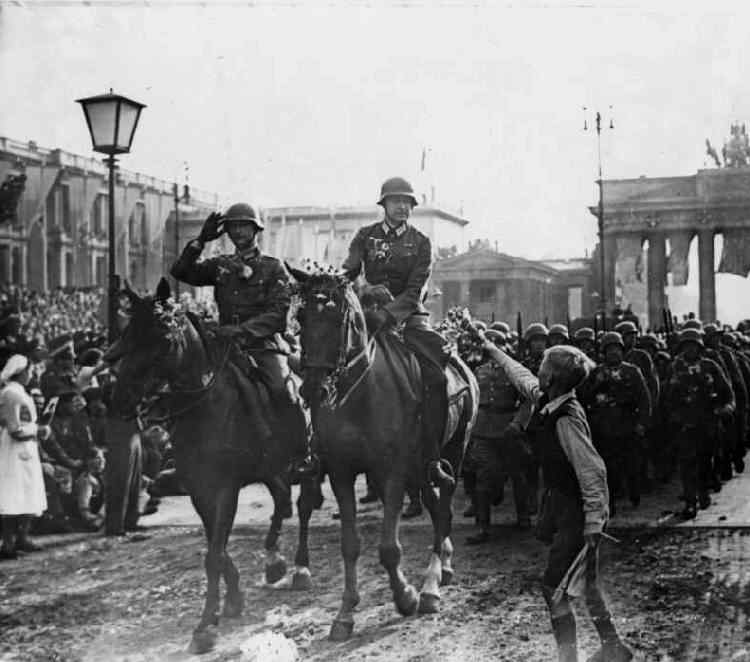
World War II formaly began with the NAZI invasion of Poland (1939). Historians often note the earlier Japanese seizure of Manchuria (1931) and invasion of China (1937) as well as early European Axis aggressions as a prelude to war. And it is accurate to see the War as a continuation of World War I with a 1-2 decade armistive in between. The NAZI invasion was followed by a British and French declaration of war, but failure to come to Poland's assistance. Within only a few days, the Soviets joined the NAZIs in invading Poland, followed by a series of other invasions of their own. The NAZI success in Poland was followed by a string of startling military successes, especially the invasion and defeat of France (1940). The NAZI successes were puncutated by the victory of the RAF in the Battle of Britain (1940). The Italians joined their Axis partner after the defeat of France was already largely achieved. Almost from the beginning, however, the Italians proved more of a drag on the NAZI war effort than an assett. The War was tranformed when Hitler ordered the invasion of the Soviet Union and then without any effort to coordinate opetrations, the Japanese bombed Pearl Harbor. Historians argue about the turning point of the War. After a series of almost uniterupted victories, the War turned against the Axis in second half of 1942. The Red Army bled the Wehrmacht on the Eastern Font while the Western allies ponded German cities. Finally the German losses in the East combined with growing Allied air power enabled the Western Allies to renter the Continent with the D-Day landings. What followed was a string of Allied victories, although achieved at great cost. Finally after Hitler's suicide and the fall of Berlin the NAZIs surrendered (1945). The Japanese surenderd after America dropped the A-Bomb and the Soviets invaded Manchuria (1945).
Traditional World War II histories generally begin with the rise of the NAZis in Germany and the early NAZI aggressions. This is in part because these actions primarily affected the Western Allies (Britain and France) and led to the NAZI invasion of Poland resulting in Britain and France declaring war and the eventual involvement of the United States. Thus it is no accident that the Western historians have followed this focus. This was, however, not the war Hitler wanted. His eyes as can be easily seen in Mein Kampf was focused on Lebensraum and the East. And even after stunning victories in the Wast, victory in the East, Hitler's territorial demands on France were limited and he was prepared to allow the British to keep their empire. The East Hitler wanted was largely, but not entirely part of the Soviet Union controlled by Stalin. At the same time, Stalin looking west desired to expand his territory. This was the central conflict leading to World War II and is no accident that these two totalitarian powers joined together to launch the War and eventually fell out and fought to the death over the East. The war in the East was the largest most expansive war ever fought in human history. The area at stake was an artifact of World War I. Three great empires were destroyed in World War I: the German, Austro-Hungarian, and Russian Empires. These Empires had goverened a dizzening complexity of ethnic, national, and religious groups. This involved almost all of Europe east if the Rhine, They were largely goverened by Germans/Austrians and Russians. As a result, a huge area of Eastern and Central Europe was up for grabs. An area that was not heavily industrialized, but had vast resources, including agricultural and raw materials. After the War, the Soviets reestablished control of the Ukraine, but lost control of Finland, the Baltic Republics, most of Poland, and areas in the south which became part of Romania. The Austro-Hungarian Empire was broken up into a number of ethnically based, but diverse states. None of these new nations had the military power to maintain their independence from the powerful countries they found to the East and West, although immediately after World War I, neither the Russians/Soviets or Germans were capable of reestablishing their old empires. On the fringe of this was a relatively small anount of territory transferred from Germany, much of it going to the new Polish state. This vast area located between the Soviet Russian heartland and NAZI Germany would be the prize to be won or lost and the heart of the conflict we now know as World War II. The primary area contested was the regions of the former Tsarist Empire--modern Beylorussia, Poland, and the Ukraine, inhabited by these three ethnic groups as well as Jews.Balts, and others. Not only was the area contested by the NAZIs and Soviets, but there were serious conflicts betwwen the various ethnic groups as well. And both Hitler and Stalin had frightful plans to remake the ethnic, national, and relgious demographics of the region. One author estimates conservatively that Hitler and Stalin in this area shot, starved or gassed 14 million non-combatants. [Snyder]
The Bolshevicks which fought the Russian Civil War managed to regain control of the vital Ukraine as well as Central Asia, and the Caucauses for the new Soviet state. They were not able to regain control of Finland, the Baltics, Belyorusia, Poland, and province west of the Ukraine. The Bolshevicks also promoted revolutions in various European countries. The most prominant risings were in Germany (Berlin and Munich) and Hungary. Once Stalin was in control of the Soviet Union (late-1920s), he began preparatioins to regain control of the areas of the lost areas of the Tsarist Empire. Huge resources were devoted toward expanding the military. Stalin began the killing process before Hitler even seized power in Germany. The first step was to smash the restive nationalist element in the Ukraine. This was accomplished through collectivization and then the engineered Ukranian famine (1932-33). Stalin is believed to have killed 3 million Ukranians. At the peak of the famine, Ukranians were dieing a something like 10,000 a day. And Stalin kept it a secret, Soviet propsganda at the time was perpetrating the image of a bountiful life style. So no international effort was mounted to save the Ukranians. Next followed an effort to wipe out the kulaks--essentially successful peasant farmers. Soviet agriculture never recoverd. The next step was to move against the Poles who he considered like the Ukranians another disloyal ethnic group. About 0.6 million Poles lived in the western Soviet Union. Stalin's orders were to 'keep on digging out and cleaning out this Polish filth'. The KGB executed over 0.1 million Poles before actually invading Poland. [Snyder] The Russians themselves did not escape Stalin's attention. The Great Purge of the 1930s was to ensure that all domestic doubters or opponents were eliminated and that the population was cowed into unquestioning obedience.
All three Axis countries (Germany, Italy, and Japan) were involved in military campaigns before World War II finally began with the German invasion of Poland in 1939. NAZI Germany renounced the Versailles Treaty as soon as Hiltler seized power, but the next few years was spent in supressing domestic oppositon and sreadily excluding Jews from national life. The NAZIs remilitarized the Rhineland in 1936 and carried out the Anchluss with Austria in 1937. These actioins coukld be seen as domestic German matters. he next target was Czechoslovakia which had been created by thge Versilles Peace Treaty. Hitler in 1938 demanded the Sudetenland in Czecheslovakia which had a minority German population. The British and French gave in at talks held in Munich, but the NAZIs then seized the rest of the country in March 1939, areas without German poulations. The Germans beginningh in 1936 were also active in Spain helping Franco establish a Fascist regiment. The defenseless Basque village of Guernica was the first European city to be destroyed by the Luftwaffe. The Italians conducted a mercilless campaign in Libya to supress rebels, including the use of poison gas. This was generally seen as an internal colonial matter. This changed in 1935 when the invaded Ethiopia, using modern weaponms, again inclusing poison gas, to attack a largely unarmed country. They were condenmed by the Leagur of Nations and then walked out of the organization. Japan invaded Manchuria in 1932 and established a puppet regim, Manchuko, under the figurehead last Chinese Emperor, Pu Yi. The Japanese invaded China itself in 1937. Theuy were also condemned by the League of Nations and withdrew. Japan drove deep into China, but was able to defeat thr Chinese which received miklitary assiastance from the Americans and British. The war with China was to tie down the bulk of the Japanese Army throughout World War II. A little known, but major engagement was fought with Soviets troops along the border. The Soviets were commanded by Georgy Zukov and smashed the Japanese. This experience probably played a major role in convincing the Japanese to strike America rather than the Soviets in 1941.
The active military phase of World War II began with the NAZI invasion of Poland (1939). The NAZI invasion was followed by a British and French declaration of war, but failure to come to Poland's assistance. Within only a few days, the Soviets joined the NAZIs in invading Poland, followed by a series of other invasions of their own. The Soviet invasions were not as well publicized because the British and French wisely did not declare war. The NAZI success in Poland was the result of a not only a much larger and better equipped military, but the adoption of a tactical doctrine fully utilizing modern weaponry--Blitzkrieg. The success in Poland was followed by a string of startling military successes, especially the invasion and defeat of France (1940). Neither the British or French has perceived the lessons of the Polish campsign and were not prepsred for Blitzkrieg. The NAZI successes were puncutated by the victory of the RAF in the Battle of Britain (1940). The NAZIs in 1940 had victory within their grasp, but allowing the British Army to escape at Dunkirk and the victory of the RAF over Britain meant that Britain could continue the war, especially because President Roosevelt had decided to support Britain. Although not clear at the time, the Anglo-American industrial capacity was already beginning to make itself felt. The Italians joined their Axis partner once the German success was clear. Almost from the beginning, however, the Italians proved more of a drag on the NAZI war effort than an assett. The Germany achieved futher suuceesses in the Balkans (April 1941). The War was tranformed when Hitler ordered the invasion of the Soviet Union. Here the Axis had another opportunity to win the War. The Wehrmact achieved enormous successes at the outset of Barbarossa (June 1941). It seems likely that if the Japanese had attacked the Soviet Far East that the Axis would have prevailed. But rather than a coordinated attack, the Japanese without any effort to coordinate opetrations, the Japanese attacked Pearl Harbor, the forward base of the U.S. Pacific fleet. This with the failure of Barbarossa resulted in an enormous shift in the strategic ballance.
The War Word history changed fundamentally in December 1941. Few months in world history have bveen crammed with so many momentous events. Historians argue about the turning point of the War. Most look to the decisive Allied victories in the second half of 1942 as the turning point. First the British smashed the Afrika Korps at El Alamine. Than the Red Army un;eased the their winter countrt-offensive at Stalingrad. It was in 1942 that the course of the War changed [Groom] It was the AXIs' last real chance to win the War. They would have to win the War in 1942 or the surperior resources and industrial capacity of the Allies would inevitably prevail. Major campaigns, however, were not settled until later. The Battle of the Atlantic was not decided until mid-1943 and the air war over Europe what not decided until early-1944. As important as 1942 was, it was the period from June to December 1941 that in fact the decisive period of the War. Hitler until this point had exercised considerable caution. He attempted to pick off his enemies and vulnerable neutrals one by one, taking care to placate the Soviet Union and avoiding conflict with the United States. This changed when he decided to invade the Soviet Union (June 1941) and incredibly when that attack was beaten back before Moscow, declared war on the United States (December 1941). [Dowing] Hitler is often faulted for invading the Soviet Union before defeating Britain. This is a valid criticism, although a military case can be made for the invasion. The decession to declare war on the United States, while still fighting the Soviet Union, however, was strategic madness and is in sharp contrast to his deft handling of strategic ininitatives in the first plase of the War. One wonders if the shock of failure in front of Moscow combined wih the drugs provioded by his doctor may not have addled his mind. Hitler made his decessions unilaterally so it is difficult to tell just what what drove him to do this. Here historians can only speculate. In the same week that the Red army launched its conter-offensive before Moscow, the Japanese struck the United States at Pearl Harbor. The Japanese attack wa in sharp contrast to the German invasions in Europe which were designed to destroy the ability of adversaries to make war and defeat them in a short campaign. Until the invasion of the Soviet Union, each of the German campaigns had lasted only a matter of weeks. Only the British escaped destruction. The Japanese war plan was very different. They never conceived of invading the United States. Rather they believed that the United States would not have the moral fortitude to wage war once the Pacific fleet was destroyed. As a result, the Japanese for the cost of sinking eight aging battleships (most of which were refloated) brought the United States with its enormous resources into the War and with its war making cpability untouched.
After a series of almost uniterupted victories, the War turned against the Axis when the Wehrmacht was stopped before Moscow (December 1941). Although not fully understood at the time, this like the defeat of the Luftwaffe in the Battle of Britin the previous year was far more important than undestood at the time. The Germans launched the War with the Soviets as an ally. This ment they had access to needed resources from the Soviet Union. Defeating the Soviet Union would have given them permanent access to those vital resources, but the failire of Barbarossa meant that the inherent weakenesses of the German war effort would be magnified by having to fight the Soviets and Allies at the same time. Germany simply did not have the population, resources, or industry to fight both the Soviets and the Allies. And the failure before Moscow locked them into a long brutal war of attrition--the same situation that resulted in the World War I defeat. In addition the Red Army badly mauled the Wehrmacht (Winter 1941-42). And to make matters even worse, the Soviets and Western Allies now had time to lern the same Blitzkrieg tactics that had won the Germans their early victorie. The Germans and Japanese managed to gain some major victories (Spring 1942). The Germans renewd their offensive in the Soviet Union during the spring and the Japanese launched a stunning series of offensive operations in the Pacific. It again looked like the Axis could not been defeated. This all began to change when the Japanese Navy were defeated at Midway (June 1942) and Guadalcanal was invaded (August 1942). The German juggernaut was stopped at El Alemasine (October 1942) Stalingrad (November 1942). The Western Allies began the around the clock bombing of Germany (January 1943). The final pieece of the Allied war plan fell into place with the defeaft of the U-boats (July 1943). Churchill writes in his memoirs that with the Soviet Union surviving the initial NAZI assault and United States finally in the War, victory was inexorable. He was right, inexorable--but costly. It was a matter of applying the vast, sperior resources to smashing the Axis. The Germans and Japanese had no way of changing that dynamic. It may seem strange that the first phase of the war was almost entirely a series of Axis victories and the second stage of the war was an almost uninterupted string of Allied victories. The reasons of course are simple. First, the Germans and Japanese poured vast resources into the military while the Allies limited defense spending. Second, in the space of 6 months, the Axis without any real attempt at coordination forced the Soviet Union into the Allied camp and then brought America into the War. A more disaterous strategic undertaking is hard to imgine. Given the humnan, industrial, and material resources of the Soviet Union and the United States, this incredible strategic move almost preordained the defeat of the Axis. The Red Army bled the Wehrmacht on the Eastern Font while the Western Allies pounded German cities. Finally the German losses in the East combined with growing Allied air power enabled the Western Allies to reenter the Continent with the D-Day landings (June 1944). What followed was a string of Allied victories in the East and West. The most impprtant was the Red Army's powerful Bagration Offensive which smashed Army Group Ceter (July 1944). With the failure of the July Bomb plot to kill Hitler (July 1944), the German people were condemned to the massive destruction they had inflicted on other countries as the Soviet and Allied armies converged on the Reich. The Soviet and Allied victories were only paused in the West by the Bulge (December 1944). The Soviet and Allied victories were impressive, although achieved at great cost. The Soviets routinly lost more men than the Germns even in their great victories. Finally after Hitler's suiside and the fall of Berlin the NAZIs surrendered (May 1945).
Like the European War, the Pacific War can be neatly divided into two phases with a slightly different time line. As in Europe, the Japanese like the Germans began the War with a series of spectacular air, land, and naval victories. In the first 6 months of the War, the Japanese smashed American and British naval units beginning at Pearl Harbor (Decembr 1941). They seized a vast swath of territory in the Pacifuic and Souitheast Asian with the resources that the Japanese military had long coveted. Neither the Americans or British believed that the Japanese had a military capable of such action. Advanced air craft, a competent well-trained navy, and the long-lance torpedo were at the core of the Japanese succeses. The string of Japanese losses ended with the decisove American carrier victory At Midway. The First Air Fleet lost four of its six front-line carriers (June 1942). And well before the Japanese thought possible, U.S. Marines launched the first Allied offensive of the War (August 1942). .
Looking back as a historian, it is almost incomprehensible that Japan decided to wage war against the United States. War with Britain and the Netherlands is more understandable. Britain in 1941 looked like if not a defeated nation, at least a severely weakened one. The Netherlands was occupied by Axis ally NAZI Germany. America is a very different matter. The United States was not at war. It had not been weakened by the War. And Japan had no commitment that the Germany would join them if they attacked America. War with America seems like an extrodinarily wreckless decession for a country already mired down in a war with China and that had experienced a sharp defeat in a short war with the Soviets. Why would Japan have decided on war with America, a country with a larger population and a much larger industrial and scientific base. The road to war began early in the history of modern Japan. The origins of the Pacific War are not as neatly tied to World War I as the European War. While in Europe the colonial competion was held in check, in part because of Bismarck's diplomacy and moderate approch of Queen Victoria and King Edward VII, in Asia Japan pursued a more aggressive foreign policy, including the First Sino-Japanese War (1894-95), the Russo-Japanese War (1904-05), and the colonization of Korea (1909). World War I (1914-18) provided Japamn the opportunity to expand in China and the Pacific. It was during the War that Japan issued the Twenty One Demands on China (1915). This eventually became the cornerstone of Imperial policy, especially as the military grew in significance. It would also bring Japan in conflict with the United States because it fudamentally challenged the American Open Door Policy in China. The first major confrontation was a diplonatic one, negiatiatuins overal naval arms limitations--rge Washington Navalm Talks (1921).
The Japanese debated for some time how to benefit from the War in Europe. Ther military decided to use the opportunirt to seize British, Dutch, and French colonies. The Royal Navy was fully committed in nthe Atklantic and the Dutch and French were occupied. Only the Americans had powerfulm naval forces in the Pacific. And President Roosevelt moved them forward to Pearl Harbor (October 1940). The Japanese decided that they cpild not seize the long coveted Southern Resource Zone (SRZ) without neutralizing the American Pacific Fleet. As in Europe, the Japanese like the Germans began the War with a series of spectacular air, land, and naval victories. In the first 6 months of the War, the Japanese smashed American and British naval units beginning at Pearl Harbor (Decembr 1941). They seized a vast swath of territory in the Paciuic and Southeast Asian with the resources that the Japanese military had long coveted--the Southern Resource Zone (SRZ). Neither the Americans or British believed that the Japanese had a military capable of such action. Advanced air craft, a competent well-trained navy, and the long-lance torpedo were at the core of the Japanese succeses.
The string of Japanese victories ended with the decisive American carrier victory At Midway. The First Air Fleet lost four of its six front-line carriers (June 1942). And well before the Japanese thought possible, U.S. Marines launched the first Allied offensive of the War--Guadalcanal (August 1942). It was hear that the weakenesees of the Japanese military and war strategy began to appear. Japan began the War with some marvelous weapons and committed fighting men, but without the logistical capabiliy of supplying fild armies. The early victories came because the Japanese forces werre able to seize, British, Dutch, and American supplies. The Japanese attempted to do the same on Guadalcanal, but American Marines stopped them in three major engagements and the U.S. Navy fought a series of fierce naval engagements. Bioth sises suffered najor losses, but in the end, the Imperioal Fleet withdrew. The Japanese not killed in the fighting on Guadalcanal begam to starve in large numbers. And by the time the Japanese began evacuated the emaciated survivors, American industry had begun delivering powerful new aircraft as well as modern ships like the Fletcher-class destroyers and the Essex-class carriers. American marines proved at Tarawa that even well fortified island garrisons could not withstand well suported amphibious invasions. At the same time, American submarines made it impossible of getting resources from the SRZ back to the Home Island. And the Japanese garrisons on the islands not invaded began starving. The American term waa 'withering on the vine'. And when the Imperial Navy finally reemerged, it was destroyed defending the Marianas and Phillipines (June-October 1944). The Japanese finally surrenderd after America dropped the A-Bomb and the Soviets invaded Manchuria (1945).
Histories of the War are generally written from the perspective of two great Alliances: the Axis (Germany, Italy, and Japan) and the Allies (America, Britain, the British Dominions, and France) along with the Soviets. This is not a correct assessment of the situtation. The Soviets were a third power center, separate from the Axis and the Allies. The Axis succeeded during the first phase of the War in part because the Soviets were a junior partner. The Allies prevailed because Hitler firced the Soviets into the war on the allied side. This is an important destinction because after the War some observers complain that the post-War peace settlement was not well handled by Roosevelt and Truman. The simple fact, however, is that the Western Allies did not win the War, it was the Western Allies and the Soviets. This the post-War settlement would not be dominated by democratic values. These values were promoted in the West in the countries liberated by the allies. In the East, the Soviet victory meant that one form of totalitarianism would be relaced by another. Here we will develop a chronology of the three major groups involved in the War.
Groom, Winston. 1942: The Year That Tried Men's Souls (Atlantic Monthly, 2005).
Downing, David. Sealing Their Fate: The 22 Days That Decided World War II.
Hitler, Adolf. Mein Kampf.
Snyder, Timothy. Bloodlands: Europe Between Hitler and Stalin (Basic: 2010), 524p.

Navigate the CIH World War II Section:
[Return to Main World War II military campaign page]
[Biographies]
[Campaigns]
[Children]
[Countries]
[Deciding factors]
[Diplomacy]
[Geo-political crisis]
[Economics]
[Home front]
[Intelligence]
[POWs]
[Resistance]
[Race]
[Refugees]
[Technology]
[Bibliographies]
[Contributions]
[FAQs]
[Images]
[Links]
[Registration]
[Tools]
[Return to Main World War II page]
[Return to Main war essay page]