|
The British were one of two countries that fought the NAZIs from the onset of the World War II (September 3, 1939). to VE-Day (May 1945). The other country of course was Poland. The experiences of the two countries were very differemt, because the NAZIs occupied Poland, dismembering the coutry and persusing genocida racial policies. Britons were not, immeiately affected by the fighting, except the children in the city were evacuated and men mobilized for the military. The War first came hime to Britain after the fall of France (June 1940). The Luftwaffee in the ensuing Battle of Britain destroyed large areas of London and other major British cities. The cost of the War and the U-boat campign in the North Atlantic resulted in increasingly strict rationing of both food and clothing. For 12 months Britain fought alone. American assistance like Lend Lease playerdca major role in keeping Britain in the War. Britain mobilized its resources as few countries had ever done. Civilian units were mobilized go support both farm and industrial production. Finally Hitler turned east, redeploying the Luftwaffe for the invasion of the Soviet Union (June 1941). And American joined the War (December 1941). With Hitler's focus on the East and deployment of the American 8th Air Force to Britain, the Allies established air superiority in the West. Even so, the NAZIs with their V-1 and V-2 programs conducted two more air campaigns against Britain. While Britin was a key part of the winning Allied coalition, the country paid a heavy price. Shortages and rationing continued for several years following the War.
The story of the British Home Front is an under reported and very important part of World War II. Britain braced for war as Hitler prepared to invade the Sudetenland of Czechoslovakia. Primeminister Chamberlain avoided war by caving into Hitler's demands at the Munich Conference (September 1938). Neither Britain and France used the 1 year gained at a terrible price from the Munich Conference to good effect. One area that the British did prepare for was an German aerial bombing campaign. Modern interceptors were rushed into production and the Chain Home radar and spotter network completed. Less successful was the preparation of bomb shelters.
NAZI Foreign Minister Ribbentrop and newly appointed Soviet Commissar for Foreign Affairs Molotov on August 23, 1939, signed the Nazi-Soviet Non-Aggression Pact. At the time of thesigning, British and French delegations were in Moscow trying to reach an understanding with Stalin. Hewas convinced, however, that they were tring to draw him into a war with Hitler. The two countries which until that time had been bitter foes, pledged not attack each other. Any problems developing between the two countries were to be delt with amicably. It was last for 10 years. The Pact shocked the world and the purpose was immedietly apparent. It meant that Germany could attack Poland without fear of Soviet intervention. Thus after defeating Poland, Germany did not have to fear a full-scale European war on two fronts. What was not known at the time was that there was a secret protocol to the pact which in effect divided Eastern Europe betwen the two countries. This protocol was discoered after the end of the World War II in 1945. The Soviets continued to deny this protocol until 1989. The NAZIs 8 days after signing the Pact invaded Poland on September 1, 1939, launching World War II. Britain and France declared war September 3. Poland's fate was sealed on September 17, when the Soviets invaded Poland from the east. Although the Soviet's did not enter the War against Britain and France, the Soviets were virtual NAZI allies as they provided large quantaies of strategic materials, especially oil. Communist parties in Britainand France opposedthe war effort. The Communst Party in America opposed President Roosevelt's efforts to expand defense spending and assist Britain and France.
The British Goverment realized that the signing of the NAZI-Soviet Non-Agression Pact (August 23) meant war. Parliament the next day passed the Emergency Powers (Defense) Act after only a few hours of debate (August 24, 1939). The Act gave the Government the authority to issue virtually any regulation they deemed appropriate through orders in council. More than 100 new regulations were published (August 29).
NAZI Germany invaded Poland, launching World War II (September 1, 1939). The British attempted diplomatic contacts demanding the Germans withdraw which the NAZIs ignored. Britain with no response from the diplomatic overtures, declared war on NAZI Germany (September 3). The British were one of two countries that fought the NAZIs from the onset of the War to VE-Day (May 1945). The other country of course was Poland. The experiences of the two countries were very differemt, because the NAZIs occupied Poland, dismembering the coutry and persusing genocida racial policies.
Britons were not, immeiately affected by the fighting, except the children in the city were evacuated and men mobilized for the military. The British Government even before war was declared on Germany in September 1939 sought to safeguard the civilain population, especially children, from aerial bombardment. The Government on August 31, 1939 ordered the evacuations to begin. Within a few weeks, 3 million Britains, mostly children had been evacuated from the cities. It was the most extensive movement of people in British history. Caos insued as the children were tagged liked parcels and shipped out of the cities. The abrupt separtaion of many very young children from their parents was a traumatic experience. The British concern was especially deep because of the Luftwaffe atracks on civilian populations. Even before the Blitz, the British watched in horror as the Luftwaffe in September launched terror attacks on Warsaw and other Polish citids. The vast majority of the children evacuated were sent to the English countryside, usually to live with individual families who volunteered to care for them. After the German victory in France (June 1940) and the Blitz on Brutain began (July 1940), the Government began to see Canada and other Commonwealth nations as safer havens, nor only from the aerial bombardment, but also from a possible German invasion. Some children were evacuated by ship to British Dominions, including Australia, Canada, New Zealand, and South Africa. The first child evacuees, or "guest children" were of the wealthy classes, sometimes entire schools were sent through private arrangements to family or friends in Canada. The British public eventually demanded the government pay so that less privileged children were also eligible. The War situation changed by early 1941. A German invasion was no longer though eminent and the Luftwaffe was forced to wind down its bombing campaign. Two ships carrying child evacuees were torpedoed. As a result, the Government in early 1941 ended further evacuation plans. This program has been the subject of both scholarly study as well as a wide range of liteary and theatrical treatment. Britain mobilized its resources as few countries had ever done.
Parliament passed a Bill for limited conscription (April 1939). Britain's left-wing unions had opposed conscription because of the huge losses of World war I, but in the deepening European crisis the Trade Union Council agreed to support the Governments conscription plans (May 1939). Parliament extended conscription to all men age 19-41 (December 2, 1939). Parliament extended conscription for men and added women 20-30 years of age (March 5, 1942). Women were not used in combat, but served in a range of non-combat functions. This is an example of the extent of the British war effort. The NAZIs in Germany never drafted women for military service. Younger boys could enlist. Here I am not sure of the age limits in place during the War. I believe the Royal Navy was accepting boys at age 15 years. I'm notv sure about the Army or Royal Air Force. The Merchant Navy apparently accepted boys at age 14 years. Raymond Steed a galley boy served with the Merchant Navy at age 14. Perhaps he did not give his correct age. His ship hit a mine off the coast of North Africa when on April 26th 1943 it hit a mine. Raymond died in this incident. He was Britain's youngest boy to die on active service during the War. He was one of 3,597 boys under the age of 18 to die on active service.
Production assessments vary as to the size of various national economies at the time of World War II. One ranks the British economy fourth in the world ($284 billion), behind Ameroiv, the Soviet Union and Germany. [Harrison] This combined with that of France ($186 billion) suggests a nationl output substabtially greater than Germany ($351 billion). We note other assessments suggesting that Germany had the second largest economy. We use data compiled by Mark Harrison at Cambridge University. A complication here is that Germanty annexted Austria, Czechoslobkia and much of Poland (1938-39), expanding its economy. These matters are discussed in detail. [Harrison] The data is only a rough estimate, but it is fairly clear that while Germany had the largest economy, Britain and France combined had the edge. What ever the data set used, it is clear that the Allies (Britain and France) could have matched the Germans. The British in cooperation with France could have built a military more than capable of stopping the Germans. Prime-Minister Chamberlain was, however, primarily concerned with preventing a war through negotiation rather than preparing to fight a war or even pursue it aggresively once Hitler launched the War. As it turned out, it was German tactical doctrine (Blitzkrieg) that would prove desivive when war came. Britain not only had a substantial industrial base, but a very important research and technical establishment capable of developing modern weaponry. As a result, defeating Britian was essential in any German war plan. Hitler wanted to do so, but his focus from the ealiest days in Munich with the fledgling NAZI Party was on the East. And when the Luftwaffe failed to bend Britain to his will (July-September 1940), he could not resist delaying any further the titantic conflict in the East that he was determined to launch. The British war economy hinged on the ability of the Royal Navy to keep the sealanes open, especially the vital North Atlantic routes to America and Canada. Without imported raw material, oil, and food, British industry could not function. Britain's one major natural resource was coal. (The same was true for Germany, although in the German case the imports were delivered by rail.) Thus for Britain, after the Battle of Britain, the Battle of the Atlantic was the key campaign of the War on which all else depended. As the War played out, Britain did not have the industrial capability to manufacture many of the weaponry and equipments its scientists developed, part because so much of the British industrial effort was focused on the strategic bombing campaign. But America did have the industrial capacity to manufacture eapns devised by Brirish scientists and this began even before America entered the War. Many important American weapons came out of cooperation with the British. America at the time of world War I had very few advanced weapns programs. America provided the economic aid Britain needed to continue the War through Lend Lease. And Britain provided America with a wide range of research results on adanced weapons systems. This was especially important because American arms research and development programs were relatively limited before the War. British industry was similar to German industry in that it has two destinct sectors. There were highly modern corporations using advanced technology and production methods. There was also a less modern sector more like workshops. Unlike Germany, Britain had a fairly efficent agricultural sector. And another difference from Germany was that the Empire provided British industry access to raw materials--ashlong as the Royal Navy could keep the sea lanes open. As a result of the fall of Frnce (June 1940), the British adopted rationing and mobilization policies far more severe than the Germans. The Germans would eventually follow, but by the time they did it proved to late to make a difference.
As Britain moved toward war in the late-1930s, the issue of how war information should be handled arose. Britain like America had a free press so unlike the Fascist and Communist dictatorships, there was no easy answers other than the dictatorships were so blatantly evil and determined to have a war that it was their actions (And the information available in 1939 just skimmed the surface as to how evil these dictatorships actually were.) It was Hitler himself that convinced the pacifist-minded British people that they would have to fight another horrific war. It was certainly not Government propaganda. In fact, Chamberlain as part of his appeasement effort toward Herr Hitler, attempted to keep information about the extent of German rearmament from the British people. He felt that growing anti-German feeling was impairing his attempt to reach an understanding with Hitler. This was Chamberlain's almost fatal mistake, misjudging Hitler's character and the possibility of peace. The totalitarian NAZI state should have given Chamberlain a clue, but it did not. Hitler was mystified after the fall of France as to why Britain refused to make peace, unable to comprehend that it was his behavior and decisions that made peace with Britain impossible. There were precedents for managing information during war time. Near the end of World War I, Britain established a Ministry of Information--MOI (1918-19). It was created during the the crisis created by German preparations to win the War with men released from the Eastern Front after the collapse of the Russian Army. Press baron Lord Beaverbrook was the first Minister, but the MOI continued to operate for months after the end of the War. The British Government toyed with reestablishing the Ministry during the Munich Crisis, but it was not actually established until a day after the Government declared war on Germany (September 4, 1939). There were several ministers, but Anti-Appeasers Duff Cooper and Brendon Bracken were the most important. They did not have to justify going to war, Hitler had done that for them. The major issues faced by the MOI was how to maintain morale in the face of catastrophic battlefield defeats and the Blitz. The MOI also provided valuable information helping the public cope with the war situation, especially after the fall of France when Britain became the front line of the War (June 1940). The first efforts were rather amateurish compared to Goebbels' sleek NAZI Ministry of Propaganda output, but the British would learn. And as in World War I, America would become a major target.
The successful NAZI conquest of Poland was followed by inactivity in the West. Hitler was ready to move west and scheduled several Western Offensives, but the General Staff managed to disuade him for a variety of reasons, primarily the insuitability of the weather. The press styled the inactivity "The Phony War"--a term originally coined by isolationist Senator Borah in Ameeica. The French Army refused to sally beyond the saftey of the Maginot Line. In actuality, it was a deadly race with Britain and France attempting to rearm so that they could meat the inevitable German Western Offensive. The Germans had to knock out the Allies before they could rearm with the support of American industry. To the surprise of many, Hitler after Poland did not unleash the Lufwaffe on the Allies--not yet. [Freidel, pp. 328-329.] The initial panic by civilians subsided. British children that had been evacuated began coming home, especially as Christmas approached.
Millions of Europeans were displaced by World War II. This began well before the War when Jews and political disidents were forced to fleethe country. Thus at the outbreak of the War (September 1939), there were substantial numbers of German citizens in Brtain, many of them were Jews and anti-NAZIs. The British detained
28,000 Germans (including Austrians). The pro- and anti-NAZIs were at first interned together in the same facilities. And as some of the Kinder Transport children began to turn 18, they were also interned. The British proceeded to intern all German nationals, regardless of their political orinentation or religion. Authorities did the same when Italy declated war (June 1940). The internment camps were on the Isle of Man. This was a location isolated from the British mainland and had holiday accommodation that becuse of the War could not be used. (The English Channel was no longer a place to take vacations.) The British classified these individuals as "Alien Civilians", the same term as used in World War I. The Government at first moved to move these alien civilians. The Government when a German invasion seemed eminent decided to move them to Canada nd Australia where they would not pose a danger. The Arandora Star carrying German and Italian aliens was torpedoed and sunk (July 1940). The result was 743 deaths, including prisoners, crew, and guards aboard the vessels. There were 813 enemy aliens who survived. They were subsequently included in the 2,500 aliens men transported aboard HMT Dunera for internment in Australia.
There were a small number of German spies and saboteurs that the Germans had inserted or recruited. A few more were inserted during the War. The British MI-5 very quickly rounded up the German agents. We do not have details on how the British questioned the German agents. We do know there were a number of executions which was acceptable under internsaional law. The Brtish used he Tower of London during both World Wars for executions. Captured German spies were shot there. German Corporal Josef Jakobs was shot for espionage (August 15, 1941). Threatened with execution, MI-5 managed to turn several of the agents who were useful in transmitting disinformation to the Abwehr.
The Germans proceeded to conquer virtually all of Western Europe. After a few months of the "Phony War", France's turn came. The Germans struck on a wide front against the neutral Netherlands, Belgiym, and Luxemburg. The terror bombing of Rotterdam convinced the already hard-pressed Dutch Army to surrender. The British Expeditionary Force (BEF) rushed north to aid the Dutch. The Germans then struck in the Belgian Ardenes which allowed them to avoid the formidable Maginot Line. The French and Belgians considered the Ardenes impassable to tanks. The Germans managed to easily penetrate the rough terraine, crossed two substantial rivers, and the XIX Panzer Corps rapidly reached the English Channel--cutting the BEF off from the French and rendering the Maginot Line uselss. The French entrenched behind the Maginot Line simply could not cope with the exposive highly mobil style of Blitzkrieg warfare. The Panzers surrounded the Belgian Army which King Leopold III surrendered. The BEF was within Hitler's grasp. The Panzers were only a few miles south of Dunkirk and facing no serious opposition. Hitler ordered the Panzers to halt. Some believe that he hoped this gesture would help convince the British to comes to terms, other believe that is was just as it was described at the time, aneeded pause to regroup and prepare for a more coordinated assault. [Davidson, p. 408 and Fest, p. 630.] What ever the reason, this 48-hour respite allowed the British to organize a defensive perimter around Dunkirk and begin an almost miraculous withdawl. Nearly 340,000 men were evacuated from Dunkirk, including French and Dutch sholdiers. This is even more important that it sounds as akmost all if the British sholdiers were regulars and would form the corps of the future British Army that would play such an important role in the War. All of the BEF's equipment, however, was lost. Paris soon fell and the French signed a NAZI imposed armistace. The collapse of France after only a few weeks was a disaster of emense proportions. It was the French Army that had provided the bulk of the allied War Western Front in World War I. The German victory was no ccomplished with superior numbers or weaponry. In fact they had fewer men, tank, and planes. What they had was a superior tactical doctrine. The Germans were amazed to find, for example, that French tanks were not even equipped with radios, and a more disciplined fighting force. NAZI propaganda began to describe Hitler as " Der grösste Feldherr Allerzeiten " (the greatest field commander of all time).
The Luftwaffee in the ensuing Battle of Britain destroyed large areas of London and other major British cities. The Battle of Britain was the first major camapign fought in the air. The German initiated their long awaited western campaign in May 1940. Paris fell June 14 and France capitulated June 22. The fall of France meant that Britain stood alone and for a year had to valiantly fight the Germans without allies. American public opinion was decisively isolationist--against involvement in another European war. Most Europeans and Americans thought Britain would soon colapse and further resistance was futile. But the British stirred by Prime Minister Churchill did fight. The Luftwaffe quickly established bases in France and by July 10 launched preliminary strikes in what has come to be called the Battle of Britain. The Luftwaffe while better trained and outnumbering the RAF was ill prepared for the campaign. They did not appreciate the critical importance of the British home chain radar network. They also had no straegic bomber fleet. The air offensive was to be conducted with two engine bombers that proved highly effective in short range tactical operations, but were not well suited for longer-range strategic bombing. The Battle of Britain began in earnest on July 10 and reached intensive levels on August 13 with Luftwaffe raids on British airfields and aircraft factories. Hitler had assumed that the Luftwaffe could force the British to capitualte. He saw world politics in racial terms and in relatity wanted the British as allies or at least neutrals in his planned invasion of the Soviet Union. Unlike his strategy against the Poles, Dutch, and Belgians, there were no German terror bombing of London and other British cities. The Luftwaffe im its August campaign seriously weakened the RAF and Fighter Command was having increasing difficulty maintaining its forward air bases in Kent. Then off-course German bombers accidentally bomb London on August 23-24. RAF Bomber Command on August 25-26 mounted a small reprisal raid against Berlin. Hitler is furious and orders an immediate change in Luftwaffe tactics. Rather than completing its offensive against the RAF infrastructure, Hitler ordered a "blitz" on British cities which began in earnest on September 7. The Luftwaffe wreaked havoc on civilians in London and major English cities. An estimated 42,000 civilians were killed. Thousands of civilians were killed. Edward R. Murrow broadcasting from London ("London calling ...") described Britain's valiant resistance to rapt American radio audiences, greatly affecting American attitides toward the Hitler and the NAZIs. White British cities burned, the RAF was given a respite, allowing its forward air bases to recover from the damage done in August. As a result the RAF was able to mount increasingly costly attacks on the German bomber fleets. The Lutwaffe eventually is forced to shift to nightime raids. Night bombing made it impossible to hit actually military and industrial targets, only cities could be targetted. The British were battered, but held. It was the first German defeat of the War. The narrow, but decisive victory in the Battle of Britain changed the course of the War. The Luftwaffe eventually ended the major offensive against the British as the German military in 1941 began preparing for Opperation Barbarosa, Hitler's long awaited dream of invading the Soviet Union which at the time was a virtual German ally. As Hitler turned his evil view east toward Russia, a huge unsinkable aircraft carrier with a population willing to make virtually any sacrifice remained in his rear. For the NAZIs, the loss of the Battle of Britain was a crusing blow, not only because of the serious losses, but because it was a struggle involving scientific and technical ingenuity in which the Germans had assumed that they had a commanding lead.
Britain during the Battle of Britain was not a remote rear area, but the front line in the War. London beca,e the prime target. Initially the Luftwaffe targeted the RAF airfields in southeastern England to gain air superiority over the invasion beaches. When this campaign did not go fast enough and after a retalitory bombing raid on Berlin, Hitler ordered London to be targeted. The change in tactics surprised the RAF and LOndon civilians. Most parents had retrived their children that had been evacuated after the War began. London was thus full of children. Thus Children in Britain were front row observers in the Battle of Britain which took place in the skies over them. Bits and pieces of shot down air craft and anti-aircraft shrapnell and shells became prized collectables. Boys would comb through bomb sites, a very attractive and dangerous undertaking.
The British began preparing their beaches for war during the Phoney War. We are not sure just what was done during the phoney war, but we notice images of civilians filling sand bags just before the Germans launched the War. The activity at the time was probably more to prepare sand bags for protecting city buildings than defending the beaches. The beaches were a major source of the sand. Of course sand did nit have tobe used. Many sand bags were filled with dirt. With France in the War, the British Channel coast was still a rear area. Even so, the beaches had to be patrolled to some extent to guard agsinst spies and sabatouers who could be landed by U-boats during the night. We believe that civilians continued using the beaches for the rest of the summer, but our information is limited. Many of the city children of course were evacuated. After the fall of France, this changed dramtically (June 1940). The British Channel beaches became the front line of the War rather than the rear areas they had been in Wotld War I. They had to be fortified against the expected German invasion--Operation Sea Lion. The British set about building concrete landing traps, barbed wire barriers, scaffolding all along the coast, but especially the southeast coast where the Germans were expected to land. The Army also began laying mines in large numbers. Artillery was at first very limited as most had been left behind at Dunkirk. Large areas of the sea front was sealed off for about 3 years. Piers were an important part of British beach resorts. The Army even demolished parts of the piers at Hastings, St. Leonards, Eastbourne and Brighton to ensure that the Germans could not make use of them when the landings began. Plane spotters were positioned at or nearby the beaches. People along the southeastern beaches saw the Luftwaffe German air armadas crossing the Channel and then RAF pursuit of the raiders trying to reach their French air bases. Small beach areas were finally reopened for swimming in the summer after the D-Day landings(1944). Digging up the mines after the War was a major project.
And in a step not taken by the Germans even in the final last year of the war, women were mobilized. Britain used women to man the factories so the men could join the forces. Many women joined the forced themselves, including the teenage Princess Elizabeth who learned autmobile mechanics. Girls also went into the Land Army to make sure that farmers had the labor to maintain agricultural production.
Hollywood films of course dominated the American film market. British films were also widely circulated in America. England had one of the world's most important film industries at the time of World War II. Although not quite up to Hollywood in box-office appeal, studios like Ealing made many important films. Film studios including German studios made anti-war films in the 1920s. We are unsure as to just when the studios began to change in the 1930s. As far as we can tell, the studios did not change until the outbreak of the War. It is interesting, that British studios also refrained from attacking the NAZIs. This of course reflected the appeasement policies of the Chamberlain Government. We do not know if the British Government actively tried to influence studio productions. British law did not permit the Government to issue orders, but the Government certainly could influence the studios in a variety of ways. Earnings from runs in German theaters may have been another factor. We know that the British made many important films during the war. The best know British anti-NAZI films are all war-time films. The best known is probably "Mrs. Minerva" (England, 1942) which won as Oskar. Another war-time film was "The Pied Piper (England (1942). After the War began of course censorship and war acts gave the Government the ability to control film content. This was not the case before the War.
The Boy Scouts as in World War I mobilized to support the war effort. We think that they were involved in a range of home front activities. This time after the fall of France, the Home Front becme the front line with the Bttle of Britain. We have been unable to find much information on the various activities the Scouts engaged in during the War. We know they were involved in civil defense and helping with the evacuations in various ways. Hopefully HBU readers will have some information on this. The Scout programs were impaired by both the call ups for military service which look many experienced Scouters and youth lreaders out of the program. The ecacuations from the cities also disrupted many Scout troops. Presumably the boys joined troops in the areas to which they were evacuated. This is also something we have been unable to find information about. The War ended with the NAZI surrender (May 1945) and the Japanese surrender (August 1945). We are not sure how this affected the Scout movement, but one impact was that many de-mobilized Scouters and former Scouts could now contribute to the movement. Britain was severely weakened by the War and war-time austerity continued after the War.
For 12 months after the fall of France, Britain fought alone. But Britain was not entirely alone. There were the Dominions. And then there was America. America was still at peace and and most Americans wanted no part of the War. There were still neutrality laws to be overcome. President Roosevely was, however, anything but neutral. President Roosvelt increased American assistance after the fall of France began to increase, depite an upcoming election. An American electorate was becoming increasinly supportive of Britain, but not willing to enter the War. After the disaster of France Congress began repealing the Neutrality Laws. The Presudent iordered the U.S. Army to sorted through weapons in American arsenals to ship to Britain (June 1940). The initial steps were modest, little bases for destroyers. American military personnel was training the British how to use American equipment. Equipment was shipped to Britain before the expanding American Army was supplied. A major shift was when the Republicans nominated Windle Wilkie who favored aid to Britain. This undercut the isolstionists and freed President Roosevelt's hands. Congress voted huge increases in defense spending and a peace time draft. An American was on the Catalina that spotted Bismarck (March 1941). Prime-minister Churchill did not fully understand why President Roosevelt seem to hesitate. While support for Britain was growing, a huge swath of the American electorate continued to opose entering the War. There was support for aid to Britain as long as it was short of war. The next major step was Lend Lease. Here America crossed the line. Lend Lease was an act of war without declaring war. America through Lend Lease underwrote the British war effort. It meant essentially after the RAF victory in the Battle of Britain that Germany no longer had the economic capability of defeating Britain. In frustration Hitler turned East and Britain ws no longer alone (June 1941). President Roosevelt and Prime-minister Churchill met to sign the Atlantic Charter and begin joint war planning (August 1941). And the next step was another act of war. It made no sence to to build war material for Britain if it could not be delivered. So President Roosevelt ordered the U.S. Navy into the North Atlantic to escort the convoys. Thus the Navy was in a shooting war with the U-boats before America actually entered the War. The President surely felt that an incident would cause a firestorm in public opinion. There were incidents, but no firestorm. Hitler ordered the U-boat captains to avoid incidents with American ships, hoping to complete the destruction of the Soviet Union before tirning on America. Finally Barbarossa failed before Moscow, Hitler in frustration after Pearl Harbor declared war on America (December 1941). Britain finally had her ally. Churhill wrote after the War that for the first time since becoming prime-minister that he slept knowing that Britain was saved,
The royal family played an important and prominant part, partiicularly but not entirely on the home front. It did not begin well for the royal family. The affair with Mrs Simpson and the abdication of Edward VIII left the royal family in disray. The modern, well soken and personable Edward had been groomed for the throne. He was popular and well though of by the British public. His abdication was a great shock (1936). It was also a shock to his younger brother Gerorge who with wife and two daughters. George was quite happy with his quiet life as a naval officer. Prince George had not been raised gto rule. And his speaking voice was marred by a nervous stuuter--hardly a voice to lead the nation in the greatest crisis of its history. King George VI did, however, rise to the occassion. His first major act as king was a state visit to the United States, the beginning of the Anglo-American relationhip that would be the cornerstone of the Allied war effort. King George VI was only 3 years into his reign when war broke out (1939). King George and Queen Elizabeth remained at Buckingham Palace throughout the War, even during the London Blitz. They sent Princesses Elizabeth and Margaret to the relative safety of Windsor Castle Buckingham Palace did suffer nine direct hits during the Blitz. King George and the Queen, often together, toured the areas hit by German bombs as well as the Londoners sheltering in bomb shelters. (This was something Hitler refused to do.) Their show of courage and concern was an inspiration for the British people. The Queen Mother was also active. When German invasion threatened, Queen Elizabeth took pistol lessons. The King went abroad to visit his troops, in both France and North Africa. Perhaps his most moving visit was to Malta which had suffered an even heavier and protracted bombardment than London. One of the King's brothers was killed in the War. Princess Elizabeth when she became of age insisted on entering the services and learned to drive abulances and how to repair them. The VJ Day celebration centered on Buckinghm Palace where the royal family appeared with Primeminister Churchill (1945).
Food had played a key role in World War I. Industrialization meant that both Britain and Germany were no longer self sufficent. Here France was in a better position. The Allied Naval Embargo made it impossible for Germany to import food from abroad. The failure of the Cental Powers to address this problem by maintaining farm labor levels and rationing undermined home front morale. Britain was able to maintain supplies until poor harvests and other problems reduced the supply. In response the British Government established the Minnistry of Food. Germany hoped to cut off food and raw materials and unleased unrestricted submarine warfare. The principal result, however, was to bring America into the War. The Woman's Land Army was created to help with the harvest. The Ministry of Food was wound down and disbanded after the War. When world War II broke out, Britain was again vulnerable because it imported 60 percent of its food. This time Hitler made sure that the German people would be well fed. He looted the economies of occupied countries, causing shortages and even famines. The Ministry of Food was restablished (September 1939). The British set out to increase domestic food production, A key slogan was 'Dig for Victory'. They also introduced the rationing of available supplies to ensure that everyone's minimal needs were met. The success of U-boats at the onset, daused Hitler to order a major U-boat campaign to cut Britain off fromn America and the Dominions. William Morrison was the first Minister. The Ministry became the sole buyer and importer of food. They regulated prices, in part to guarantee farmers fair prices and markets for their produce. The Marketing Boards, except for milk and hops, were suspended. The Women's Land Army was restablished (1940). Schoolboys also helped bring in the harvest. Lord Woolton succeeded Morrison as Minister for Food. The United States passed the Land-Lease act (1941). This was not only to provide Britain war material, but food, agricultural machinery, and equipment. The British did their bes\t to reduce imports and increase domestic harvests of key food stuffs such as potatoes, carrots, onions, wheat, and rye. Lord Woolton proved to be an effective public relations man. He persuaded Britons to try new things and adopt new methods. Woolton helped Britain increase food production and make better use of items that were not in short supply, like carrots. The Ministry even providing recipies using items actually available in the shops. the British people thus learnt new skills to alleviate the wartime shortages. The British diet was dull. Childre growing up during the War did not know about items like bananas oranges and chocolate. As sugar was not priduced domestically, candy, jam, and other sweets were in very short supply. One reason why British kids loved American JIs who hadpockets full of gum and Hershey bars. One historian writes about the Mimistry, "It fought on the Home Front, so played a part in winning the war. Also it kept children and adults healthy throughout the period." [Patten, p. 9.]
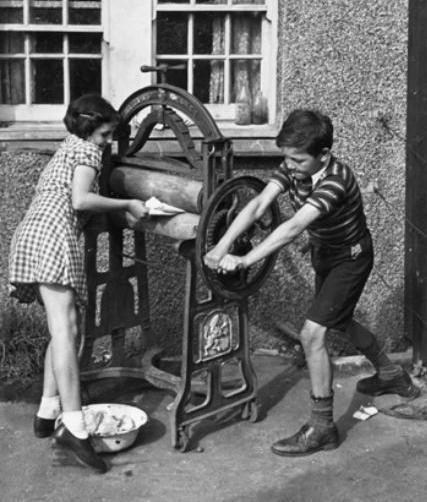
Food which had to be imported in large quantities was rationed. The cost of the War and the U-boat campign in the North Atlantic resulted in increasingly strict rationing of both food and clothing. Clothing was in short supply. It was rationed in June 1941. Often clothes did not fit children properly or clothes had gone from one child to another as the garment was out grown. Eventually extra clothing coupons were given to children to help them get the shoes and clothes they needed. Food was rationed and candy, chocolate and fresh fruit were difficult to obtain. Bananas were not again seen in Britain until well into the 1950s. Children had a weekly sweet ration of 57g. This was one small packet of sweets. The government encouraged the growing of food. Digging for victory became a popular slogan in growing vegetables. This was an activity that children did as well as adults. Children had supplementary rations of milk and orange juice. Cod liver oil was given to children but it was not well liked and taken under sufferance.
Given the strength of pacifist and anti-War sentiment in Britain before the war, there was remarkably little ant-War sentiment once the war began. This was largely because Hitler and the NAZIs made it very clear that there was no alternative, but War. And Hitler's peace offers were meangingless give his failure to live up to treaty commitmets. Although the British people were never fully informed of the offers. Some in the Government were willing to consider treating with the NAZIs, but Prime Minister Churchill saw clealy what Marshal Pétain failed to see--surrender to the NAZIs meant national disaster. Once the Luftwaff began the Blitz, support for the war only strengthened. This support for the War was genuine and deep. The British Government had much more authority to control the press and deal with disenters than the American Government. There were some arrests such as Sir Oswald Mosley, the leader of the British Union of Fascists, but very few. He was imprisoned for a time (1940-43) and after that he and his wife lived under house arrest. Generally as George Orwell noted, the British government was content to ignore such opposition. And there continued to be a free press. While there was virtually no resistance to the War despite the severe rationing and military reverses. A challenge to press censorship was led by a young Labour MP, Michael Foot. There was some criticism of Churchill's war leaderisip. The Government handily survived a no confidence vote. Then after the Alemein victory (October 1942), Churchill's leadership ws never again threatened. There was some muted protest against area bombing from the Church, but the got little press coverage and at any rate, the public was more interested in bombing the hell out of the Germans. The Governments realized that anti-Wwar sentiments and rhetoric represented the views of a tiny minority of the British people and posed no real challenge to the War effort. Even late in the war, the V-1 and V-2 attacks only confirmed the commitment of the British people to vigorously pursue the war. This did not begin to change until the end of the war with the Dresden bombing (February 1945).
After the fall of France, Britain was virtually alone. There was support from the Dominions and america, but the frontline of the War was the Channel. This had not been the case in World War I. Thus for a year, Britain had to endure the full fury of the NAZI war machine and the very real possibility of invasion. The Luftwaffe remorselessly pounde London and other british cities. The RAF prevented an invasion, but could not protect British cities from night bombing. Britain's salvation was that its cities were much more spread out than Germn cities and the Luftwaffe did not have atrategic bombing force. The British people were under no illusion of the character of the NAZI aggresors and what they would bring, but few fully appreciated the draconian future they would have experienced under NAZI rule. Finally after being stimied at the Channel fora year, Hitler turned east. Considering himself to be a military genius, he decided that it would be easier to defeat the Soviet Union which he concluded would 'fold like a house of cards'. He redeployed the the Luftwaffe and Panzers for the invasion of the Soviet Union (June 1941). And American joined the War after Pearl Harbor and Hitler declared war (December 1941). With Hitler's focus on the East and deployment of the American 8th Air Force to Britain, the Allies established air superiority in the West. The air war shifted to the skies over first France and then the Reich.
HBC contributor William Ferguson tells us, "I visited the Imperial War Museum in London during June 2005. They had a fascinating exhibition called 'The Children's War'. It is based on a book by Juliet Gardner who describes how British children were involved in and affected by World War II. This is my recollection of the themes the exhibition dealt with. It effectively highlights how British children were involved in the War. For children in Britain September 1939 was a warm sunny month. It was the end of the summer and the start of things to come. Sunday September 3 was the start of the Second World War. Most families were at home that Sunday listening to the radio. They were listening to the voice of Neville Chamberlain, the then British Prime Minister; tell the nation that Britain was at war with NAZI Germany. The War would last until 1945 but nobody knew that then. In the Second World War, British children found that they were in the front line of the war. They had to endure nightly bombing raids in which their homes were destroyed, family members and neighbours injured or killed. The first big trauma for children though was being evacuation from manufacturing towns and cities.
The British knew very little about Americans before the war. In World war I, Americans went to France in large numbers and not Britain. American and Britains shared a common lanaguage and cultural tradition, but were two very different period. Few Britains had ever met an American. Most of what the average Britain knew about Americans came from Hollywood movies which were popular in Britain and did not have the languge of other foreign movies. American aid had helped keep Britain in the War during the fiirst 2-years, but the British had done the fighting. Pearl Harbot changed this and within weeks a flood of Amerivan GIs, mostly soldiers and airmen began arriving in Britain. It was a cuThe principal role of the Americans was to prepare for the cross-Channel invasion and to joun in on the strategic bombardment of Germany. For the British it was a cultural revolution. The British had never seen anything quite like then. The Americans were brash, forward, outgoing, and generally less reserved than the British-and they game in massive numbers. Perhaps more than anything they were fun loving and had money. The British who had lived under NAZI bombs and threat of invasion for 2-years were glad to see the Americans arrive. Some were, however, less pleased than oyhers. There were two groups who took tonthe Americans from the very beginning. Furst were the young women who lived a dull existance under rationing for 2-years. American GIs were more than willing to take them out for a good time complete wuth swung-time dancing. The second group to take to the American GIs were Britush kids. The easy-going, gum-chewing Americans really impressed the kids, not to mention the gum and candy to be had.
Although the Luftwaffe was effectively defeated by early 1944, this did not prevent the Germans from launching two more terror bombing campaigns with their V-weapons. The V-1 was a very simple weapon. It was inexpensive an easy to design. It was a essentially a pilotless bomb--a precursor to today's cruise missle. The V-2 was a radically diffearent weapon. It was a scienific achievement of the first magnitude--the first balistic missle. These weapons symbolize in microcosim what was wrong with the NAZI weapons development prigram. There were two many for a national at war with limited resources. The V-1 while it could be stopped was so simple and easy to build that the Germans could have built huge numbers that could have overwealmed British defenses. The V-1 was fully developed by early 1944. If fired at the the Channel ports, they could haave seriously disrupted the D-Day invasion preparations or the invasion itself. But instead of focusing on the V-1, the Germans devoted huge resources to the V-2. While it was a scientific marvel, it was inexpensive and very complicted to build. Thus far fewer V-2s could be built. Given the limited payload, the cost of the V-2 was not conmenserate with the damage inflicted. The V-2 was terrifying. There was no warning and no defense. It could destroy an entire city block. But it could only target a city, not any priority factory or military instalation. And destroying London homes and shops was by mid-1944 not going to stop the Allied armies.
While Britin was part of the winning Allied coalition, the country paid a heavy price. Shortages and rationing continued for several years following the War. [ After the War: This trend also happened to the next generation of children born after WW2. There were comic stories about the War in all its theatres. A boys comic called "The Victor.' featured stories of World War II--V.C holders. There were a host of films about the war that were regular featured at the cinema. There was also a programme on TV called 'All Our Yesterdays.' It used Pathe newsreel film and dealt with life in Britain over the previous 25 years. It started in the mid 1930s and was a regular weekly feature on British TV. It came to an end when
the time period the programme covered reached 1945.
We are archiving individual accounts about Britsh children during the War. Like their parents, the eperiences were many and varied.
Patten, Marguerite. The Ministry of Food: Thrifty Wartime Ways to Feed Your Family (Hodder & Stoughton, 2010).

Navigate the CIH World War II Section:
[Return to Main home front page]
[Return to Main World War II: British page]
[Biographies]
[Campaigns]
[Children]
[Countries]
[Deciding factors]
[Diplomacy]
[Geo-political crisis]
[Economics]
[Home front]
[Intelligence]
[POWs]
[Resistance]
[Race]
[Refugees]
[Technology]
[Totalitarian powers]
[Bibliographies]
[Contributions]
[FAQs]
[Images]
[Links]
[Registration]
[Tools]
[Return to Main World War II page]
[Return to Main war essay page]