Weimar Republic (1918-33)
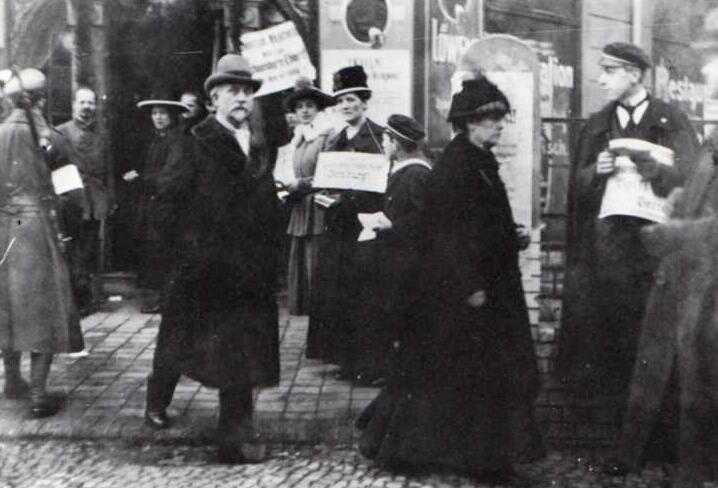
Figure 1.--Women voted for the first time in the German elections of 1919. Over three-fourths of the voters chose parties which supported the Republic. Some historians believe that if the Allies had offered the Republic a generous peace that the history of the 20th century would have been very different. Notice the two boys wearing their school caps.
|
|
A new German Weimar Republic relaced the Imperial German Government at the end of World War I. The Allies refused to negotiate with the German military. Thus the Armistace (1918) and resulting Versailles Treaty (1919) were signed by republican officials. This allowed right-wing politicans after the War to claim that the German Army was not defeated, but stabbed in the back. The Republic from the beginning had major problem. It inherited a civil service from Imperial Germany that was strongly monacharist in loyalty and suspicious of parlimentary democracy. The officer corps of the Army took a oath of loyalty to the Reoublic, but in fact was deeply suspicious of the Weimar regime and from the onset set out to evade the restrictions of the Versailles Treaty--in oart explaining how the NAZIs were able to so quickly rearm after seizing power. Popular support for the Weimar Republic was impaired by first the public shock at the Versailles Treaty and then the ruinous inflation. In fact the Republic was headquarters in Weimar rather than Berlin because the Army remamed the Reichwehr could not guarantee security in Berlin. Gradually the Republic began to gain some credibility. Competent fiscal management, the Dawes Plan, and the Locarno Agreements had by 1925 considerably improved the economic situation in Germany.
The Weimar Republic was born out of World War I, up to that time, the most destructive war in world history. Millions had died and the German economy was crippled by the allied blockade. At the beginning of 1918 victory looked assured. Germany hoped to bring the War to a successful conclusion in 1918. The Russians were knoicked out of the War and forced to sign the humiliating Breast-Litovsk Treaty which made Germany dominant in the East and allowed for the creation of a German protectorate in the vast Ukraine (March 1918). After forcing Russia out of the war, German military forces were moved west. It also enabled the Germans Army to focus on the Western Front. Ludendorff's massive offensive nearly achieved victory (July). The Germans also resumed unrestricted submarine warfare, bring America into the War (1917). Thus when the Germann offensive struck, a American Ecpeditionary Force (AEF) was in France to bolster the Allied lines. When the German offensive failed, the Allies began the final offensive of the war, bolstered by British tanks and the AEF. The German Western Front began to crack under Allied offensives. Germany's defeat in World War I staggered the Germany people. They had such faith in the Army. After 4 long year of war, Germany in only a few months went from assured victory to total defeat. The German Army was decisely defeated and forced to sign an Armistace (November). After 4 years of terrible sacrifice, the long suffering German people were horrified and bewildered at the outcome. In addition there were food shortage, economic dislocation, and fighting in the streets.
End of the Monarchy (November 9-10, 1918)
The last Imperial Chancelor was Prince Max von Baden. He had been chosen by the Kaiser, Hindenberg and Ludendorff because they thought he might be able to appleal to President Wilson. It was Prince Max who engineered the removal of Ludendorff and promissed the Allies reforns. Wilsom was, however, adament. The Allies would not deal with the Kaiser and the German military. Wilson informed Prince Max without as change of government, America would ask "not for peace negotiations, but surrender" (October 23). Prince Max tried to convince Kaiser Wilhelm to abdicated, but he refused. Finally he acted on his own and announced the Kaisrs abdication (November 9). Prince Max then himself resuged and turned the Government over to Friedrich Ebert, head of the Social Democrats--the largest party in the Reichstag. Ebert had lost two sons in the War, but was not a revolutinary. He wanted Wilhelm's abdication, but was not commited to an end to the monarchy. News of these developments brought crowds into the streets. They marched down Unter den Linden demanding "peace and bread". They carried flags and banners and tore the Imperial cockade from soldiers' caps. Social Democratic leader Philipp Scheidemann announced the creation of a democrati republic from a Reichstag balcony. Afterwards Ebert who did not want to that far privately chided him. A detachment of sailors seized the Kaiser's palace. And from that palace Spartacist leader Karl Liebknecht proclaimed a German Soviet Republic. (The Spartacists were radical Socialists who would become the German Communist Party-KPD.) Wilhelm asked the Army to restore order, but was told the Army could no longer guarantee his security. Early the next morning, Wilhelm left Berlin aboard his private train for exile in the Netherlnds (November 10).
Allied offensives on the Western Front cracked the German front forcing them back toward Germany. The German Navy mutined. Riots broke out in Germany cities. The General staff informed the Kaiser that they could no longer guarantee his saftey. He abdicated and fled to the neutral Netherlands. A German Government was hastily formed and asked for an armistice based on President Wilson's 14 Points. After determining that the request came from a civilian German Government and not the Kaiser or German military, the Allies accepted the German offer. The gun fell silent after 4 years of vicious fighting at the 11th hour of the 11th day of the 11th month (November 11, 1918). There had been over 8.5 million soldiers killed and 21.2 million wounded. A new German Weimar Republic relaced the Imperial German Government at the end of World War I. The Allies refused to negotiate with the German military. Thus the Armistace (1918) and resulting Versailles Treaty (1919) were signed by republican officials. This allowed right-wing politicans after the War to claim that the German Army was not defeated, but stabbed in the back.
The Army Welcomed Home (December 1918)
The people of Berlin formally honored the soldiers home from the front a month fter the Armidstice (December 10, 1918). The soldiers marched through the Bradenburg Gate in the hear of the city. Only this time Germany had been defeated. The German peole did not yet fully comprehend the extent of the defeat. All along Unter den Linden the people of Berlin cheered as if the Army had brough home yet another resounding victory. On the reviewing stand were both officials of the new German Republic and the Army. General Scheuch, the Minister of War spoke. Inexplicetly President Friedrich exlaimed, "You have not been beaten on the battlefield." Of course they had been and only the Armistice prevented the Allies from crossing the Rhine and occupying Germany. The German people had paid such a staggering price that few could conceive that Germany had actually been defeated militarily. Slowly fed by right-wing politicans, the myth of the "November Criminals" began to take root, that Germany had been sold out by Socialists and Jews.
Creating a Constitutional National Assembly(December 1918)
Following the abdication of the Kaiser a new government had to be organized to replace the Imperial Government. A Conference of German States met to discuss a new constitution in the Reichs Chancellery (November 25). The real decesions were made by the Workers' and Soldiers' Council which met in Berlin. At first only local Berlin representatives met, but they were soon joined by representatoves from the rest of Germany. The opening session included 450 representatives (December 16). The Socialists dominated the session. A cabinent called the Council of the People's Representatives was formed by the majority Socialists (Ebert, Scheidemann, and Landsberg) and Indepdents (Haase, Dittmann, and Barth). The Socialist proposed "peace, security, and order". The Independents wanted a "social republic" dominated by the workers--essentially a Bolshecick style Soviet republic. This confirmed the split in the labor movement that had developed during the War. Radical Socialists like Karl Liebknecht had voted against war credits at the very beginning of the War. The Socialists secured 400 votes for a constitutinal national assembly (December 19). The Independents walked out, determining to take their struggle to the streets.
Freikorps units were organized in Germany after Wotld War I, mostly from disilusioned right-wing veterans as well as some youths who had been too young to participate in the War. The veterans had made huge sactifices during the war and did not understand how Germany with its martial heritage could have lost the War. They were outraged with the Versaillers Peace Treaty which transferred former German/Austrian territory to neigboring coutries, including the newly crrated countries of Poland and Czechoslovakia. The new German Republic faced many problems after World war I. It was set up at Weimar because the Socilists who dominated the Republic did not think it could be defended in Berlin. One of the problems was the luke warm support from the Germany Army. The Republic faced attacks from Communists wjo tried to seise control. Another problem were areas of Germany whose future were to be decided by plebesite. This was a special problem in the Eat where the new Polish Republic wanted to expand its territory. Polish military units attempted to seize territory. The Allies did not permit the German Army to intervene. The Freikorps were used to both defeat Comminist uprisings and to fight the Poles. Many Freikorps members were hostile to the Weimar Republic, but willing to fight Communists and Poles. The most prominant Freikorps unit was Brigade Ehrhardt. It was the Freikorps that suppressed the Bavarian Communists Many Freikorps members gravitated to right-wing parties like the NAZIs. Quite a few NAZI luninaries served in the Freikorps, including Seep Dietrich, Hans Frank, Heinrich Himmler, Reinhard Heydrich, and others. Many lesser known Freikorps members gravitated to the the SA. Thus the Freikorps is seen by many as the origin of the Sturmabteilungen (SA)--The NAZI stormtroopers. They certainly played an important role, but the more direct origin was in the right-wing political parties that formed in Germany following the War.
Berlin: Sparticist Uprising (December 1918-January 1919)
The Kaiser had been deposed without bloodshed. The birth of the Republic resulted in intense fighting throughout Berlin. A batalion of sailors had occupied the Kaiser's palace in a show of force to protect the Govern,ent formed when the Kaiser was forced out (November 9). They proceeded to loot the palace of its valuables. The Government eventually ordred them out of the palace. They demanded back pay and proceeded to seize the Chancellery, arresting SD officials, including Berlin's Military Commnder Otto Wels. Prsident Ebert appealed to the Supreme Military Headquaters. Ludendorff's successor General Gròner responded. A minor military scirmish dislodged the sailors (December 25). The radical Socialists (indeendents and Spartacists) were apauled that the Government would use the old Imeprial Army to attack the rebolutionary sailors who had helped overthrow the Kaiser. They called Ebert and the SD "murderers. The action thus shatered the frayed unity of the Socialists. The Government began to replace Independents in the cabinent and lesser offices. This came to a boil when they fired Berlin Chief of Police Emil Eichhorn. The Independents and Communists (Spartcists) went into the streets to drive Ebert and the SD from power (January 5). The Soviet Emnassy supported them with srms and money. The Soviet Ambassador was a friend of Leon Trotsky and committed ton world revolution. The Communists demanded a Soviet-dstyled dictatorship of the proletariat. Ebert agan had to ask the Army for support. SD leader Gustav Noske organized the Government's resonse. He approved the formation of Freikorps. These were units outside the military command composed of veterans and firner officers. Fighting waged for 7 days (January 6-12). It became kniwn as "bloody Spartacus week". Eventually the Government gained the upper hand. Both rmy units ad the Freikorps took savge rvenge, executing many Spasracits who atte,pted to surrender. And a few days after the fighting ended, soldiers clubbed Rosa Luxemburg to death. Liebknecht was also murdered. Both were Spartacists, but had opposed the uprising and had wanted to contest the upcoming elections.ighting was not confined to Berlin. Violence occurred in Ruhr cities, Leipzig, Hamburg, and Bremen and fkred gain in Berlin. Noske again ordered the Freikorps to move against the Comminists and they acted with considerable brutality. Thi poisoned the relationship betwee the SD and Communists and is one reason why the Left was unable to unite in the future to successfully resist the NAZIs.
Election of 1919 (January 1919)
The Republic held its first election (January 19). It was a historic elkection not only because of the fall of the monarchy, but because women voted for the first time. Everyone over 20 years of age was eligible to vote and about haslf did so, The result was a stunning victory for democracy. The SD emerged as the dominant party with 11.5 million votes and 163 seats. The Center and Democrats who also did well were suporters of the Republic. These three parties gained three-quarters of the votest cast. The Germans were clearly prepared to embrace democracy. The Allies were not, however, prepared to embrace the Germans. Lloyd George, Clemanceau, and Orlando demanded harsh policies including burdensome retributions. Wilson was more willing to seek a moderate peace, but in the end gave into his colleagues, in part to secure their support for the League of Nations and his commitment to national self-determination. The principle of national self-determination of course sounds morally uplifting. It also mean that there would no matter how the boundaries were drawn, ethnic minorities in the new states ad this included German minorities in the surounding countries.
Historians criticise the Allies for the harsh terms that they imposed upon the Germans and the critiscm certainly is in part true, especially the economic retributions. History is not, however, that simple. The part of the Versailles treaty that the ultra nationalists found most offensive was the loss of territory and creation of new states out of former German and Austrian territory--especially Czechoslovakia and Poland. There was also territory lost to Lithuania, Denmark, Italy, and France. Thus nationalistic resentment would have festered in Germany even if the Allies had been more willing to embrace the new German Republic.
Freikorps to restore oder. Freiderich Ebert who had helped negotiate the Armistace and associated with the Versailles Treaty became the first president of the Republic. The Government first meets in Weimar rather than Berlin. This decession results from the unstable security situation in Berlin with political rioting and other disorders. Jews played an important role in the first
cabinet formed after the 1918 revolution (Hugo Hasse and Otto Landesberg),
the Weimar Constitution was drafted by a Jew (Hugo Pruess).
>
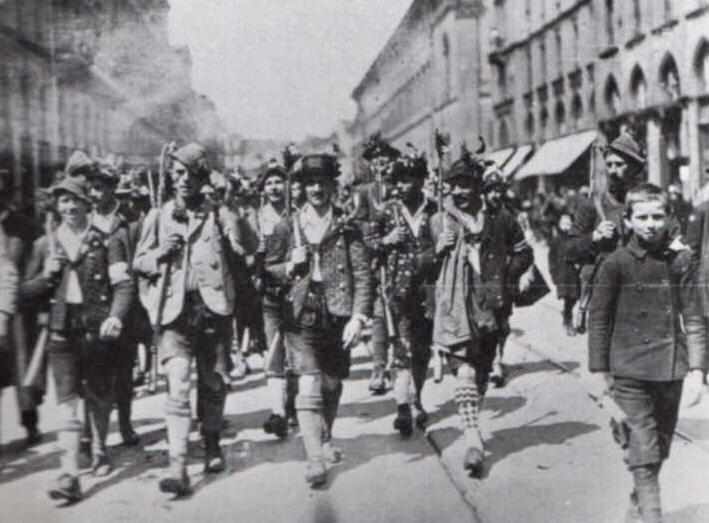
Figure 2.--The Bavarian Goverment called upon both the Army and Freikorps to oust the Communists that had seized power in Munich. The Freikorps in particular behaved with great brutality. This was the Freikorps Werdenfls, a Bavarin unit. The Socialist movement in Germany split over World War I. SPD alliance with the Freikorps and the brutality used would further split the Socialist movement of which the Communist were a part. The inability of Socialists and Communist to cooperate in the later years of the Weimar Republic would be a central factyor in the NAZI seizure of power.
|
|
The murder of Sparticists Rosa Luxemburg and Karl Liebknecht in Berlin after the Sparticist uprising were the first notable political murders in Germany. Thet were, however, only the beginning. Kurt Eisner, a journalist, had become Bavarian primeminister after the ovrthrow of the monarchy (November 7, 1918). He proved to be an honest, but inept politican. When elections were held for the Diet, Eisner and his party won only three seats (January 12, 1919). The conservative Bavarian People's Party dominated the election and won 66 seats. Eisener set out to for the opening of the Lantag to resign and was shot by a nationaslist officer, Count Arco-Valley (Febrary 21). The population of Munich was outraged. A Worker-Soldier Peasant Central Committee was formed and proclaimed a state of seige. The Diet was not allowed to convene for several weeks, but finally met (March 17). They chose SD Johannes Hoffman minister president. Then new of a Communist Government seizing power in Hungary reached Munich (March 21). Local Communists decided this was the time to strike. What followed was the bloodiest episode in post-War Germany. The Communits Government was initially led by of all people, a romantic poet, Ernst Toller. Within only a week more hard core Soviet influenced Communists led by a young sailor, Rudolf Egelhofer, had control of the Governent. He set in motion a lawless period of seizing bank deposits, looting homes, and confiscating private assetts. Hoffman set up in Bamberg and urged the population to resist the Communists and requested military intervention from Berlin. The Communists turned back an Army column at Dachau north of Munich. Hoffman also requested Freikorps. The Freikorps were only minimally disciplined and committed terrible attricities as they moved toward Munich. One notable incdent was murdering 52 Russian POWs. The Comminists retailiated by shooting hostages, members of nationlis, anti-Semetic Thule Society. The Army and Freikorps finally fought their way into Munich from several directions on May Day (May 1). Mamy Communists who attempted to surrender were shot. The "liberators" aldso shot many civilians suspcted of sympathizing with the Communists. The episode profoundly affected Bavarian politics. Bavaria during the Imperial period had been much more liberal than Russia. The brief period of Communist control turned Bavaria to the right, creating strong anti-Communist feeling and because there were many Jews among the Communists, intensified anti-Semetic feeling.
The Versailles Peace Treaty ending World War I was signed on June 28, 1919, about 7 months after the Armistice stopping the fighting on November 11, 1918. It was one of the mos important treaties of the 20th century. It had a huge impact on the international status of Germany, impacting the country territorially, militarily, and economically. Germany was made a pariah country and largely blamed for the start of the War. Of major significance, the Germany being published was the Germany of the Weimar Republic and not Imperial Germany as the Kaiser had abdicated. As a result, the domestic German opposition to the changes, including the territorial changes, came to be directed at the Weimar Republic and not the Imperial Government that had conducted the War. The NAZIs and other right-wing groups were to saddle democratic politicians with the "shame of Versailles". Germany under the terms of the Treaty suffered many consequences. The navy and merchant marine was lost. The battleships had to be turned over the the Allies. The battleships ships in fact steamed into the British naval base at Scappa Flow. The German captains, however, rather than turning them over to the British, scuttled them. Germany lost her African and Pacific colonies. Along with territorial losses in Europe were important natural resources. The German Army was reduced to virtual impotence. And the country was saddled with immense retributions. A critical element in the treaty was the principle of national self determination promoted by President Wilson. This resulted in the creation of a large number of small, weak states in Eastern Europe. It must be said that the the Versailles Treaty was not as onerous as the Treaty of Breast-Litovsk (1918) imposed on the Russians. Still it was undeniably harsh. Many historians see it at the first step toward World War II. Popular support for the Weimar Republic was impaired by first the public shock at the Versailles Treaty.
The new German Republic from the beginning had major problem. The first was the Versailles Peace Treaty. The Allies refused to treat with the military. Thus the resulting Versailles Peace Treaty was associated with the Socialists (Social Democratrs) which signed the Treaty. Here there was no negotition. The negotiatons were all between the Allies. The German delegation was presented wuth the Treaty. They had a choice of signing the Treaty or the Allies would occupy Germany. As the Treaty was enormously unpopular in Germany, the popularity of the new Government was affected. Right wingers began calling the SPD leades, the 'November criminals' referring to the Armistic that was sisned in November and ended the War. Important elements of the Government had little loyalty to it. The Weimar Republic inherited a civil service from Imperial Germany that was strongly monacharist in loyalty and suspicious of parlimentary democracy. The officer corps of the Army took a oath of loyalty to the Reoublic, but in fact was deeply distrustful of the new government. And the Army from the onset set out to evade the restrictions of the Versailles Treaty--in part explaining how the NAZIs were able to so quickly rearm after seizing power. The Republic was not headquarters in Berlin the imperial capital. The new Government chose Weimar rather than Berlin because the Army, remamed the Reichwehr, could not guarantee security in Berlin. Weimar was also politically unstable. The Social Democrats (SPD) were the largest political party, but important elements of the political system was opposed not only the Social Democrats politically, but to the Weimar Republic itself. This includes a number of right-wing parties which at first were relatively small. Of more immediate concern was the Communists (KPD) which had considerable support among the working class. They might be expected to make common cause with the SPD, but they were expecting the Revolution which occurred in Russia to spread west and they saw the SPD as an imediment, splitting the working class. After the insurrections in Germany failed, the KPD viewed the SPD as traitors. The rightest Kapp Putsch also failed, but showed how the old aristocratic, militaristic segment of the population also opposed Weimar. In the midst of these insurrections, the Weimar Government faced enormous problems resukting from the War. The Gernman state after 4 years of War was bankrupt. The Germans did not have the Americans to help support the war effort. Serious food shortages existed. The cinscription of workers had adversely affected food production. And the British naval blockade had prevented food imports. And to assure German compliance with the Armistice, the blockade was not immediately lifted. There were other shortages such as for coal. Unemployment soared as the military demobilized. Industry faced the problem of shifting production back to a peace-time economy. Then the the Allied Reparations Commission presented the government with a bill for reparations of £6.6 Billion (1921).
Kapp Putsch (March 1920)
Following the Sparticist Uprising (1919), right-wing extremists attemp to seize power in the Kapp Putch (1920). The Kapp Putsch was the initial military response to thr restructions of the Versailles Treaty. It was an open rebellion by military officers still loyal to the monarchy. It was led by an East Prussian Junker,
Kapp, supported by World War I leadet General Ludendorff, and Captain Ehrhardt. There was condsiderable support within the Army evenn on the part of officers not involved in the putsch. Many officers were threatened by demobilization to met the 100,000 limit set by the Versailles Treaty. Kapp and his associayes seized control of Berlin. Kapp declared military law. He authorized the death penalty against strikers. Weimar officials were unable to oppose Kapp militarily. Their were no military units loyal to the Government to deploy. The Republic was ineffectual in defeating the putsch, but despite the threats of execultion, the Kapp Putsch was defeated through a general strike. [Gumbel] Another factor was that if the Kapp Putsch had succeeded, the Allies almost certainly would have uintervened.
The Reichwehr
German had been united by The victory of Prussian Army aided by the smaller armies of other German states in the Franco Prussian War. Germany was thus united around the Prussian state with its important martial influence. The military thus had enormous influence in Germany, even after World War I. The Germany army under the Weimar Republic was referred to as the Reichswehr. It was the Army that organized efforts to evade the disarmament restrictions of the Versailles Treaty. In the German Empire the military had been a virtual state within a state. There had been huge budgets, an aristocratic, cohesive social system, and close contacts with major industrialists.
[Gumbel] Under the Weimar Republic the much-reduced and thus imbitered military continued to control military policy and not civilian officials. A major factor here was civilian officials given the high-level of oposition needed to court the army knowing they might have to rely on the army to put down putches and rebellions. Civiliam Weimar offivcials never attempted to staff the Army with officers commited to the Republic and democracy. Rather the officer-corps was dominated by officers who continued to be sympathetic to the monarcy. As a result, despoite the fact that Weimar elected officials from the the Center, Democratic, and Socialist parties supported by the industrial working class as well as sections of the middle class. [Gumbel] This was further complicated with Hindenburg was elected president (1925). Many Germans viewd the Reichwehr as the embodiment of German patriotism and civiliam politicans with contempt. As the NAZI Part grew one development which caused increasing concern to Reichwehr commanders was the SA. Under NAZI leader Ernst Röhm, a confident of Hitler, the SA came to outnumber the Reichwehr. It was a private army posing a real threat to the Reichwehr itself.
Flag
The Weimar Government adopted a new flag for Germany. The flag of Imperial Government was a black, red, and white flag. Weimar adopted a new black, red, and gold flag. This was based on the banners udsed during the 1848 revolutions, which sought to create a unified democratic Germany. This flag was never popular with the monarchist-minded military. [Gumbel]
Reparations (1921)
The Allies calculate that Germany owedcwar reprarations of É6.6 billion. German officials protest that this is an unrealistic high figure that Germany could never pay, especially given the shartered state of the Germant economy after the War. The British and French continued to insist on that figure.
The German military had been the most powerful in Europe. The Prussian officer class which had been the backbone of German military leadership was extremely resentful of the limitations imposed by the Treaty. Among the severe penalties
that the treaty imposed on Germany was a comprehensive disarmament regime. Germany was prohibited from weapons such as combat aircraft, tanks, and submarines. Severe limititations were put on the size of the military forces. As a
result, the Germans from the breginning set out to evade the limitations. The military frustrated in its efforts to seize control of the Government (ythe Kapp Putsch), began to develop sureptious efforts to evade the Versailles Treaty. The NAZI rearmament program beginning after their seizure of power is the best known evasion, but efforts to evade the Treaty began years before in the Weimar
Rdepublic. Some of these were authorized by the civilian Weimar Governmnt. Others were conducted by the military in secret, both from the Allies and from the Government. Some of these efforts were suptergfuges to like non-military names to desguise the purposes of groups and keeping military connections secret. Another ploy was to conduct activities and programs in foreign countries. One of the first steps was the Rapollo Treaty (1922) with the Soviets.
Inflation
The image of the Republic was devestated by the ruinous inflation which followed the War. In particular the German middle class was devestated by the infkation. With mny this permanately affected how they viewed the Republic.
Economic Stability
Gradually the Republic began to gain some credibility. Competent fiscal management, the Dawes Plan, and the Locarno Agreements had by 1925 considerably improved the economic situation in Germany.
Occupation of the Ruhr (1923)
The Germans as they had warned, were unavle to meet the reparation payments and default. The French and Belgians moived troops into the Ruhr and organize an occupation to enforce thereparation payments. Some of the French troops are Black colonial forces. The NAZIs are later to make use of the babies fathered byb the occupation soldiers, referring to them as the "Rhineland Bastards". German workers stage a general strike. The Ruhr was the industrial heartland of Germany. The German economy was devestated. The Government prints marks to meet its financial obligations. The result is hyper inflation. Middle class Germans see their savings wiped out. Photographs from the era show children with wagons full of valuelass bank notes or playing with the bills. The collaose of the Mark further weakens the support of the middle class. This is a critical development because in any democratic society it is always the middle class that is the backbone of democratic government.
Gustav Stresemann (1923)
Gustav Stresemann (1878-1929) was appointed Chancellor (1923). He ended the policy of passive ressistance to the Allied occupation of the Ruhr. The also acted to end hyper-inflation, introducing the Reichmark, a new currency to stabilize the currency. Strssman surved also served as Foreign Minister (1923-29). He was generally seen as a spokesman for German industrialists. As foreign minister, however, he worked diligently to gain Germany a respected place in world affairs. Here he achieved considerable success. His approsch was to fulfill German treaty requirements and in return to seek conciliation with with the Alliefd powers and moderation of their repriation demsnds. He hekped to secure Allied evacuation of the Ruhr (1925) and the Rhineland. He accepted the Dawes Plan for rescheduling repsaration payments (1924). He was an architect of the Locarno Pact (1924) and helped to secure German entry into the League of Nations (1926). He shared the the 1926 Nobel Peace Prize with Briand. He signed the Kellog-Briand Pact for Germany (1928). As has happened in msny other countries, his achievemebts were more recognized abroad thann at home. German public opinion gradually became radicalized by left and right wing political figures.
Hitler used the SA to stage a putch in Munich. As it was launched from a beer hall. Gustav von Kahr, the Bavarian state leader, called a meeting of local officials (November 8, 1923). While von Kahr was speaking, Hitler with armed stormtroopers burst into the building. Hitler jumped on top of a table and fired a pistol. He told the astonished officials that he had just launched the National Revolution. The event became known as the Beer Hall Putch. It is quickly supressed. Hitler is arrested and jailed in Landsberg Prison. He only serves 9 months. While inprisoned he writes Meim Kampf with the assistance of his secretary Rudolf Hess. He realized that he could never over come the military. He decided his only alernative was to use the political process to seize power, but clearly states in the book his vision for Germany and Europe.
The Weimar Republic shared the same police intitutions as imperial Germany. German had a federal system. The systtem was much like that of the Unitrd States. There wa no national police force. Each of the states (Landen) that comprised the Empire and now the Weimar Republic had police forces as did muncipalities. And each of these different police forces had their own poilicies. This hampered law enforcement and after the disolution of the Empire, Weimar politicans cut budgets. Atvthe same time economic problems and dislocations resulted in an increase in crime. Criminal gangs proliferated and became involved in prostitution, drugs, gambling, pornography, robbery, and other ilicit activities. The gangs were well organized and financed and commonly operated across state lines. This comjplicated police investigations. There was no national police force during the Weimar Republic. Most German policemen in the Weimar Republic were not NAZIS, even after the NAZI Party had grown in importance during the late-1920s and early-30s. They were, however, like the Army, overwealmingly conservative. Many had monarchist sympathis, but attempted to sty out of politics. Most pursued their duties in a porofessional manner and tended to see themselves impartial enforcers of the law. German policemen, however, like Reichwehr officers were were suspicious of democratic parties, especually the Communits, but also moderate soiilists (the Social Democrats, Center, Liberals). They had been trained and served under the Imperial service to see these parites as not loyal to the state. And these were the very political paries that dominated the Weimar Republic. Right wing parties, even those engaging in violoence were seen by many poicemen as more loyal and patriotic. This in part explains Hitler's treatment after the abortive Beer Hall Putsch.
Dawes Plan (1924)
American statesman Charles Gates Dawes (1865-1951) formulated a plan to spread out the German repration payments over a much longer period which he proposed to the Allied Reprirations Commission. Dawes also helped to arrange for American loans to Germany. The plan became known as the Dawes Plan. Dawes was receive a Nobel Peace Prize (1925). He was also elected Calvin Cooldidge's Vice President (1924). The Dawes PLan did help revive the Germany economy, butb left it heavilyb linked to the American economy with severe consequences when the Depression unfolded (1929).
Locarno Treaties (1925)
Britain, France, and Germany negotiate the Locarno Treaties (1925) the terms of which recognized the boundary between France and Germany. The feeling of good will resulting from the Treaty among the world war I atagonists is known as the Locarno Honeymoon. The Treaty included no guarantee for boundaries in the East. The Soviet Union was not included in tghe negotiations and many Bolshevicks considered the treaty as a hostile act aimed at the Soviet Union.
Election of 1924
The NAZIs won 32 seats in the elections of May 1924. They had even less success in elections held in December 1924. The NAZIs won only 14 seats in the Reichstag compared with the the 131 won by the obtained by Social Democrats (SD) or Socialists. The Communists (DKP) won 45 seats.
Field Marshal Paul von Hindenburg
Field Marshall Paul von Hindenburg along with Field Marshall Lundendorf had been the two key key German military commanders of the German World War I military effort. He was elected president of the Republic (1925). His election is an indication of the degree to which right-wing elements had succeeded in transferring responsibility for the disasster of Wotld War I from the military to civilian politicans. Note that in the major Allied countries (Americam France, and Germany), no military leader became an important political leader after the War. It was the aging President Hidenburg that would eventually consent to making Hitler Chancellor (1933).
Presidential Election of 1925
Field Marshal Hindenburg was elected president after President Freidrich Ebert died (1925). Hindbenburg was supported by the conservatives (naionalists, the Army Prussian Junkers, and others) and defeated the SDP and center parties. The German presidency was aelatively weak office. The Government was run by the Reich Chancrellor supported by a majority coalition in the Reichstag. With the rise of the NAZIs, however, the Reichstag became deadlocked. This thus increased the importance of the presidency and Hindenburg himself gave the post great prestige.
Germany is allowed to join the League of Nations (1926). Many considered this as a step symbolizing Germany rejoining the international community.
Kellog-Briand Pact (1928)
The Kellog-Briand Pact was a major step in 20th century diplomacy. Much of the world (68 countries) condemned war and pledged to renounce war "as an instrument of nationsl; policy". These countries agreed to persue peaceful meansc to solve international dissputres. The Pact is named after its chief promoters, French Foreign Minister Aristide Briand and American Secretary of State F. B. Kellog. However lofty its goals, there was no mechanism included to enforce the pkledge. As Amerivans had not joined the League of Nations and it was an issue in American politics, the League was not mentioned in the Pact.
The Weimar era edperirenced a rich flowering of the arts with notable work in architecture, art, literature, movies, and other media. German artists were important in the development of modern art. I do not think, however, there are yet any of these German artists archived in the HBC art section. Hitler who fancied himself an artidt hated their work, The NAZIs were later to spondsor an exhibition of decadent art. Many of these artists fleedc Germany, many coming to New York. Not wll known today is that the German film industry led by UFA was a major competitor to Hollywood in the internation movie market. German novelist Eich Maria Remarque (1897- ) published All Quiet on the Western Front (1929). It was an immediate success both in Germany and in the Allied countries. This anti-war novel was widely read and popular films were made based on the book. The fact that an anti-war book was so popular in Germany demonstrates how most Germans were at the time opposed to War, even to correct what they saw as their legitimate grevinces. Hitler was often frustrated by this and was careful to adjust his message so as not to overtly advocate war. The NAZIs of course hated the book. As a result, Remarque had to flee Germany (1932) even before the NAZI seizure of power. Remarque was high on the list of books burned after the NAZI seizure of power (1933). He came to America where he cointinued to write. His books after the War dealt with man's adjustment to a chotic war-torn world. Many artists, movie actors and directors, and writers who fled Germany after the NAZI take over came to America. This played a major role in the artistic development of America. Significantly anothervarea in which thjis ocvcurred was nuclear physics.
Young Plan
American industrialist Own D. Young (1874-1962) conceived of a plan to finally settle German World War I repriations. Young proposed amending the Dawes Plan by reducing the German repriations to É2 billion. It was adopted by the Allies, but the Depression and NAZI seizure of power made it inoperative.
Election of 1928
Economic conditions had improved considerably. In the prosperous economic climate even the monarchist People's Party joined in a coalition with the three main republican parties. The NAZIs were still unable to muster muct political success in 1928. They won only 12 Reichstag seats. The Party was, however, growing and were very well organized. Membership stood at 108,000 in 1928.
The Depression played an important role in the NAZI sizure of power and in the image that Hitler built in Germany once he seized power. Tragically for Germany, the most serious period of the depression followed the New York Stock Market crash (1929) through Hitler's seizure of power (1933). The impact that the Depression had on Germany folded neatly into Hitler's political drive for power. Apparent economic improvements in Germany were an important element in Hitler's real popularity after seizing power. The view of the Hitler and the NAZIs in Europe was substantially different in Europe during the 1930s before Hitler launched World War II than it is today. It should be remembered that until Kristallnacht (November 1938) that NAZI actions against the Jews were not greatly different fom how Blacks were treated in the American South. In fact many NAZI racial laws were based on laws enacted against Blacks by Southern state legislatures. There were prominent Americans (Lindberg, Ford, and others) before World War II who were impressed with the NAZIs. Hitler was seen by many as the most dynamic leader in Europe. One reason for this was that NAZI policies essentially ended the depression by 1935. Many Germans had turned to the NAZIs in the earlt 1930s because of the Depression. The NAZIs expanded German labor programs, creating a National Labor Service must like the American CCC. The NAZIs seized control of the economy. German industrialists benefitted and soon learned that it was very dangerous to defy the Government. It might be argued that Germany under the NAZIs had the most controlled economy in Europe. Their major project was the construction of the Autobauns. The massive new armaments program was a major factor in putting Germans back to work. The German GNP was back to pre-Depression levels by 1935. NAZI policies made sure there was no longer wide-spread unemployment and destitution in Germany. The German people, however, wre not better off. The benefits of the expanding economy was not brought to them in terms of more consumer goods, but rather a rearmed military. Many Germans, however, were convinced that they were better off. This was in part due to declinging product standards. It was also a result if the effectiveness of NAZI propaganda which emphasized the increased international respect with which Germany had achieved. [Hanby]
The Saar (1930)
The Saar is a heavily industrialized region with important coal resources. Itv is located on the French norder north of Loraine. The population is mostly German-speaking Catholics. The Saar under the terms of the Versaiiles Treaty was made an autonomous territory administered by France under League of Nation supervision until its final dstatus woukld be determined by a plrbecite schuled for 1935. France until that date had a right to exploit the coal mines. Allied occupation troops withdraw from the Saar (1930). The population overwealming voted to return to Geramny in the plebecite (1935).
Political Violence in the Weimar Republic
Political violence was almost unheard of in Germany before World War I. It became a fact of life at the end of the War, forcing the Kaiser into exile (1918). The Prussian province of Saxony was a focal point where the Communist uprising (March 1921). Two Combat Leagues (Wehrverbände) were founded: the right-wing Stahlhelm and the Social Democratic Reichsbanner. The Freikorps were an important force in supressing the Communist uprisings, including the one Bavaria. And of course it was in Munish, Bavaria that Hitler staged is Beer Hall Putch (1923). Many authirs blame the rise in political violence on the Communists. Other authors disagree. Some authors also claim that the horrors of World War I doomed the Weimar Republic from the beginning. There is no doubt that Weimar was constantly in crisis, but there were alternatives to the NAZI seizure of power. [Schumann] Of course the Wall Stree Crash and the ensuing Depression sharply narrowed those alternatives. As the NAZIs grew in importance, especially after 1929. Conflict was repoted between youth groups. This was especially the case of fights between the NAZIs with Jewish, Socialist, and Communist groups. At the time like the group here, the HJ which was an arm of the SAj was primarily composed of teenagers. The NAZIs used political violence as an act of polify to undermine public confidence in the Weimar Republic. NAZI SA Stormtroopers openly attacked people, especially Communists and Socialists on the streets. There are also stories of NAZI and other Fascist youth groups beating up groups such as this SAJ group and harrassing them.
Gustav Stresemann (1878-1929)
Gustav Stresemann formed the German People's Party shortly after the World War I Armistice (1918). He was elected to the National Assembly that gathered at Weimar to draft a new constitution (1919). He was elected to the new Reichstag (1920). , Stresemann was chancellor of a short-lived coalition government (1923). Hi coalition fell apart, in part because of his forcefullness in dealitng with Hitler's Putch. Centrist Party leader, Wilhelm Marx, suceeded him and chose him as foreign minister. Stresemann would serve with such distinction under four governments. Some referred to him as the greatest master of German foreign policy since Bismarck. Stresemann died (October 1, 1929). This was about the same time of the Wall Street Stock Market crash which brought on the Great Deression. Stresemann had been a modrating influence in the monarchist-oriented German People's Party. As a member of the governimng coalition, he had helped to negotiate a reduction in reparations payments and , ended international controls on the German economy. His most notable achievement was surely tghe reconciliation between Germany and France, for which he and Aristide Briand received the Nobel Peace Prize. As part of this effort, he achieved abn end to the French occupation of the Rhineland (the Young Plan). The diplomatic wranging, however, had enflamed German public opinion. With the death of Stresemann, the German People's Party vered right, adopting a much more strident foreign policy. [Gilbert-Large, p. 255-56.]
The NAZIs during the 1920s were a small right-wing party with political influence. It was founded after the War, one of a number of right-wing parties. Hitler was recruited by the Army to spy on the Party and proceeded to take it over. The NAZIs from the beginning were a right-wing nationalist party, Hitler added a much stronger racial element. The failire of the Beer Hall Putch (1923) convinced him that he would have to seize power through the ploitical process. Hitler was a persuasive speaker and he gathered a group of supporters with organizational and political skills. He also attrscteed the support of right-wing industrialists who prtovided financial support. Even so, his support was limited to the right-wing fringe. It was the Deression that changed the political dynamic that enavled him to attrat the support of a much broader cross section of German voters.
Political Instability
With the German People's Party moving to the right and out of Government, the governing coalition was weakened at the same time the NAZIs and Communists were growingbin strength. When the Government moved to reduce unemployment payments, the socialists balked. They wanted to maintain the payments, but require employers to increase contributions. The big industriaists saw lawing off workers as a way of breaking the power of the unions. They certainly did not want to increase payments to the unemployed. The Government fell (March 1930). This left a weakened Government unable to adopt needed programs to address the Depression.
Chancellor Brüning (1885-1970)
With the fall of the governing coalition, Hindenberg appointed Heinrich Brüning as Germany's next Chancellor. Brüning was from the Center Party. He was an ardent Catholic and unlike the soicialists, admired the mikitary. This of course explained his appointment. Brüning was a financial expert and believed in thecestablished doctines of the day, esoecially balanced budgets. He was determined to reduce unemployment payments. When the socialists refused to go along, he sought support in the right with only moderate success. After the Reichstag rejected his proposals, he began to rule through emergency decrees, a precedent Hitler and the NAZIs were to use.
Election of 1930 (September 14)
The elections of 1930 were a disaster for Germany. In the middle of the building economic crisis, the German electorate reached out to the political extremes, both the left and right. It was the showing of the NAZIs that stunned Germany. Brüning had thought that right-wing parties he could work with (like the German People's Part or the German Natioanlist Part) would take delegates away from the socialists. It was the NAZIs, however, who gained power. While not achieving a majority, the NAZIs increased their number of searts in the Reichstag from 15 to 107. This made the NAZIs the largest party in Germany and meant that Germany was essentially ungovernable. From the day of this election, the central question in German politics was wehther or not the NAZIs would form a government.
Emergency Rule
Brüning At this timec could have formed a government with the socialists. This he adamently refused to do. Instead he ruled by emergency decree. There were provisions for this in the Constitution (paragraph 48). No one had expected, however, that a chancellor would use the provision to rule for any extended period of time. And a government could be dismissed by a majority vote of the Reichstag. The socialists, fearing that the fall of the Government might result in a NAZI Government refused to votecagainst the Government. By absatining, the moderates could narrowly prevent the NAZIs and Coomunists from voting out the Government. Brüning believed thatvhis emergency rule could demonstrate the need for a more authoritarian system. [Gilbert-Large, p. 257.] Brüning did not, however, gain in popularity. An aborted custom's union with Austria and the specter of Brüning and other German officials going hat in hand to Paris and London asking for finacial concessions undermined his standing among the political right which he had hoped to build. After the presidebntial elections of 1932, Hindenburg dismissed him.
Hitler throughout Hindenburg's presidency used the Brown Shirts (SA) to commit continual acts of political violence to destabalize the German political sitution and tarnish the image of the Weimar Republic amomg Germans. The Communists persued the same course, refusing to form an alliance with the Socialists and other moderate political parties. With the onset of the Depression (1929), the NAZIs became the single most important political party in Germany, although still a minority party. Hitler aimed at displacing Hidenberg as president (1932). He conducted one of the first modern political campaigns. He effecitively used the radio and criss crossed Germany by air--giving the image of a youthful, dynamic leader to lead Germany out of its economiv and political crisis. Of course the political crisis was largely created by the NAZI Brown shirts. Hidenburg honored the terms of the Constitution, Hindenburg had never concealed the fact that he was a monarchist at heart. Her surrounded himself with advisers who began to see the instability of Weimar as an opportunity of reserecting the monarchy. The Kaiser was across the border in the Netherlands and had quite a number of sons. The NAZIs toyed with the Hohenzollerns, but the Kaiser himself would have nothing to do with them.
The NAZI's after the July 1932 election were the largest German political party, but did not have a majority in the Reichstag. Hidenburg dismissed Brüning and the result was political instability in the Reichstag. President Hindenburg refused to appoint Hitler Chancellor and instead turned to Papen. The political situatation remained unstable. The newly elected Reichstag in September voted no confidence in the Papen government. The November 1932 Reichstag election results were: NAZI Party 196 seats, Social Democrats 121 seats, The Communist Party 100 seats, and the Centre Party 70 seats. The NAZIs lost a few seats, but continued to be the largest party in the Reichstag. Hitler continued to demand to be appointed Chancellor, Hindenburg refused saying that he said he did not trust Hitler to rule democratically. Hindenburg preferred Papen, but the Army objected. Hindenberg turned to General Kurt von Schleicher who lasted 57 days. Finally Hidenberg, running out of options, turned to Hitler whom he appointed January 30, 1933. Hidenberg attempted to control Hitler by placing Papen as vice-chancellor and surrounding Hitler with moderate ministers who supported Papen. Hitler by carefully selecting his cabinent posts was within days gaining control. To be sure of success, however, he needed a mahority in the Reichstag. He insisted on a new election. In the middle of the elections the Reichstag went up in flames on Februarry 27, 1933. A Dutch Communist was blamed. Historins still debate who was responsible. Many blamed the NAZIs, but it appears that neither they or the Communist Party was responsible. Hitler took full advantage of the situation and claimed that the fire was a Communist plot, and persuaded Hindenberg to sign an emergency Law for the Protection of the People and State. The law suspended people's rights and allowed the Nazis to arrest many Communists and others. This was the key legal document allowing Hitler and the NAZIs to seize power. Historians use different terms to describe the NAZI victory. Some suggest that Hitler was elected. In fact the NAZIs never gained a majority in as German election, even the tainted 1933 election. The description of seizing power seems more correct.
Sources
Davidson, Eugene. The Unmaking of Adolf Hitler (Univesity of Missouri: Columbia, 1996), 519p.
Gilbert, Felix with Duncan Clay Large. The End of the European Era, 1890 to the Present (Norton: New York, 1991), 598p.
Gumbel. E.J. Disarmament and Clandestine Rearmament under the Weimar Republic. Gumbel was a pacifists who helped expose the German rearmament program.
He was as a result charged with high treason by Weimar authorities.
Hanby, Alonzo. For the Survival of Democracy.
Schumann, Dirk. Political Violence in the Weimar Republic, 1918-1933: Battle for the Streets and Fears of Civil War (Studies in German History series).
CIH -- WW II

Navigate the CIH World War II Section:
[Return to Main German World War II page]
[About Us]
[Aftermath]
[Biographies]
[Campaigns]
[Children]
[Countries]
[Deciding factors]
[Diplomacy]
[Geo-political crisis]
[Economics]
[Home front]
[Intelligence]
[POWs]
[Resistance]
[Race]
[Refugees]
[Technology]
[Totalitarian powers]
[Bibliographies]
[Contributions]
[FAQs]
[Images]
[Links]
[Registration]
[Tools]
[Return to Main World War II page]
[Return to Main war essay page]
[Return to CIH Home page]
Created: 4:20 AM 2/10/2007
Last updated: 2:15 PM 7/14/2012