**
World war II Japan victory of the strike south faction
World War II: Japan--Victory of the Strike South Faction
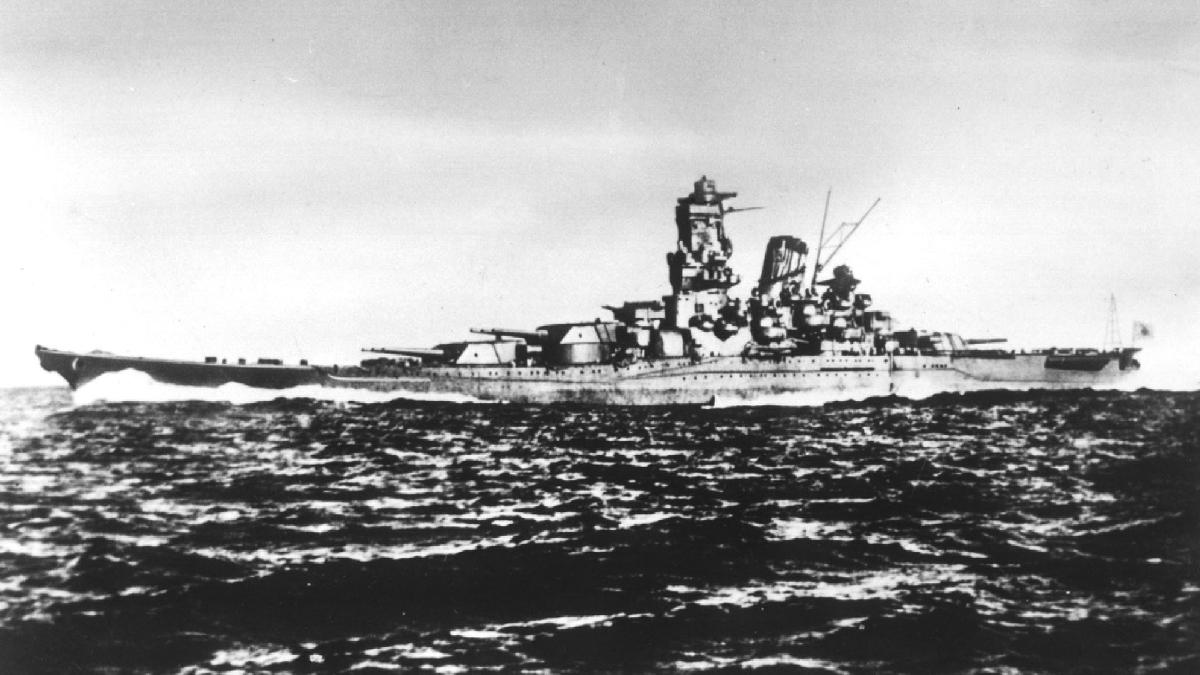
Figure 1.--The victory of the Strike South Faction virtually by definition maeant a naval war giving priority to the Imperial Navy. The Japanese understood that they could not out build the Amerivams. So they decided on quality as poart of the Decisive Battle Doctrine. This led to the contruction of two super battleships -- 'Yamato' and 'Musahshi'. Here we see 'Yamato'.
While the Strike North Faction was initially the preminent Japanese Army faction, a series of shocking events after Japan's invasion of China led to the victory of the Strike South Faction within the Imperial Army. The Japanese were shocked at the very vocal American reaction to their war in China. This was of some consequence, not because of the moral outrage, but the fact that Japan was very dependant on America for raw materials, especially oil. The American Moral Embargo (July 1938) was thus a very real threat. Next came an offensive at Khalkhin Gol on the Mongolian border (July 1939). Theor initil enthusiasim was followed by perhaps the greatest shock of War for the Japanese, the NAZI-Soviet Non-Agression Pact (August 1939). NAZI Germany was Japan's principal ally against the Soviet Union which the Strike North Faction wanted to attack. NAZI diplomats had not consulted with the Japanese before signing the pact. Japanese military and civilian officials had no idea it was coming. This led to the Japanese questioning the value of the Anti-Comintern Pact and the reliability of their German ally. And then came the most important development was an undeclared and poorly reported border war with the Soviet Union, a massive Red Army counter attack led by Marshal Georgy Zukov (August 1939). The Red Army routed the Japanese along the Khalka River. The Japanese Army chiefs were shocked to see how ill-prepared they were to fight a modern, well equipped army with modern weapons. This seems to have significantly reduced the Imperial Army's enthusism for invading the Soviet Union. The result was the Strike South Faction emerging as the dominat group in the Imperial Army.
Japanese Military Factions
Japan after wars with China (1894-95) and Tsarist Russia (1904-05) emerged as the dominant power in East Asia. And domestically the military gained enormous prestige. After World war I the military began expabong its role in Givernment, assasinating civilian forces who dared to resist them. Traditional factions in the Japanese military as they gined political influence began to coalease which became known and the Strike North Faction and the Strike South Faction. As Rurope headed toward war, the two factions argued about how Japan could best take advantage of the developing war in Europe to expand the Empire. The Strike North Faction came to dominate Army thinking while the Strike South Faction gained great influence within the Navy. While inter-service rivalries were pronounced, the origins of the two factions were much more complicated than simple inter-service infighting. Relatively junior officers with limited educations or perspectives began assassinating not only members of the rival faction (both military and civilians), but also civilian officials preceived as unsupportive of the military. Initially the Strike North Faction predominated. It was especially pronounced in the prestigious Kwantung Army. Notably few of the partisans advocating war had traveled outside of Japan. They thus had very limited experiences telling them about other countries, either about other people or the industrial prowess of those countries. Instead their were highly energized by xenephobic nationalism and ideas of racial superiority. Men like Admiral Yamaoto who understood the dangers of war set themselves up as assasination targets.
Strike North Faction
The Strike North Faction became the dominant orientation of the Japanese Army, strongly influencing the Japanese High Command. The Strike North Faction grew out of Kōdōha (the Imoerial Way). This was a political/social outlook enunciated by Sadao Araki and his protégé Jinzaburō Masaki. Araki was a respected political philosopher within the Army. His central thesis was linking the ancient samurai bushido code with modern nationalism. Kōdōha had many ideas similar to European Fascism which also embraced militarism and rejected liberal democracy. Araki fuseddevotion to the Emperor, the people, the land, and morality into a unified nationalist spirit. Despite the fact that it was Japan's industrial development that had enabled Japan to emerge as an important power, Kōdōha saw a need to return to a nostalgic notion of an idealized pre-industrialized Japan, uncorupted by the West. Araki saw the need to purge the strate of corrupt bureaucrats, opportunistic politicians, and greedy zaibatsu capitalists. The corrupt, greedy, and oportunistic were often simply those who had question the ideas held by impressionable young officers. He saw aurified state as being led by the the Emperor n a "Showa Restoration" backed by the military.
tion of the military in terms of For Araki and his followers, central to military preparation was ideologicalm or spiritual training, something akin to French élan. important.
Prime Minister Inukai appointed Araki Minister of War (1931). Mazaki was appointed Vice Chief of the Imperial Japanese Army General Staff. From those positions, both proceeded to purge followers of their chief rival General Kazushige Ugaki from key posts in both the Ministry and the General Staff. Ugaki in contrast to philosophy saw the need to modernizae weaponry as more important. Kōdōha emerged as a major component of the Strike North Faction, in part because of its strident anti-Communist orintation. This orientation was especially strong in the Kwantung Army stationed in Manchukuo. There strategic concept was simple--sever the Soviet Trans-Siberian lifeline. The Railway was vulnerable because for over a thousand miles in ran close to the Manchukuo border. And if Japan could seize Mongolia there were even more places to cut the Railline. The Strike North Fsction srgued that if Japan could cut the Transiberian, the Soviets would have no way to supply military forces in the Far East. The Imperial Japanese Navy could prevent supply by sea. The potential gains were emense: Mongolia, the Soviet maritime provinces, and large parts of Siberia. These buffer territories woild shield the Japanese Empire in the north and provide the Japanese the enormous natural resources of Siberia. Striking north would also cut the Chinese Nationslists off from Soviet assistance. And advocates within the Army believed that this was the most achievable as it required war only with the Soviet Union.
Strike South Faction
The other important faction found considerable support within he Imperial Japanese Navy. The Strike South Faction had its origins in the less well defined Tōseiha group. The most important proponent was General Kazushige Ugaki who was a military man rather than a political philosopher. He was supported by Hajime Sugiyama, Koiso Kuniaki, Yoshijirō Umezu, Tetsuzan Nagata, and Hideki Tōjō who would emerge as Japan's most important war leader. This was a much more amprphous group who principal common belief was opposition to Araki and Kōdōha. It should not be thought tht the two factions were diametically opposed . In fact they shared many common beliefs. They both were convinced of a need to strengthen the military and reform the political system. Both sides were strongly influenced by European political developments. We see a general rejection of liberal democracy and the adoption of totalitarian, fascist and state socialist elements as the military became increasingly influential during the 1930s. The basic difference was the rejection of the wreckless confrontational approach advocatefd by Kōdōha which wanted to launch a revolution in Japan. The more educated and experienced Tōseiha were not opposed to war and expansion, but foresaw that a future war would not be won by spiritual revival, but by technology and industry needed to wage a total war. They saw a need to unite all elements in Japan, including the bureaucracy and the zaibatsu to strengthen Japan's military potential. Tōseiha favored a more cautious defense expansion at a time that Kōdōha was arguing for war with the Soviet Union. Ironically it would be within Tōseiha that the Strike South Faction grew and the idea of war with the United states. The Strike South Faction y favored expansion into the Pacific where Japan could also obtain the natural resources it required for both indudstry and war. They thus became known as the Strike South faction. One reason the Navy preferred the Strike South orientation was that it gave them the primary military role. In addition, at the time there was no important oil fields in Siberia, but the Dutch East Indies to the south offered all the oil Japan needed to make war. Resource poor Japan needed all kinds of natural resources and the Strike South Faction was lured by the emnense resources of the Southern Resource Zone (SRZ). Chief among those resources was oil, the single-most important resource the Japanese needed. Oil of course was a major concern of the Imperial Navy because of the huge quantities of oil that would be nedded by navy ships and an expanded merchant marine. There was also support for the Strike South fction among the powerful industrial Zaibatsus who saw advantages from associating with the Navy an the possible profits from exploting the SRZ.
Seizing the Southern Resource Zone, however, would mean war with America and the European powers and before World War II broke out, even the most ardent natioinalist believed this was beyond Japan's military abilities.
Domestic Struggle (1931-36)
As the military expanded its influence in the Japanese Goverenment, the two factions struggled over who would control the Government. This struggle began in earnest after the Manchurian Incident and the creation of Manchuluo (1931). Kōdōha was initially the dominnt dominant action, reflecting the influence of Araki among younger officers. Araki resigned as Minister of Defense as a result of declining health (1934). This was the beginning of
Kōdōha's decline. General Senjuro Hayashi replaced Araki as Minister of Dense and had Tōseiha leanings. Kōdōha-influenced Army officers conspired to assasinate important civilian politicians wgo were deemed not sufficently resopnsive to military needs. The plot was uncovered before they acted (November 1934). The Tōseiha group forced the resignation of Mazaki from his position as Inspector General of Military Education. This unimposing title was actually the third most important position in the Japanese Army. He apparently was complicit in the plot. Some 3,000 other officers were demoted. Kōdōha did not go quietly. Saburo Aizawa, a committed Kōdōha officer, shot Tōseiha leader General Tetsuzan Nagata. This is known as the Aizawa Incident. Aizawa's was tried by a military tribunal held by the First Infantry Division in Tokyo. The Division's commander, General Heisuke Yanagawa, was a strong Kōdōha man. He seemso have had no problem with determining events by shooting civilian politicans and fellow officers. The Araki trial thus became a public vehicle for Kōdōha to vilinize Tōseiha. Aizawa was portrayed a pure spirited patriot. General Nagata was portrayed as a an unprincipled power-mad schemer who thus needed to ve killed. The Aizawa trial climaxed with a ytotally unexpected event. The High Command ordered the First Infantry Division from Tokyo to Manchukuo. This did not defuse the situation. Kōdōha officers decided this was the ctime to act. They supported th First Infantry Division in a coup d'état (February 26, 1936). The coup failed and Kōdōha members were purged from senior positions. Kōdōha leader Sadao Araki resigned from the Army. Kōdōha as an organized faction within the Army ceased to exist. And as a result Tōseiha also declined as its core had been to resist . Tōseiha formally gained control of the Army. The Kōdōha ideals, however, and by this time had been widely accepted throiughout the officer corps, more so the Army than the Navy, but the Navy was not unaffected.
The Kōdōha/Tōseiha split would live on as the struggle between the Strike North nd Strike South fashion.
American Actions (1938-39)
American public opinion was outraged by the Japenese aggression in China. Both the Rape of Nankin and the bombing of Japanese cities were wiidely reported in American nespapers and magazines as well as movie newsreels. Interestingly, public opinion was willing to tolerate more aggressive american policy in Asia against Japan than in Europe against the NAZIs. The reason for this dichotomy is not alltogether clear. Many Americans because of the work of missionaries felt a connection with China and were outraged by Japanese aggression, especially the brutality they saw in shocking images. The NAZIs were much more clever doing this period. They coughed their aggressive moves in terms of uniting German people and undoing the "unjust" Versailles Treaty. And they were able to get what they wanted without war because Britain and France refused to stand up to them. Perhaps another reason was that the American people feared NAZI Germany militarily, but did not think that the Japanese were a serious military threat. The U.S. Navy also did not accurately assess the Japanese military capability. American policy toward Japan was to use economic sanctions to disuade them from aggression. The first such action followed horific Japanese bombing raids in Canton targeting civilians. President Roosevelt issued a "moral embargo" he asked American aircraft manufacturwers and exporters to stop selling aircraft and aircraft parts (July 1938). The U.S. Government also began to persuade oil companies from exporting to Japan, although took no formal action. Japan proceeded to occupy Hainan Island (February 1939). Next the Japanese seized Spratly Islands, a menacing step because they were close to both French Indochina and British Borneo. President Roosevelt responded with a formal embargo of airplanes and parts. He also ordered the Navy to shift ships from the Atlantic to strengthen the Pacific Fleet. The President also ordered the State Department to inform the Japanese Government that the United States intended to abrogate the 1911 Trety of Commercen and Navigation which reglated trade between the two countries. This was of considerable significance. It gave the Administration the authority to extend the embargo to important materials (such as aluminum, molydenum, nickel, and tungsten). These actions had little impact on the Japan's aggressive moves. They did, however, draw the attention of the Japanese Government from a focus north to a focus south.
The NAZI-Soviet Non-Agression Pact shocked the world (August 1939). Stalin and Hitler had been such bitter enemies, it did not seem possible that they could forge and alliance. The Wesrern Allies (Britain and France) knew at once that it was a prelude to war. But it was not just the Allies who were shocked. Japan was also shockrd. NAZI Germany was Japan's principal ally against the Soviet Union which the Strike North Faction wanted to attack. NAZI diplomats had not consulted with the Japanese before signing the pact. This led to the Japanese questiining the value of the Anti-Comintern Pact and their German ally. It seemed that the Japanese could not rely on the NAZI Germany. This undercut the Strike North fction as it meant that Japan would have to fight the Soviet Union alone. Even so some in the Army thought that this was precisely what the country should do.
Large scale clashes occurred beginning May 1939 between Japanese and Soviet forces on the Mongolian plains along the border with Japanese-held Manchuria (Manchukuo). Neither side declared war. The Japanese released photographs of captured Soviet soldiers (July 1939). The conflict was little reported in the West. An offensive planned and executed by Marshall Zukov ended in a decisive voctory for the Soviets. The Japanese were forced to seek an armistace (September 1939). The clash was, however, of imense strategic significance, significantly affecting the strategic conduct of World War II. It was undoubtedly a factor encouraging Stalin to respond favorably to NAZI initiatives for a Non-Aggression Pact (August 1939) to ensure that the Soviet Union would not face a two-front war. Hitler ignored the Soviet performance and instread saw the inept Red Army offensive in Finland as evidence that the Soviets could be easily defeated. The Japanese Army concluded that further attacks on the Soviets were unwise. This was an important factor in attacking south in 1941 at America rather than north at the Soviet Union. It was also a major factor in refusing entrities from Hitler in 1942 to attack the Soviet Union, freeing the Red Army from what may have been a disastrous two-front war. Thec experiebce seemsxto have convinced even the most rabid Kōdōha-influenced Army officer that Japan should not attack the Soviet Union again. Unfortuntely it does not seem to have disuaded them from war itself.
World War II (September 1939)
If the victory of the Strike South Faction had not already been sealed, the outbreak of World War II must have settled the debate. World War II erupted in Europe when Hitler ordered his Panzers to invade Poland (September 1, 1939). Two days later Britain and France honored their commitments to Poland and declared war (September 3). The world was stunded at the strength of the German Blitzkrieg of Poland. For the Japanese, there was a huge advantage. To seize the Dutch West Indies and other colonies in Southeast Asia, they would have to confront Britain and France, two countries with powerful navies and substantial military forces. War in Europe meant that neither country would be in position to resist Japanese aggression with great force. If their had been any remaining doubt, the Strike South Faction in the Imperial Army was now in firm control. And subsequent German military victories only increased wht the Japanese saw as an opportunity. Thecfall of France in particular created an iresistable opportunity. This took France out of the war and imobilized the powerful French fleet. And the British hard pressed in the Atlantic and Mediterranean by the Gernmans and Italians could not commit a substantial portion of the Royal Navy to the Pacific. This created an unexpected opportunity to carve out a vast empire in the Southern Resource Zone offering the oil Japan needed for its war economy. And it meant that the only force standing between them and their imperial expnsion was the neutral United States and tts Pacific Fleet which had been moved forward to Pearl Harbor.
Modern war requires oil. All three Axis countries had a significant problem. They were not self-sufficent in petroleum. Each of the Axis countries attempted to resolve this limitation to varying degrees of success. Japan would require huge quanities of oil of it planned to wage a naval war in the vast streaches of the Pacific. Japan had to import almost all of its oil in peacetime and war would significantly increase tghe quantities required. Japan was a densly populated, resource poor country. Expansion into Korea and Manchuria (Manchuko) managed to acquire many needed resources. The most critical resource that Japan lacked was oil. And to make matters worse, the United States was the major world producer of oil. America was also Japan's principal supplier--the same country the United States would have to fight if it was to seize an empire in the resource-rich South Pacific--especially the DEI which had developed important oil fields. The United States attempted to disuade Japan from waging aggressibe war in China. The United States began a series of trade restrictions until it became clear with Japan's move into southern Indochina that Japan was preparing to launch a major aggressive war in the Pacific. America responded with an oil embargo. Tyhis action made war inevitable. It only became a question of when and where Japn would strike. Japan had oil stockpiles that could supply its normal needs for 2 years, but only about 1 year if Japan went to war because of the huge increased requirements to fight a naval war. This set in motion a time table. Japan had either to decide to cease aggression in China or go to war before it ran out of oil.
The victory of the Strike South Fation resulted in one of the most successful military campsigns in human history. Beginning with the daring attack on the American naval base at Pearl Harbor by the First air Fllet, the Japanese in a few short months conquered almost all of Southeadt Asia, the Southern Resource Zone that they had long coveted. It was a series of stunning victories extendiung all the way to the border of India in the West, the American Aleution Islands in the north, Wake Island in the east and New Guinea and the Solomons in the south. Jpan now seemingly had thge resources to expand its ijndustrial base and wage a protracted war. They did not think, however, tht this would be necessary as the Kōdōha-influenced military were sure that the weak-spirited Americans would not have the stomache to fight a protracted war. It all prived a phyric victory. Japan's war plan was based on a German victory over the Soviet Union. But only days after the Pear Harbor strike, the Red Army launched counter offensive before Moscow that would devestate the Whermacht, making a German victory unlikely. And Japan had not struck a decisive blow against America, but rather aroused a 'sleeping tiger', as Admiral Yamamoto put it. Japan had launched a naval war, meaning an indistrial war against a country whose industrial capacity dwarfed that of Japan. The outcome of the War once the Soviet Union survived was pre-ordained, although there would be nearly 4 years of bloody fighting. As Churchill wrote in his menoirs wrote, "Silly people, and there were many, not only in ememy countries, might discount the force of the United States. Some said they were soft, others that they would never be united. They would fool around at a distance. They would never come to grips. They would never stand blood-letting. Their democracy and system of recurrent elections would paralyse their war effort. They would be just a vague blur on the horizon to friend or foe. Now we should see the weakness of this numerous, but remote, wealthy, and talkative people. But I had studied the American Civil War, fought out to the last desperate inch. American blood flowed in my veins. I thought of a remark which Edward Grey had made to me than thirty years before -- that the United States is like 'a gigantic boiler. Once the fire is lighted under it there is no limit to the power it can generate.' Being saturated and satisfied with emotion and sensation, I went to bed and slept the sleep of the saved and thankful." [Churchill, p. 507.]
Sources
Churchill, Winston S. Memoirs of the Second World War (Bonanza Books: New York, 1959), 1065p. This is the abridged version by Denis Kelly of Churchill's epic World War II memoirs.