|
"In Tokyo, throughout Japan a wierd, an unreal atmosphere of victory and invincibility still pervails. A feeverish, fradulent security shrouds the island. Reports from all the battle fronts tell of nothing but Japanese triumphs, Allied disaster. But beneath the cheering, oozaes out the hideous truth. Back from the battle fronts come the white boxes with the ashes of the dead, the fallen. Welcome home young man. You were ours and they took you away. You are no more. Suns may rise and set, but you must sleep on during one never ending night."
-- NBC. Victory at Sea.
Japan was the most industrialized country in Asia, but the country's industrial capacity was a fraction of that of America and Britain. And the country had to import raw material, including vital resources like petroleum. Nor was the country self-production in food production. The Militarists who made the decession for War calculated that Japan could seize the resources it needed in a quick war and that the Americans and Eutropeans would not be willing to wage a costly war to recover the lost territory. That was essentially the gamble made at Pearl Harbor. That gamble was lost at Midway. Not only did Japan suffer that disastrous defeat, but it suffered it at a time that the Imperial Navy was still dominant in the Pacific and before American industrial production had decisively shifted the ballance of forces. The Japanese militarists absolutely controlled the press in Japan. Only news of Japanese victories were allowed in the press and for the first 6 moths there were plenty of those. When Japanese defeats began to occur, they were strictly prohibited in the press. When the sailors and surviving air men returned from Midway (June 1942) they were held incomunicano least news of the disastrous defeat leaked out. (Even Army commanders were not fully informed.) We are not sure when the Japanese people began to realize that their country was losing the War. In fact Japan lost very little territory until 1944. And the fighting was very distant from Japan. The militarists believed that the NAZIs in Europe would occupy America's military and thus Japan's smaller industrial output would be suffient for a short war. Japan mobilized the country's industrial capacity. Women and children were ordered to work in factories as well as on farms. Japanese industry, however, proved totally incapable of matching America production in quantity or quality. The Japanese did succeed in seizing vital natural resources in Oceania and Southeast Asia, including oil and rubber (1942). Unfortunately for the Japanese the U.S. Navy was successfully waging a sunmarine campaign that made it impossible to ship these resources to Japanse factories (1943). Worse still the Americans took the Marianas which brought Japanese industry within the range of the new American B-39n bombers. The losses of the tiny attols and islands in the central Pacific, however, brought the Japanese Home Islands within reach of the new American B-29 bombers. The strategic bombing of Japan was a disaster that could not be hidden by control of the press. These raids must have come as a huge shock and may well have been the first infication to the Japanese people that the War had turned into a national disaster. The first raids were of marginal effectiveness, but by 1945 the U.S. Arny Air Firce was burning the heart out of one Japanese city after another--including Tokyo. There was also a poor harvest which combined with the destruction of the Japanese merchant marine meant that there were growing food shortages. Rationing reduced rice and other food purchases to 1,500 calories--subsistence levels. But as the war continued into 1945 even that amount was often not available. The stategic bombing campaign had by mid-1945 destroyed Japan's transportation system. Had Japan not surrendered (August 1945), Japanese civilians would have starved in large numbers during the Winter of 1945-46.
Japan was the only industrialied country in Asia. The country was, however, deprndent on both imported raw materials and food. The country built up a formidable military, but few World War II belgerants were so poorly situated to wage an extended war. It was capable of supporting the war in China, but bot without consequences. Thus rather than achieving benefits from occupying large areas of China, the Japanese people began to feel adverse impacts from the war and massive military spending. The country's industry directed at military production rather than consumer goods. And to make matters worse, the United States, Japan's major trading partner began to take commercial actiins to sanction Japan for its aggression in China. Drafting large numbers of young men also affected the country's agricultural prodyction which in the best of times only provided part of the domestic food demand. While the Japanese economy could support the war in China, it was totally inadequate to support the Japanese military in the Pacific War with the United States, especially as Japan was still mbigged down in Chians. The Japanese milutarissts achieved spectacular vicyories in the first 6 months of the War. Then at Midway (June 1942), Japan's offensive capability was sverely restricted. And gradually the American industrial capacity began to make itself felt in the Pacifiv battlefields. This had severe consequences for the Japanese war economy. Japan went to war to acquire needed resources such as oil, tin, eubber, rice, ect. As a result, of the offensive that followed Pearl Harbor, it acuired those resources, but after Midway, the merican Pacific Fleet gradually cut off the Home Islands fron he resources it acquired in the South Pacific and Southeast Asia, This was largely done by American sunmarines which decimated tne Japamese Maru flet but were joined by surfac fleet and carrier operations. Japan's industrial capacity was a fraction of the American industrial production, but was severly impaired when raw materilas deliveries could no longer be delivered. Food supplies wre short even before the Pacific War, but as the American blockade intensified, the Japanese begam to go hungary.
The Militarists who made the decession for War calculated that Japan could seize the resources it needed in a quick war and that the Americans and Europeans would not be willing to wage a costly war to recover the lost territory. That was essentially the gamble made at Pearl Harbor. That gamble was lost at Midway. Not only did Japan suffer that disastrous defeat, but it suffered it at a time that the Imperial Navy was still dominant in the Pacific and before American industrial production had decisively shifted the ballance of forces.
It is very difficult to know what the Japanese public thought about the War. The only informatiion they had about it was from yhe milyary cintrolled media. Any criticism of the War effort could mean serious truble with the Kempeitai (憲兵隊). This was an Army police unit, but as the militry expanded its influence abd eventually seized control of the country, became a kind of secret police like the Gestapo in NAZI Germany and the NKVD in the Soviet Union. As far as we can tell there was no real opposition to the War in Japan. We know that no one was was allowed to express oposition. But there seems to have been very limited opposition to supress. Some Japanese leaders have expresed to us that there was some opposition to the War among educated Japanese who were aware of the industrial strength of the West, but did not dare express their opinions. Military leaders Were more interest in forces in bring rather than potential. This appears to have been a relatively small group. Our assessment is that by far the strongest factor in Japanese society was devotion to the Emperor and a fervent nationlism. And the fact that the media was totally controlled by the Army stoked the nationalist fervor. Japanese citizens had little real sources of information other than a steady stream of propaganda. The one exception was returning Japanese servicemen. Few soldiers returned from the Pacific and Southeast Asia. But some did from China. Hust what they told their families we do not know. We have not seen that addressed in the Japanese literature. Even the military did not have reasonable sources of information. The Imperial Navy, for example, hid the dimensions of the Midway disaster from the Army. Of course there were no public opinion poll and if there had been no one could havebeen expected to express a negative oinion. But a good indicator of the public support for the War was the fierce perdormance of Japanese soldiers on the battlefield. In the Pacific, even when defeat was certain, only a handful of Japanese soldiers chose to surrender. And when Japanese civilians were encountered (Saipan and Okinawa) even many civilians chose surrender. It much be stressed that while the Japanese public supported the war effort, that by no means suggests the public supported the horrendous reign of terror with war crimes and atrocitie perpetrated by the Japanese military throughout the War. The vast mjority of Japanese people were totally unaware of what was being done in their name.
Japan moved toward a parlimentary democracy in the early 20th century. A lively if discreet press covered political and economic affairs. This began to change in the 1920s as the military began to exert its influence in the political arena. Extremists in the military began to assasinate politicans who spoke to boldly or actively opposed the military. The Communists in particular were targeted, but democrtatic politicans were also killed. The military during the 1930s seized almost complete control over the government. Military officers were appointed to head the various ministries. And eventually the post of prime minister. Using state agencies, the military formalized control over both publishing and education. The purpose of both became indocrinsting the Japanese people into politica and social attitudes deem appropriate by the militarty. The Japanese militarists absolutely controlled the press in Japan. The secret police were the Thought Police. One of their functions was to ensure that newspapers and magazines printed what the military wanted. Here publishers were not so foolish as to print anything questioning the War. The Thought Police wee more likely to be involved with individuals who did not quite understand what the military wanted. And this became increasingly complicated as the War went against Japan. Only news of Japanese victories were allowed in the press and for the first 6 months there were plenty of those. When Japanese defeats began to occur, they were strictly prohibited in the press. When the sailors and surviving air men returned from Midway (June 1942) they were held incomunicano least news of the disastrous defeat leaked out. (Even Army commanders were not fully informed.) We are not sure when the Japanese people began to realize that their country was losing the War.
|
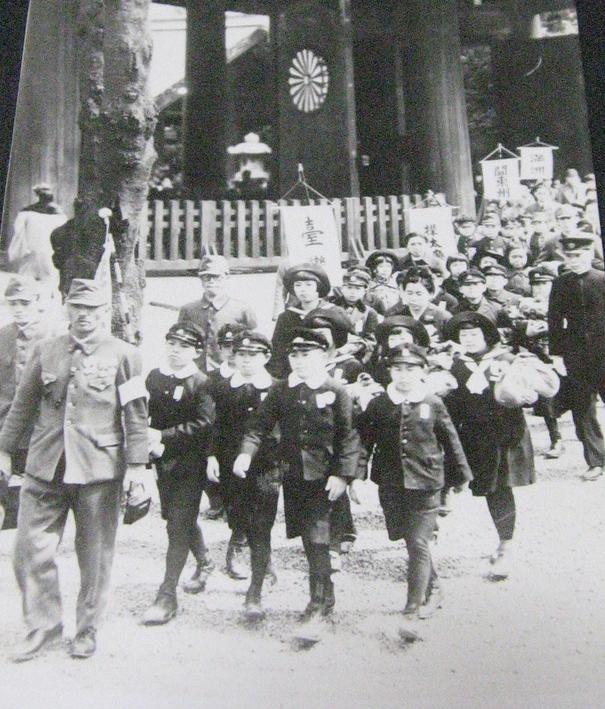
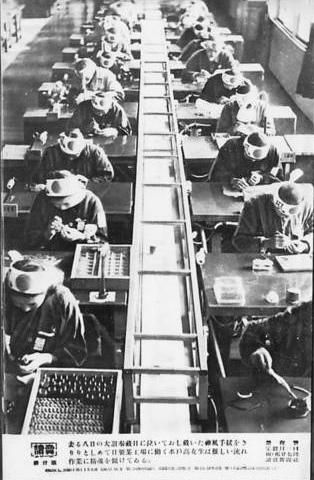
Japanese children were affected in many ways by the War and participated in th war effort. The schools were affected by the increased militarization of Jpanese society througout the early-20th century, espcially during the 1920s and 30s. The Japanese military played a much larger role in education than was the case in Germany both t the time of World War I and II. In the lead up to World War II, military officers were assigned to schools to supervise and conduct military acivities there. As the War begn to go against Japa, teen agers were mobilized, inclusing younger teens. They were pulled out od the schools and sent into the factories to replced the men conscripted for military service. Child labor bcme an important element in Japanese war industries. We do not yet have much information about the role of Japanese youth organuzations during World War II. We do note Japanese Boy Scouts after the invasion of China, preparing to collect funds for the National Defense Fund. The Scouts were a small, vountary group. Among the militarists they wre suspected of being influenced by the Americans. We are not sure yet what happened to them once the War began. The Japanese closely followed the War in Europe, including the Allied strategic bombing campaign. They also knew that the Americans were building the long-range B-29 Superfortress. And with battlefield reverses, they began to consider the possibility for the Allied bombardment of the Home Islands. The Japanese Government began preparing evacuation plans (late-1943). The Ichii-Go offensive suceded in taking areas in China that the Americans oplanned to use to bomb the Home Islands. The fall of the Marianas (June-July 1944), howver, gave the United States possession of air field that brought the Home Islands in range of the B-29s. The Japanese began evacuating entire schools from the cities. They relocated 450,000 children with their teachers (but not their parents) to the countryside (1944). When the United States air campaign began to increase in effectuiveness (late-1944), an estimated 10 million people fled the cities. As the possibility of invasion became a reality, militart drills in the schools became formalized by the military as Ketsugo. The Japanese military was going to send children with sharpened bmboo poles gainst American soldirs. Mass suiside was also possible. It had taken plce on the islands with Japanese civilins. The childrn were not to kill themselvs. This was to be done by their parents and soldiers.
World War II even before the arrival of the Americans revolutiinized Japan with the impact on women. Much has been written about about the impact of the War on women in Amerca and Britain. The impact on Japanese women was even more dramatic. Rural women had since ancient days worked with their men in the field. The situatiin was different in Japan's rapidly expannding industrial cities. Women mostly remained quietly at home, carrying out domestic duties and traditiinal activities like the tea ceremony. They did not vote or engage in public discouese in any notable way. Working-class women were to some extent involvd in the wider economy, working in the silk, textile, and weaving factories. They were, however, either very poor or youths after finish school. After marriage they retired to the home, no longer working for wages. They would only venture out to the local markets or family outings. Japanese men expected their wives to be subservient and obedient. Few Jaoanese women questioned this role. Some authors even report that traditional roles grew even more rigid in the early-20th century. You can see this in family portrits. Men and children commonly wear Western dress. The women, however, wear traditiinal clothing. Japan began wageing war nearly a decade before the outbreak of war in Europe. The japanese military seized Manchuria (1931). This was a relatively limited undertaking because the Chinese Government did not resist. This changed when Japan invaded China proper (1937). Even so the mikitary-dominated Government had no intention of fundamentally changing Japanese society. As a result, despite increasing strains in the economy and the absence of men called up for military srvice, the Government did not mobilize women. This changed when Jaoan launched th Pacific War by attacking the United States at Pearl Harbor (1941). This required a much greater national effort, especially because the war in China continued. The Government called upon women to support the war effort and to make sacrifices to achieve victory. And the effort needed along with the sacrifices only increased as the war after Midway (1942) began to go wrong. Japan mobilized for war to a greater extent than perhaps any other country, only the resources needed for war were not available. Although Japan conquered the Southen Resource Zone (SRZ)m it coveted, as the U.S. navy recovered, most of those resources and the japanese Maru fleet reached nom closer to the warbindustries on the Hime Island than the bottom of the pacufic Ocean. One resource at first untapped was the counttry's women. The militarists who launched the War had no intention of doing so, but they began a social revolution, forever altering the role of Japanese women.
The Neighborhood Association (隣組 -- Tonarigumi) was central to the Japanese home front. It was based on mutual-aid associations that had existed infirmally fior centuries. The mikitary government formalized their role (1940). The tandard Tonarigumi was made up of 10-15 households. They were organized for a range of activities such as fire fighting, civil defense and internal security. Women were instructed in cooking and ulitzing unfamiliar food substitutes, an increasingly important matter as rations were cut and food shortages became inceasingly severe. The Home Ministry was responsible for organizing and instructing the Tonarigumi. All familes had to join and participte. The Tonarigumi played a role in allocating rationed goods, distributing government bonds, public health, and civil defense. A major assignment was supporting the National Spiritual Mobilization Movement, by both distributimg government propaganda and overseeing participation in patriotic rallies. There was also an important security role. The Tonarigumi provided a network of informants for the Tokkō Police, The alerted the police about any vilation of laws and both questiinabke political as well as or immoral behavior. The Japanese organized Tonarigumi in the territories it occupied. This included Manchukuo, Mengjiang (Mongol Border Lands), and the Wang Jingwei puppet Chinese Government. This was repeated in the occupied territories of the SRZ.
The Japanese did succeed in seizing vital natural resources in Oceania and Southeast Asia, including oil and rubber (1942). Japan had a basic problem in that these resources were located at some distance from the Home Islands. The Japanese had to rely on its merchant marine to bring these resources home and to deliver war material to Japsanese fighing men. Japan began the war with the world's third largest merchant marine. It was necessary for an industrialize but resource poor island nation that needed both raw materials and food imports. Japan in peace needed 3 million tons of shipping. For war it needed double that ammount. The Japanese won an empire streaching from Siberia to the South Pacific. But none of those victories were of benefit if the resources obtained can not be brought back to the Home Islands. This was a serious weakness and opened Japan to a commerce war like the one the Germans unsuceesfully waged in the North Atlantic against Britain. Unfortunately for the Japanese the U.S. Navy launched a major a submarine campaign in the Pacific. The American campaign was not very effective in 1942 and early 1943, primarily because the Navy had supplied its submarines with defective torpedoes. Once that problem had been corrected, U.S. Navy submarines based in Pearl Harbor set about destroying the Japanese merchant marine. This campaign and the U.S. liberation of the Philippines had made it impossible to ship these resources to Japanse factories (1944). By 1945 not only were Japanese factories that survived the air war having to scale back production because of raw material shirtages, but food imports were decling to a point that the country faced famine.
apanese casualties until the final year of the War were almost entirely military. Seeing the images of the atomic bombing of Japan, it would seem that Japan must have suffered the greatest casualties of the War. Nothing could be further from the truth. In fact, Japanese casualties were small fraction of the casualties in the contrivers that they invaded and the brutal occupation imposed. The Japanese seized Manchuria, but there was only limited fighting and minimal casualties (1931). Chang and the Nationalists declined to contest the aggression. The Japanese launched the Second Sino-Japanese War by invading China proper (1937). Here the nationalist fought and there were casualties on both sides. After heavy combat and the lost of the best Nationalist units, the nationalist began to withdraw into the interior. Fighting continued, but at a lower level. Casualties declined, but continued. More important for the Japanese was the strain on the economy. After 4 years of fighting the casualties mounted, although only a fraction of Nationalist casualties let alone the enormous civilian casualties in China. Japanese civilians were affected by the economic strain and family losses. But as the Chinese had no appreciable navy and air forces there were no loss of life on the Home Islands. The Japanese attack on the American Fleet at Pearl Harbor, as strange as it may sound. was intended to finally end the fighting in China (December 1941). Of course it did not. Casualties at first were limited as the Japanese swept over the Pacific and Southeast Asia, this began to change after Midway (June 1942). The loss of carriers at Midway and declining control of ocean area meant the the Imperial Navy could no longer provide Japanese soldiers the support they needed. And casualties began to mount, especially after high performance aircraft and new ships began to pour out of American factories and shipyards. The losses sustained only added to the steady stream of losses from China. Even so the level of losses should not be overestimated. Japanese garrisons might fight to the death on a Pacific island, but there were only so many men that could be crammed on to a Pacific island, even defeat in Burma did not involve massive losses. There were substantial losses in the Philippines and Okinawa, but not crippling losses. The strain of war had begun to affect Japanese civilians from an early point, primarily due to food shortages and the American submarine campaign meant that their victories in the Pacific and Southwest Asian would not benefit civilians or aid the war economy. The loss of the Marianas meant that the United States could begin the strategic bombing campaign (June-July 1944). This meant that for the first time, Japanese civilians faced not only shortages, but death and destruction from the skies. American bombers methodically reduced Japan's timber and paper cities to glowing ash heaps even before dropping the two atomic bombs. Japanese military casualties totaled over 2.1 million men. Civilian casualties resulting from military action, mostly the strategic bombing campaign totaled about 0.5 million people. Another 0.5 million civilians may have perished from malnutrition and related diseases. Today in Japan discussion of the War gives great attention to civilian casualties. There is virtually no appreciation for 1) Japanese Army actions against their own civilians and 2) how small Japanese civilian casualties were in comparison the civilians who were killed by Japanese soldiers or who perished in famines caused by the Japanese occupation actions in China, the Pacific, and Southeast Asia.
The tide of battle began to shift in 1942 with the Anerucan naval victory at Midway. Even so, Japan lost very little territory until 1944. And the fighting was very distant from the Home Iskands. The militarists believed that the NAZIs in Europe would occupy America's military and thus Japan's smaller population and industrial output would be suffient for a short war. The War of course proved not to be short and the United States was able to mount offensives much qyuicker than anticipated and with aower the Japanese never imagined. Worse still fir the Japanese, theur Army was oprimarily in China and naval reverses meant that it was very difficult to oppose the American advances in the Pacific. And with the loss of the Maruianas, the Americans now had bases that brought the Home Islands within range of the new long range B-29 Suoerfotrtresses that were now comong off production lines in large numbers.
Japan worked on a variety of secret weapons. There were programs to develoop chemical and biological weapons. These weapons were tested on POWs and actually used in China. Other secret weapons included jet aircraft. The Germans provided some technical assistance, mostly late in the War. The Japanese also had an atomic program. Here the Japanese also tried to obtaon German assistance. One secret weapon that was actually implenmented were baloon bombs. They were incendiary devices designed to be carried by the jet stream 5,000 miles across the Pacific and start fires in the forrests of the Pacific northwest. These bomns were constructed by children in their school yards. [Thomas p. 140.] This of course was an action that blurred the difference between civilian and military targets. The plan was to make 50,000 of these bombs and create chaos in the Northwest. About 9,000 of these bombs were actually launched (November 1944-April 1945). The bombs did set some fires. The only casualties were a man and five children in Oregon who came across one of the bombs and accidentally set it off (May 1945). The Jaopanese evetually gave up on the effort as they found no reports of fires in the American media. We still have limited information about Japanese schools during the War. We do have some information about school uniforms.
Worse still the Americans took the Marianas which brought Japanese industry within the range of the new American B-29 Superfortresses. When Japan launched the War, the Home Islands were well beyond the reach of existing bombers. The military men which launched the War did not expect techonlogy to advance as rapidly as uit did. With the fall of the Marianas abd the introduction of the B-29s, this was no longer the case. The losses of the tiny attols and islands in the central Pacific, however, brought the Japanese Home Islands within reach of the new American B-29 bombers. The strategic bombing of Japan was a disaster that could not be hidden by control of the press. These raids must have come as a huge shock and may well have been the first infication to the Japanese people that the War had turned into a national disaster. The first raids were of marginal effectiveness, but by 1945 the U.S. Arny Air Firce was burning the heart out of one Japanese city after another--including Tokyo.
One can ghelp but wonder why a country with wood and paper cities would go to war after whiening much more substabtial European cities going up in flames, but this as hardly Japan's only weakness. Another was food security. The country was not seld suffient in food production ans a substantial section of the population teetered in the brink of malnutrition in the best of times. On paper, Japan may have seemed in better shape than Britain which imported about half its food needs. Japan only imported about one-fifth. But it was a very important one-fifth. Important imports included salt, sugar, soy beans, and rice. And Japan did not have the ability to adjust food production as the British were able to do. As soon as the American submarine campaign began to achieve some success (1943), food imports began to fall, significantly impairing the domestic food situation. And the sutuation was further imperiled when the fish catch began to decline with the loss of boats and shortages of fuel and raw materials like sisal. Fish was the principal protein import in the Japanese diet. And if this was no bad enough, as the Japanese begn bringing back soldiers from China to defend the Home Islands, this created further stress on the domestic food supply, epecially the rice supply. And there was no way of expanding production by cultivating more land. Virtually all the arable land was already under cultivation. Paddies already climbed up cliffs. And there was no way of mechanizing the often small fields. In fact yield declined as inputs like fertilizer became difficult to obtain an healthy young men were either drafted or went to the cities where decent salaries were availbke in factories. In the final 2 years of the war, women and school children comprised the rural work force. More than a million school children ended their studies and were sent into the countryside to perform agricultural labor. The Government set up 15,000 communl kitchens and 30,000 nurseries so the women could concentrate their energies on agicultural labor. [Collingham, p. 231.] There was a poor harvest in 1945 which combined with the destruction of the Japanese merchant marine meant that there were growing food shortages. Rationing reduced rice and other food purchases to 1,500 calories--subsistence levels. But as the war continued into 1945 even that amount was often not available. The stategic bombing camopaign had by mid-1945 destroyed Japan's transportation system. Had Japan not surrendered (August 1945), Japanese civilians would have starved in large numbers during the Winter of 1945-46.
Japan after the American invasion of Okinawa still had powerful forces in the field. They had substantial forces in Manchuria, China, Formosa (Taiwan), Indo-China (Vietnam), Malaya/Singapore, and the Dutch East Indies (Indonesia). With so many strong, undefeated forces, many in the militry did not believe Japan should surrender. These forces, however, could not assist in the all-important defense of the Home Islands--unless brought home. And this was only possible with the forces in China and Manchuria. Japan's merchant (maru) fleet by 1945 had been largely destroyed and moving troops and supplies was only possible in the inland seas where American naval patrols could only operate with difficulty--even submarines. The maru fleet had ben lrgely destroyed by American submarines, isolating Japan from its remaining empire and resources it needed to continue the War. The strategic bombing campaign had destroyed most Japanese cities and industry. Using fire-bombing tactics, the wood and paper structures thst housed the population had been reduced to ashes. And in the resulting conflagrations, war industry factories were also destroyed. The once proud Japanese Navy has been almost completely destoyed. But now American surface vessels and carriers patrolled the waters south of Japan. And to complete the blockade of Japan, aerial mines had been dropped in all important ports. This meant that raw material and petroleum could no longer supply the few factories that had survived the bombing. It also meant that badly needed food could not reach Japan. And the Japanese had already been forced to strictly ration food to virtual starvation levels. Personal accounts reveal the joy that civilians had in finding a noodle or bean at the bottom of a soup bowl. Japan was a heavily industrialized nation and the mountenous terraine limited arable land. As result, Japan had to import large quantities of food. And to make matters worse, the 1945 harvest was expected to be a poor one. Along with destoying Japanese cities, the Americn bombardment was also destroying the transportation system, especially the rail system. This meant there would be no way of getting the 1945 harvest into the cities. The Government put school children and other civilians to work collecting acorns in a desperate attempt to utilize every possible food resources. The Japanese had at first attempted to intercept the B-29s with fighters, but with limited and consumed irreplaceable fuel reserves. So by June they stopped interception attempts. This was to conserve availble planes and fuel for a massive Kmikazee assault on the expected American invasion fleet. The American flyers began referring to their raids as 'milk runs'.
Japnaese readers tell us that the talk of mass suiside if America had invaded in incorrect and it would not have occurred. These opinions are often paired with a criticism of America for dropping the two aomic bombs which is seen as unecessary because Japan was alreadt ready to surrender. We are not at all sure about this. Large numbers of civilians including women and children did commit suiside in both Saipan and Okinawa, the two places American forces came in contact with Americans. Of course the children did not kill themselves, this was done by their parents. As the invasion of he Home Islands never tool place, there is no way of knowing what woiuld have transpired. It is true, however, that the Japanese Government was preparing civilians to resist the invasion and this included mass suicide when resistance was no longer possible. . The Government told civilians that the Americans would treat them barbarically, rapeing women and flatening civilans with tanks. A headline in a Tokyo newspaper read, "SUBLIMELY WOMEN TOO COMMIT SUICIDE ON ROCKS IN FRONT OF GREAT SUN FLAG; PATRIOTIC ESSENCE STUNS THE WORLD". [Thomas, p. 141.]
Yasukuni is Japan's most revered Shinto Shrine. It might be compared to Arlington National Semeetary in America. It is located in Chiyoda, Tokyo, Japan. It was established by the Emperor Meiji to hinor any individuals who had died in service of the Empire of Japan during the Meiji Restoration. The shrine's purpose has been since expanded and now lists the names, origins, birthdates, and places of death of 2.5 million men, women and children from conflicts spanning from the Boshin War (1867) to World War II (1937-45). Yasukuni according to Shinto tradition houses the souls of the dead as kami, or 'spirits/souls'. Many of the most revered are military heros. After the War, the Shinto religion was separated from the Japanese Government. Thus it became a strictly religious matter. The Shintp priests at the shrine have complete religious autonomy to decide who to be honored. They believe that enshrinement is permanent and irreversible. Controversy behan several years after the War when the priests at Yasukuni decided to honor Primeminister Tojo and other war criminals, convincted of horific crimes and attrocities. thus when Japanese primeministers visit Yasukuni, it causes ill feelings in Asian countries where the Japanese military was responsible for barbaric war crimes. It is continuing evidence that the Japanese refuse to accept resoionsubility for launching aggressive war and treating the people in occupied areas savagely. The respnse in Korea and China is the most notable.
Collingham, Lizzie. The Taste of War: World War II and the Battle for Food (The Penguin Press: New York, 2012), 634p.
Thomas, Evan. Sea of Thunder: Four Commanders and the Last Great Naval Campaign, 1941-1945 (Simon & Schuster: New York, 2006), 414p.

Navigate the CIH World War II Section:
[Return to Main Japanese World War II page]
[Return to Main World War II home front page]
[Return to Main World War II Pacific campaign page]
[Biographies]
[Campaigns]
[Children]
[Countries]
[Deciding factors]
[Diplomacy]
[Geo-political crisis]
[Economics]
[Home front]
[Intelligence]
[POWs]
[Resistance]
[Race]
[Refugees]
[Technology]
[Bibliographies]
[Contributions]
[FAQs]
[Images]
[Links]
[Registration]
[Tools]
[Return to Main World War II page]
[Return to Main war essay page]
[Children in History Home]