|
Japan with little encouragement joined the Allies in World War I. The country played only a minor role in the War, but gained German possessions in the Central Pacific which they proceeded to turn into fortified bases. Japanese diplomats at both Versailles (1919) and the Washington Naval Conference (1921) failed to achieve goals and this angered nationalist elements, especially in the Army. The Depression and resulting protectionist trade policies in America and Europe adversely affected the Japanese economy. The Japanese military increasingly advocated action to secure markets and raw materials. This process began with the Japanese Army seized Manchuria and set up the puppet state of Manchuko (1931). This brought international condemnation and Japan withdrew from the League of Nations. An Army revolt in Tokyo failed, but left the Army essentially in control of the Japanese Government (1936). The Japanese signed the Anti-Comintern Pact to protect their position in Manchuko (1936). Japan invaded China proper (1937). Many historians date this as the beginning of World War II. After the NAZI victories in Europe, Japan moved into French Indo-China (1940). Japan formally joined the Axis (1941). The United States objected to Japanese expansionist policies and moved the Pacific fleet to Pearl Harbor and initiated embargoes of strategic materials. The Army had been the main force pushing for war, the Navy realizing they would have to fight the American and British fleets were less enthusiastic. Once the decision was made, however, the Navy dutifully prepared for war. Hitler as Soviet resistance stiffened expected Japan to join his anti-Bolshevik struggle. Instead the Japanese struck south with a devastating carrier attack at Pearl Harbor (1941). This brought America into the war and initiated a war of unprecedented savagery. The Japanese Army treated both POWs and civilians with unprecedented cruelty. As Japanese naval commander Yamamoto predicted, spearheaded by a powerful carrier force, Japan in 6 months swept over Southeast Asian and the central Pacific with largely ineffective opposition. The decisive American naval victory at Midway (1942) significantly weakened the Imperial Navy. This provided America's vast industrial strength to build the naval forces needed to seize the Pacific island bases to bring the war to Japan. America then launched a devastating strategic bombing campaign culminating in the dropping of the atomic bombs (1945). Most countries that played important roles in World War II have come to terms with the War. Japan is the principal country today which keeps the truth of the War from their school children.
Looking back as a historian, it is almost incomprehensible that Japan decided to wage war against the United States. War with Britain and the Netherlands is more understandable. Britain in 1941 looked like if not a defeated nation, at least a severely weakened one. The Netherlands was occupied by Axis ally NAZI Germany. America is a very different matter. The United States was not at war. It had not been weakened by the War. And Japan had no commitment that the Germany would join them if they attacked America. War with America seems like an extraordinarily reckless decision for a country already mired down in a war with China and that had experienced a sharp defeat in a short war with the Soviets. Why would Japan have decided on war with America, a country with a larger population and a much larger industrial and scientific base. The road to war began early in the history of modern Japan. Wars with China (1895), Russia (1904-05), and Germany (1914-18) proved both short and profitable, enabling Japan to build a small empire. The rising influence of the military brought to power men of limited outlook who saw military action as a legitimate use of sate power. They were backward looking men who saw the European empires of the 19th century as to what Japan should seek to establish. And they were men who were strongly influenced by the historic image of the Samurai and Bushido which convinced them that Japanese racial superiority and martial spirit could prevail over the material superiority of America. Despite the power of American industry, they saw Americans as a weak, decadent people who would not fight. Most of the Japanese militarists who made this judgement on which the very life of Japan would hang, knew no Americans and had little or no experience with America.
The Japanese faced a quandary. They had achieved success after success in China, but still the war dragged on. The war in China put substantial demands on the Japanese economy. To make matters worse, their primary source of resources to conduct the war in China as the United States. This was especially true of petroleum. Japan would have to end the war in China or find alternative supplies of natural resources. German successes in Europe opened up the prospects of seizing the resource rich British, Dutch, and French colonies in Southeast Asia. But situated between the Home Island and those resources were the American Philippine Islands and the implied threat threat of the Pacific Fleet which President Roosevelt had moved forward to Pearl Harbor. One of the not yet fully understood questions of World War II is why the Japanese did nor strike north at the Soviets after the Germans had destroyed much of the Red Army. Once the Japanese had decided on war with America. Their focus became the Pacific Fleet at Pearl Harbor. The Japanese strategic concept was to smash the Pacific Fleet and seize a huge empire with the resources it needed and then fortify it so that it would be enormously costly for the Americans to retake. The resources from the empire which the Japanese called the Greater East Asia Co-Prosperity Sphere were to be used to support the Japanese military. The Japanese with little knowledge of America were convinced that America would never make the sacrifices needed to retake the Japanese conquests. This strategic concept was fatally flawed. First, the attack on Pearl Harbor was a startling military success, but a strategic blunder of incalculable proportions. The attack turned a bitterly divided America into a unified, mortal enemy. Second, the Japanese strategy had no provision for attacking the industrial base of the United States, an industrial base far exceeding the industrial capacity of Japan. This industrial base allowed American to build a military force that Japan could not possibly match. Third, the Japanese were unprepared for the American submarine campaign, a campaign which by 1943 was beginning to deny Japanese industry the resources from their newly won empire. The Japanese found their army bogged down in unwinnable campaigns in China and Burma and marooned on isolated Pacific islands that they could no longer supply or even defend. Nor could the resources of their empire be brought back to the factories on the Home Island. Japan at the time of its surrender in 1945 was approaching starvation.
A military historian assessing the strengths and weaknesses of Japan would be hard put to understand why the country would have ever launched a war against the United States. The further imponderable is that unlike their Axis partners where the decision for war was made by the whims of an all-powerful dictator, the Japanese actually carefully studied the issue and the decision for war was made a consensus of the country's military leadership. The only factor that makes the decision for war somewhat understandable is that they were under the impression that the Germans had defeated the Soviet Red Army and the Soviet was about to collapse. Overall, the Japanese, however, were next to Italy, the weakest of the major World War II belligerents.
The Japanese has some real strengths. Japan was an industrial power, in fact the only industrial power in Asia. This gave them the ability to wage war in China, a much more populous country. Japan was better prepared for war having devoted a substantial part of its national income to build a powerful navy. Especially important was the First Air Fleet. This gave them the opportunity to win a short war with the United States which was not prepared. It had a technical capability to produce two important weapons, the Mitsubishi A6M Zero and the Long Lance Torpedo. The Japanese leadership had a compliant population and a fiercely devoted, determined military which supported the leadership at all levels without question. There were some competent military leaders, most prominently Adm. Yamamoto and Gen. Yamashita. And they had a powerful Axis ally--NAZI Germany.
Many of Japan's strengths had offsetting weaknesses. While Japan was the only industrial power in Asia, its industrial capability was a fraction of that of the other belligerents and paled in comparison to the huge industrial base. This meant that while Japan might win a short war, it has little chance of winning a long, drawn out war of attrition. This was especially the case of a naval war which relied heavily on industrial power. The limited industrial also mean that the Japanese soldier fought the War with the worse weaponry of any power. Japan also had only a fraction of the technological capability of America and Britain. The Japanese might have done well if the War was fought with the same weapons that Japan and America brought to the table in December 1941. But it was not. The Japanese largely did fight the War with the same weapons, but America did not. America with its massive industrial and technological capability not only could replace losses, but could introduce many advanced weapons that the Japanese could not match. A compliant population not asking questions was an advantage as long as Japanese leaders made correct decisions. But of course the decisions they made were disastrous. Overall, Japan had perhaps the most incompetent military leadership of all the major belligerents. The most respected commander was Adm. Yamamoto. His Pearl Harbor plan worked well against the unprepared Americans. Yet it was the same Yamamoto who planned perhaps the most incoherent naval battle plan in history--Midway. Japanese Army commanders exhibited little tactical subtlety. They were prone to ordering Banzai attacks that proved suicidal against a modern military force. In major battles, Japanese casualties exceed American casualties by a ratio of 10 to 1. The large Japanese Army proved of little use in fighting a naval war and air war. And their German ally which they believed had defeated the Red Army proved to have failed disastrously. Japan's wood and paper cities were particularly vulnerable to strategic bombing. But of all Japan's weaknesses, the most important was the almost total lack of critical natural resources. And it was not just a matter that there was very little on the Home Islands, but having to import food, metals, oil, and other material made them vulnerable to a maritime interdiction campaign. Japan focused on naval war ships. Its maru fleet (merchant marine) was barely adequate in peace time, but was grossly inadequate for war. And this was before the American submarine force began to systematically destroy the marus.
Japan fought World War II with two services, the Imperial Army and the Imperial Navy. The Imperial Army was the dominant service. There of course was a third unit, the Air Force, but like the United States it was part of the Imperial Army and the Navy had its own separate air service. The strongest support for Pacific War came from the Imperial Army which was determined to complete its subjugation of China. It was the Army that led the militarization of Japanese society, assassinating any political leader who questioned the military. Curiously this was after failing to win the War in China which was being fought at enormous cost. Not only had the Army failed to complete its victory in China, but the Army was decisively defeated by the Red Army in a sharp engagement on the Mongolian Border (July 1939). Fighting the poorly armed Chinese was one thing. Fighting a well armed, modern army was a different matter.
One might have though with that Japanese commanders would have realized that their equipment was deficient in fighting a well-armed foe. Incredibly, the Japanese militarists decided that they could go to war with the United States and Britain. The militarists apparently concluded that the Deutsche Wehrmacht after launching Barbarossa (June 1941) would smash the Red Army and the United States would have to concentrate its efforts in Europe. They also did not believe that the Americans had the warrior spirit needed to fight a war. The Wehrmacht not only failed to destroy the Red Army, but suffered devastating losses in a Red Army Winter Offensive before Moscow. The most technologically advanced service was the Imperial Navy. And they would have to bear the brunt of the Pacific War. They had a magnificent fleet and well trained sailors and aviators. And it was with the First Air Fleet that Japan attacked Pearl Harbor Launching the Pacific War. It was a brilliant executed attack and one of the greatest blunders in military history. The Japanese air forces proved highly effective at the beginning of the War, both because of advanced air craft and superbly trained air crews. The Imperial Army achieved some stunning successes early in the War, but as American industry began to restore the military balance, weaknesses in Army tactical doctrine and weaponry led to one failure after another in the Pacific despite the fanatical commitment of the individual soldier. As the Allies began to field well trained and equipped forces, the Japanese string of victories ended. Even when the Japanese had a substantial superiority in forces, they filed to retake Guadalcanal, in large part because of astonishingly amateurish tactics. Army doctrine soon degenerated into how to kill as many Americans as possible in hopeless defenses of one Pacific island after another.
A militaristic party rose to dominate the Japanese government during the early era of his reign. His complicity with the militarists is a not well researched subject. Not every authority agrees with the widespread belief that Hirohito had no hand in Japan's conduct in World War II. Far from it. One example is Imperial Conspiracy written by David Bergamini (1971) who found that Hirohito was behind all the major decisions in the war, but that his role was covered up, and that General MacArthur knew, but went along with the whitewash for pragmatic reasons. Loyal Japanese officials and military commanders, unwilling to see the Emperor soiled by association with crimes committed in his name, saw their honorable duty as taking the punishment. What ever Hirohito's role, the militarists during his reign pursued expansionism, war with China (1937-45), and military alliance with the Axis powers (1940). The alliance led to Japan's participation in World War II and its attack on the United States in 1941. Toward the end of the war Hirohito sought peace, and in August 1945 he broadcast the unconditional surrender of Japan to the Allies.
The Japanese militarists having successfully taken on China (1894-95) and Russia (1904-05) and participating in World War I believed that in possession of a powerful fleet they could now enter World War II to solidify their position in China and expand their empire with the Southern Resource Zone. Rather than join the NAZI war with the Soviet Union, the Japanese instead struck south with a devastating carrier attack at Pearl Harbor (1941). A Japanese carrier task force composed of six carriers on December 7, 1941, executed a surprise attack on the American Pacific Fleet at Pearl Harbor. It was a brilliant tactical victory for Japan, but perhaps the greatest mistake in modern military history as it brought a suddenly united America with its vast industrial capacity into the War. The Japanese launched 360 aircraft which in 2 hours struck Peal Harbor just as the American sailors were waking up on a sleepy Sunday morning. The strike sunk or heavily damaged six of the eight American battleships, three cruisers, three destroyers, and most of the Army Air Corps planes on the island. America was at war.
The Japanese led by Admiral Yamamoto were the first to begin to grasp the full potential of naval aviation, although the big-gun battleship devotees still had enormous influence. And even Yamamoto did not fully understand how obsolete the battleships had become. Admiral Nagumo demonstrated the power of carrier-based aircraft at Pearl Harbor. And this was compounded by their sweep across the Pacific (1942). Yamamoto was correct in his assessment of the importance of the carrier. He also warned the Imperial Government that he could guarantee naval dominance only for 6 months, an amazingly accurate assessment. Japanese leaders had no concept of how quickly America could build new carriers and update their aircraft. In the end, the Pacific War was won by the carriers, but it would be the American carriers. The primary target of the Japanese at Pearl Harbor were the three carriers of the Pacific fleet Enterprise, Lexington, and Saratoga). By mere chance, none were at Pearl. Admiral Nimitz who after the strike was ordered to Pearl was given command of the Fleet. He had to develop a strategy to hold off the Japanese with those three carriers while America built a powerful new fleet. Had the Pacific Fleet's battleships not been devastated, there are probably would have been a major fleet action in which the U.S. Navy would have suffered far greater damage. Without the battleships, however, Nimitz was forced to build a naval strategy around carriers, the major surviving force. The United States began an immense effort to build a vast naval armada. Priority was given to 40 new carriers-many of which were the Essex class fast carriers. These enormous fighting ships were over 800 feet long and totaled 27,000 tons. These carriers, however, would not begin to arrive until 1943. Until then, Nimitz would have to hold off Yamamoto and the First Air Fleet with a few carriers, obsolete aircraft, and a devastated Pacific Fleet.
The attack on Pear Harbor This brought America into the war and initiated a war of unprecedented savagery. The Japanese Army treated both POWs and civilians with unprecedented cruelty. Most accounts of World War II find that the Pacific War was fought more savagely than the European War, especially the fighting between the Germans and Western Allies. The differences can be exaggerated. There were German atrocities in the West (Oradour-surGlane and Malmedy). Both the Germans and Allies carried out air raids on civilian populations. There are, however, reasons to conclude that the fighting in the Pacific Theater reached a level of savagery not normally experienced in the Western Front of the European War. A range of explanations have been offered to explain the savagery of the conflict. Race certainly was a factor. The overwhelming factor, however, appears to be the Japanese martial code (Bushido) and the assumption as in the case of the NAZIs that the War was won and Japan would never have to answer for the atrocities committed. In fact Japan has a nation has never come to terms with the atrocities committed by the Imperial army in its name.
Japanese American children were severely affected by the war. Those living in Pacific coast states were move into internment camps. Although not separated from their patents, Japanese Americans in Pacific coast states were interned in concentration or relocation camps as they were called. Italian and German families were also interned, but only aliens or those whose parents have been involved or suspected of involvement in subversive activities. The Japanese were treated differently in part because of Pearl Harbor, but racial factors were a significant factor. President Roosevelt in February 1942 signed the order "evacuating" Japanese, most of whom were Japanese citizens, from the West Coast. Like the Germans, American authorities developed euphemisms for what was done to the Japanese. The order only affected the West Coast, not the Japanese on Hawaii. About 127,000 Japanese Americans were interned. It was one of the most grievous violations of the civil rights of American citizens in United States history. While the internment of Japanese Americans was a terrible injustice, depriving them of their property in many instances and their freedom for several years, the camps were quite different than the the NAZI and Japanese concentration camps. The internees were given adequate food and the children attended local schools. Japanese Americans formed Boy Scout troops such as at the Gila River Relocation Center, Arizona, during 1943.
The primary Japanese objective as it moved to war was seize control of China. This was clear from an early point with the first Sino-Japanese War (1894-95). And the Japanese made in clear with their Twent-One Demands (1915). This was different thas the NAZI General-Plan Ost. They did not want to replace the Chinese population, although they did attempt to colonize Manchuria after they seized it. They did want to control Chinese markets and gain access to Chinese natural resources. The Chinese refused to surrender
The Japanese decided that the way to finally win the war in China was to go to war with Britain and America. It is the military battle campaigns that interest most readers about World War II. The Pacific War began with the Japanese carrier strike on Pearl Harbor (December 1941). Of course the Japannese had neen at war for a decade beginning with the invasion of Manchuria (1931) and a full-scale war with China (1937). The Japanese offensive was of unprecedented scale and scope, The Imperial Navy committed its ebtire fleet: 10 battleships, 6 regular carriers, 4 auxiliary carriers, 18 heavy cruisers, 20 light cruisers, 112 destroyers, 65 submarines, and 2,274 combat planes. The Pacific War would be the greatest naval war in history. And what the Japanese threw at the Americans would be a fraction of the Big VBlue Fleet that the Amerucans would eventuallyb deploy. With the American fleet immobilized at Pearl Harbor, the Japanese were able to sweep through the Southwest Pacific and Southeast Asia. Guam was quickly taken. Resistance at Wake Island surprised the Japanese, but after the initial assault was repulsed, a second assault took the island. MacArthur's defense of the Philippines was compromised when most of his planes were destroyed on the ground at Clarke Field. General MacArthur commanded the most important American military force west of Pearl. The subsequent campaigns can be viewed on a chronological, operational, and theater basis. World War II consisted of land, naval, and air operations. Japanese land operation were primarily in China, Burma India Theater (CBI), especially China. Here we are talking about the troop dispositions and not the importance of the operations. The problem for the Japanese is that even after 6-months of stunning successes, the American refused to ask for an armistice. This mean that Japan would have to fight the Pacific War with an army that was primarily deployed in China and only limited capabilities to transport it to the Pacific or even to adequately supply the units already deployed there. It is a little difficult to talk about the land operations in the Pacific war because so much of it was amphibious operations on relatively small islands. The Pacific War is best known for some of the greatest naval battles in history. The Imperial Army scored some major victories beginning with Pearl Harbor. And this was the case even after Midway. Unlike the Imperial Army, the Imperial Navy was well trained and had some excellent ships and weaponry. The Japanese gave as much as they received in the naval battles around Guadalcanal (August-September 1942). Radar was of great assistance to the depleted American fleet. But by 1943 the overwhelming American superiority in both ships and aircraft mean that the Imperial Navy could no longer go toe to toe with the Americans. There is no best way to view the camaigns, it depends on one's interest. Some readers like a chronological view and may have an interest in specific years. Others are interested in an operational assessment because of specific interests in land, sea, and air operations. And other readers have specific theater interests. The Japanese calculated that America could not efferctively conduct a two-ocean war. They were amazed at the ability of the Americans to produce new ships and bring to the Pacific. And then after y=the German U-boats were dealt with (mid-1943) the U.S. Navy and eventually the Royal Navy could increasingly concentrate on the Pacific.
The Japanese in the territories territories during the early phase of its imperial expansion (Taiwan 1894 and Korea 1909) were subjected to a Japanization policy. These countries were not so much occupied as subjected to a fundamental reordering of culture. Some attention was given to education, but instruction was in the Japanese language. This apparently was also the plan in Manchuria (Manchukuo), but included colonization by immigrant families. The territories seized in the Pacific War were military occupations. It is unclear what Japan's long-term plans for the new Empire were. Occupation policies depended in part on the political orientation of the population. The Japanese were especially severe with the Westerners they found in the occupied territories and the Chinese. There were Chinese communities in many large cities in the Burma, Dutch East Indies, Indo-China, Malaya, Philippines, and Thailand. The Civilians from Allied countries, which happened to be the colonial powers, were interned in near genocidal conditions. The Japanese also did not trust the Chinese. Singapore had a largely ethnic Chinese population. The most deadly action was the Sook Ching Massacre. While there were differences among the many mostly European countries occupied, the Japanese pursued some consistent policies. First all considerations were secondary to the war effort, including the welfare of the occupied people. And as the Japanese did not bring food for their soldiers with them, this would result in mass starvation in the Dutch-East Indies and Indo-China and serious local food shortages throughout the occupied areas. In fact, isolated Japanese garrisons throughout the Pacific began to starve. Second, Japanese civilian occupation authorities had no control over the military. Third, every occupied area had to be self-sufficient, including food. Occupied areas were not allowed to import food, including territories that before the War were dependent on imports. Fourth, there was no rule of law. When food shortages developed because of Japanese mismanagement, the Japanese Army was free to go out into the countryside and seize food from the peasantry. Fifth, the Japanese pursued the propaganda narrative of Asia for the Asians. This appealed to some of the nationalists in the European colonies. It was less persuasive in the Philippines where the United States was in the process of independence and the Filipinos already had home rule and Democratic elections. It is unclear to what extent the Japanese would have permitted autonomy after the War. And meaningful independence seems out of the question. Even autonomy is something the Japanese did not allow anywhere in their existing empire, including Japan itself. The military had seized control of the Government. It defies logic to think that the military would have permitted independence when they denied it to their own people. There is absolutely no doubt that the Japanese would have retained control over critical natural resources, especially oil.
Specially trained American aviators in B-25s took off from the carrier Wasp to strike Japan. It was the first blow to the Japanese home islands. The raid was led by Lt. Col. Jimmy Doolittle. The physical damage was inconsequential, but the psychological impact was immense. Most of the American aviators crash landed in China and were helped to reach safety by Chinese Nationalist guerillas. The Japanese reprisals were savage. A estimated 0.5-0.7 million Chinese civilians were murdered. The Japanese Navy was so embarrassed th hey rushed forward plans to bring the decimated American Pacific Fleet to battle at Midway Island.
Some authors believe that a commitment to military intelligence existed in Japan as a result of the Samurai tradition. And that the same was not true of the West, especially the United States. Japanese intelligence operations were part of their early successes as Japan began to modernized after the Meiji Restoration (1870s) Japanese intelligence operations assisted in the First Sion-Japanese War (1894-96 ) and the Russo-Japanese War (1904-05). there was also some successes in he seizure of Manchuria (1931) and the Second Sino-Japanese War (1937-45). This was because China was not a united country and the different Chinese war lords could be turned to various extent. Japan's Army and Navy operated intelligence operations as did the Diplomatic Service. Of course Pearl Harbor was a major coup of Japanese Naval Intelligence. But the stunning victories in Malaya and Singapore were in part due to Japanese intelligence operations. But despite these operations, Japanese intelligence made two huge mistakes that led the country careening toward national destruction. First they miscalculated Soviet capability. The Japanese believed that NAZI Germany had defeated the Red Army (Summer 1941). And as a result the United States would have to focus its limited military power on Fighting the NAZIs in Europe. Second, they miscalculated American resolve and industrial capabilities. One Japanese sourcec argues that it was notb that capable Japanese intelligence officers were incompetent, n=but that suffered from limited resources and werec sidelined by operations officers who had little interest in intelligence or reffered to them in making strategic decisions. 【Kotani】 Thus after the first six months of the War and the extraordinary success of Japan's military offensive, Japanese intelligence played little role in the Pacific War. Midway was a total failure of Naval Intelligence (June 1942) as was the failure to understand that JN-25vhas been broken. And when the American First Marine Division went ashore on Guadalcanal (August 1942), Army Intelligence was telling the High Command that it would be well into 1943 before the Americans could mount any kind of offensive. Japan's one possible intelligence operation that could have impacted the War effort was using the Indian National Army to undermine Allied control of India proved a total failure. This failure was largely because Japanese intelligence successes were only achieved in peace time when Allied guard was down and the industrial engines and mindset of the West were turned to peace time pursuits. It was Soviet intelligence operations that achieved a major victory when Soviet agent Richard Sorge correctly assessed Japanese intentions (1941), although it is unclear if his reports had any impact on Stalin's thinking. It would be Allied intelligence that would dominate the Pacific War, primarily code breaking. Both American and British success in breaking the Japanese codes had a substantial impact on the Pacific War, especially at the Coral Sea (1942) and Midway (1942). As the initiative shifted to the Americans, learning of Japanese intentions became less important. The code breakers did develop information that led to an air strike which succeeded in killing Admiral Yamamoto (1943). Cracking the Maru codes would be a major part of the hugely successful American submarine campaign (1943-45). So ineffectual the Japanese were in signals intelligence was that the best Allied source on NAZI Germany proved to be the detailed reports that Ambassador Ōshima sent to Tokyo from Japan's Berlin Embassy which were intercepted and decrypted. The Americans never launched a major military deception campaign in the Pacific, in sharp contrast to the operations in Europe. This was because the islands the United States targeted were limited to those with air bases in range of American air power, although when there were a lot of islands (the Solomons and New Guinea, the Japanese could be kept guessing. One historian explains that the American assessment. The Americans believed that the Japanese Empire was "... too incompetent to understand what was being told them, and stood too low in the estimation of the secession makers for it to have done much good if they had." 【Holt】 The Americans did carryout one important deception effort--Operation Bluebird. This was designed to convince the Japanese that southern China and Formosa (Taiwan) were to be invaded rather than Okinawa.
We do not yet have much information on the Japanese home front during World war II. Japan was the most industrialized country in Asia, but the country's industrial capacity was a fraction of that of America and Britain. And the country had to import raw material, including vital resources like petroleum. Nor was the country self-production in food production. The Militarists who made the secession for War calculated that Japan could seize the resources it needed in a quick war and that the Americans and Europeans would not be willing to wage a costly war to recover the lost territory. That was essentially the gamble made at Pearl Harbor. That gamble was lost at Midway. Not only did Japan suffer that disastrous defeat, but it suffered it at a time that the Imperial Navy was still dominant in the Pacific and before American industrial production had decisively shifted the balance of forces. We do not know a great deal about the Japanese home front. The Japanese militarists absolutely controlled the press in Japan. Only news of Japanese victories were allowed in the press and for the first 6 moths there were plenty of those. When Japanese defeats began to occur, they were strictly prohibited in the press. When the sailors and surviving air men returned from Midway (June 1942) they were held incommunicado least news of the disastrous defeat leaked out. Even Army commanders were not fully informed.) We are not sure when the Japanese people began to realize that their country was losing the War. In fact Japan lost very little territory until 1944. And the fighting was very distant from Japan. The militarists believed that the NAZIs in Europe would occupy America's military and thus Japan's smaller industrial output would be sufficient for a short war. Japan mobilized the country's industrial capacity. Women and children were ordered to work in factories as well as on farms. Japanese industry, however, proved totally incapable of matching America production in quantity or quality. The Japanese did succeed in seizing vital natural resources in Oceania and Southeast Asia, including oil and rubber (1942). Unfortunately for the Japanese the U.S. Navy was successfully waging a submarine campaign that made it impossible to ship these resources to Japanese factories (1943). Worse still the Americans took the Marianas which brought Japanese industry within the range of the new American B-29 bombers. The losses of the these tiny atolls and islands in the central Pacific, however, brought the Japanese Home Islands within reach of the B-29. The strategic bombing of Japan was a disaster that could not be hidden by control of the press. These raids must have come as a huge shock and may well have been the first indication to the Japanese people that the War had turned into a national disaster. The first raids were of marginal effectiveness, but by 1945 the U.S. Army Air Force was burning the heart out of one Japanese city after another--including Tokyo. There was also a poor harvest which combined with the destruction of the Japanese merchant marine meant that there were growing food shortages. Rationing reduced rice and other food purchases to 1,500 calories--subsistence levels. But as the war continued into 1945 even that amount was often not available. The strategic bombing campaign had by mid-1945 destroyed Japan's transportation system. Had Japan not surrendered (August 1945), Japanese civilians would have starved in large numbers during the Winter of 1945-46.
The first important Allied effort o stop the Japanese sweep through the Pacific occurred in the Coral Sea. The Japanese planned to seize Port Moresby, completing their conquest of New Guinea. Port Moresby would have also posed a threat to Australia itself. A Japanese naval task force en route to seize Port Moresby was intercepted by an American carrier force, alerted by code breakers. It was the first carrier to carrier engagement in history. The Japanese succeeded in sinking Lexington and heavily damaging Yorktown. The Japanese lost a light carrier and another carrier was heavily damaged. Despite the American losses, the Japanese invasion force turned back, the first major Japanese reversal of the War.
A key factor in the battle identified by both American and Japanese assessments is Japanese 'Victory Disease'. It serious affected both the Imperial Army and Navy. And it affected the thinking and assumption of senior Japanese commanders, including Yammoto and Nagumo. 【Symonds】 This thinking affected the important Midway Battle in many ways. The Japanese High Command instead of hording their carriers for the all important destruction of the American carriers, they sent them into the Coral Sea for the secondary objective of seizing Port Moresby. This was not Yamamoto's desire, but forced in him by the High Command. For the first time the Japanese juggernaut was stopped in the coral sea, but victory Disease caused the Japanese to see it as a resounding victory. Most importantly, Yamamoto and other Japanese admirals do not seem to have seem to have questioned why the America carriers showed up in the Coral Sea at precisely the right time and place to oppose their Port Moresby MO operation (May 1942). The Pacific is a huge expanse. The odds of this happening without information on Japanese planning were astronomical. And then unquestionably accepted the intelligence assessment that two American carriers had been sunk. They just ignored the damage inflicted on their carriers. As a result, Nagumo at Midway Operation AF only had four of the plsnned six fleet Kido Butai fleet carriers (June 1942). Other mistakes flowing from the Victory Disease was a poor search effort and an inadequate fighter cover over the carriers. Given the long stream of Japanese success beginning with Pearl Harbor it was not surprising. They began to assume they would be successful because in engagement after engagement, they had been successful. As any stock market brochure will tell you, the best indicator of future success is prior performance. This is also true with the military. The Japanese successes were due to elevated military spending for two decades and America severely limiting military spending. The Japanese had been involved in wars since the Meiji Restoration. Their many victories followed by the early victories after Pearl Harbor led them to believe their own propaganda and the strength of the Bushido Code. In fact, the Javanese had never been really tested by a major military force until taking on the Red Army at Khalkhin Gol (1939). Victory Disease caused the Japanese to dismiss this and concluded that the Americans could not mount a serious operation. The Japanese commanders were convinced that they were innately superior to the Americans. The advantages the Japanese held, however, were most effective at the beginning of the war. The U.S. Navy carrier groups were closing the gap by the time of Midway, although new carriers and advanced aircraft were yet to arrive. What had changed was Station Hypo cracking JN-25. And while the Japanese had the advantage after Pearl Harbor, they had one huge weakness, their military system and industrial base did not have the capability of replacing losses at the needed rate. The Victory Disease prevented them developing the best tactics needed to destroy the U.S. Pacific Fleet or understanding the capabilities of their adversary. It also caused them to give only, minimal attention to damage control, seen as admitting to weakness and conceding that the enemy could effectively shoot back. Nothing could exemplify this more than Col. Ichiki's attack on the Marines at Alligator Creek on Guadalcanal (August 1942). Amazingly, Banzai attacks became a characteristic of Japanese tactics, long after their Victory diseases had long since faded. The tactic was effective in China, but a disaster against heavily armed Marines.
The decisive American naval victory at Midway (1942) significantly weakened the Imperial Navy. This provided America's vast industrial strength to build the naval forces needed to seize the Pacific island bases to bring the war to Japan. Admiral Yamamoto was convinced that the remaining American carriers could be brought to battle and destroyed at Midway. The Japanese plans were based on achieving an element of surprise and on the fact that two American carriers had been destroyed in the Coral Sea, in fact the Yorktown, although heavily damaged had not been sunk. American code breakers had alerted the Americans to the Japanese plans. Admiral Nimitz positioned Enterprise and Hornet, along with the hastily patched up Yorktown northwest of Midway to ambush he Japanese. The American carrier victory at Midway dealt a crippling blow to the Imperial Navy. The Americans sank four first-line Japanese carriers, killing most of the well-trained crews. While the Imperial Navy still held an advantage, it was no longer an overwhelming one. Meanwhile American shipyards were turning out the new Essex class carriers that would engage the weakened Imperial Navy in 1943.
The first America land offensive in the Pacific occurred on the virtually unknown island of Guadalcanal in the Solomons. Allied coast watchers reported the Japanese were building an air strip on Guadalcanal. From that base, the Japanese could threaten the sea lanes to Australia. A marine invasion force was rapidly assembled. It was a risky operation from the onset. Although dealt a serious blow at Midway, the Imperial Navy still dominated the Pacific and outnumbered the American Pacific fleet in virtually every class of warship--including carriers. Yamamoto, the bold naval commander who planned the Pear Harbor attack, turned tentative after Midway.
The United Sates after climbing up the Solomon chain and isolating Rabaul perused two separate offensives. American industry was by 1943 producing war material in such quantity that it could both supply the European theater and support twin offensives in the Pacific. First, MacArthur and the Army would continue to move west along the New Guinea Coast toward the Philippines. Second the Navy would open an entirely new offensive in the Central Pacific. Carrier strikes had hit Japanese-held islands, but the new offensive would be amphibious landings to seize the islands. The first landing was at Tarawa in the Gilberts. Te casualties were horrendous. The next was the Marshalls. These landings covered by the Big Blue Fleet steadily expanding in size and capability were unopposed by the Imperial Fleet. The strength and timing of these landings caught the Japanese off guard. They did not believe the United States capable of so many landings over such a wide area. They had hoped that heavily fortified islands could resist amphibious invasion. This proved to be an illusion.
While Midway and Guadalcanal were the turning point of the Pacific War, it was in the Marianas that Japan's fare was sealed. American carrier aircraft broke the power of Japanese naval aviation. The one power Japanese First Air Fleet never again staged a major carrier strike on American forces. Even more significant were the air bases afforded by the Mariana Islands. These bases brought the Home Islands into range of the the new long-range B-29 bombers. The invasion of Saipan was one of the key confrontations of the Pacific War. Earlier Pacific Island invasions had made it clear that the Japanese would not surrender no matter how great the forces availed against them. American planners concluded that if the Japanese would fight to the death on isolated Pacific islands, that they would resist to the end in the defense of the Home Islands. The casualties of an invasion of the Home Islands could be horrendous. It was thus important to bring the Japanese Home Islands within the range of American bombers so that the Japanese war making power could be smashed. Seizure of the Marianas would provide the bases from which America could begin the bombardment of the Home Islands. There was a Japanese civilian population on Saipan. Japanese authorities urged the civilians to kill their children and commit suicide. Many did. After the Americans secured the island, the Japanese civilians were interned, but in relatively comfortable circumstances.
Japan did not and does not today admit the full extent of its responsibility for launching World War II. Many Japanese attempt to hide the extent of their country's war crimes and prefer to view their country as a victim of the War. The list of Japanese atrocities and war is very long, involving the deaths of millions, mostly innocent civilians. The list in its entirety is too extensive to list here, but we need to mention some of the most terrible atrocities committed by the Imperial armed forces. The primary war crime is the launching of aggressive war first against China (1937) and then the United States, Britain, and the Netherlands (1941). Specific examples include the terror bombing of undefended Chinese cities (Shanghai); massacres of Chinese civilians (the Rape of Nanking), use of biological and chemical weapons, mistreatment and massacres of Allied POWs (the Bataan Death March), abuse of civilian internees, use of slave labor, conscription of civilian women for prostitution (Korean comfort women).
The American conquest of the Philippines was an event that was impossible to hide even by the Thought Police. Even the most obtuse subject of the Emperor could not fail to ask himself if the War was one glorious Japanese victory after another, how could the Americans take the Marianas? The most obvious casualty of the loss of the Marianas was Prime-Minister Tojo. Army fanatics who assumed that any defeat was the result of incompetence threatened assassination. Tojo had never been a dictator and he resigned and withdrew into a quiet retirement until after the War American MPs arrested him. A new Government as formed (July 1944). The new Government included Admiral Mitsumasa Yonai who had argued against war before Pearl Harbor.
The Emperor was not, however, despite the appointment of Admiral Yonai intent on ending the War. Rather he adopted the policy of gyokusai--broken gem. The essence of this concept was a Japanese saying--"better to be a gem smashed to bits than a whole tile". Imperial General Headquarters's documents at this time speak of "Gyokusai of the 100 million". The 100 million was an inflated reference to the entire Japanese population. 【Thomas, p. 139.】 Now that American had proven a potent military force, the militarists no longer believed that Japan could prevail on the battlefield. Most still did not believe that Japan could be forced to surrender. Rather the prevailing strategic thinking was to make every American offensive as costly as possible and simply outlast the Americans. The Emperor wondered why the Imperial Navy did not engage the Americans more forcefully in the Philippine Sea and demanded a major fleet action.
The Filipino people suffered grievously under Japanese occupation. This helped fuel an effective Resistance campaigns carried out by guerillas which had achieved control of substantial areas. The Japanese, however, controlled the population centers, especially on Leyte and Luzon. The Navy preferred targeting Formosa (Taiwan), but MacArthur eventually prevailed with his insistence that America must return to the Philippines. He considered his vow to return a pledge to the Filipino people that had to be honored. Some how his vow, "I shall return." seems less appropriate than "We shall return", but it was pure MacArthur and he convinced President Roosevelt. Reports from resistance fighters and American pilots revealed that the Japanese were not heavily defending large areas of the Islands. The invasion of Mindanao was considered unnecessary and the decision was made to strike first further north at Leyte. It was in this engagement that the Kamikazes first appeared, although still in relatively small numbers. MacArthur anf Filipino President Sergio Osmeña waded ashore with the invasion force at Leyte Gulf (October 20, 1944). The American Army forces advanced steadily. The Japanese resisted, but could not match American fire power. The most serious Japanese resistance occurred at sea. The resulting naval engagement following on Battle of the Philippine Sea is commonly referred to as the Battle of Leyte Gulf. It was the largest sea battle ever fought and resulted in the destruction of the Japanese fleet as an effective fighting force. This opened the way for the land campaign. Further landings occurred at Ormoc (December 7, 1944).
Guadalcabal had been an eye-opening experience for the Americas. An enemy that refused to surrebder even when defeated was not something that the Americans or other Western countries had ever encountered before. It was also an eye-opening experiencee for the Japanese. For the first time they encountered a Western combat force that effdectively stood and fought and the Marines on Guadalcanal were not even well supplied for that first critical month. The Japabnese were so shocked that they began claiming thar the Marines we recrited from prisions and lunatuic asylums. After the first year of the Pcigic War, the Japanese realized that their offensive combat power was limited. Their statdegy became to kill as many Anmericans as possible. It was no longer to defeat the Americans, it was to make the Pavific War so costly that the American peoole would recoil in horror and force the Government to make peace. And as the Pacific War followed its bloody path, Japanese resistance only increased and began taking more and more American lives. But nothing approached the fricity of what took place in the two final battles: Iwo Jima 6,000 killed (February 1945) and Okinawa 12,500 killed (April 1945). The Japanese commanders had time to dig in with substantial forces and skillfukkly plan deadly deffensive operations with the full knowlefge that they and their ciommand woykd be obliterated. The battles proved even more deadly for the Japanese, but they were deadly enough for the America to adjust their thinking. The final impact of the blood letting was to guarantee that the Americans would use the atomic bomb neaing completion.
It was in the Philippines campaign that the Kamakazes first appeared, although still in relatively small numbers. General Kimpai Teraoki commanded Japanese air forces in the Philippines. He rejcted Onishi's plan and refused permission to form Kamaikaze units to oppose the American invasion. He was apauled of the idea of using youth so recklessly. When the Imperal Fleet and conventional air attacks failed to halt the American landings on the Philippines, younger Japanese air commanders demanded more unconventional tactics including Kamakaze suiside attacks. HMAS Australia, the flag ship of the Royal Australian Navy, was the first Allied warship to be struck by a kamikaze pilot (October 21). A Kamikaze hit Australia again and the ship was forced to retire to the New Hebrides for repairs (October 25). On the same day a squafin of five Zeros from the 26th Air Flotila staged an unauthorize Kamikaze attack on the U.S. escort carrier St. Lo. One of the Zeros penrtrayted the fighter cover anf hit the carrier. Fires spread to the ship's bomb magazine which exploded and sank the ship. The results elecrtified the Japanese Navy. Japanese Kamakaze pilots also hit everal other Allied ships, casuing extensive damage. Kamikaze pilots in the Philippines sank 16 American ships. After the defeat of the Imperal Fleet in the Battle of Leyte Gulf and the advance of American forces on Leyte, the Japanese intensified the Kamakaze attacks, but were limited by the dwinling Japanese air craft strength. The kamikazes appeared in substantial numbers at Ormoc (December 1944). After that, the American infantry overran the air bases on on Leyte and Luzon from which Kamikaze attacks could be launched in the Philippines. The Japanese had prepared fortified positions supported with heavy artillery. Ormoc fell (December 10). The initial Japanese successes in the Philippines resulted in an immediate expansion of the program. The increasingly desperate High Command changes its opinion. Teraoki was dismissed and replaced by Onishi.
Japan began its aggression by invading Chinese Manchuria (1931). Here and for 14 years the Japanese invaded other countries and territories. And even after they were stopped at Guadalcanal, they fought the war locations far away from the Japanese Home Islands. The little white boxes came home to Japanese mothers and rationing became more severe, but the actual fighting was still in distant lands. This changed dramatically in 1945. It should not have been a surprise to any Japanese people reading a map. But one catastrophe after another began to unfold. The American took Iwo Jima (February 1945). Iwo was the first Japanese territory to fall to the Americans. This was followed by the first really destructive air raids (March 1945). In the ensuing months, the United States would burn the heart out of industrial Japan. Than the Americans landed on Okinawa, another actual Japanese territory. The Generals assured the Emperor that this would be the decisive battle and they would be defeated. They had made thee same prediction about other major battles. After Okinawa fell--the Emperor with Tokyo burning before his eyes lost all confidence in the military. After Okinawa fell, it was clear that the Americans were preparing to invade the Home Islands and they realized that the blow would begin in southern Kyushu which was in range of newly won air bases in Okinawa. The Japanese began a massive buildup of man and material in Kyushu. Units were drawn down from China and Manchuria to prepare for the invasion. Not only were military resources deployed, but the Japanese organized civilians, including children, to stop the Americans. All of the Japanese islands are mountainous, including Kyushu. This provided like Okinawa, enumerable defensive positions to kill Americans. This was a strategy the Japanese adopted beginning with Tarawa in the Gilberts. The Japanese believed that if the killed enough Americans that the United States would tire of the War and make peace. Unfortunately for the Japanese it failed on one Pacific island after another. It not only filed, but convinced the Americans that the atomic bomb had to be used to avoid the terrible bloodletting that would result from an invasion. The Americans might have used the bomb anyway, but the terrible losses on Iwo and Okinawa made the use of the bomb inevitable.
The last step in the war against Japan was the invasion of the Japanese Home Islands. Based upon Japanese resistance on one after another Pacific islands, American planners believed that Japan would never surrender and a climatic, bloody invasion would be needed--Operation Downfall. This was the proposed Allied invasion plan. There were two elements: Operation Olympic and Operation Coronet. Operation Olympic was scheduled for November 1945. The goal was to capture areas of the southern-most main Japanese island--Kyūshū. Invading the northern island of Hokkaido was considered, but discarded, largely because of the inclement weather. Kyūshū was the obvious objective because newly one bases in Okinawa could provide staging areas and air cover. The Japanese easily predicted the target. All they had to do was to calculate the range of air cover from Okinawa. As a result, the Japanese Army began to heavily reinforce Kyūshū. Next would be Operation Coronet in early-1946. This would involve the invasion of the Kantō Plain, near Tokyo, on the main Japanese island of Honshu. Airbases on Kyūshū captured in Operation Olympic would permit land-based air support for Operation Coronet. Air support was central in American military operations. Gen. Marshal advocated an invasion and Adm. Nimitz supported him. Gen. MacArthur was assigned to command the invasion and began the planning. His plan provided that once Kyushu was secured, that air bases there could cover more northerly landings close to Tokyo. Had Downfall been launched, it would have been the largest amphibious operation in history, dwarfing the D-Day landings which had the advantage of being just a few miles across the Channel. In addition to the huge logistical issues, Japanese geography and terrain made these invasions a daunting prospect. Japan is a very mountainous country. There were few flat plains making sweeping armored thrusts possible. A fight for the Home Islands would be more like Okinawa, meaning huge American casualties and much larger Japanese losses, in both military personnel and civilians, not even including the fact that Japanese civilians were already approaching starvation. The Japanese were planning a massive defense of Kyūshū. American casualty estimates ran up into the millions. The Japanese casualties which had been 10 to 1 in just military personnel on Okinawa would have been astronomical on the Home Island. And the Japanese as part of Operation Ketsugo planed to use civilians to resist the invasion. The American military fully expected, and had every reason to do so, that the Japanese Army would resist to the death just had they had done on Okinawa. In addition, the Japanese had amassed large numbers of aircraft which could be used in Kamikaze attacks on any invasion fleet. Many Japanese today maintain that Japan was near defeat and ready to surrender. It is certainly true that the military situation for Japan was hopeless and the population approaching starvation. This does not mean, however, that the Imperial Army was preparing to surrender. The situation had been hopeless in every island fight after Guadalcanal and the Japanese still fought to the death. Ultra intercepts reported that the Japanese were strengthening their defenses in southern Kyushu. The Army High Command deployed three divisions there (June 1945) and that had been increased to 9 divisions (July 1945). Reinforcements were brought back from China and Manchuria. In addition, the Army had encouraged, even forced, civilians to commit suicide as on Saipan and Okinawa. Some observers are convinced that Japanese civilian casualties in any invasion of the Home Islands would have been the greatest civilian disaster of World War II. Millions of Japanese soldiers and civilians may have died if America had invaded Japan. Ultra intercepts revealed constant strengthening of forces on Kyushu which reached 13 divisions. Both Marshall and Nimitz began to have second thoughts. Planners began to consider alternatives like poison gas, atomic bombs, or changing the invasion site. MacArthur continued to insist on Kyushu. 【Giangreco】
Japan in 1945 was in a very different position than Germany. The Bulge offensive was Germany's last desperate gamble. The German armies in all sectors (except Norway) were defeated and no longer capable of offering effective resistance in either the western or eastern fronts. The generals saw no possibility of staving off defeat and the situation became increasingly clear as the Western Allies and Soviets drove into the Reich. The situation for the Japanese was very different. Defeat had only been experienced at sea and on Pacific islands involving relatively small garrisons. The bulk of the Imperial Army was still in tact in China and facing Chinese armies of limited capabilities. And even after Okinawa, the Japanese had a very creditable military force as well as a largely hidden force of Kamikaze aircraft ready to reign hell on any invasion fleet. In addition the Government were still controlled by military men concerned primarily with their honor and seeing no obligation to the civilian population. The War Cabinet even after the Nagasaki attack was was still undecided on surrender. War Minister Korechika Anami still wanted to continue the War, When told about the mushroom cloud, he replied, "Would it not be wondrous for this whole nation to be destroyed by a beautiful flower?" 【Pellegrino】 And this is how many Japanese military commanders thought. It seems almost incredible today, but it was all true in 1945. Many Army commanders simply saw it dishonorable with strong forces in the field to surrender. And to them honor transcended the future of their nation. There was no doubt about where the first American blow would fall. It would be the southern island of Kyushu because of the limits of American air power from the newly won bases on Okinawa. The Japanese began moving reinforcements and supplies into Kyushu. Kamikaze planes were staged there. Civilians were to be a part if the defense under the Ketsugo program. The People's Volunteer Army was formed. Millions of copies of 'People's handbook of resistance combat' were printed and distributed.
The Japanese Government had become a thoroughly entrenched military oligarchy with little or no real civilian involvement. At the top of the structure was Emperor Hirohito who was considered to be divine by the Japanese people. We are not sure how seriously the senior commanders took this, but they certainly paid him great deference. The country's Prime-Minister, the head of government was chosen by the Emperor but he was not entirely free to choose who he may have wanted given military control of the country. Which of course is why he chose Gen. Hideki Tojo (1941). The Emperor did not actively participate in policy discussions. Almost always a policy was placed before him and he would have to approve or not approve it. He virtually never disapproved. It was the Prime-Minister, not the Emperor who chose the Cabinet. The two all important military appointments were chosen by the military, meaning in practice the military incumbents from the former cabinet. Cabinet decisions required a unanimous vote. This theoretically gave each cabinet member the veto power. This was not exactly the case given the military's long record of assassination and intimidation. It took considerable courage to veto what the military wanted which before the war was aggression and territorial expansion. By 1944 despite catastrophic defeats talk of ending the war and making peace was still impossible. Unanimous decisions were then presented to the Emperor for his approval. Failure to reach a unanimous decision or the resignation of a cabinet member in protest would end a Prime-Minister's government which is what happened when Tojo resigned in disgrace. 【Barrett】 He asked for a meeting with the Emperor who refused to see him. He then resigned. Two prime-ministers followed him. Kuniaki Koiso (July 1944 - April 1945) did not changed Japan's war policies in the slightest with predictable results. He and the Emperor watched while Japan's great cities were reduced to glowing embers around them. Baron Kantarō Suzuki replaced him as the Americans invaded Okinawa, the stepping stone to the Home Islands (April 1945). Major decisions were made by a War Cabinet known as the Big Six. The official name was the Supreme Council for the Direction of the War. It was created by Prime-Minister Kuniaki Koiso after he replaced Tojo (July 1944). It consisted of the Prime Minister, Minister of Foreign Affairs, Minister of the Army, Minister of the Navy, Chief of the Army General Staff, and Chief of the Navy General Staff. 【Frank, p. 87.】 The War Cabinet of Prime-Minister Suzuki Government (April 1945) included:
Prime Minister: Admiral Kantarō Suzuki, Minister of Foreign Affairs: Shigenori Tōgō, Minister of the Army: General Korechika Anami, Minister of the Navy: Admiral Mitsumasa Yonai, Chief of the Army General Staff: General Yoshijirō Umezu, Chief of the Navy General Staff: Admiral Koshirō Okinawa (later replaced by Admiral Soemu Toyoda). Of these men Gen. Anami who controlled the Army was by far the most important and determined to fight it out to the bitter end. Images can be deceiving. Suzuki dressed in civilian clothes but was a retired admirals. Tōgōwas the only civilian. War developments began to coalesce the War Faction (Anami, Umezu, and Toyoda) and a still reticent Peace Faction (Suzuki, Tōgō, and Yonai).
The War Cabinet met to consider the consequences of the NAZI surrender (May 8) now that Japan stood alone against massive Allied military power. They listened to a dire report of their country's faltering economy and war production. Foreign Minister Tōgō proposed for the first time the need to end the War. The battle for Okinawa was still underway. All the other members were steadfast against ending the War. The Emperor was silent. The other members suggested that Tōgō approach the Soviet Union and attempt to develop a more friendly relationship to explore the possibility of purchasing oil, aircraft, and other war supplies. There was even the wildly fanciful thought of an alliance with the Soviets to fight the Americans and British, showing how completely out of touch with reality the War Cabinet was. Tōgō as a result sent a series of messages with Ambassador Naotake Satō, as former foreign minister himself, in Moscow (June-July). It is not clear to what extent Tōgō believed this was a viable option or just did to allow him to report that he had tried to the War Cabinet. Sat for his part attempted to dispel Tōgō of any illusions concerning to the Soviets. The Americans which had broken the Japanese Diplomatic Purple code as early as 1940 in an operation known as Magic--followed these messages.
Japanese resistance on Okinawa, after nearly 3 months of savage battle, finally collapsed on Okinawa (June 22). The same day the War Cabinet met. For the first time the Emperor took the lead in the discussions. This was the defensive moment. Only the Emperor could break the deadlock in the War Cabinet and he finally began to assert himself--something virtually unheard of. The military had been promising him a decisive battle and victory throughout the Pacific War. And after the first exhilarating 6 months it had only been a steady stream of defeats. He had gotten his final decisive battle -- Okinawa. And the Japanese defense failed without any observable slacking of America's determination to pursue the War. Japanese cities were being burned to the ground around him. (The Imperial Palace was off limits to American air attacks.) He pushed the Government to pursue a diplomatic option to end the War without specifying specific offers to the Allies. The Emperor did not dare order a surrender, but in reality that was the only way of ending the War. Both factions spoke out, the emerging Peace Faction led by Foreign Minister Tojo and the War Faction led by General Anami. It was decided to ask the Soviet Union to mediate an end of the War. There was no reason to believe that the Soviets could be trusted ti do this. In fact no one actually trusted the Soviets. But this spoke to the desperation of the Japanese leaders and the unwillingness to surrender. Stalin actually was against an end to the War. With the NAZIs defeated, he was moving huge forces east. And did not want the war to end before he had launched a great offensive into Manchuria and had seized vast territories from the Japanese.
The Japanese from the very onset of the War were behind the times. Their war plan was based on the Germans featuring the Soviet Union and just as the bombs were falling on Pearl Harbor, the Red Army had launched their winter offensive before Moscow has stopped the Wehrmacht cold. The first 6 months were stunning, but then at Midway (June 1942), it all began to unravel. the It took the Japanese Army a year to even realize their principal enemy was the Americans. 【Shindo】 They were first focused on the Soviets and then the British. The American twin South/Pacific Campaigns kept the Japanese constantly off balance. It became increasingly clear even to the Japanese after a year of war that they were not going to win the Pacific War. The dawning took a little longer to filter through the military establishment, in part because the Imperial Navy kept the Midway disaster and other naval reverses secret from the Army. After losing the Marianas, the truth could no longer be ignored. The Japanese became increasingly desperate to end the War, but were determined to win a battle so that would improve their bargaining position. That victory never came--just more defeats. And then the bombing. They wanted to end the War, but not to give up territory or permit an occupation. Even after the loss of Okinawa, the militarists were delusional. They actually thought that Stalin would help them negotiate a settlement with the United States. And after the Potsdam Declaration, they saw no urgency in ending the War as they built up their defenses on Kyūshū -- continuing their policy that had failed one island after another--bleed the Americans. And all the while the American air campaign was burning one city after another. The Japanese had been bombing China for more than 10 years. Now the bombs began falling on Japanese cities. Japan's military commanders were unmoved. Gen Anani talked of a beautiful death for the nation like a cherry blossom. Emperor Hirohito was constantly frustrated as the War played out. His military commanders promised him again and again a decisive battle that would force the Americans to make peace. Battles Japan would lose one after another. And then after Okinawa, the military was planning one more 'decisive'; battle, to defeat the American invasion force. Finally, the Emperor broke the deadlock and chose to surrender.
The Allies at in the Potsdam Declaration demanded that Japan surrender (July 27, 1945). , the Allied powers requested Japan to surrender. The Japanese military despite the fact that the Allied bombing had destroyed major cities, were determined to resist, hoping that the cost of invading Japan would deter the Allies. The United States dropped two atomic bombs on Hiroshima and Nagasaki (August 6 and 9). The Soviet Union declared war on Japan and invaded Manchuria (August 8). There is reason to believe that the Soviet declaration of war and rapid seizure of Manchuria was more important in forcing Japan to surrender than the atomic bombs. Emperor Hirohito finally decided to surrender unconditionally (August 14). The success of the Soviet Army convinced even Imperial Army officers and the Ministry of war that defeat was inevitable. Emperor Hirohito on August 14 decided to surrender unconditionally. Even after the atomic bombs and the debacle in Manchuria, there were hardliners that were opposed to surrender. A group calling themselves the Young Tigers seized the Imperial Palace grounds and tried to prevent the Emperor's surrender broadcast. The attempted coup almost succeed. On what has become called "Japan's Longest Day" the attempted coup, bombing raid blackout, intrigues,and killings which determined the fate of millions of Japanese people. It was a complicated series of events involving both great heroism and treason by officers convinced that they were behaving honorably. The Commander of the Eastern Army, however, remained loyal to the Emperor, dooming the coup. 【PWRS】 The formal surrender was held underneath the guns of the battleship USS Missouri in Tokyo Bay. Not knowing just what the Japanese were planning, the American carriers were standing at sea just off Japan.
Seeing the images of the atomic bombing of Japan, it would seem that Japan must have suffered the greatest casuaties of the War. Nothing could be further from the truth. In fct, Japanese csualktyis were small fraction of thr csualties in the ciuntriers that they invaded and the brutal occupation imposed. The Japanese seized Manchuria, but there was only limited fighting and minimal casualties (1931). Chiang and the Nationalists declined to contest the aggression. The Japanese launched the Second Sino-Japanese War by invading China proper (1937). Here the nationalist fought and there were casualties on both sides. After heavy combat and the lost of the best Nationalist units, the nationalist began to withdraw into the interior. Fighting continued, but at a lower level. Casualties declined, but continued. More important for the Japanese was the strain on the economy. After 4 years of fighting the casualties mounted, although only a fraction of Nationalist casualties let alone the enormous civilian casualties in China. Japanese civilians were affected by the economic strain and family losses. But as the Chinese had no appreciable navy and air forces there were no loss of life on the Home Islands. The Japanese attack on the American Fleet at Pearl Harbor, as strange as it may sound. was intended to finally end the fighting in China (December 1941). Of course it did not. Casualties at first were limited as the Japanese swept over the Pacific and Southeast Asia, this began to change after Midway (June 1942). The loss of carriers at Midway and declining control of ocean area meant the the Imperial Navy could no longer provide Japanese soldiers the support they needed. And casualties began to mount, especially after high performance aircraft and new ships began to pour out of American factories and shipyards. The losses sustained only added to the steady stream of losses from China. Even so the level of losses should not be overestimated. Japanese garrisons might fight to the death on a Pacific island, but there were only so many men that could be crammed on to a Pacific island, even defeat in Burma did not involve massive losses. There were substantial losses in the Philippines and Okinawa, but not crippling losses. The strain of war had begun to affect Japanese civilians from an early point, primarily due to food shortages and the American submarine campaign meant that their victories in the Pacific and Southwest Asian would not benefit civilians or aid the war economy. The loss of the Marianas meant that the United States could begin the strategic bombing campaign (June-July 1944). This meant that for the first time, Japanese civilians faced not only shortages, but death and destruction from the skies. American bombers methodically reduced Japan's timber and paper cities to glowing ash heaps even before dropping the two atomic bombs. Japanese military casualties totaled over 2.1 million men. Civilian casualties resulting from military action, mostly the strategic bombing campaign totaled about 0.5 million people. Another 0.5 million civilians may have perished from malnutrition and related diseases. Today in Japan discussion of the War gives great attention to civilian casualties. There is virtually no appreciation for 1) Japanese Army actions against their own civilians and 2) how small Japanese civilian casualties were in comparison the civilians who were killed by Japanese soldiers or who perished in famines caused by the Japanese occupation actions in China, the Pacific, and Southeast Asia.
American troops landed in Japan immediately after the Imperial Government surrendered on September 3. The American occupation was completely unlike the Japanese occupation of the countries that it had conquered. Most Japanese were stunned by the final year of the War and the massive destruction. There was also widespread hunger. Many Japanese had been led to expect a brutal American occupation. The United States oversaw an occupation with fundamentally changed the nature of Japanese society, rooting out Japanese militarism and fomenting the development of democratic political regimes and social structures. Women were enfranchised and labor unions allowed to organize.
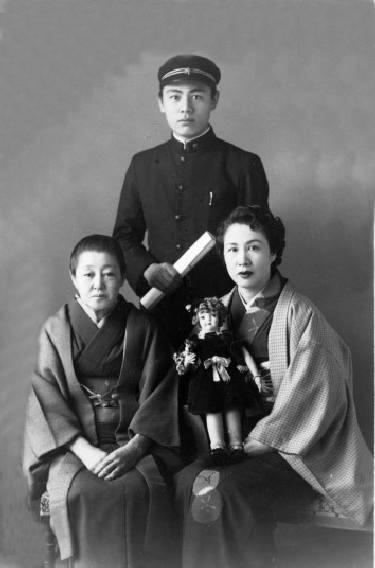
We note an unidentified boy graduating in 1939. Japan had been at war in China for 2 years. While China was devastated by the Japanese onslaught, the Japanese people at home were not yet significantly affected as would be the case when Japan attacked the United States. A Japanese reader Fujioka Keisukeremembers his childhood during and after the War began with America. We also note Okinawan girl Tomiko Hika. One of the hear-rending image if the War is an unknown Nagasaki boy. He is only known to history as 'The boy by the crematorium place'.
Most countries that played important roles in World War II have come to terms with the War. Japan and the Soviet Union are the principal country today which keeps the truth of the War from their school children. What Japanese children are told about the War is a widely debated subject in Japan. Most Japanese children today believe that their country was a victim of the War and not the primary aggressor nation. The atomic bombing of Hiroshima and Nagasaki receive wide coverage every year leading children to view their country as a victim of the War. Few Japanese children have any idea of the enormity of Japanese war crimes. Important Japanese politicians, especially officials with nationalist sympathies in the Liberal Democratic Party, persist in perpetrating a number of myths and historical lies. This has caused considerable problems for Japan in countries they occupied during the War and wear war crimes were committed. One of the most persistent myths is that Japan was "tricked" in attacking the United States by a wily American President. The truth of course is that the decision to go to war was made by a series of Japanese government after a lengthy study of the evolving military situation in Europe and Asia. The Japanese decided to hitch their star to the Germans and the decision to attack the United States was made at a time when the NAZI Panzers were rampaging through the Soviet Union and the Soviet collapse seemed inevitable. The defense of being "tricked" is unworthy of a great nation. It is the kind of defense used by petty criminals caught up in a sting operation.
The Japan Defense Agency Historical Branch (BKS) is an important source of information, but Western researchers have found them very difficult to work with. One researcher says that communications with BKS must be by letter in the Japanese language. Responses may take 6 months, if they come at all. Another researcher says that a 6 month turn around is an optimistic expectation. The problem with the BKS is that it is not governed by Western historical standards. The War is still a very subject in Japan and Japanese Government and military authorities are still intent on positioning Japan as a victim of the War rather than a perpetrator. As a result, most of the Government's military records have been destroyed. One source estimates 95 percent. Much of what has survived is in the BKS archive. And given the enormity of the War effort, even 5 percent is as a result, unlike the Western Allies and European Axis, the archives are extremely limited. Soviet archives are also extensive, but difficult to access. The principal Japanese source on the War is the Senshi Sosho, a detailed, multi-volume work. There are 102 massive volumes and it is by far the most detailed account of the Japanese war effort. Not addressed are the atrocities committed by the Japanese military during the War. A copy is archived in the Library of Congress. Unfortunately, it has never been translated in its entirety and thus requires Japanese-language capability to use. Only a few relatively small segments of some of the volumes have been translated. A very important additional source is war-time the Ultra/Magic decrypts. And as in the West there are war time accounts published by Japanese officials and military figures.
Barett, David Dean. 140 Days To Hiroshima.
Giangreco, D.M. Hell to Pay: Operation Downfall and the Invasion of Japan, 1945-1947
Frank, Richard B. Downfall: The End of the Imperial Japanese Empire (New York: Penguin, 1999).
Halloran, Richard. "How Japan got ready for suicide," New Tork Times (August 5, 1985)
Kotani, Ken. Foreword by Murray Williamson . Translated by Chiharu Kotani. Japanese Intelligence in World War II (Oxford: Osprey, 2009). 224p.
Pacific War Research Society (PWRS). Compiler Kazutoshi Hando. Japan's Longest Day.
Schom, Alan. The Eagle and the Rising Sun: The Japanese-American War 1941-1943 (Norton, 2003).
Shindo, Hiroyuki. "Japan's War, 1943-45" 2018 International Conference on World War II, (National Workd War II Museum: December 1, 2018). Broadcast on C-Span.
Spector, Ronald H. At War at Sea: Sailors and Naval Combat in the Twentieth Century (Viking, 2001), 463p.
Symonds, Craig L. The Battle of Midway (Oxford: 2011), 452p.
Thomas, Evan. Sea of Thunder: Four Commanders and the Last Great Naval Campaign, 1941-1945 (Simon & Schuster: New York, 2006), 414p.

Navigate the CIH World War II Section:
[Return to Main World War II country page]
[Return to Main World War II Pacific campaign page]
[Biographies]
[Campaigns]
[Children]
[Countries]
[Deciding factors]
[Diplomacy]
[Geo-political crisis]
[Economics]
[Home front]
[Intelligence]
[Resistance]
[Race]
[Refugees]
[Technology]
[Bibliographies]
[Contributions]
[FAQs]
[Images]
[Links]
[Registration]
[Tools]
[Return to the Main World War II page]