
Soviet Great Patriotic War: Political and Historical Controversies
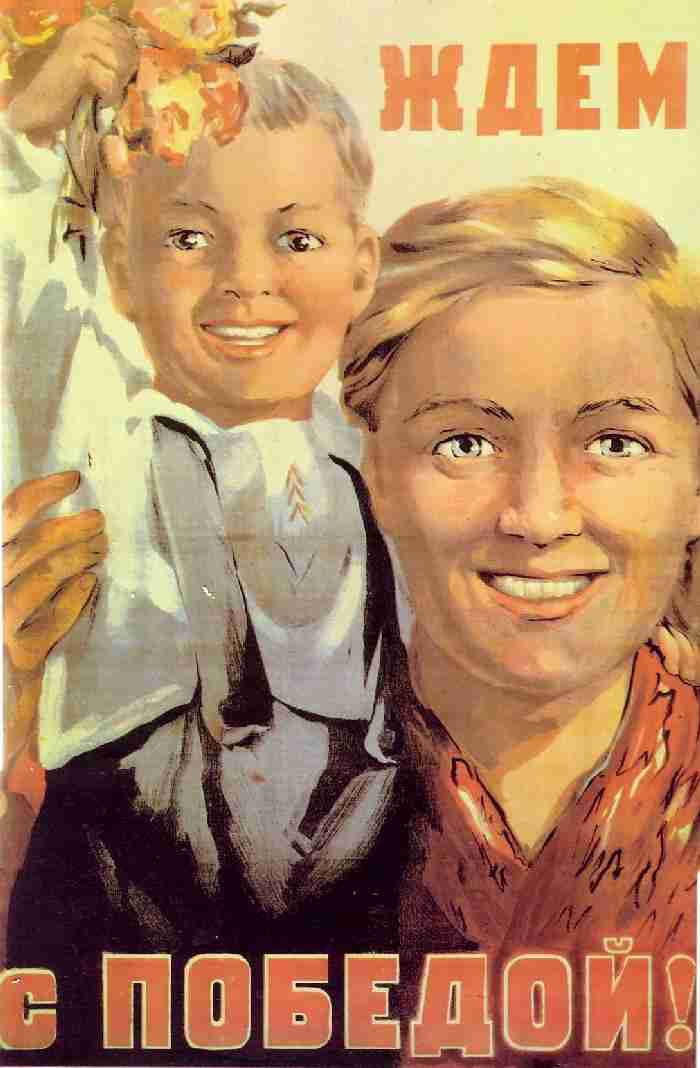
Figure 1.--It was the emense effot and sacrifice of the Soviet people which played the major role in destroying NAZI Germany. The price paid by the Soviets is beyond calculation. About 30 million Soviet citizens died in the War. As a result, the Russian people today look at the Great Patriotic War in almost religious terms. Any criticism of the Soviet war effort is highly controversial and normally resented by the great majority of the Russian public. Despite the great achievement in destroying NAZI Germany, Soviet actions in the War were in fact only exceeded in barbarity by the NAZIs. The Soviet poster here reads, "Waiting for victory", however I think there is also the meaning then our soldiers will come home.
|
|
The Soviet Union played the major role in the defeat of NAZI Germany. The great bulk of the Wehrmacht was deployed in the Eastern Front and most of the casualties sustained by the Germans were sustained in the East. German casulaties totaled in the East totaled about 10 million men, including 3.5 million deaths. This was achieved at enormous costs. About 30 million Soviets citizens died in the War, accounts vary as does the definition of Soviet citizens. Most souces agree that about 15 percent of the Soviet population perished. The bravery and sacrifice of the Soviet people bleed the Wehrmacht to such an extent that the Western Allies were able to reenter the Continent with the D-Day invasion (June 1944). Without the enormous casualties sustained by the Germans in the East, the D-Day invasion would have been impossible. The conduct of the war in the East and its importance importance is not well studied in the West. This is in part the result of the greater interest in the Western campaigns, but also because the Soviets and now the Rusians restrict access to primary sources. There are of course Soviet accounts, but these books do not normally meet the standards of Western historography. As a result the Russian people today look at the Great Patriotic War in almost religious terms. Any criticism of the Soviet war effort is highly controversial and normally resented by the great majority of the Russian public. Despite the great achievement in destroying NAZI Germany, Soviet actions in the War were in fact only exceeded in barbarity by the NAZIs. Stalin was in fact a virtual NAZI ally in the early phase of the War. Stalin launched a serious of aggressions against neigboring states. Once in control of the areas invaded, large numbers of people were arrested, killed, and deported. He delivered large quantities of strateic materials to support the NAZI war effort. After the German invasion the NKVD brutally treated Russian soldiers with large-scale arrests and execuutions. There were further mass arrestts and deportations of ethnic groups. The Soviets allowed the Germans to destroy the Polish Home Army in Warsaw. The Red Army engaged in mass rapings in Berlin and other German cities. Russian POWs who survived the horendous NAZI camps were consigned to the Gulag. Also the massive casualties experienced by the Red Army has not been well studied or the fact that the Soviet population was not as united in resisting the NAZIs as Soviet historians suggested. Much of this is not widely known, much less openly discussed in modern Russia.
Importance of the Eastern Front
The Soviet Union played the major role in the defeat of NAZI Germany. The great bulk of the Wehrmacht was deployed in the Eastern Front and most of the casualties sustained by the Germans were sustained in the East. German casulaties totaled in the East totaled about 10 million men, including 3.5 million deaths. It is difficult to se how the Western Allies could have won the war, ave the use of the atomic bomb without the contribution of the Soviet Union. Of course the Germans would never had achieved the voctories they did had Stalin and the Soviet Union not supported the German war economy for nearly 2 years and allwoed the Germans to concentrate their forces on the west. Stalin complained at Teheran that he was habing to fight the Germans virtually alone. He did not mention that he not only forced the British to fight the Germans alore, but supplied the Germans with ctitical raw materials while Britain was fighting for its life. That said, the Soviet role in the defeat of NAZI Germany was massive and can not be denied. The Soviet victories were achieved at enormous costs. About 30 million Soviets citizens died in the War, accounts vary as does the definition of Soviet citizens. (Many were in the areas invaded and annexed by Stalin (1939041). Most souces agree that about 15 percent of the Soviet population perished. The bravery and sacrifice of the Soviet people bleed the Wehrmacht to such an extent that the Western Allies were able to reenter the Continent with the D-Day invasion (June 1944). Without the enormous casualties sustained by the Germans in the East, the D-Day invasion would have been impossible and thus the liberation of Western Europe.
Western Assessments
The Soviets and now the Russians commonly complain that their role in the defeat of NAZI Germany is not recognized by the West. It is certainly true that this is Hollywood promotes. But what reasonable person gets their history or values from Hollywood. But it is why many Russians think it is what Americans believe. (In the Soviet Union and Russia today film makers and historians take their cues from the Government so it is understandable that Russians think this way.) But there is no serious American or even Western historian who has does no recognize the emormous role played by the Sovit Union in the distruction of NAZI Germany. Any American who has ever opened a history book is aware of the Soviet Union's huge role. Not only Western historians writing about World War II make this very clear. And Western experts on the Soviet Union also often make this point. One British expert complained that in the West too much emphasis is given to the Western contribution to the defeat of the NAZIs. [Braithwaite] As discussed above, World War II was essentially won and lost on the Eastern Front. But it is true that Western historians tend to give more attention to the battles fought by their armies an less attention than would normally be waranted to battles in the East. A lack of historical understanding is not the only reason that the war in the East is not given more attention. The lack of historical attention to the Eastern Front is in part the result of the greater interest among Westerners in the Western campaigns fought by theur armies. This is the natural case for any people at any time. Americans are more interested in the Bulge than the gight fir Karkox, just as the Soviers were more interested in Kharkov. It is also important to note that the Soviets and now the Rusians restrict access to primary sources. The Soviets did not allow Western historians wanting to write about the eastern Front to view their archives. It is a little disengious to complain that your country has not been given its due and at the same time close your war time archives so that historians can npt study it. Despite freezing out Western historians, American and other Western historians fully recognize what happened in the East. Even so the Russians who did for a few years after the collapse of the Soviet Union allow some aome access for Western scholars to World war II archives are once more freesing out Western scholars.
While western historians recognize the huge contribution of the Red Army on the Eastern Front, we fond a tendency in Russia today to dispirage the contrinution of the Western Allies. We do not see that tendncy in the West, but it is pronounced in Russia. This began even during the War. Stalin at Tehran complained that the Western Allies were relying on the Red army to fight the Wehrmacht and not doing enough in the West. Churchill of course could have said that Stalin not only allowed Britain to fight alone, but all the time was supplying the Germans vast quantities of critical raw material to support the NAZI war economy. Often lost in this discussion is the totality of the Western contribution. And it is not jst th Russians who do not unfderstand. I find tht the Western histotical treatment has been so even habdd that even many in the West do not understand the contribution of the Western Allies. So we think that it is important to detail what the Western Allies did to fefeat the NAZIs and to defeat the Siviet Union. It should be stressed that some of this did not directly result in German casualties, but did significantly reduce the ability of NAZI Germany to wage war or improve the ability of the Soviets to wage war. A good example would be American Lend Lease food shipments to the Soviet Union. This did not kill a single German, but significnly supported the fighting capability of the Red Army.
As a result the Russian people today look at the Great Patriotic War in almost religious terms. Any criticism of the Soviet war effort is highly controversial and normally resented by the great majority of the Russian public. The Great Patriotic War is an extremely sensitive issue in Russia for several reasons. The men and women who fought the war against the NAZIs are revered in Russia today and rightly so. Among older Russians it is proabably the cost of the War in terms of casualties and destruction. The Soviet people suffered unimaginable suffering during the War and made great sacrifices. Few families were unscarred by the War. As a result, any criticism of the Soviet is suspect and among many an outrage.
Controversial Subjects
There are several topics concening the Great Patriotic War that are especially controversial. These are issues that Soviet historians either failed to mention or attempted to resolve with fornalistic propaganda descriptions. Much of this is not widely known, much less openly discussed in modern Russia.
Hitler only launched World War II after negotiating the Non-Agression Pact with the Soviet Union (August 1939). Stalin never thought that France would fall after a brief campaign. When this occurred he became in fact a virtual NAZI ally in the early phase of the War. Stalin delivered large quantities of strateic materials to support the NAZI war effort. The two dictators partioned Eastern Europe leading to a series of Soviet agressions.
Despite the great achievement in destroying NAZI Germany, Soviet actions in the War were in fact only exceeded in barbarity by the NAZIs. Stalin launched a serious of aggressions against neigboring states. Once in control of the areas invaded, large numbers of people were arrested, killed, and deported. After the German invasion the NKVD brutally treated Russian soldiers with large-scale arrests and execuutions. There were further mass arrestts and deportations of ethnic groups. The murder of Polish POWs in the Katyn Forest is the best know of these actions.
The most dramatic resistance effort by the Polish Home Army was the uprising against the NAZIs in Warsaw when the Soviets neared the Vistula (July 1944). After Operation Bagration (June-July 1944), Warsaw on the Vistula was the principle barrier standing between thev Red Army and Berlin. The Poles did not greet the Red Army in the same way that populations in the West cheered the Americans and British. They had no illusions about what would follow in the wake of the Red Army, a Stalinist dictatorship. The Home Army (loyal to the London goverment-in-exile) decided on a desperate gambit at the Red army apprpached the Vistula. They would stage an insurrection and free Warsaw. The Home Army rebelled (August 1) anticipating the support of the Red army. Instead Stalin ordered the Soviet troops to stop on the far side if the Vidtula. The German reaction was savage. On one day alone the SS rounded up and shot 25,000 Polish men women and children. The Americans offered to drop supplies, but Stalin refused permission for the flights to use needed Soviet air bases to refuel for the return trip. Thev Poles fought valiantly on, finally capitulating (October 2). The Germans at Hitler's orders virtualy razed the city. The Soviets finally took Warsaw with little resistance from the Germans (January 1945). [Davies]
Mass rapings
The Soviet conquest of Berlin proved to be a nightmare for the surviving women, almost all of whom were raped. This begun even before the Red Army reached the Reich. It did not just occur in Berlin. It is estimated that 2 million German women were raped by Russians at the end of the War. Perhaps 0.2 million of those rapes took place in Berlin. The rapes included children, nuns, old ladies, and even Russian women brought to Germany to work as slave laborers. The Soviets denied the German civilian reports, but Soviet archieves leave no doubt as to what occurred. [Beevor] This is still very contoversial in Russia, as the Great Patriotic War is still considered in an almost religious way by Russians. While Soviet authors were not allowed to mention it, famed war correspondent Vasily Grossman did detail it in his notebooks. Grossman admired and empthized with the Red Army soldiers who defeated the NAZIs. He was apauled, however, by the riotous behavior he observed, especially the raping of girls and women. He wrote of the "horror in the eyes of women and girls". He reports that liberated Soviet slave workers reported being raped to him and even liberated contration camp imates were raped. [Beevor and Vinogravoda]
Russian POWs
Russian POWs who survived the horendous NAZI camps were consigned to the Gulag.
Red Army Casualties
Also the massive casualties experienced by the Red Army has not been well studied. More than 8 million Red Army soldiers are believed to have been killed during Word War II on the Eastern Front. One author points out that Red army losses were at least 3 times as high as those sustained by the Wehremacht. [Merridale] This is understandable in the initial phase of the War with the Wehrmacht advancing before a stuned Soviet military. Soviet losses, however, tended to be very high even in the battles they won and when they had overwealming strength in numbers and equipment. Soviet historians never addressed this glasring disparity. Part of the reason was Stalin disasterous military orders. Another factor was the Great Purges which left the Red Army without trained commanders. But another factor appears to be the willingness of Red Army commanders to use tactics that resulted in massive losses. This included even comanders luke Zukov.
Varied support
The Soviet population was not as united in resisting the NAZIs as Soviet historians suggested. When the NAZIs invaded there were mass surrenders. The surrenders of such magnitude are still not fully explained. There is no doubt that the shock and awe of the NAZI onslaught was a factor. It is unclear to what extent anti communist sentiment or anti-Stalin sentimentment may have been a factor. There is no doubt that Ukranian natiionalism was a factor. It was also a factor that the NAZIs failed to take advantage. Brutal NAZI actions in fact forced ukranians and others to fight the NAZIs. Vassily army's was painted by the Soviets as NAZI suympathizers, but in fact were largely Russians who desired a non-Communist Russia. Desertion rates early in the War were quite high until the Soviets began shooting deseters in large numbers. There were 158,000 men shot for desertion and this is probanly a low figure because of many unrecorded summary executions. [Merridale] Stlin was to say that "It takes a brave man to be a coward in the Red Army."
World War I was one of the deadliest conflicts in history. Some 16 million people were killed. There is no precise account. Many authors have addressed the topic of the impact of World War I on Britain and France. The British lost less than 1 million men, the French more than a million. These casulaties had profound social and political impacts. They left France unable to effectively resist Hitler and nearly had the same impact on Britain. Many in both countries as well as Ameruca came to believe that the War a huge mistake launced by war profiteers and no important issues were involved. The Russians lost even more, more than 2 million people, the exact number is not well documented. The losses were a factor in the rise of the Bolshevicks. Britain might have had the same fate as the French, were it not for the Channel and inspired leadership of Winston Churchill. Thus the question of how the Soviet losses of so many must have had huge impact on the Soviets. And added to that was the enormous number of people that Stalin had killed even before the War. I have never read, however, a detailed assessment of the impact. Many in Russia today hate Stalin, but many including young people revere him as a great leader. Thus any assessment of the impact of these terrible events is not an easy topic. The impact of World War II was very different than World War I. Most people in Allied nations saw it as a vital war with real values at stakes. Industrilists were seen as heroes and not war profiteers. Soviet losses were enormous, perhaps some 25 million people, again not well documented. Stalin was seen as a hero even though he oversaw an alliance with Hitler that made the war possible. The Soviet Union has a long sad history of totalitarian oppression, both within and outside its borders. Know wht Hitler and the NAZIs planned, however, the Great Patriotic War is widely seen as the great achievementb of the Soviet Union. The returning soldiers were greeted as heos. It solidified Stalin and the Communist hold on the Soviet UInion. Most Soviets hoped that their huge effort to defeat the NAZIs would mean aelaxation of totalitarian rule. This proved to be a misplaced hope. Only with the death of Stalin did police state rule begin to relax somewhat.
Sources
Beevor, Antony. The Fall of Berlin 1945.
Beevor, Antony and Luba Vinogravoda. A Writer at War: Vassily Grossman with the Red Army, 1941-1945 (Pantheon, 2006), 378p. This is an important document. There are passages from Grossman's notebooks (without the distortions of the Red Star editors along with interperative material written by Beevor.
Braithwaite, Rodric. Book TV, CSpan2, October 4, 2006. Sir Roderic was the British Ambassador to the Soviet Union and has written widely about the Soviet Unin and Russia, includig some important books on World War II.
Davies, Norman. Rising '44: The Battle for Warsaw (Viking, 2004).
Merridale, Catherine. Ivan's War: Life and Death in the Red Army (Metropolitn, 2006), 462p.
CIH -- WW II

Navigate the CIH World War II Section:
[Return to Main Great Patriotic War page]
[Return to Main World War II country page]
[Biographies]
[Campaigns]
[Children]
[Countries]
[Deciding factors]
[Diplomacy]
[Geo-political crisis]
[Economics]
[Home front]
[Intelligence]
[POWs]
[Resistance]
[Race]
[Refugees]
[Technology]
[Bibliographies]
[Contributions]
[FAQs]
[Images]
[Links]
[Registration]
[Tools]
[Return to Main World War II page]
[Return to Main war essay page]
Created: 5:11 AM 3/29/2005
Last updated: 6:22 AM 2/19/2017